Skip to content

In Texas, the remarriage of either parent does not, by itself, automatically change child support, and guideline support is generally based on the paying parent's net resources using 20% for one child, 25% for two, 30% for three, 35% for four, 40% for five, and at least 40% for six or more children. If you live in Humble, Atascocita, Kingwood, or Northeast Houston, that usually means a new wedding ring alone won't change what the current order says.
That answer matters because many parents learn about a remarriage in the most ordinary way possible. You see engagement photos online. Your child mentions a new stepmother or stepfather at dinner. A wedding invitation shows up, or maybe your ex casually says they're getting married again. Then the questions hit fast. Will support go up? Will support go down? Does the new spouse's income matter now?
Those worries are common, and they're understandable. Child support orders affect your monthly budget, your child's routine, and your sense of stability. For families in Harris County, even a small change can feel big when you're already balancing rent or mortgage payments, school costs, health expenses, and co-parenting stress.
The good news is that Texas law is usually more straightforward than rumors make it seem. A parent's remarriage often creates confusion, but the legal rule itself is not complicated once you see how courts look at it. The court focuses on the legal parents' support duties to the child. It doesn't usually treat remarriage itself as the event that changes the order.
That doesn't mean remarriage is always irrelevant. It means you have to separate the marriage itself from the life changes that may follow it. That distinction is where many Humble-area parents get tripped up.
If this topic is stirring up conflict with an ex or extended family, it may also help to protect your peace while you sort through the legal side. Practical guidance like reVIBE Mental Health boundary tips can help you manage difficult conversations without making a hard co-parenting situation harder.
A New Marriage and Old Worries about Child Support
In Humble and Kingwood, I often hear the same first reaction from parents: “My ex got remarried, so the court must be able to change support now.” That assumption makes sense emotionally. A new marriage looks like a major life event, so people naturally expect a legal order to shift with it.
But child support after remarriage in Texas usually doesn't work that way. Texas courts care less about the ceremony and more about whether something legally significant changed after it. The marriage may be a backdrop. It usually isn't the trigger.
Why parents get confused
Part of the confusion comes from everyday logic. If one household now has two adults sharing bills, people assume that should affect support. If the receiving parent marries someone with a high income, the paying parent may feel the child needs less support. If the paying parent marries someone financially secure, the receiving parent may assume support should rise.
Those reactions are human. They just don't match the standard Texas approach.
A new spouse may change a household. That alone usually doesn't change a child support order.
Another source of confusion is that people mix up child support and spousal support. They are not the same thing. A remarriage can matter very differently depending on which order you're talking about.
A calmer way to look at your situation
If your former spouse has remarried, start with three practical questions:
- What does the current order say: Pull the signed order and read the child support section carefully. Many parents rely on memory and miss key details.
- What changed after the marriage: Focus on income, a new child, major changes in the child's needs, or job-related issues.
- Has a judge signed anything new: Until a court signs a modified order, the existing order usually remains in effect.
For families in Atascocita, Kingwood, and Northeast Houston, that simple reset often lowers the temperature. It moves the conversation away from anger about the remarriage and toward facts a Harris County court would evaluate.
The Core Texas Rule on Remarriage and Child Support
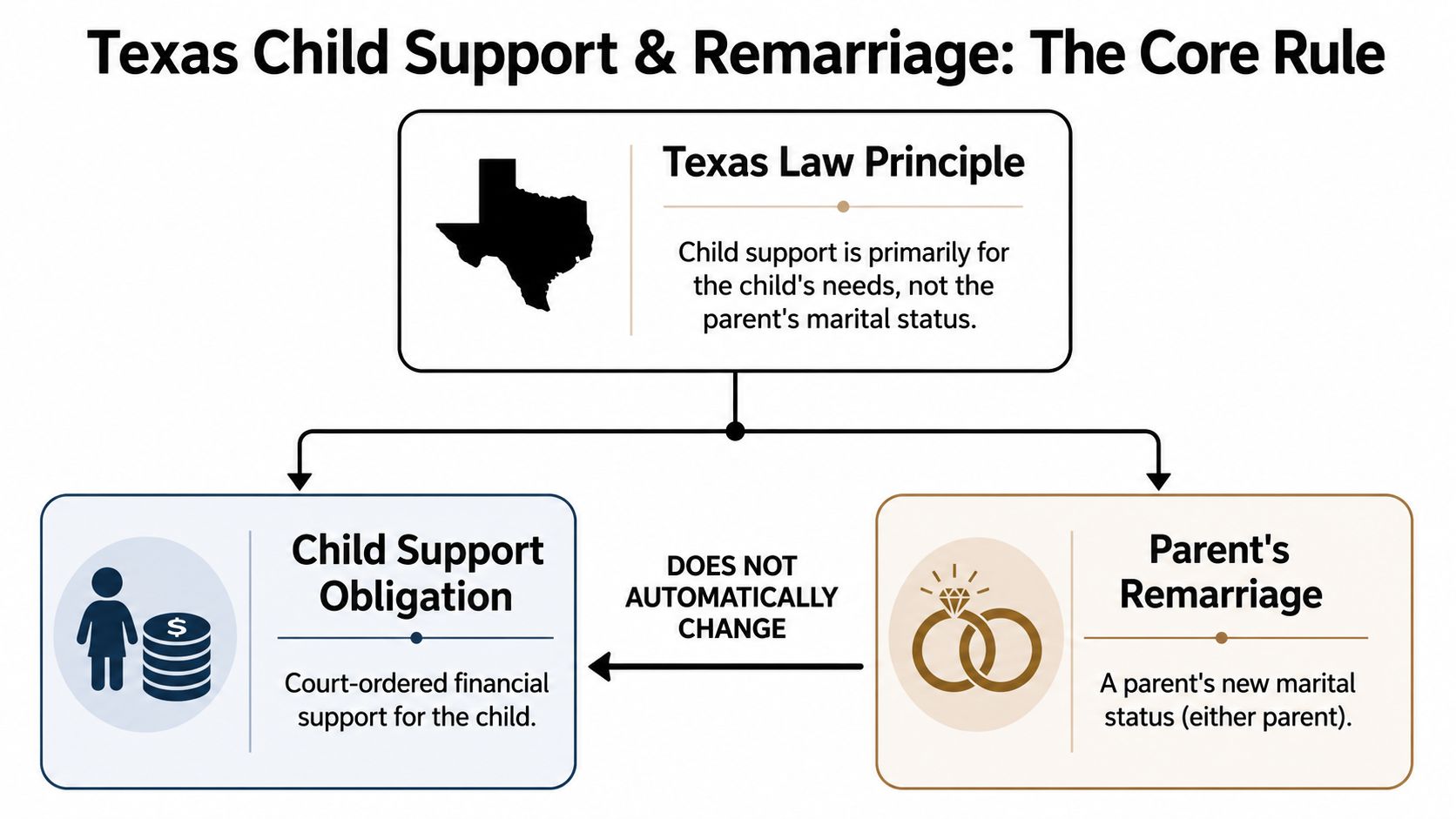
Texas treats child support as a duty tied to the child and the legal parent who owes support. It is not a reward or penalty connected to remarriage. That's the core rule.
A useful way to think about it is this. Child support is like an obligation created by the original legal parents of the child. If one parent later marries someone new, that new spouse didn't step into the original support obligation just by joining the household. The legal duty still belongs to the parent, not the spouse.
What Texas usually looks at
Texas generally bases child support on the obligor's net resources, not the new spouse's income. The standard guideline percentages are 20% for one child, 25% for two, 30% for three, 35% for four, 40% for five, and at least 40% for six or more children, as explained in this discussion of remarriage and Texas child support guidelines.
That same guidance also notes two points that matter a lot in real cases:
- The new spouse's earnings usually aren't part of the standard calculation.
- The receiving parent's household income, including a new spouse's income, generally is not part of the ordinary guideline calculation.
This is why a parent in Kingwood can't usually walk into court and say, “My ex married someone wealthy, so I should pay less,” or “My ex married a high earner, so I should receive more.” That argument usually misses the legal target.
What the rule means in plain English
If you pay support, your ex's new spouse usually doesn't become financially responsible for your child just because they got married.
If you receive support, your new spouse's paycheck usually doesn't erase the other parent's duty to support the child.
Those two ideas drive most of the answers people need when asking about child support after remarriage in Texas.
Practical rule: Courts usually look at the paying parent's resources and the child's support needs, not whether either parent's household now looks more comfortable.
Common misunderstandings
People often expect household fairness. Texas support law usually focuses on legal responsibility instead.
Here are the misunderstandings I hear most around Humble and Northeast Houston:
- “Their new spouse makes good money, so support should drop.” Usually not. A new spouse's income typically isn't the number the court starts with.
- “I remarried, so I need to report my spouse's income as part of child support.” Usually not for the standard support calculation alone.
- “The wedding itself is enough to reopen the order.” Usually not. A remarriage by itself typically isn't the event that changes support.
That last point leads to the main question. If remarriage alone usually doesn't do it, what does?
When You Can Modify Child Support After a Remarriage
The important legal standard in Texas is a material and substantial change in circumstances. A court usually needs that kind of change before it will revise an existing child support order, and remarriage by itself usually does not meet that standard, as noted in this overview of how remarriage affects child and spousal support in Texas.
That's the line parents in Humble, Atascocita, and Kingwood need to keep in mind. The wedding itself is usually not enough. The legal effects that follow the marriage might be.
Changes that can matter
One of the most common examples is a new child after remarriage. Texas family-law guidance recognizes that a parent may receive an income credit for children they have a legal duty to support, but the court still has to protect the children from the earlier relationship. That means a new baby can justify a review. It does not guarantee the result a parent wants.
Other life changes may also support a modification request if they are serious enough and supported by evidence. The analysis is always fact-specific, but these are the kinds of issues parents should evaluate closely:
- A new legal duty to support another child: This often comes up after remarriage when a parent has another child.
- A major change in the paying parent's income: The reason for the change matters, and documentation matters even more.
- A meaningful change in the child's needs: Medical, educational, or care-related changes can become central.
- A lasting shift in circumstances, not just a short rough patch: Courts tend to look for something real and ongoing.
For a closer look at how guideline support is approached, parents often benefit from reviewing how child support is calculated in Texas.
Changes that usually do not matter by themselves
Some facts may feel important at home but carry less legal weight on their own:
- The ex-spouse got remarried.
- The ex-spouse moved into a nicer home with their new spouse.
- The receiving parent's household now has more income because of the new marriage.
- A parent feels the arrangement is unfair because one household seems more comfortable.
Those facts may explain why emotions are running high. They usually do not, standing alone, satisfy the legal standard.
Grounds for Child Support Modification in Texas
| Circumstance | Likely to Justify Modification? | Reasoning |
|---|---|---|
| A parent remarries | Usually no | Remarriage alone usually is not a material and substantial change |
| The paying parent has a new child after remarriage | Possibly | A new legal duty of support can matter, though the court must still protect the prior child |
| The receiving parent marries a higher earner | Usually no | The new spouse's income generally is not part of the standard child support calculation |
| The paying parent has a significant change in income | Possibly | A court may review whether the change is real, substantial, and supported by evidence |
| The child develops major new needs | Possibly | A meaningful change in the child's circumstances can support review |
| The parents make an informal side agreement | No, by itself | The existing order remains important until a judge signs a new one |
A key distinction from spousal support
This area gets messy because people use the word “support” to mean more than one thing. Texas treats child support and spousal support differently.
The same legal guidance notes that spousal support can terminate automatically upon the recipient's remarriage, while child support does not work that way. That difference surprises many people. They hear “remarriage changes support” from a friend, but the friend is often talking about the wrong kind of support.
If you remember only one distinction, remember this. Child support and spousal support follow different rules after remarriage.
Real-world examples parents often ask about
A parent in Atascocita remarries and has another baby. That may justify a review because there is now another legal child to support. A parent in Kingwood remarries someone with a high salary, but nothing else changes. That alone usually won't justify modification. A parent in Humble remarries, relocates jobs, and experiences a lasting income change. The remarriage itself may not matter, but the income issue might.
That's why these cases turn on details. Not wedding announcements. Not assumptions. Not pressure from relatives. Facts, documents, and the legal standard decide whether a judge is likely to consider a change.
How to Request a Modification in Harris County
Once you believe there has been a real change in circumstances, the next step is process. Harris County courts need more than a good reason. They need the right filing, the right evidence, and the right follow-through.
For many parents in Humble and Northeast Houston, the hardest part is not the legal rule. It's knowing what to do first.
Start by checking whether your facts are strong enough
Before filing anything, sit down with the current order and compare it to your current life. Courts don't modify orders because something feels unfair. They modify orders when the evidence shows a legally meaningful change.
Parents often prepare better when they gather documents before emotions take over. That may include pay records, tax information, health insurance details, medical records tied to the child's needs, and anything showing when the change happened.
The Harris County roadmap
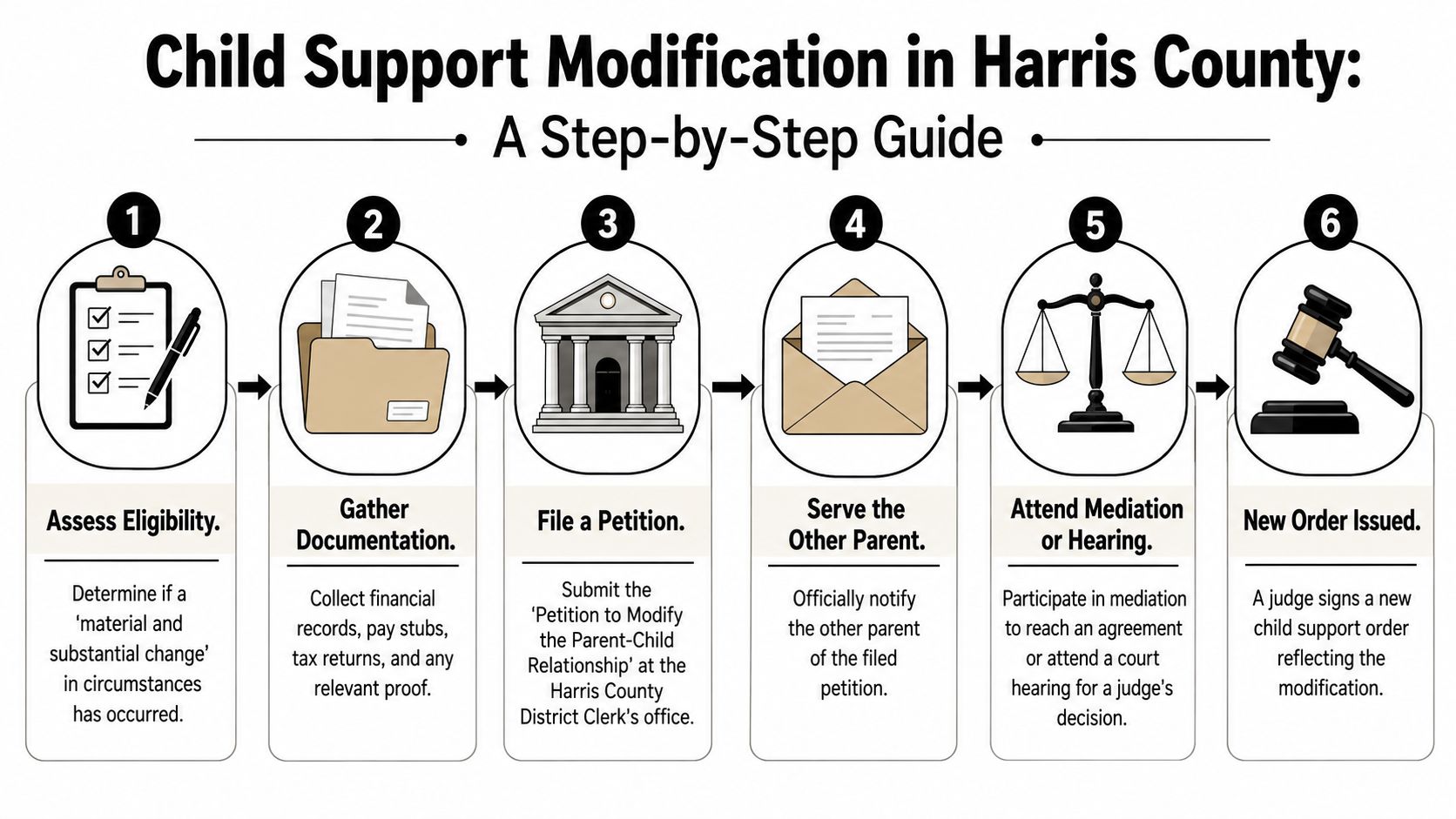
Most modification cases follow a practical sequence like this:
Review the current order carefully
Make sure you know exactly what the signed order requires today. Verbal side deals don't replace court orders.Collect supporting records
Financial records often matter most. If the issue involves the child's needs, gather school, therapy, or medical documentation that helps explain the change.File the proper modification case
In many cases, that means filing a Petition to Modify the Parent-Child Relationship through the Harris County District Clerk.Make sure the other parent is properly served
The court generally requires formal notice. Informal texting about the case isn't the same thing.Prepare for mediation or court
Many family cases involve settlement efforts before a final hearing. If agreement doesn't happen, the court may decide the issue after hearing evidence.Wait for a signed order before changing payment behavior
Parents often make costly mistakes here. A filed case is not the same as a modified order.
One practical resource for local families dealing with this process is child support modification guidance for Humble cases.
What judges and court staff usually want to see
A modification request becomes easier to evaluate when the paperwork tells a clear story. That means your documents should answer questions like:
- What changed: Be specific about the event or condition.
- When it changed: Dates matter in court, even if the relationship history feels obvious to you.
- Why the change is substantial: Show why this is more than a temporary inconvenience.
- How it affects support: Connect the facts to the existing order.
Bring paper that proves the point. Courts rarely act on frustration alone.
Local practical advice for Humble-area parents
Parents in Humble, Kingwood, and Atascocita often share one challenge. They wait too long because they hope the other parent will “do the right thing” informally. Sometimes that works for a while. Sometimes it collapses the moment a disagreement starts.
A few habits can protect you:
- Keep communication civil and brief: Angry messages often become distractions rather than evidence.
- Save records in one place: Create a folder for pay stubs, notices, medical bills, and school records.
- Don't self-adjust payments: Even if you think you're clearly right, the signed order still matters until the court changes it.
- Ask questions early: A short legal review can help you avoid filing too soon or waiting too long.
If you're comparing options, families sometimes speak with private counsel, review local self-help resources, or consult a family law office such as the Law Office of Bryan Fagan to evaluate whether the facts support filing in Harris County.
What happens after filing
Some cases settle in mediation. Others don't. If there is no agreement, the court may hold a hearing and decide whether the evidence proves the required change.
At that stage, organization matters. So does credibility. A judge usually wants a clear explanation, reliable records, and a practical request that fits the facts. Parents who stay focused on the child and the order usually present stronger cases than parents who focus only on resentment about a remarriage.
Stepparent Adoption and Ending Child Support Obligations
There is one remarriage-related topic that deserves special attention because it is completely different from an ordinary modification request. That is stepparent adoption.
A regular stepparent and an adoptive stepparent are not the same in Texas law. A stepparent who has not adopted the child may play a major day-to-day role in the child's life, but that alone does not automatically place the same legal duties on them as a legal parent.

A stepparent in the home is not automatically a legal parent
This is one of the most misunderstood parts of blended-family law. A child may call someone “mom” or “dad” in daily life, and that relationship may be loving and stable. But unless there has been a legal adoption or another court action creating rights, the stepparent usually does not become the child's legal parent through marriage alone.
That matters because child support obligations belong to legal parents. The emotional reality of a blended household and the legal structure of parenthood are not always the same thing.
When adoption changes the legal picture
A stepparent adoption can permanently change legal rights and obligations. If a stepparent adopts the child, the legal effect can include ending the prior biological parent's support obligation, but this is not a casual paperwork fix. It is a major legal and family decision.
In many situations, that process involves consent from the biological parent whose rights would be terminated, unless a court has legal grounds to terminate those rights. Because of that, adoption cases are often more sensitive and more serious than parents first expect.
For families considering that route, Texas private adoption guidance can help explain how the process differs from a standard support dispute.
Stepparent adoption is not just about money. It reshapes the child's legal family.
Many parents benefit from hearing a broader explanation before deciding whether adoption is the right path for their family:
Compare the two situations side by side
- Non-adopting stepparent: May help raise the child, but usually doesn't become automatically responsible for the original child support order.
- Adoptive stepparent: Takes on legal parental rights and responsibilities through a formal court process.
- Biological parent whose rights end: Their legal relationship to the child can be terminated, which can also end the related support duty.
This is why parents should be careful not to mix up remarriage, modification, and adoption. They are connected topics, but they are not interchangeable legal events.
Frequently Asked Questions for Humble Families
Parents in Humble, Atascocita, Kingwood, and Northeast Houston often ask the same follow-up questions once they understand the general rule. These answers can help you spot where a concern is legal, where it's practical, and where it's mostly a co-parenting issue.
My ex quit working after remarrying a wealthy spouse. Can that matter?
It can. The court usually focuses on the parent's own financial situation and support duty, not the new spouse's paycheck. If a parent reduces work or stops working after remarriage, the legal question is often whether that parent's change is genuine and supportable under the circumstances.
What matters most is proof. If you believe the parent is avoiding support obligations while relying on a new spouse, collect records and speak with a lawyer about whether the facts support a modification or enforcement strategy.
Does my ex's new spouse get a say in decisions about my child?
Usually, a new spouse does not automatically gain legal decision-making authority just by marrying a parent. Daily involvement is common in blended families. Legal authority is a separate issue.
That means a stepparent may help with school pickup, meals, transportation, or routines in the home, but that does not usually turn the stepparent into a legal co-parent overnight. Many conflicts calm down once families separate practical household help from actual legal rights.
If I receive child support and remarry, do I have to report my new spouse's income just because I got married?
Remarriage alone does not usually make your new spouse's income part of the standard child support calculation. The ordinary focus remains on the legal parent who owes support.
That said, every court filing should be handled carefully. If you are involved in active litigation, don't guess about what financial information may be requested in your specific case. The safer move is to review the facts and your documents before filing or responding.
When parents overshare irrelevant facts, they often create side arguments that distract from the real legal issue.
If both parents agree to change support after a remarriage, can we just handle it ourselves?
You can agree in conversation, but that does not mean the agreement is safely enforceable. The signed court order still carries legal weight until a judge signs a new one.
Many parents in Harris County get blindsided. One parent starts paying a different amount based on an informal deal. Months later, the other parent denies the deal or changes positions. The arrears issue then becomes much harder to fix than it would have been if the agreement had been put into a new order.
Can remarriage affect custody even if it doesn't change support?
Sometimes, but not automatically. A remarriage may bring new schedules, a move, new household members, or changes in stability. Those facts may matter in a custody dispute if they affect the child's best interests.
The key is the same one that appears throughout child support after remarriage in Texas. Courts usually care about the legal and practical consequences of a remarriage, not the remarriage by itself.
Get Clarity on Your Case with a Humble Family Lawyer
If you're worried about child support after remarriage in Texas, the most important thing to remember is simple. Remarriage alone usually does not change child support. A court generally needs something more, such as a material and substantial change connected to income, a new legal duty to support another child, or a meaningful change in the child's needs.
That distinction matters because it protects families from making quick assumptions based on emotion. It also protects parents from making risky choices, like changing payments on their own or filing a weak case built only on frustration about an ex-spouse's new marriage.
For parents in Humble, Kingwood, Atascocita, and across Northeast Houston, these cases are rarely just about legal rules on paper. They involve real budgets, real schedules, and real stress inside blended families. A short conversation about your exact facts can often save months of conflict and confusion.
You don't need to figure out all of this alone. If you're dealing with a recent remarriage, a possible modification, questions about a new child, or concerns about whether your current order still fits your family's life, getting local guidance can make the next step much clearer.
A Harris County case depends on details. The current order matters. The timing matters. Your documents matter. So does the way your request is presented to the court.
That's why personalized legal advice is worth it. Online information can help you understand the rule. It can't review your order, your income records, your child's needs, or your local court process the way a lawyer can.
If you need clear answers about child support, modification, custody, or adoption issues in Humble, Atascocita, Kingwood, or Northeast Houston, schedule a free consultation with the Law Office of Bryan Fagan. Our Humble office helps local families understand their options, prepare the right documents, and move forward with confidence.