Skip to content

If you're raising a child with someone you never married, the legal side can feel strangely out of step with everyday life. In Humble, Atascocita, Kingwood, and across Northeast Houston, many parents are already doing the work of co-parenting before they ever speak to a lawyer. They split daycare pickup, trade weekends, share doctor updates, and handle school forms together. Then a disagreement happens, or one parent moves out, and suddenly everyone asks the same question: what rights do we have?
That question sits at the center of custody for unmarried couples in Texas. The short answer is that Texas gives unmarried parents a path forward, but it doesn't treat both parents the same automatically. The legal system wants formal parentage and a real court order. Until that happens, a family can be functioning in practice while still being exposed legally.
Navigating Parenthood in Humble Without a Marriage License
A lot of parents come in after months or even years of making it work informally. Maybe the baby was born at a hospital near Humble, both parents were there, both families celebrated together, and everyone assumed things were settled. Then the parents separate. One moves to Kingwood. The other stays in Atascocita. The child is still little, and now nobody agrees on who decides daycare, doctor visits, or where the child will live most of the time.

That uncertainty is common. It doesn't mean either parent has failed. It usually means the family has reached the point where goodwill isn't enough anymore.
What families often worry about first
The first worries are usually practical, not legal:
- Medical decisions: Who can approve treatment if the child gets sick?
- School choices: Who handles enrollment, records, and parent conferences?
- Parenting time: What happens if one parent suddenly stops allowing visits?
- Stability: Can one parent move away from Northeast Houston without a clear agreement?
Those are real concerns because unmarried parents in Texas don't begin from the same legal position as married parents. The law has specific rules about who is legally recognized and when a court can step in.
Parents often think they need a fight over custody before they need a lawyer. In reality, many need help earlier, when they're trying to turn a fragile routine into something enforceable.
The issue isn't just rights on paper
For many Humble families, the deeper problem is this: the parenting arrangement may be working only because both people are cooperating at the moment. If that changes, there may be no court order to enforce exchanges, support, or decision-making.
That's why local parents often need more than a basic explanation of "mom has rights and dad needs paternity." They need a plan for what comes next. They need to know how Texas courts convert day-to-day parenting into a legal structure that protects the child and gives both parents clear expectations.
The First Step Establishing Legal Parentage in Texas
The first legal question is parentage. In Texas, unmarried parents don't start at the same place. A Texas family-law explanation notes that the mother is automatically the child's legal parent at birth, while an unmarried father doesn't gain custody or visitation rights by being named on the birth certificate. It also explains that paternity must be established, usually through an Acknowledgment of Paternity or a court paternity case, before a father can seek conservatorship or possession rights, as discussed in this Texas explanation of how to establish paternity rights.
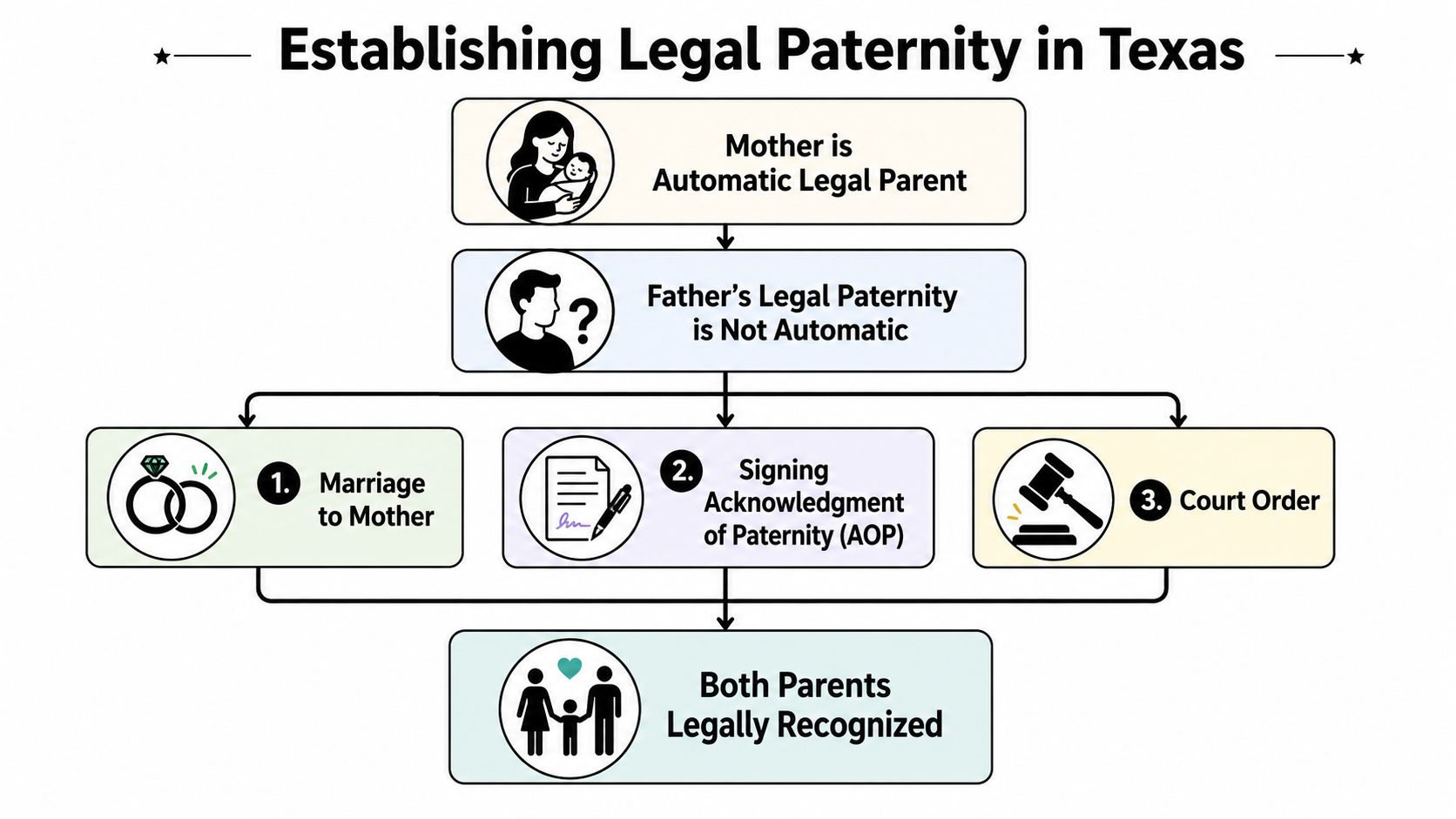
That rule surprises many fathers. They were present at birth. Their name may be on paperwork. They've been changing diapers and paying bills. But legal fatherhood and biological fatherhood are not always the same thing in a Texas courtroom.
Why legal parentage matters so much
Without legal parentage, a father can't ask the court for enforceable custody rights. He also can't rely on an informal understanding with the mother if that arrangement falls apart.
Think of paternity as the key that opens the courtroom door. Before that key is in place, the court can't properly decide possession, conservatorship, and many related issues.
The common ways paternity gets established
For most unmarried parents in Humble and nearby communities, paternity is handled in one of two ways.
Acknowledgment of Paternity
This is often called an AOP. It's a formal document signed by both parents recognizing the man as the child's legal father. Many parents complete it around the time of the child's birth.
Court paternity case
If one parent disputes paternity, refuses to sign, or the facts are more complicated, a court proceeding may be necessary.
Some Texas discussions of the issue also note other statutory routes in certain situations, but in everyday family law practice, these two paths are the ones most parents encounter first.
A simple comparison
| Path | Best fit | Main benefit | Common challenge |
|---|---|---|---|
| AOP | Both parents agree | Faster and simpler | Doesn't resolve the full custody arrangement by itself |
| Court case | Paternity is disputed or unclear | Creates a formal legal finding | Takes more time and procedure |
When an AOP makes sense
An AOP is often the smoothest route when both parents agree about fatherhood and want to move forward without unnecessary conflict. If you're already co-parenting in Atascocita or Kingwood and both of you want a stable legal foundation, this may be the starting point.
But parents often make one mistake here. They think signing an AOP finishes the whole problem. It doesn't. It establishes legal parentage. It does not automatically create a full court order for custody, visitation, child support, and decision-making.
Practical rule: Establishing paternity answers "Who is the legal father?" It doesn't answer "What is the parenting plan?"
When a court case is necessary
A court case may be needed when:
- Paternity is denied: One parent says the man is not the father.
- Communication has broken down: The parents can't agree on documents or next steps.
- The child has been raised informally: The family acted as a unit, but nothing was formally finalized.
Texas law can also create a presumption of fatherhood in certain circumstances. One Texas source explains that under Texas Family Code §160.204, an unmarried man may be presumed to be the father in specific situations, including when he and the mother lived together and he openly held the child out as his own for the first two years of the child's life, and in certain marriage-related circumstances or when a child is born within 300 days after the end of a marriage. That discussion appears in this overview of unmarried-parent custody rules in Texas.
If you're unsure which path fits your case, a local guide like this overview on how to establish paternity in Texas can help you understand what documents and court steps may apply.
Understanding Your Rights Conservatorship and Possession
Once legal parentage is in place, parents usually start using the word "custody." Texas courts use more specific terms. The most important are conservatorship, possession, and access.
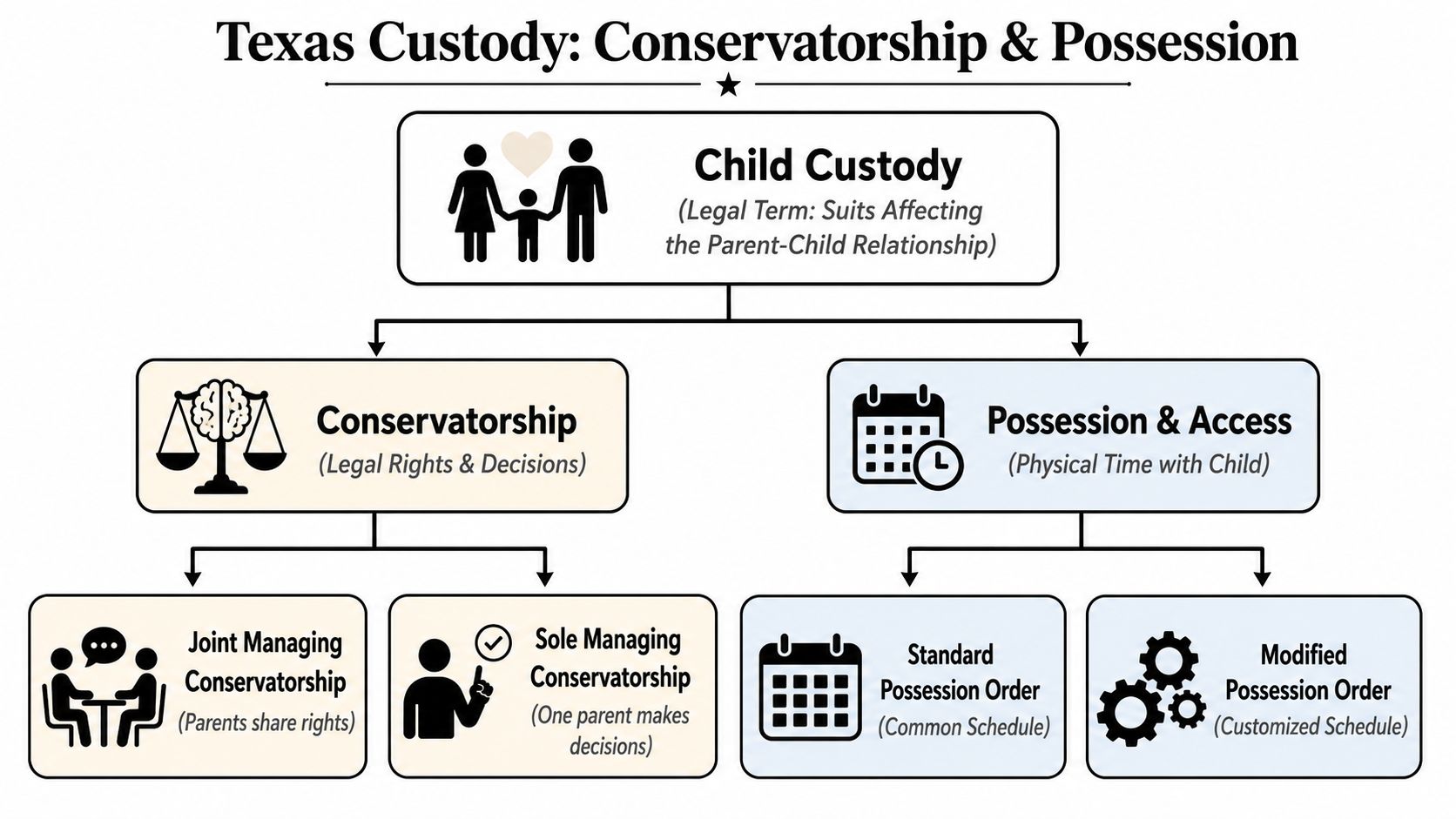
For families in Northeast Houston, these words matter because they divide parenting into two separate ideas. One is decision-making. The other is time with the child.
Conservatorship means authority
Conservatorship is about legal rights and duties. It answers questions like:
- who can make educational decisions
- who can consent to medical care
- who can access school and health records
- who can decide where the child primarily lives
Texas courts often use the label Joint Managing Conservatorship when both parents share major rights and duties. In some cases, one parent may be given more exclusive authority, which is often called Sole Managing Conservatorship.
That doesn't automatically tell you how much time each parent gets. A parent can share major decision-making rights and still have a limited or structured possession schedule.
Possession and access mean parenting time
Possession and access deal with the calendar. This is the part parents usually picture first. Weekends, holidays, summer time, pickups, drop-offs, and exchange locations all belong here.
A useful way to think about it is this:
| Term | Plain-English meaning |
|---|---|
| Conservatorship | Who gets to make major decisions |
| Possession | When the child is physically with each parent |
| Access | The right to see, communicate with, and spend time with the child |
If you've ever felt confused about "legal custody" versus "physical custody," this local resource on the difference between legal and physical custody can help connect Texas language to everyday parenting issues.
A short video can also help make the terminology less abstract:
What the court focuses on
After paternity is established, Texas courts decide conservatorship and possession using the best interest of the child standard. The same Texas source that discusses presumed fatherhood under §160.204 explains that custody disputes are governed by that best-interest standard, which is central to conservatorship and possession decisions in Texas.
That means the court isn't rewarding one parent for being more upset, louder, or more financially comfortable. The court is trying to build a workable arrangement around the child's welfare.
Some parents walk into court wanting a label. Judges care more about how the order will actually work for the child on school mornings, holidays, and medical decisions.
What this means in real life
A Humble parent may say, "I don't care about the legal words. I just want to know if I get to help raise my child." That's a fair reaction. The legal words matter because they decide whether you can enforce your role.
A court order can spell out:
- Residence rights: Which parent can determine the child's primary residence
- Shared decisions: Whether both parents participate in major choices
- Specific time: Exactly when each parent has possession
- Limits and protections: Rules that reduce future conflict
For unmarried parents, the case then shifts to practical considerations. Once parentage is established, the law turns to building a structure that can survive stress, conflict, and changes in routine.
Creating a Workable Parenting Plan and Possession Schedule
Many unmarried parents in Humble already have a parenting pattern before they ever file anything. One parent handles weekdays because of work hours. The other takes more evenings. Grandparents may help with pickups in Kingwood or Atascocita. The child may already be settled into a daycare or school routine.
The legal problem is that an informal schedule stays informal until it's in a court order. A Texas family-law source notes that the mother is generally treated as the sole legal and physical custodian at birth, and that an unmarried father must establish paternity before seeking conservatorship, possession, visitation, or decision-making rights. It also states that being listed on the birth certificate alone isn't enough to create full, enforceable parental rights, and a court order is required, as explained in this discussion of Texas child custody laws for unmarried parents.
Turning routine into a real order
A good parenting plan should match the family's actual life, not just legal vocabulary. If your child attends school in Humble ISD, the schedule has to work on school nights. If one parent works shifts near Northeast Houston, exchanges need to fit that reality. If the parents live close enough to share weekday time, the plan should account for that.
Parents often need written terms for issues such as:
- Exchange logistics: Where the child is picked up and dropped off
- Holiday rotation: How major holidays and school breaks will be handled
- Communication rules: How parents share updates about school, health, and travel
- Geographic limits: Whether the child must remain in a defined area unless the order changes
Why customization matters
Texas uses standard frameworks in many cases, but real families don't live standard lives. A parent who starts work early may need a different school-day exchange. A toddler's routine may need more frequent contact than a teenager's. A child with medical needs may require tighter communication rules.
That's why a parenting plan should answer the questions people usually overlook:
| Issue | Why it matters |
|---|---|
| School-year schedule | Prevents confusion over weekdays and activities |
| Holiday terms | Cuts down on predictable annual disputes |
| Travel and moves | Protects the child's routine and parent access |
| Decision-making process | Reduces fights over healthcare and education |
A parenting plan works best when someone unfamiliar with your family could read it and still know exactly what happens next Friday at pickup time.
If you want to see how a written schedule can be built around real parenting needs, this guide on how to write a parenting plan is a useful starting point.
Informal co-parenting isn't the finish line
This is the step most online guides skip. They explain paternity, then stop. But for many unmarried couples in Texas, the harder issue isn't proving fatherhood. It's converting an unwritten arrangement into a court order that can be enforced.
That's especially important if:
- one parent has started missing exchanges
- a new partner is increasing conflict
- one household is talking about moving
- support is being paid inconsistently
- the parents agree today but don't trust that things will stay calm
A workable order gives both parents predictability. Of greater consequence, it gives the child a routine that doesn't depend on daily negotiations.
Handling Child Support and Medical Expenses
Money is often where informal co-parenting breaks down. One parent pays some expenses directly. The other covers daycare. Someone pays for medicine, then asks to be reimbursed later. Without a court order, those arrangements can become arguments very quickly.
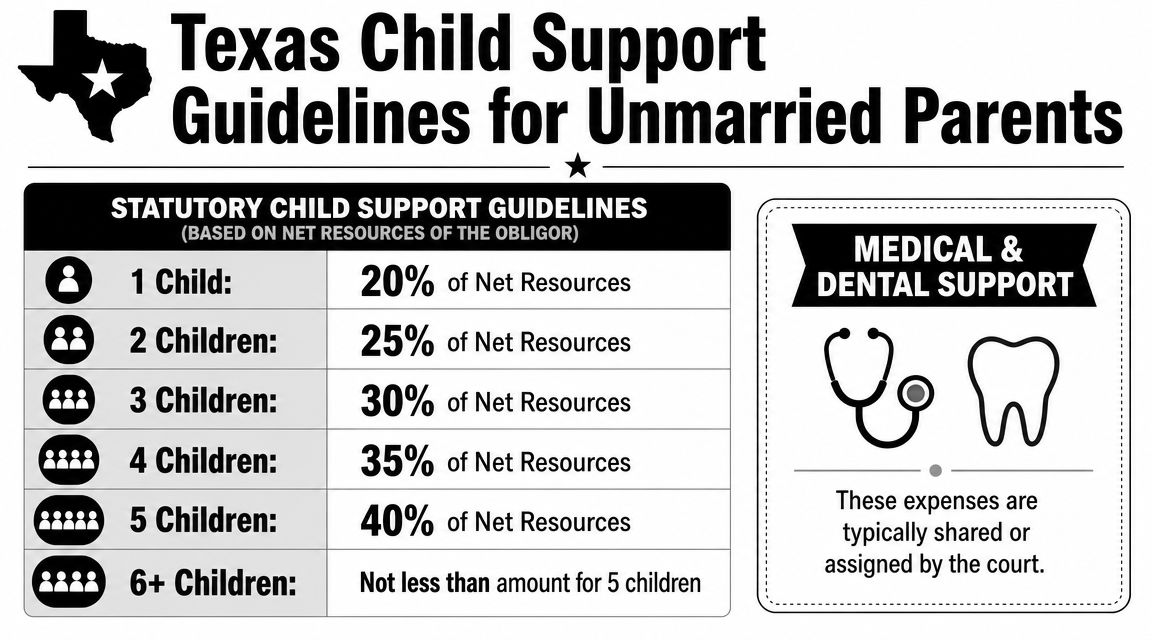
One of the most useful legal tools here is a Suit Affecting the Parent-Child Relationship, often called a SAPCR. A Texas family-law source notes that a common challenge for unmarried parents is converting an informal arrangement into an enforceable order, because a birth certificate or verbal agreement doesn't create enforceable rights for custody, visitation, or child support. That source explains that the critical legal step is obtaining a SAPCR order that formalizes these issues in court, as described in this article about child custody laws for unmarried parents in Texas.
What support orders usually address
A support order commonly deals with more than one monthly payment. It may address:
- Child support: Ongoing financial support for the child
- Medical support: Who provides health coverage for the child
- Uncovered expenses: How parents divide bills that insurance doesn't fully pay
- Payment method: How support is tracked and enforced
The point isn't just assigning dollars. It's creating clarity.
Health coverage and practical planning
Medical support matters because children's costs rarely arrive in a neat monthly pattern. Prescriptions, copays, urgent care visits, and specialist appointments can all trigger disputes if the order is vague.
Some parents also need help comparing insurance options outside an employer plan. If you're sorting through coverage questions for your child, it may help to find Community Health Choice options and then discuss with your attorney how any available plan fits into a proposed support order.
Local reality: The strongest support order is one that tells both parents what to do before the expense happens, not after they are already arguing over reimbursement.
For unmarried parents in Humble and nearby areas, support and medical expense terms should be treated as part of the larger parenting structure. If the arrangement is left informal, enforcement becomes much harder when one parent stops paying or disputes what was agreed.
How Our Humble Attorneys Can Help Your Family
A lot of parents call our office after the arrangement at home stops feeling stable.
One week, pickups happen the way they always have. The next week, one parent changes the schedule, stops answering messages, or says, "You are not taking the child unless we do this my way." In Humble, Atascocita, Kingwood, and across Northeast Houston, I see the same problem again and again. Two parents may both love their child and still have no court order that tells either one what happens next.
That gap matters. An informal co-parenting plan works only as long as both parents keep agreeing. A signed court order turns those day-to-day expectations into rules both parents can rely on and, if necessary, ask a judge to enforce. That is often the practical turning point for unmarried parents. The issue is not only proving who the legal parents are. The issue is getting from "this is what we usually do" to "this is what the order requires."
Our job is to help you make that shift clearly and carefully.
What legal help looks like for unmarried parents
In real cases, that often means helping a parent:
- file the correct parent-child case in Texas court
- gather texts, school records, daycare information, and calendars that show how parenting has been handled
- turn a loose verbal agreement into written terms a judge can approve
- address disputed issues such as pickup locations, holiday time, decision-making rights, and notice for schedule changes
- respond if the other parent cuts off contact, refuses to cooperate, or threatens to move with the child
This work is part legal procedure and part problem-solving. Conservatorship, possession, child support, and medical support are legal labels. For a family in Humble, those labels usually mean plain questions. Who picks up from school. Who can consent to counseling. What happens on Thanksgiving. Who carries insurance. What if a parent misses three weekends in a row.
A good court order answers those questions before the next argument starts.
Why local experience helps
Harris County family cases involve forms, deadlines, local court practices, and judges who expect clear, workable proposals. Parents also need orders that fit real life here. Commutes, school zones, shift work, daycare hours, and exchange points all affect whether a possession schedule will hold up outside the courtroom.
I often tell parents to treat the order like a set of written directions for a long trip. If the directions are vague, everyone ends up arguing at the first turn. If the directions are specific, both parents know what to do even when they are frustrated with each other.
The Law Office of Bryan Fagan handles family law matters involving custody, support, and parent-child relationship cases for local residents. If you are unsure whether your family needs a parentage case, a custody order, or help fixing an arrangement that has started to break down, an attorney can explain the path that matches your situation and work toward an order your family can use.
Frequently Asked Questions About Unmarried Custody
What if the other parent is denying paternity
If paternity is being denied, the case usually moves out of the informal stage and into court. That matters because rights tied to conservatorship and possession depend on legal parentage being recognized. If one parent refuses to cooperate, the court process creates a structured way to resolve the dispute and move toward enforceable orders.
Your practical takeaway is simple. Don't rely on texts, family assumptions, or verbal promises when paternity is contested. Get legal guidance early so the issue can be addressed correctly before the conflict expands into custody and support fights.
Can a father get custody rights if he is on the birth certificate
Being on the birth certificate may feel important, and emotionally it is. But by itself, it doesn't create the full, enforceable parental rights many people assume it does. For unmarried parents, legal recognition and a court order are what turn parenthood into enforceable conservatorship and possession rights.
If you're already acting as a parent, don't assume the paperwork you signed at birth covers everything. Many parents in Humble learn too late that they still need court action to protect their role.
What if we already have a verbal agreement and it's working
A verbal agreement may work while both parents are cooperative. The problem is that it can stop working overnight. One disagreement over daycare, a new relationship, or a move across the Houston area can expose how fragile an unwritten arrangement really is.
If the current routine is good for your child, that's a strong reason to formalize it. Courts often benefit from seeing a pattern that has already been working. A written order can preserve that stability instead of leaving it vulnerable.
Can one parent move away with the child
Moves become much more complicated when there is a court order with residence terms or geographic limits. Without a clear order, conflict grows fast because the parents may have very different assumptions about what is allowed.
If the other parent is talking about leaving Humble, Atascocita, Kingwood, or the surrounding area with the child, don't wait for moving day to ask legal questions. The earlier you act, the more options you may have to protect the child's routine and your access.
Parents often focus on whether a move is fair to them. Courts usually focus on how the move affects the child and the child's relationship with both parents.
Can we make our own parenting plan without fighting in court
Yes, many parents can negotiate terms outside a trial setting. But even a friendly agreement should be written carefully and made enforceable through the proper legal process. A vague agreement can create just as many problems as no agreement at all.
A strong parenting plan should address the issues parents usually skip, including travel notice, exchange timing, school breaks, healthcare communication, and what happens if a holiday schedule conflicts with a regular weekend.
Can an unmarried mother block all contact
Not necessarily. The answer depends heavily on whether legal parentage has been established and whether a court order exists. If there is no enforceable order in place, the situation can become chaotic very quickly. That's one reason unmarried parents shouldn't delay legal formalization when co-parenting is already underway.
If contact has suddenly been cut off, the next step isn't usually a heated text exchange. It's getting legal advice about what rights exist now and what needs to be filed.
Do unmarried parents use different custody standards than divorced parents
The custody analysis centers on the child's best interest. What differs for unmarried parents is often the legal setup at the start, especially parentage and the need to create an initial order through the correct procedure. Once the court is properly dealing with conservatorship and possession, the focus is on the child, not on whether the parents were married.
That distinction matters because many parents think the law punishes them for not marrying. In practice, the larger issue is usually whether they took the formal legal steps required to create enforceable rights.
Is it worth going to court if we're mostly getting along
Often, yes. Getting along is helpful, but it isn't a substitute for legal protection. In fact, cooperation can make the process easier because both parents may be more willing to preserve a schedule that already works.
The best time to formalize a parenting arrangement is often before a major conflict starts. Once trust breaks down, every issue gets harder, from pickup times to reimbursement requests.
What documents should I start gathering
Start with anything that shows the child's day-to-day life and each parent's involvement. That can include school records, daycare information, medical records, calendars, messages about exchanges, and proof of who has been handling major responsibilities.
You don't need to organize your whole life before talking to a lawyer. But if you bring a clear timeline and a few core records, the conversation becomes far more productive.
When should I talk to a lawyer
Talk to a lawyer as soon as you realize the informal arrangement may not hold. That might be after a separation, after access is denied, when one parent mentions moving, or when you want to formalize a stable routine before conflict starts.
Early advice can prevent expensive mistakes. It can also help you approach the other parent with a clearer, calmer plan.
If you're dealing with custody for unmarried couples in Texas and need practical guidance for your family in Humble, Atascocita, Kingwood, or Northeast Houston, schedule a free consultation with the Law Office of Bryan Fagan. Our Humble office can help you understand your rights, prepare the right filings, and work toward a clear court order that protects both your child and your future.