Skip to content

If you're reading this after a long overnight shift in Humble, Kingwood, or Atascocita, you're probably carrying two kinds of exhaustion at once. One comes from work. The other comes from worrying that a Texas judge will look at your schedule and decide you're not the parent your child needs.
That fear is understandable. It's also often misplaced.
Parents in Northeast Houston work nights every day. Nurses, refinery workers, dispatchers, deputies, EMTs, warehouse supervisors, and logistics employees keep this area running around the clock. Working nights does not automatically cost you custody in Texas. What matters is whether your parenting plan protects your child's routine, school life, sleep, supervision, and emotional stability.
If your child is struggling with the stress of separation or divorce, practical support outside the courtroom can help too. Families often benefit from guidance on emotional support for children during divorce, especially when a changing work schedule adds more transition to a child's week.
Your Guide to Navigating Texas Custody with a Night Shift Job
Texas courts don't decide custody based on job titles. They decide custody based on the best interest of the child. That's the rule that drives everything.
For a night-shift parent, that means the court isn't asking, “Do you work overnight?” The court is asking better questions. Who gets the child ready for school? Who handles bedtime when you're at work? What happens if your shift runs late? Does your plan work on a normal Tuesday, not just in a polished proposal prepared for court?
What worried parents usually get wrong
Many parents assume the other side can walk into court and say, “She works nights,” or “He's never home at bedtime,” and that's enough. It usually isn't.
Judges in Harris County want specifics. They want to know whether your child has a stable home, a reliable caregiver when needed, and consistent routines across the week. If you can prove that, your night schedule becomes one fact in a larger picture, not the whole case.
Practical rule: Your schedule matters less than your system.
That distinction gives you control. You may not be able to change your industry or your shift overnight, but you can build a parenting plan that shows structure, backup, and follow-through.
What you should do first
Start with the basics before you argue anything in court:
- Map your actual work pattern. Use your real shift rotation, overtime history, and commute time.
- Identify your reliable backup people. Not “my mom can usually help,” but specific names, days, and roles.
- Build around your child's life. School start time, homework, activities, meals, and sleep come before your convenience.
- Document everything. Judges trust evidence more than promises.
Parents handling custody when parents work night shifts in Texas usually do better when they stop defending their job and start proving their plan. That's the shift that matters.
Understanding the Best Interest of the Child Standard
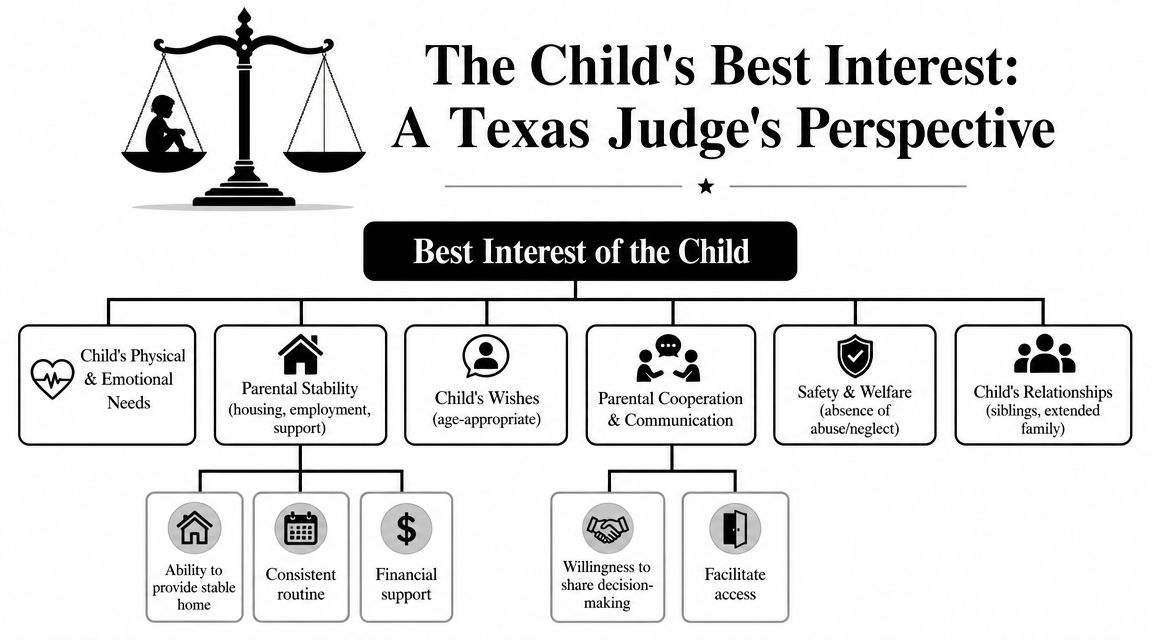
A parent can work a 7 p.m. to 7 a.m. shift and still be a strong custody parent in Texas. The legal question is simpler than people expect. The court asks whether your child will have a stable, safe, and predictable life under the orders being requested.
Texas judges decide conservatorship and possession based on the child's best interest. Your job matters only to the extent it affects daily life. In a night-shift case, that means the court will focus on routines, supervision, school attendance, emotional stability, and the quality of the plan behind your work schedule. Research on evening and overnight work has raised concerns in some families about parent-child closeness and child behavior under added stress, as summarized by North Carolina State University. That does not mean a night-shift parent is at a disadvantage by default. It means judges want proof that your child's routine stays steady.
What a judge is evaluating
Your parenting plan works like a test of real-life stability. In Harris County, judges are not impressed by broad promises. They want to see who gets the child ready for school, who covers the overnight hours, what happens if you are held over at work, and whether the same dependable adults show up every week.
That review usually comes down to a few concrete questions:
- Who handles the child's routine? Morning prep, school transportation, homework, meals, bath time, and bedtime all matter.
- Is the schedule predictable? Children do better when the week has a pattern they can count on.
- Who provides backup care? Judges give more weight to named, reliable caregivers than vague assurances.
- How well do the parents communicate? School updates, medical information, and schedule changes need to be shared without constant conflict.
- Will the child feel secure in both homes? Emotional steadiness and physical safety carry real weight.
Specifics win these cases.
A parent who shows a judge a written childcare plan, a work calendar, and a school-friendly routine usually comes across as prepared and credible. A parent who says, “I'll figure it out,” does not.
Joint Managing Conservatorship and primary residence
Parents usually say “custody,” but Texas law breaks the issue into conservatorship, possession, and access. If you're trying to understand those terms in plain English, our pages on child custody matters in Humble and Texas conservatorship issues can help you connect the legal labels to daily life.
Here is the point that matters most. Joint Managing Conservatorship does not mean equal time, and it does not guarantee that both homes function the same way. It usually means both parents share major rights and duties. The parent with the right to designate the child's primary residence often has major practical influence because that choice affects school zoning, weekday structure, and which home becomes the child's anchor.
For a night-shift parent, that issue is often where the case is won or lost. If your proposed arrangement protects sleep, school attendance, and handoffs without confusion, you are giving the court a workable option. Harris County judges tend to respond well to practical schedules tied to real school and childcare logistics, especially when a Humble-area parent can show exactly how weekday care will work instead of asking the court to assume it will.
A strong custody case proves your child is cared for every hour, even when you are at work.
What best interest means for Harris County families
In Humble, Atascocita, Kingwood, and Northeast Houston, overnight work is part of daily life. Hospitals, refineries, logistics companies, law enforcement agencies, and emergency services all depend on parents who work outside a normal daytime schedule. Judges know that.
What they will not excuse is avoidable instability.
If you are building a case around custody when parents work night shifts texas, stop framing it as whether your schedule is fair to you. Frame it the way the court will. Show that your child has consistent sleep, reliable transportation, steady supervision, and a routine that holds up on an ordinary school night in Harris County. That is the standard. That is also the kind of evidence that persuades local judges.
How Texas Courts Really View Night Shift Parenting
A lot of parents walk into a custody fight convinced the judge will automatically favor the parent with the daytime schedule. That's outdated thinking.
Courts have moved away from treating shift work as an automatic disadvantage and toward evaluating the full parenting plan. Attorneys handling these disputes report that night-shift parents can still win custody when they show dependable child-care coverage and a workable schedule. That approach tracks with broader research summarized by Deford Law Firm's discussion of custody schedules for night-shift parents, which also notes that the interaction between shift work and family structure mattered more than shift work by itself, with a reported predicted behavior-problem score of 8.82 for some high-risk groups versus 5.19 for other children, a roughly 70% increase.
The myth that hurts good parents
The myth is simple. If you work nights, you're already losing.
That's wrong. Judges don't reward appearances. They reward reliability.
In Harris County, courts see families built around hospitals, plants, transportation hubs, law enforcement, and emergency services. Overnight work is common. A judge isn't shocked by a 7 p.m. to 7 a.m. shift. What raises concern is an unstable plan, rotating chaos, or a parent who can't explain who is with the child when the parent is working.
A judge is less concerned with when you work and more concerned with who is caring for your child and how their routine is maintained.
What judges tend to trust
Night-shift parents usually do well when they present a plan that feels ordinary and repeatable. Not heroic. Not improvised. Ordinary.
Judges tend to respond well to arrangements that show:
- Predictable handoffs that don't disrupt school or sleep
- Named caregivers instead of vague backup promises
- A routine the child can follow in both homes
- A plan for overtime and emergencies
- Evidence of actual involvement in school, medical care, and everyday parenting
What undermines a night-shift case
Some parents hurt themselves by taking the wrong position. They insist their schedule “shouldn't matter.” It does matter. It just isn't the only thing that matters.
Others overpromise. They tell the court they'll personally do every bedtime, every morning, every pickup, every emergency. If that claim doesn't fit your actual work life, it can make you look less credible.
If you work nights, own it. Then show the court exactly how your child stays secure anyway. That's how you control the narrative.
Crafting a Workable Night Shift Possession Schedule
A good schedule doesn't try to copy a daytime parent's life. It builds around the life you have. If you work nights, your possession plan should protect the child's routine first and your available parenting time second.
That's where many parents go wrong. They focus on getting “equal” time before they build a schedule that can survive school mornings, bedtime, and overtime. The better approach is to design a structure that a judge can picture working week after week.
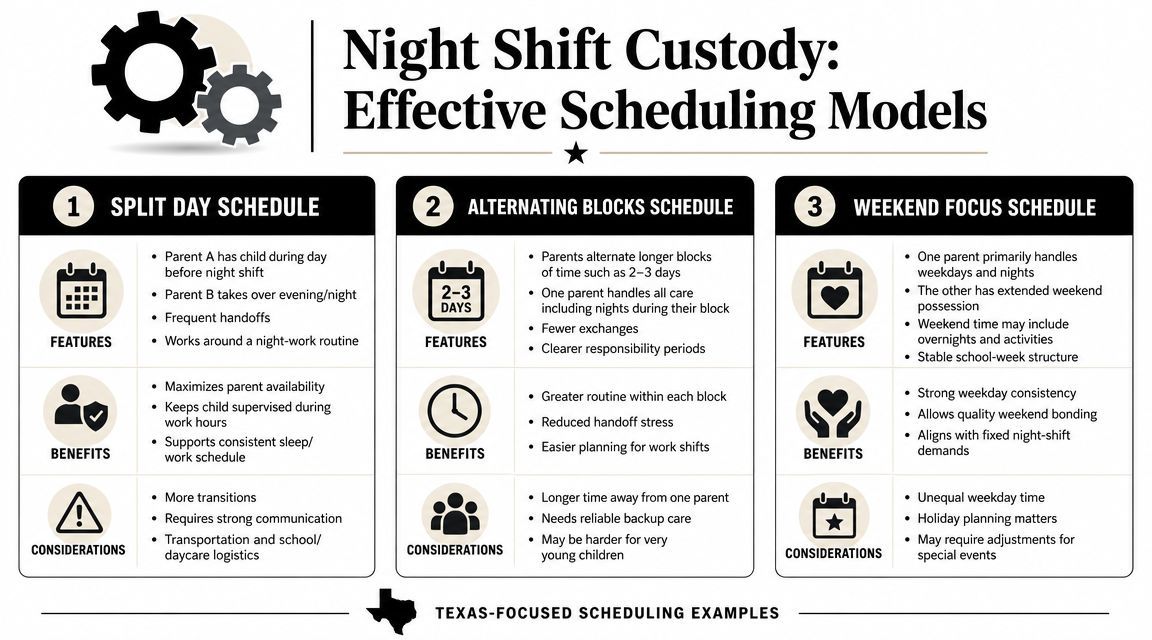
The Split Day plan
This model works well when one parent can handle evenings and nights while the night-shift parent is available during the day.
Example: a Humble-area nurse works three overnight shifts each week. On workdays, that parent has the child after school through dinner, homework, and quality time, then the other parent takes over for overnight care and school morning responsibilities. On off days, the night-shift parent handles full blocks of parenting time.
This schedule can work because it respects the child's sleep routine while still preserving substantial parent-child time.
The Tag-Team plan
The stronger “tag-team” setups often involve one parent working nonstandard hours while the other works a more standard daytime schedule. That combination can create stability when both adults are cooperative and transitions are clear.
This is often the most realistic plan for married-but-separated parents in Kingwood or Atascocita who both remain highly involved. It can also work after divorce if both homes stay close to school and each parent sticks to a defined role.
Local reality: The best schedule is the one you can repeat during a school week, not the one that sounds most equal in mediation.
The Expanded Right of First Refusal
This clause can be powerful if used carefully. If the night-shift parent is unavailable during a defined block, the other parent gets the first opportunity to care for the child before a third party does.
That sounds simple, but details matter. You need to define:
- How much time triggers the right
- How much notice is required
- Whether school or daycare hours count
- Whether a grandparent or regular caregiver is exempt
For some families, this reduces conflict and helps the child spend more time with a parent instead of a sitter. For others, it creates endless arguments. Don't add it unless the language is precise.
The Coordinated Care plan
Some parents need consistent third-party help, especially in health care, manufacturing, and emergency response. That doesn't make your case weak. It can make your case stronger if the arrangement is stable and documented.
A coordinated plan usually includes the same morning caregiver, the same daycare, or the same trusted relative for recurring transitions. Consistency is what matters.
Here's a simple comparison:
| Schedule model | Best fit | Main risk |
|---|---|---|
| Split Day | Parent works fixed overnight shifts | Too many handoffs if homes are far apart |
| Tag-Team | Parents cooperate and one has daytime availability | Conflict can break the schedule fast |
| Weekend Focus | Parent has hard weekday overnight demands | Parent may lose weekday involvement |
| Coordinated Care | Reliable caregiver support exists | Weak documentation can hurt credibility |
If you're trying to compare a custom night-shift arrangement to a more standard court framework, this guide to the standard possession order in Humble is a useful baseline. It helps parents see where they need a specific deviation and why.
What to avoid
Don't hand a judge a schedule that depends on constant favors, last-minute swaps, or an ex who already doesn't cooperate. A workable plan needs structure.
It should answer one blunt question: if your shift runs late on a Wednesday, what happens next? If your order can't answer that, it isn't ready.
Evidence That Matters for Your Humble Custody Case
Judges hear promises all day. They decide cases based on proof.
A night-shift schedule becomes legally vulnerable when it prevents a parent from personally covering school mornings or bedtime without dependable backup. Courts look for who steps in, whether the routine stays consistent, and whether the plan works in real life. Strong proposals include written contingency plans for overtime and emergencies, as discussed in this analysis of how night-shift jobs can affect custody cases.
The documents that pull weight
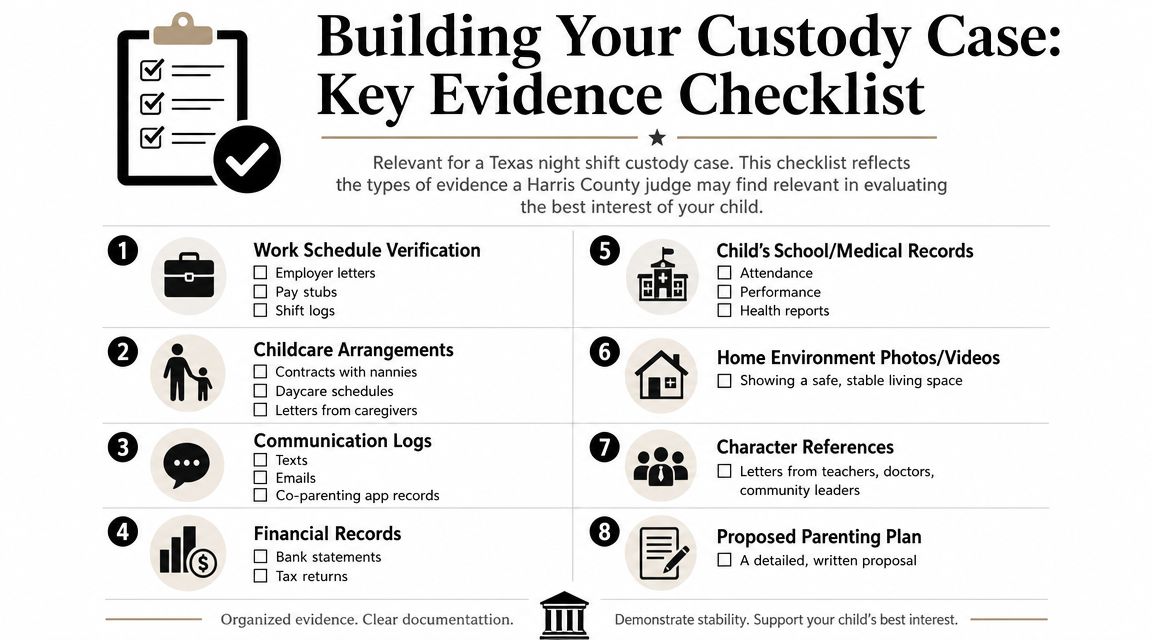
Bring hard evidence. Organized evidence. Current evidence.
Start with these:
Work schedule records
Shift calendars, employer schedules, overtime logs, and pay records help show whether your hours are fixed, rotating, or subject to call-ins.Employer confirmation
A short letter confirming your typical hours, flexibility, and any expected shift pattern can be useful if it's accurate and specific.Childcare documents
Contracts, payment records, written commitments from caregivers, daycare schedules, and transportation arrangements matter because they show your backup isn't imaginary.School and medical records
Attendance, pickup patterns, communication with teachers, appointment history, and who signs forms can show who is doing the daily parenting work.
The proof many parents forget
The strongest cases often include the less obvious material.
Consider gathering:
- A proposed parenting calendar that covers school weeks, holidays, and your actual shift pattern.
- A contingency plan for mandatory overtime, child illness, and exchange problems.
- Communication records with the other parent that show cooperation, not chaos.
- Photos of your home setup if they help show sleeping arrangements, study space, and safety.
- Third-party letters from caregivers, coaches, or school contacts who can speak to your involvement.
If you want a deeper breakdown of useful records, this article on what evidence helps in a Texas child custody case is worth reviewing before your consultation.
The parent who arrives with a binder usually has an advantage over the parent who arrives with a story.
How to organize your file
Don't dump screenshots into your phone and hope for the best. Build a file you can hand to your attorney fast.
Use a simple folder system:
- Tab one: work records
- Tab two: childcare proof
- Tab three: school and medical involvement
- Tab four: communications
- Tab five: proposed parenting plan and backup plan
Parents in Humble and Northeast Houston often wait too long to prepare this material. That's a mistake. If the other parent is already framing your night shift as instability, your documents need to answer that claim clearly and quickly.
Modifying an Order and When to Call an Attorney
Sometimes the problem isn't your original custody case. It's that your old order no longer fits your life.
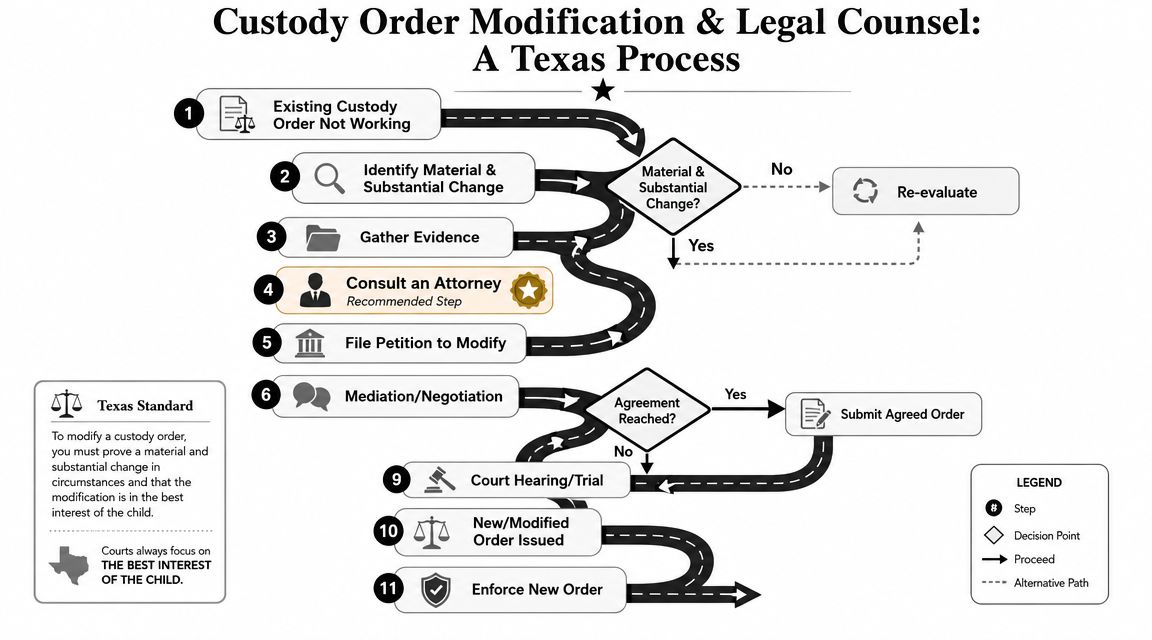
A move from day shift to nights, a new hospital rotation, a transfer to logistics, or an emergency-services schedule change can make an existing order unworkable. In Texas, a custody modification usually requires a material and substantial change in circumstances. A significant work-schedule change can fall into that category, especially when it affects exchanges, supervision, school mornings, or consistency for the child.
When modification makes sense
Not every inconvenience justifies court action. But some changes do.
You should seriously consider a modification when:
- Your shift changed in a lasting way and the current order no longer matches reality
- The child's school routine is suffering because exchanges or supervision no longer work
- The other parent is using your schedule change against you
- You keep making side deals that never get written into an enforceable order
- Your backup childcare situation has improved and your current order no longer reflects that stability
In Texas, where many parents work in health care, logistics, manufacturing, and public safety, the practical question is not whether a night-shift parent can win. The more important question is what proof reassures a court that the child's routine will stay protected, as discussed in this article about managing custody when you work night shifts.
Don't try to fix a broken order with endless informal swaps
Parents often tell me they've been “making it work” for months. That usually means the written order says one thing and real life looks completely different.
That's risky. Informal agreements can collapse without warning. Then one missed exchange turns into an enforcement fight or a sudden accusation that you're unreliable.
If your order no longer works, address it directly. A formal modification is usually cleaner, safer, and easier to enforce.
Clear signs you need legal help now
Some cases can start with direct negotiation. Many can't.
Call an attorney if any of these are happening:
- The other parent already hired counsel
- Communication has turned hostile or manipulative
- You're being accused of abandoning the child or leaving the child with others too often
- There are safety concerns
- You feel buried by deadlines, paperwork, or court procedure
- You need a local strategy tied to Humble, Kingwood, Atascocita, or the Harris County court system
For parents facing that problem, our page on custody modification in Humble explains the process in more detail. If the custody issue is tied to a larger separation or divorce, it also makes sense to review your broader family-law options with a divorce attorney before you file anything.
When the facts have changed, your court order should change too.
Protecting Your Family in Humble and Northeast Houston
It is 6:30 a.m. in Humble. You are getting home from a night shift as your child is getting ready for school. That schedule can work in a Texas custody case, but only if you show the court exactly how your child stays rested, supervised, on time, and secure every day.
That is the standard Harris County judges care about. They want specifics. In night-shift cases, broad promises lose. Detailed plans win.
Parents in Humble, Kingwood, Atascocita, and Northeast Houston often face the same problem. Their work hours are real, their parenting is real, but the court papers do not explain how both fit together. Fix that gap. A clear, local, child-focused plan is often the difference between looking organized and looking unprepared.
The right next steps
Start with the facts on the ground, not what you hope a schedule will become.
- Write out your actual weekly routine. Include shift start and end times, commute time, overtime patterns, and sleep blocks.
- Map out school-day logistics. Show who handles bedtime, wake-up, breakfast, drop-off, pickup, homework, and sick days.
- Identify every backup caregiver. List names, relationship to the child, availability, and how long they have helped.
- Build a calendar the court can follow. Include weekends, holidays, summers, exchanges, and what happens if your shift changes.
- Collect records that match your story. Work schedules, childcare receipts, school attendance, text messages, and any proof that the routine is already working.
- Get legal advice before you walk into court. Judges expect a finished plan, not a rough idea.
Strong cases in Harris County usually share one trait. The parent has already solved the practical problems before the hearing.
What judges find persuasive in local night-shift cases
A good case does not argue around the night shift. It addresses it directly.
Show that your child sleeps in the same place on school nights when possible. Show that the morning routine is dependable. Show that the caregiver stepping in during your work hours is known, consistent, and responsible. Show that exchanges are realistic for Humble-area traffic, school location, and your actual commute.
Judges also notice whether the arrangement is already working in real life. If your child has been getting to school on time, keeping a stable routine, and doing well with the current setup, bring proof of that. In Harris County, a parent who arrives with records, calendars, and a sensible plan is far more persuasive than a parent who says, “I'll figure it out.”
One practical option for parents who need help turning that reality into a court-ready strategy is working with a local family-law team such as the Law Office of Bryan Fagan, which handles child custody, conservatorship, and modification matters for families in the Humble area.
You can protect your relationship with your child
A night-shift job does not make you a weaker parent. It means you need a custody plan that is honest, specific, and easy for a judge to trust.
If your current order no longer fits your work hours, address it before the conflict gets worse. If the other parent is already attacking your schedule, prepare your evidence now. And if you are in Humble or Northeast Houston, build your case for the court you are in, with the school routine, commute realities, and caregiver details that local judges expect to see.
If you're dealing with custody when parents work night shifts in Texas, you don't have to sort through it alone. The Law Office of Bryan Fagan helps families in Humble, Atascocita, Kingwood, and Northeast Houston build workable parenting plans, pursue custody modifications, and prepare for court with clear, local guidance. Schedule a free consultation with our Humble office to talk through your schedule, your concerns, and the next step for protecting your family.