Your child is still taking naps. Daycare pickup might already be a daily scramble. You may be trying to answer work emails from Atascocita, make dinner in Kingwood, and act normal while your marriage is falling apart. That's the situation for a lot of parents dealing with a divorce with kids under 5 in Texas.
My advice is simple. Don't treat this like a paperwork problem. Treat it like a parenting stability problem with legal deadlines attached.
When a child is a toddler or preschooler, small details matter more than people expect. Missed handoffs, vague pickup plans, and half-finished agreements create conflict fast. In Harris County, the families who do best are the ones who get organized early, put a real routine on paper, and stop assuming they can “figure it out later.”
If you live in Humble, Atascocita, Kingwood, or Northeast Houston, you need a plan that works in real life. Not just a decree that looks fine in a file. A plan that covers daycare drop-off, naps, medicine, preschool, bedtime, and who's paying what.
Understanding the First Steps in a Texas Divorce
The first thing I tell parents is this: calm the noise and check whether Texas can hear your case. That question comes before everything else.
For divorce cases involving children, Texas generally cannot make initial custody orders unless Texas is the child's home state, which usually means the child has lived in Texas for at least six consecutive months before filing. Texas Law Help also states that one spouse must have lived in Texas for six months and in the filing county for 90 days before filing a divorce with children, including cases filed in Harris County. You can review those rules in the Texas Law Help divorce guide for parents with children.
If you're in Humble, that usually means your case will be filed in Harris County if the residency rules are met. If one parent recently moved, or the child has been splitting time between states, don't guess. Jurisdiction mistakes can waste time and money right at the start.
What filing actually starts
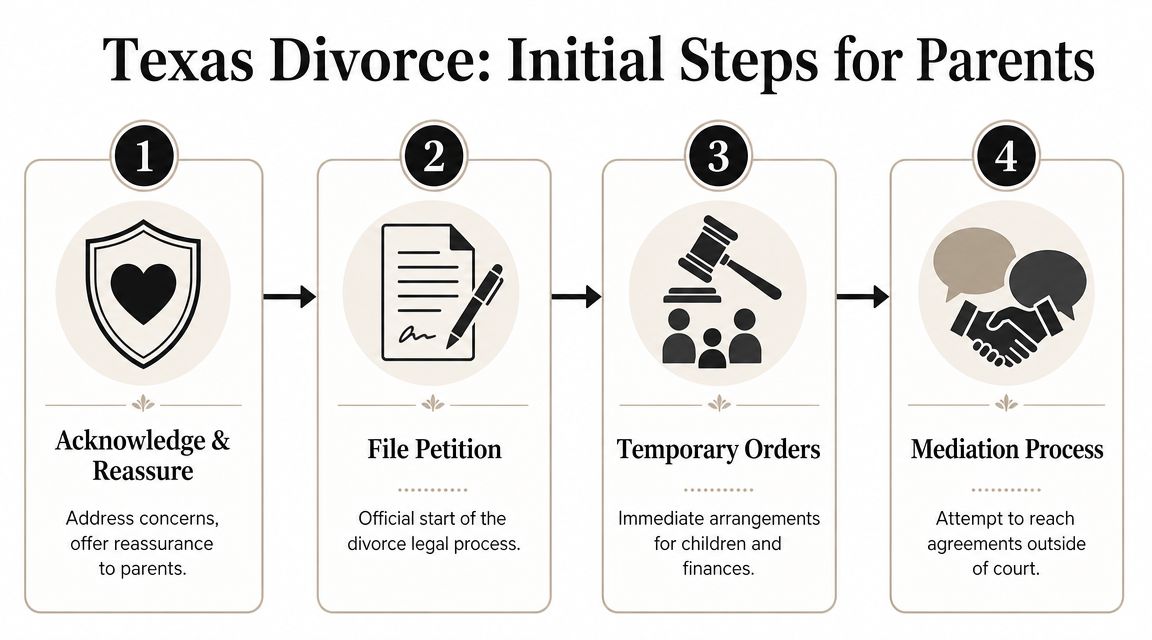
A divorce case starts when one spouse files the Original Petition for Divorce. That document tells the court you're asking for a divorce and that there are children involved. It also opens the door for the court to address parenting issues, support, and the rest of the legal details that have to be resolved before the case can finish.
Most parents feel intimidated by the petition because it sounds bigger than it is. It matters, but it's still the start of the process, not the end of it. What matters most is accuracy and strategy.
The first decisions that matter most
Once the petition is filed, I want parents thinking about these issues immediately:
- Where the child is sleeping right now: If your toddler is bouncing between houses without a predictable plan, fix that quickly.
- How the other parent will be notified: Proper service matters. Sloppy service causes delays you don't need.
- What documents need to be gathered: Daycare records, health insurance information, work schedules, and a proposed parenting routine are often more useful than people realize.
- What conflict points are already obvious: School pickup, daycare authorization, who carries insurance, and who can take the child to the doctor should be identified early.
Practical rule: If a disagreement is already happening before filing, it probably needs to be addressed in writing, not left to a text-message promise.
What the early timeline feels like
Parents in Northeast Houston often assume filing means an immediate courtroom showdown. It usually doesn't. The early phase is more administrative than dramatic, but it still sets the tone for the whole case.
You'll file. The other side must be properly notified. Then the case moves through the required waiting period and, if needed, temporary relief. During that time, the court expects adults to act like adults. That means following procedures, exchanging information, and building a decree that answers the questions a judge will ask later.
A lot of stress comes from not knowing what's next. Here's the practical version:
- Confirm residency and jurisdiction
- Prepare and file the petition
- Serve the other parent properly or handle waiver issues correctly
- Start drafting a child-centered temporary and final plan
Why Harris County parents need to be specific
Harris County courts see a high volume of family cases. Judges don't want vague promises. They want clear paperwork. If you say you've agreed, the agreement should be complete. If you say the child will have a schedule, the schedule should have exchange times, locations, and details.
That's especially true when the child is under five. A court order that doesn't clearly address possession, support, and practical parenting details is asking for trouble. The more specific you are at the start, the less likely you are to spend months fighting over avoidable issues.
Creating Immediate Stability with Temporary Orders
If you're separating from your spouse and you have a toddler, waiting around without rules is a mistake. Temporary Orders are often the tool that keeps a bad situation from getting worse.

Texas divorce cases include a mandatory 60-day waiting period, and during that time parents can seek Temporary Orders to establish custody, support, and rules of conduct while the case is pending, as described in this Texas uncontested divorce with kids guide. For a family with a child under five, that's not a minor procedural step. It's often the difference between order and chaos.
What Temporary Orders should accomplish
Temporary Orders should create stability fast. Not perfection. Stability.
For parents in Humble and Kingwood, that usually means the court addresses questions like these:
- Where the child will stay: You need a temporary possession schedule that fits the child's routine.
- Who pays ongoing bills: Mortgage, rent, daycare, and child-related expenses can't be left to weekly arguments.
- How parents will behave during the case: Rules about communication, access to the child, and day-to-day conduct can lower conflict.
- What happens while the case is still open: You need structure now, not just in the final decree months later.
A toddler doesn't care that the case is “still pending.” Your child still needs bedtime, daycare drop-off, and the same comfort object at both homes.
Why vague arrangements fall apart
Parents often try an informal arrangement first. Sometimes that works for a week or two. Then one parent is late for pickup, one keeps the child longer than expected, daycare staff don't know who's authorized, and every exchange turns into a fight in a parking lot.
That's exactly why I push parents to ask for structure early. Temporary Orders reduce room for freelancing.
If one parent says, “We don't need court orders, we'll work it out,” ask whether they've already started changing the plan without your agreement. That usually answers the question.
A good temporary schedule should reflect the child's real life. If your child naps at a certain hour, needs daycare handoffs at a certain location, or has a hard time with long stretches away from one parent, build around that.
Here's a short explanation that many parents find helpful:
What to ask for right away
I'm opinionated about this. In a divorce with kids under 5 in Texas, you should think carefully about requesting Temporary Orders if there's conflict about parenting time, money, or basic routines.
Focus on practical items:
- A detailed exchange plan: Include days, times, and where the handoff happens.
- Daycare authority: Make sure the provider knows who can pick up the child and who receives notices.
- Temporary support terms: If child-related expenses are being paid unevenly, address that.
- Communication boundaries: Use one shared method for child-related messages and stop arguing in long text threads.
If you need legal help setting up those temporary protections, one available local resource is the family law team at Law Office of Bryan Fagan in Humble, which handles divorce and child-related court orders in Harris County.
Crafting a Possession Schedule for Toddlers and Preschoolers
Many Texas parents receive bad advice on this topic. They hear that Texas often starts from a standard possession model and assume that should control everything. For a toddler or preschooler, that can be the wrong approach.
Texas guidance often defaults to a standard possession schedule, but it frequently doesn't address the practical reality of co-parenting children under five around naps, daycare, and the need for routine. Wilco family court guidance highlights that gap and notes the primary issue is building a plan that functions effectively for a very young child's daily life. You can read that discussion in the Wilco divorce with kids resource.
For a child who still naps, needs comfort routines, or struggles with abrupt transitions, your parenting plan should be built around the child's day, not around abstract labels.
Start with the child's routine, not your sense of fairness
Parents often walk into a scheduling dispute asking, “What's equal?rdquo; That's not the first question for a young child. The first question is, “What keeps this child regulated, secure, and rested?rdquo;
If your child goes to daycare in Atascocita, gets picked up at a certain time, melts down when dinner is late, and needs a consistent bedtime, that routine matters. A judge is far more likely to respect a proposal that reflects the child's actual life than one that sounds tidy but ignores reality.
The best schedule for a four-year-old may look inefficient to adults. That doesn't make it wrong.
Sample Possession Schedules for Children Under 5
| Schedule Type | How It Works | Best For |
|---|---|---|
| 2-2-3 schedule | The child rotates between parents in short blocks across the week and weekends | Parents who live close in Humble, Kingwood, or Northeast Houston and can handle frequent exchanges |
| Step-up schedule | One parent starts with shorter, frequent periods, then overnights increase over time | Very young children, breastfeeding situations, or cases where one parent is rebuilding routine |
| Weekday plus anchored weekend plan | One parent has set weekday periods and the other has predictable weekend time | Parents with fixed work schedules and daycare-based transitions |
| Daycare handoff schedule | Exchanges happen at daycare or preschool instead of at home | High-conflict parents who need lower-contact transitions |
| Customized preschool routine plan | The schedule is built around naps, therapy, daycare pickup, and bedtime patterns | Children with strong routine needs or parents with nontraditional work hours |
Schedules I often see work better
A 2-2-3 schedule can work when parents live close and communicate decently. It gives frequent contact with both parents and avoids long absences. The downside is obvious. It requires punctuality and cooperation. If one parent is always late, this schedule becomes exhausting.
A step-up plan is often smarter for younger children. That means a parent may begin with shorter, regular periods and build toward overnights as the child matures or as the routine becomes more stable. This can be especially useful if the child has had one primary bedtime caregiver for a long time.
A daycare-based exchange plan is one of the most practical solutions for working parents. Instead of meeting face-to-face for every handoff, one parent drops off and the other picks up. That reduces tension and gives the child a familiar transition point.
If you're trying to evaluate what kind of schedule may fit your family, this local guide on a child visitation schedule in Humble is a useful starting point.
Details that belong in the written plan
Parents either protect themselves or create future conflict. Your order should answer ordinary questions before they become legal problems.
Include details such as:
- Exchange location: Home, daycare, or another set place
- Pickup timing: A clear time, not “after work”
- Nap and bedtime expectations: Especially for younger toddlers
- Feeding routines: Important in breastfeeding situations or where the child has strict food issues
- Medication instructions: Who gives what, and when
- Daycare communication: Who receives incident reports, calendars, and payment notices
Daycare is often the center of the case
For many parents in Northeast Houston, daycare is the hinge point of the entire schedule. It affects possession, work, transportation, and even conflict levels.
If your child is in daycare, your plan should say:
- Who is listed on pickup authorization
- Who pays the provider and how reimbursement is handled
- What happens if the daycare closes or the child is sick
- Who handles backup care on workdays
If you leave those issues vague, they won't stay vague. They'll turn into emergency texts at 6:15 a.m.
Breastfeeding and very young children
Parents are often nervous to raise breastfeeding because they think the court will view it as emotional or manipulative. It shouldn't. It's part of the child's routine and needs to be treated that way if it's still ongoing.
That doesn't mean one parent gets frozen out. It means the schedule should be realistic. Frequent shorter visits, carefully timed exchanges, or a temporary step-up plan may make more sense than forcing a rigid standard model on a child who isn't ready for it.
What judges usually respond to
Judges tend to respond well to parenting proposals that are practical, detailed, and child-centered. They don't want a speech about who's the better parent. They want a plan that can survive Monday morning.
If you want your schedule to hold up, bring the court something concrete:
- A written proposed schedule
- The child's daycare or preschool routine
- Work schedules that affect exchanges
- A simple explanation of why your proposal supports consistency
That approach is far stronger than saying, “I just want what's fair.”
Navigating Child Support and Daycare Costs
Money fights can poison co-parenting fast, especially when the child is under five and daycare costs are already chewing through a paycheck. In Texas, child support has a formula, but your real life won't fit neatly inside a formula unless the order is drafted carefully.
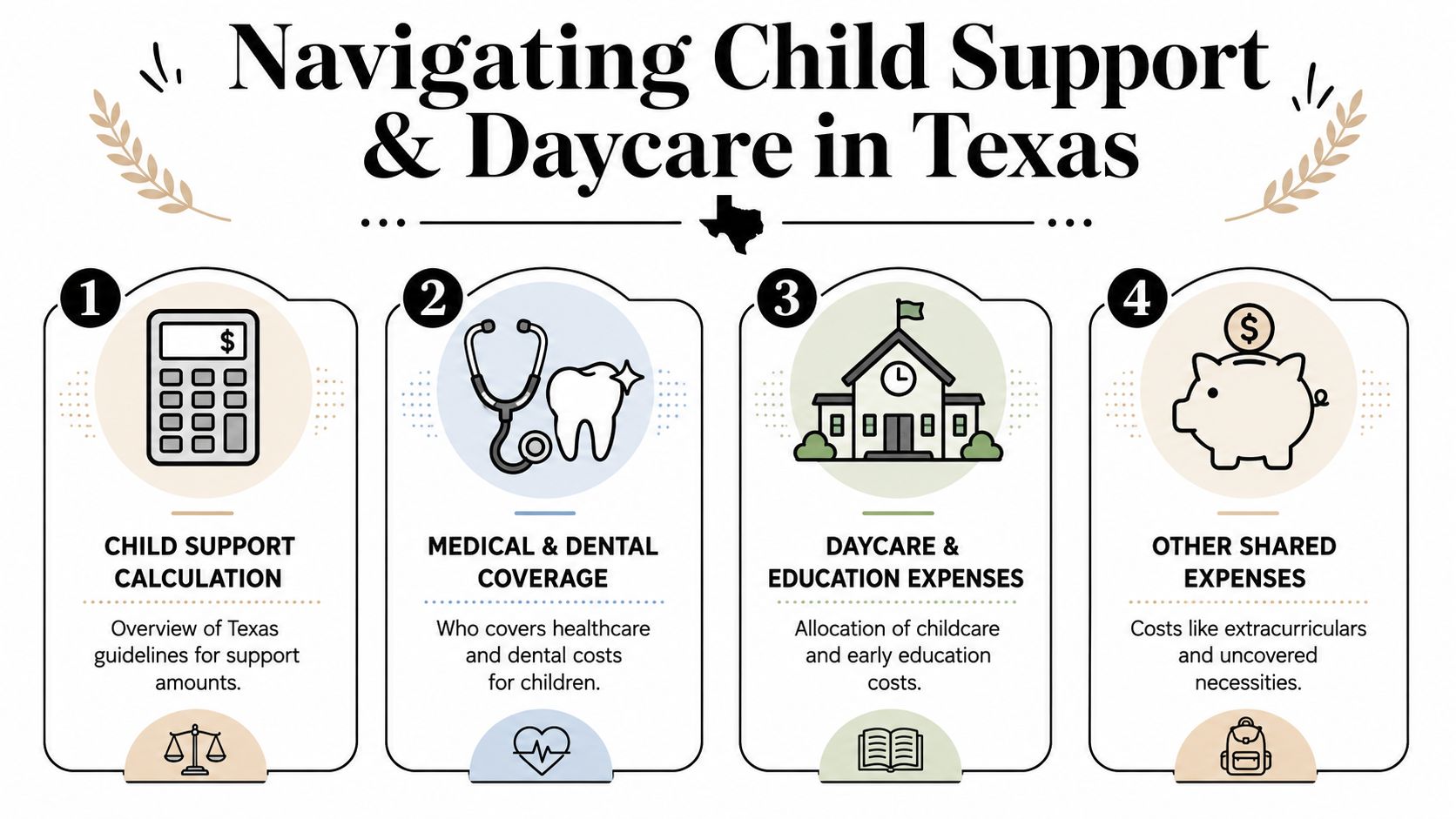
Texas calculates child support from the paying parent's net monthly resources. The guideline percentage is 20% for one child and 25% for two children, and support orders must also address health insurance and other needs, as outlined in this Texas child support overview.
That percentage is your starting point. It is not the end of the financial conversation.
What support covers and what parents still need to address
A lot of parents assume guideline child support automatically takes care of daycare. It doesn't solve the practical drafting issue by itself. You still need clear terms in the decree for who pays, how payments are made, and what happens when costs change.
For young children, I want parents focused on four buckets:
- Guideline child support: This is the baseline support obligation.
- Health insurance: The order should say who carries it.
- Uncovered medical costs: Co-pays, prescriptions, and similar expenses should be addressed clearly.
- Daycare and preschool expenses: These costs can make or break a working parent's budget.
If you want a more detailed local explanation of the formula itself, review this guide on how to calculate child support in Humble, Texas.
Daycare should be documented like a major case issue
Parents often treat daycare like a side expense. That's a mistake. For many families in Humble and Northeast Houston, daycare is one of the most important monthly child-related costs.
Be specific in your paperwork and negotiations:
- Name the provider if one is already being used
- State how each parent will contribute
- Address registration fees, supply fees, and late pickup charges
- Say what happens if a parent wants to change providers
Important point: If a cost matters enough to trigger arguments, it matters enough to put in the order.
For infants and younger toddlers, transitions between homes and daycare also create a packing problem that turns into a conflict problem. A practical tool like this infant daycare checklist can help parents decide what items should routinely travel with the child and which items each home should keep separately.
Don't ignore health insurance logistics
Health insurance needs to be more than a line item. It needs a real process.
Your order should make clear:
- Who maintains the policy
- How insurance cards and information are shared
- How parents handle reimbursement requests
- Who can take the child to appointments and receive records
In such cases, financial and parenting issues overlap. If one parent has the insurance, but the other parent handles many weekday appointments, both need access to the same information.
Keep records from day one
I tell parents to stop relying on memory the moment separation begins. Keep copies of daycare invoices, insurance notices, reimbursement requests, and any written agreement about child-related expenses.
That doesn't mean you need to become a bookkeeper. It means you need enough documentation to show a court, a mediator, or the other parent what was paid and what was agreed.
The parents who struggle most are usually the ones who say, “I'm pretty sure I covered that.” In family court, “pretty sure” is weak. Paper is strong.
Making Key Decisions as Co-Parents
A final order for a young child isn't just about where the child sleeps. It's also about who makes decisions when real life happens. Doctor visits. Preschool enrollment. Speech concerns. A last-minute urgent care trip after daycare calls.
Texas uses legal terms like conservatorship, but most parents in Humble don't need more jargon. They need clarity. Who decides what, and how do we keep that from turning into a weekly fight?
The decisions that deserve real planning
For children under five, these are usually the pressure points:
- Medical decisions: Who chooses the pediatrician, handles dental visits, and makes non-emergency treatment decisions?
- Preschool and daycare choices: Who has final say if parents disagree about a program in Humble ISD areas or nearby Northeast Houston communities?
- Therapy or evaluations: If concerns come up about speech, behavior, or development, who can consent?
- Primary residence and geography: Will the child remain in a defined area so both parents can stay involved?
A geographic restriction is often a practical protection, not a punishment. If one parent lives in Kingwood and the other lives near Atascocita, keeping the child rooted in the Northeast Houston area can preserve school continuity, daycare continuity, and meaningful access for both parents.
Joint decision-making only works if the process is clear
Parents love the idea of “we'll decide together.” That sounds mature. It also collapses quickly if nobody defines what happens after the first disagreement.
A good co-parenting plan should answer questions like:
- How much notice is required before a non-emergency medical appointment
- How school or daycare records will be shared
- Whether either parent has tie-breaking authority on certain issues
- How emergency decisions are communicated
If you're building that framework, this local co-parenting plan resource can help you think through the practical terms that need to be written down.
Young children change fast. Your decision-making plan should be structured enough to prevent conflict and flexible enough to handle new needs.
Match the parenting plan to the child's stage
A two-year-old and a five-year-old don't need the same routines, expectations, or transitions. Parents sometimes draft a plan based on what they hope the child will handle next year instead of what the child can handle now.
If you want a general developmental reference point while you're thinking through routines, sleep, and age-appropriate expectations, a parent's guide to developmental stages can help frame those day-to-day parenting questions.
The legal point is simple. Orders work better when they reflect the child in front of you, not the child you imagine six months from now.
Your Path to Finalizing the Divorce
By the time you're close to final orders, most parents are tired. That's when people get sloppy. They assume that because they've reached a handshake agreement, the hard part is over. It isn't. The final paperwork has to be complete.
In an uncontested Texas divorce, the benchmark is procedural completeness. An agreement may allow finalization after the waiting period, but any missing form or unresolved custody term in the final decree can delay the case. That warning is explained in this Texas pro se divorce process guide.
Mediation versus litigation for parents of young children
I'll be direct. If both parents are capable of negotiating safely and in good faith, mediation is usually the better path for families with toddlers and preschoolers.
Mediation gives you more room to solve practical problems that a courtroom order may handle bluntly. You can talk through daycare pickup, holiday transitions around naps, comfort items between homes, and communication rules that fit your lives in Humble or Northeast Houston.
Litigation has its place. If a parent won't cooperate, won't disclose information, or keeps creating instability, court intervention may be necessary. But if your case can be resolved through mediation, that process usually gives parents more ownership over the schedule their child will live with.
What must be finished before prove-up
Many uncontested cases often stumble. Parents think, “We agree.” The court asks, “Does your decree fully say what happens?rdquo; Those are different questions.
Before finalizing, make sure the file is complete:
- Final Decree of Divorce: It should fully address custody, possession, support, and property issues.
- Support paperwork: If support is ordered, related child-support paperwork must be ready.
- Parenting terms: Exchange logistics, health insurance provisions, and other child-related terms should be specific.
- Service and signatures: Any waiver, notice, or consent document must be properly executed.
A simple agreement isn't enough. A complete agreement in the right form is what gets a case over the finish line.
What the first months after divorce should look like
Once the divorce is final, don't start freelancing around the order. Follow it. Track compliance. Keep communication brief and child-focused.
For the first stretch after finalization, I usually suggest three habits:
- Use one communication method for child issues
- Keep a shared calendar for daycare, doctor visits, and exchanges
- Document problems early instead of letting resentment build
The first few months matter. That's when the child learns whether two homes can still feel predictable. It's also when parents either build trust or head straight back into court.
If you're facing a divorce with kids under 5 in Texas and you live in Humble, Atascocita, Kingwood, or Northeast Houston, get advice before temporary problems become long-term ones. A clear parenting plan, a workable support structure, and complete Harris County paperwork can protect your child and save you a lot of stress. Schedule a free consultation with Law Office of Bryan Fagan to talk through your situation and build a practical plan for the next step.