If you're in Humble, Atascocita, Kingwood, or Northeast Houston and staring at the house you worked hard to build, this question can feel heavier than almost anything else in your divorce. One spouse wants to stay. The other wants equity out. The mortgage is still due. The kids still sleep in their rooms. And somewhere in the middle of all that stress is a very practical legal question. Can you be forced to sell your house in a Texas divorce?
The short answer is yes, sometimes. But it doesn't happen just because one spouse demands it, and it doesn't happen because a judge flips a coin. Texas law gives courts power to divide community property in a way the judge considers just and right, and that can include ordering the marital home sold in the final divorce decree.
For many families in the Humble area, the home is the biggest asset in the marriage and the most emotional one. It's where routines happen. It's where school mornings start. It's often tied to a neighborhood, a commute, and a sense of stability. That's why this issue deserves more than a generic answer.
The better answer is this: whether a Texas court can require a sale depends on what kind of property the house is, what homestead protections apply, whether one spouse can realistically keep it, and how the final decree is written. Those details matter in Harris County courtrooms, and they matter even more when a family is trying to make smart decisions before the judge has to make them for them.
Your Home and Your Divorce in Humble TX
A couple in Kingwood may both agree the marriage is over but disagree completely about the house. One spouse wants to remain there until the children finish school. The other says the equity needs to be divided now because carrying two households isn't realistic. A family in Atascocita may face a different version of the same problem. Both want the house, but neither can refinance on a single income.
Those aren't unusual situations. They are the kinds of disputes that turn a divorce from difficult into overwhelming.
In my experience working with families around Humble and Northeast Houston, the anxiety usually isn't just about real estate. It's about losing footing. People want to know where they'll live, whether they can keep the kids in the same routines, and whether they're about to be pushed out of a home before the divorce is even over.
Practical rule: In most cases, the real turning point is the final divorce decree. That's when the court has authority to divide the property and decide whether the home will be kept, transferred, or sold.
That timing matters. A spouse usually can't force a sale during the divorce just because they want out. The legal power to require a sale is tied to the court's authority to divide community property at the end of the case.
For local families, that means the smartest move is often not asking, "Can the judge force a sale?quot; but asking, "What facts will make the judge think a sale is necessary?quot; That's a more useful question, and it leads to better planning.
When considering can you be forced to sell house in divorce Texas, know that you're already focused on the right issue. The next step is understanding what the court is looking at when it evaluates your home.
Is Your House Community Property or Separate Property?
Before anyone can answer whether the house might be sold, you have to answer a more basic question. What kind of property is it?
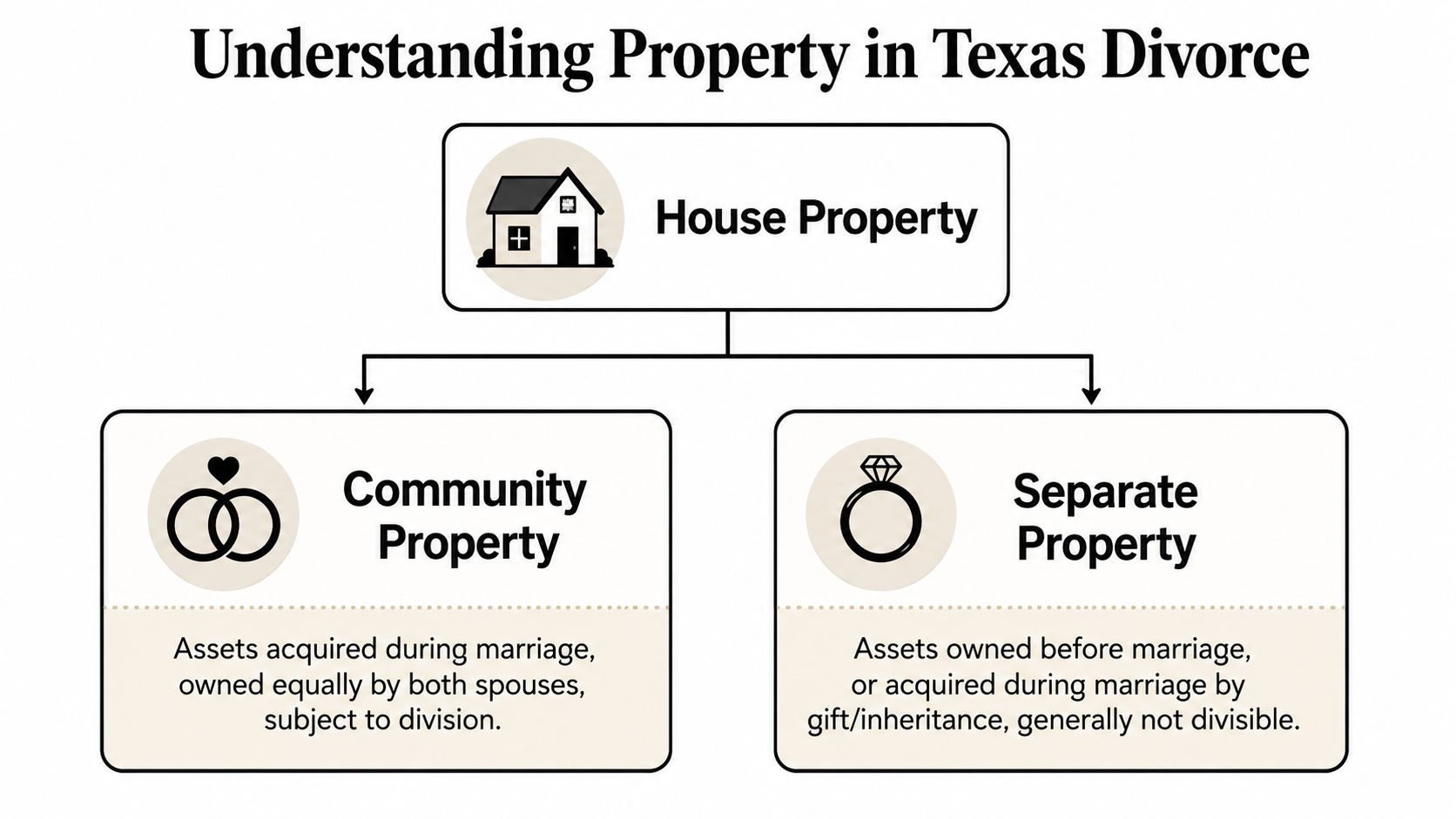
Texas follows community property rules. The easiest way to think about it is this: property acquired during the marriage usually goes into the marital pot, even if only one spouse handled the purchase paperwork. A house can feel personal, but the court starts with legal characterization, not emotion.
The basic rule that catches people off guard
A house bought during the marriage is generally presumed to be community property. That's true even if only one spouse's name appears on the deed. Texas Law Help notes that a property bought during marriage is presumed community property even if only one spouse is on the deed, so title alone is not a defense. That same guidance explains that the key legal question is whether clear evidence rebuts community status or proves separate-property tracing, and that if a decree orders transfer rather than sale, post-decree implementation often requires additional real estate paperwork.
That surprises many people in Harris County divorces. They assume the deed controls everything. It doesn't.
A simpler way to think about it
Use a shared-cart analogy. If the marriage is the shopping trip, items added during the trip usually belong in the shared cart. The house often falls into that category if it was acquired after the wedding.
Separate property usually means property one spouse owned before marriage, or property received during marriage by gift or inheritance. If the house falls into that bucket, the court's authority over it looks very different.
But many homes aren't cleanly one or the other. That's where disputes start.
Three issues that often decide the fight
When the property was acquired: Lawyers often talk about the "inception of title." In plain English, that means the court looks closely at when the ownership interest began.
Where the funds came from: If one spouse used inherited money for a down payment, that may support a separate-property claim or a reimbursement claim, depending on the facts.
What records still exist: Closing statements, mortgage documents, account records, and proof of the source of funds often make the difference between a strong claim and a weak one.
If you believe the house is separate property, documents matter more than assumptions. Judges don't sort this out based on memory alone.
Why tracing matters
"Tracing" sounds technical, but the idea is straightforward. You are showing the court where the money came from and why that source changes how the house should be treated. If a spouse had money before the marriage and used it toward the house, the issue may not be solved by saying, "I paid for it." The court wants records that connect the dots.
That can be especially important in Humble-area cases where the house was purchased during marriage but one side says the initial funds were separate. Without paperwork, a judge may stick with the community-property presumption.
What works and what doesn't
What works:
- Organized records: closing disclosures, bank records, loan statements, and proof of inherited or gifted funds.
- A clear timeline: when the house was bought, when payments were made, and who paid them.
- A realistic legal theory: either separate-property tracing, reimbursement, or a community division argument.
What usually doesn't work:
- Relying on the deed alone
- Assuming verbal family understandings control
- Waiting until the end of the case to gather financial records
Characterization is the foundation. If the home is community property, a judge has far more room to divide it, award it, or order a sale. If it is separate property, that changes the strategy dramatically.
How Texas Homestead Laws Impact a Forced Sale
Texas gives strong protection to a homestead. That's one reason people often believe a divorce judge can't touch the house. The problem is that this belief is only partly true.

Homestead protection is real, but not absolute
The Texas Constitution generally protects a homestead from forced sale except in limited circumstances. In divorce cases, though, the court is working inside a different framework. The question isn't whether the house is protected from creditors. The question is whether the court can divide community property in a just and right way.
Guerrero Law's discussion of forced sale or buyout in divorce explains that in Texas divorce cases, a court can force a house sale only within the property-division framework and subject to homestead limits. It ties that authority to Texas Family Code Section 7.001 and notes that a judge is more likely to order sale when the home is community property, neither spouse can refinance or buy out the other, and sale is the only workable way to equalize equity.
That is the practical tension many families miss. Homestead law is powerful, but it doesn't block every court-ordered sale in a divorce.
Where people get confused
Many homeowners mix together two different ideas:
- Protection against general creditors
- Division of marital property in a divorce
Those are not the same thing. A divorce court can't treat the house like a checking account and liquidate it for any reason. But it can address the home as part of dividing the marital estate.
One important distinction comes from a Texas case often cited in this area, Brock v. Brock, which is commonly used to show that a divorce court cannot force the sale of the marital homestead just to pay unsecured creditors such as credit cards. That matters because it separates a valid property-division sale from an improper forced liquidation for general debt.
A practical side issue also matters here. If you're still trying to understand how Texas treats a home as a protected residence outside the divorce setting, these homestead tax savings tips can help clarify the broader homestead concept many homeowners hear about before they ever speak with a divorce lawyer.
What timing changes
The strongest arguments about keeping the house usually need to be ready before the final decree. If you want to stay in the home, waiting until the last hearing to say, "I'll figure out the refinance later," usually isn't enough.
The better approach is to show the court a workable plan:
- Refinance capacity: evidence that a lender may approve you on your own
- Buyout structure: a practical proposal for the other spouse's share
- Possession plan: who stays in the house and who pays what until transfer or closing
A judge is more receptive to a concrete plan than a hope. If the math doesn't work, homestead language usually won't rescue the argument.
For families in Humble, Atascocita, and Kingwood, this is often where the case turns from emotional to financial. The court isn't deciding whose memories matter more. It's deciding whether one spouse can carry the house or whether sale is the only clean solution.
When Will a Harris County Judge Order a Sale?
A Harris County judge serving families from Humble and Northeast Houston isn't asking whether the home is emotionally important. That's assumed. The court is usually trying to answer a narrower question. Is selling the house the most workable way to divide this part of the estate?
Under the Texas State Law Library's explanation of divorce issues after the decree, Texas Family Code Section 7.001 allows the court to make a just and right division of community property at the final divorce decree, and the decree may order a house sold and specify how the proceeds are split. That same guidance notes that property division enforcement actions generally must be filed within 2 years of the final decree.
The checklist many judges effectively use
A judge may not say these exact words, but these are the practical issues that often drive the result:
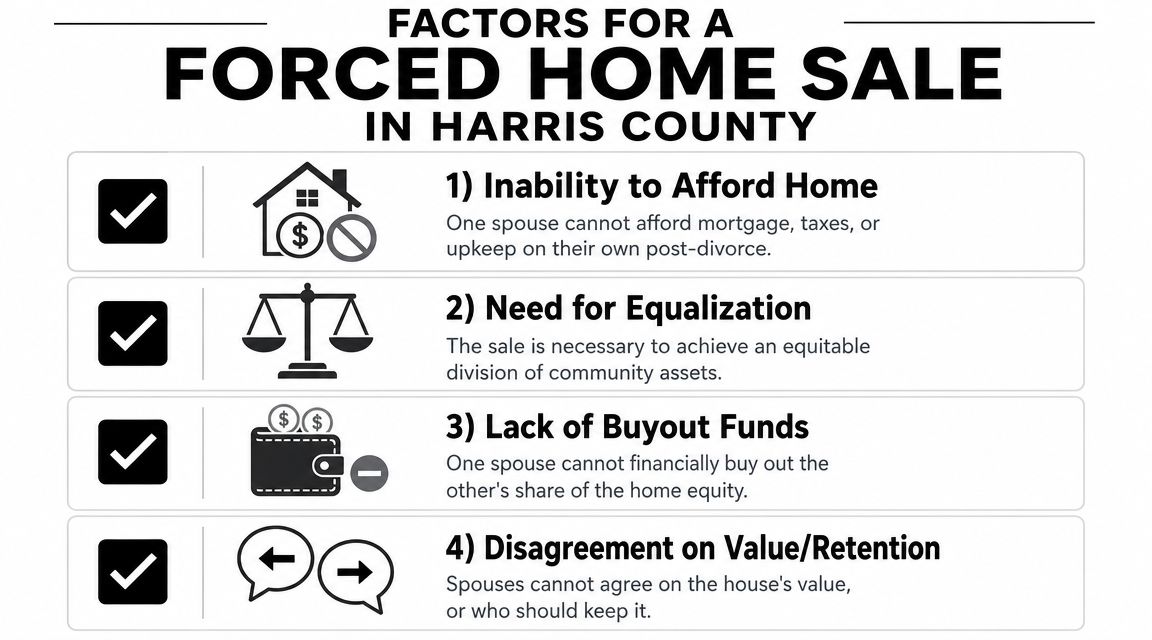
- Can one spouse afford the home alone? The court looks for realistic ability to handle mortgage payments, taxes, insurance, and upkeep after divorce.
- Is there a workable buyout plan? A spouse who wants the house usually needs more than desire. The judge wants a practical path to compensate the other spouse.
- Is the home the main source of equity? If the house is the major marital asset, a sale may be the simplest way to divide value.
- Will ongoing co-ownership create more conflict? If the parties can't agree on basic property issues, keeping them tied together through real estate often creates new litigation.
What persuades the court
If you want to avoid a sale, bring the court usable information. In many cases, the strongest presentation includes:
| Issue | Helpful proof |
|---|---|
| Ability to keep the house | pay stubs, tax returns, lender communication, budget |
| Equity division | proposed buyout amount and how it will be funded |
| Practical transition | draft possession plan and timeline |
| Property characterization | records supporting community or separate claims |
Judges in Harris County see plenty of vague promises. "I'll refinance soon" is not the same as showing current income, debt load, and a proposed deadline.
Children matter, but they don't decide everything
Parents often ask whether having minor children means the court will let one spouse stay in the home. Sometimes stability for children supports that result. But it isn't automatic. If the house isn't affordable, the court may still decide that a sale is necessary.
That can be especially true when the mortgage is high, the equity must be divided, or the spouse seeking the house can't remove the other from financial liability.
Courts often prefer solutions that can actually be completed. A plan that preserves the children's bedrooms but leaves both spouses trapped on a loan may not be seen as stable at all.
A local reality many people underestimate
Contentious cases often push judges toward cleaner outcomes. If both spouses are already fighting over access, repairs, listing terms, or payments, the court may view continued entanglement as unworkable. A sale can end recurring disputes in a way co-ownership rarely does.
That doesn't mean a sale is always likely in Humble or Kingwood divorces. It means your strategy should match how judges think. If you want to keep the house, show the court why that option is feasible. If you can't, it may be smarter to shape the terms of a sale than to resist one unsuccessfully.
Exploring Your Options Buyout vs Court-Ordered Sale
For most divorcing homeowners in Humble and surrounding parts of Harris County, the path usually narrows to two options. One spouse keeps the home and compensates the other. Or the home is sold and the net proceeds are divided under the decree.
Neither option is perfect. Each solves one set of problems and creates another.
Comparing a Home Buyout vs. a Sale in a Texas Divorce
| Factor | Home Buyout (Owelty Lien/Refinance) | Court-Ordered Sale |
|---|---|---|
| Living stability | One spouse may remain in the home | Both spouses prepare to move |
| Children's routine | Can preserve school and neighborhood continuity | May require a larger household transition |
| Mortgage liability | Usually requires refinance to separate liability | Mortgage is paid through closing process |
| Cash needs | Requires funds or financing for buyout | Equity is realized through sale proceeds |
| Future entanglement | Risk remains if refinance or transfer stalls | Often creates a cleaner break |
| Emotional cost | Home is kept, but financial pressure may increase | Emotional loss may be greater, but so is finality |
| Repair and listing issues | Fewer sale-prep issues if transfer is smooth | Parties may dispute repairs, price, and showings |
When a buyout works best
A buyout is often the preferred option when one spouse has the income to carry the house and there is a realistic way to compensate the other spouse for their share. In Texas, courts commonly resolve a marital home by awarding it to one spouse with an offsetting buyout or an owelty lien.
An owelty lien is a legal tool often used when one spouse keeps the house and the other spouse's equity interest must be secured as part of the division. The exact structure depends on the decree and the financing plan.
A buyout tends to work better when:
- The spouse keeping the home qualifies for refinance
- The equity amount can be valued without endless dispute
- Other assets can help offset the division
- Both parties want to minimize disruption for children
The downside is obvious. Keeping a house after divorce can become a burden if the payment is too high or if repairs were already hard to manage during the marriage.
When a sale is the better answer
A sale often makes more sense when neither spouse can afford the house alone, when refinance is unlikely, or when the relationship is too strained for any ongoing cooperation. Selling can also be the least risky option when the home needs work and no one has the cash to both buy out a spouse and fund repairs.
If the property needs attention before listing, some homeowners look for practical guidance on how buyers and investors approach houses that aren't move-in ready. This overview of how to sell house fast despite repairs may help you think through the practical side of a sale during divorce.
Trade-offs that matter in real life
The emotional argument for keeping the home is often strong. The financial argument may not be.
A spouse may love the neighborhood, want the children in the same schools, and feel that moving would be one more loss. But if the numbers don't support ownership after divorce, keeping the home can create a second crisis months later.
On the other hand, a sale can feel abrupt and painful, yet it may provide a clean reset. Mortgage debt is paid off through closing. The parties divide what remains under the decree. And each person can move forward without future disputes over who pays for the roof, insurance, or missed mortgage notices.
The best outcome usually isn't the one that feels good in the moment. It's the one that remains workable after the decree is signed.
Proactive Steps to Help You Keep Your Home
A spouse who wants to keep the house in a Harris County divorce needs more than a sincere reason. In practice, the stronger position belongs to the person who can show how the house will be kept, paid for, and transferred without creating more conflict later.
That starts early. In Humble and Atascocita cases, I often see outcomes shift because one spouse prepared before mediation or temporary orders instead of waiting until the final hearing.
Start with the monthly reality
The first question is simple. Can you carry this house on your own after the divorce is final?
That means reviewing the full cost of ownership, not just the mortgage payment. Property taxes in this area can be substantial. Insurance premiums change. Older homes in Kingwood and nearby neighborhoods may bring deferred maintenance, foundation concerns, or roof issues that were manageable with two incomes and much harder with one.
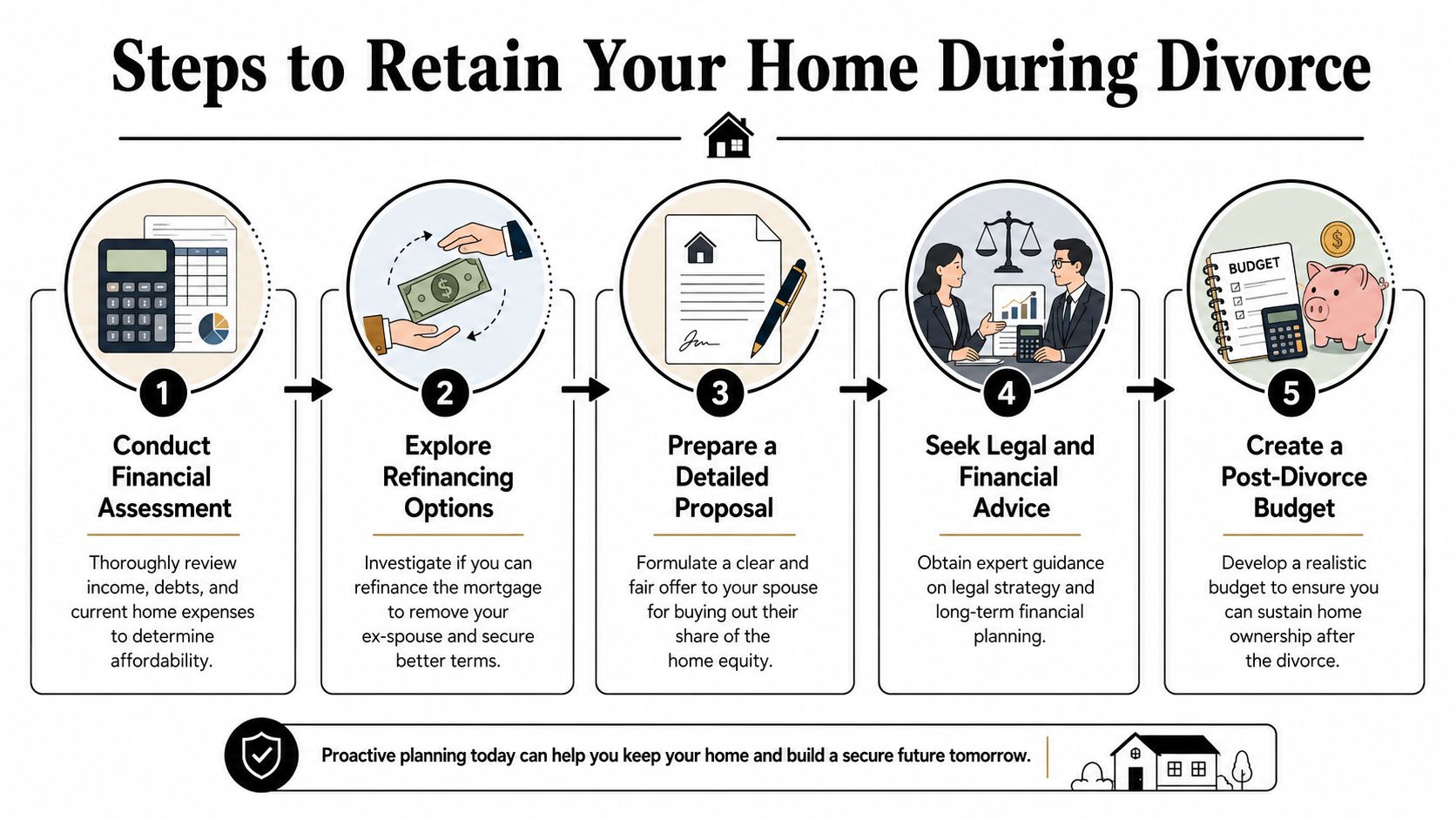
A written budget carries more weight than a promise that things will work out. Judges, mediators, and opposing counsel want specifics.
Steps that improve your chances of keeping the home
Speak with a lender before making demands in settlement talks.
Find out whether you can refinance into your sole name, remove your spouse from liability, or qualify after support obligations and debt are factored in.Collect documents before anyone asks for them.
Keep mortgage statements, recent pay stubs, tax returns, insurance declarations, HOA records, and repair estimates together. Good records make negotiations faster and more credible.Prepare a realistic buyout plan.
If your spouse has equity in the home, explain how and when that share will be paid. The proposal may involve cash, retirement offsets, or other property.Address the transition period.
Spell out who will pay the mortgage, taxes, insurance, and utilities while the divorce is pending and until refinance or transfer is complete.Get clear about your separate-property or reimbursement claims.
If you used separate funds for the down payment, major repairs, or principal reduction, gather proof now. Waiting too long often weakens a good claim.
Mediation often decides what happens to the house
Many families keep more control in mediation than they would in a courtroom. A negotiated agreement can include deadlines, refinance terms, temporary occupancy rules, and a backup sale procedure if the buyout falls through. Courts can approve that kind of practical structure, and it often serves families better than leaving every detail for a judge to sort out.
That matters in real life. Children may need stability through the school year. One spouse may need a short window to improve credit or line up financing. The other spouse may agree to wait if the decree includes protections against missed payments or delay.
Build a proposal the court can rely on
A strong plan usually includes these points:
- Confirmation that financing has been explored
- A timeline for refinance, assumption, or sale if refinance fails
- A monthly budget based on actual household expenses
- A clear method for paying the other spouse's share
- Documents supporting any reimbursement or separate-property position
Some families also benefit from working with counsel who regularly handles Texas property division disputes. The value is not in making bigger promises. It is in turning a wish to keep the home into terms a court can enforce.
The spouse with the stronger house claim is often the one who shows up with records, deadlines, and a payment plan that makes sense.
For families in Humble, Kingwood, and Atascocita, preparation changes the tone of the case. It turns an emotional request into a workable proposal.
Protecting Your Home and Your Future in Humble
The answer to can you be forced to sell house in divorce Texas is yes, but only in a specific legal setting. A judge can order a sale as part of dividing the marital estate. That decision isn't random, and it isn't based on who argues louder. It turns on characterization, affordability, equity, and whether a practical alternative exists.
The final decree matters more than many people realize. If a decree orders a house sale and one spouse refuses to cooperate, Texas family courts can enforce that order by appointing a receiver to complete the transaction. That same discussion also highlights why courts cannot typically order a home sold just to pay unsecured debts like credit cards, which is one reason the decree must be drafted carefully.
For local families in Humble, Kingwood, Atascocita, and Northeast Houston, the primary goal isn't just avoiding a forced sale. It's reaching a result you can live with after the divorce is over. Sometimes that means keeping the home. Sometimes it means negotiating a sale on terms that protect your equity and reduce conflict.
Good planning changes outcomes. So does getting advice early, before positions harden and options narrow.
Common Questions About the Marital Home in a Texas Divorce
Can my spouse force me to sell the house before the divorce is final
Usually, not just because they want to. The sale issue is generally decided through the property division process in the final decree. During the case, temporary orders may address possession, payment responsibilities, or use of the home, but that isn't the same as a final court-ordered sale.
What if my name isn't on the deed
That doesn't automatically mean you have no claim. In Texas, title alone doesn't settle whether a house is community or separate property. If the home was acquired during marriage, the court may treat it as part of the community estate unless strong evidence proves otherwise.
Can I change the locks while the divorce is pending
Don't do that without legal guidance or a court order. Lock changes can create immediate conflict and may violate existing orders or provoke emergency court action. If safety is an issue, address that directly through your attorney and the court.
Who pays the mortgage during the divorce
That depends on temporary agreements, temporary orders, and practical reality. The court may assign responsibility, but the lender doesn't care about the divorce dispute. If payments are missed, both spouses tied to the loan may feel the effects.
What happens if my ex refuses to cooperate after the decree says the house must be sold
Courts can enforce the decree. Depending on the wording of the order and the facts, enforcement tools may include sanctions, motions to enforce, or appointment of a receiver to complete the sale process.
If I want to keep the home, what should I do first
Start with proof, not preference. Gather financial records, speak with a lender, build a budget, and identify how you would buy out the other spouse if necessary. In many cases, the spouse with the clearest plan has the strongest position.
If you're facing divorce and worried about your house in Humble, Atascocita, Kingwood, or Northeast Houston, legal advice customized to your specific facts can make a major difference. The Law Office of Bryan Fagan offers free consultations through our Humble office, and we can help you understand your options, evaluate whether a buyout is realistic, and protect your interests before the final decree decides the future of your home.