Skip to content

If you're staring at a stack of credit card statements while trying to figure out divorce, you're not alone. A lot of people in Humble, Atascocita, Kingwood, and Northeast Houston assume the hardest part is deciding who keeps the house or how parenting time will work. Then the card balances show up, and suddenly the question becomes much more personal: Who is going to pay this, and what happens if they don't?
That question matters because divorce and credit card debt texas issues aren't just about fairness between spouses. They're also about your credit, your ability to rent or buy a home later, and whether a creditor may still call you after the divorce is over. The judge's order matters. But so does the contract you signed with the credit card company.
The good news is that this area of Texas law can be understood if you take it one piece at a time. Once you know how courts classify debt, how judges divide it, and what creditors can still do afterward, the situation starts to feel less like chaos and more like a problem you can manage.
Understanding How Texas Views Marital Debt
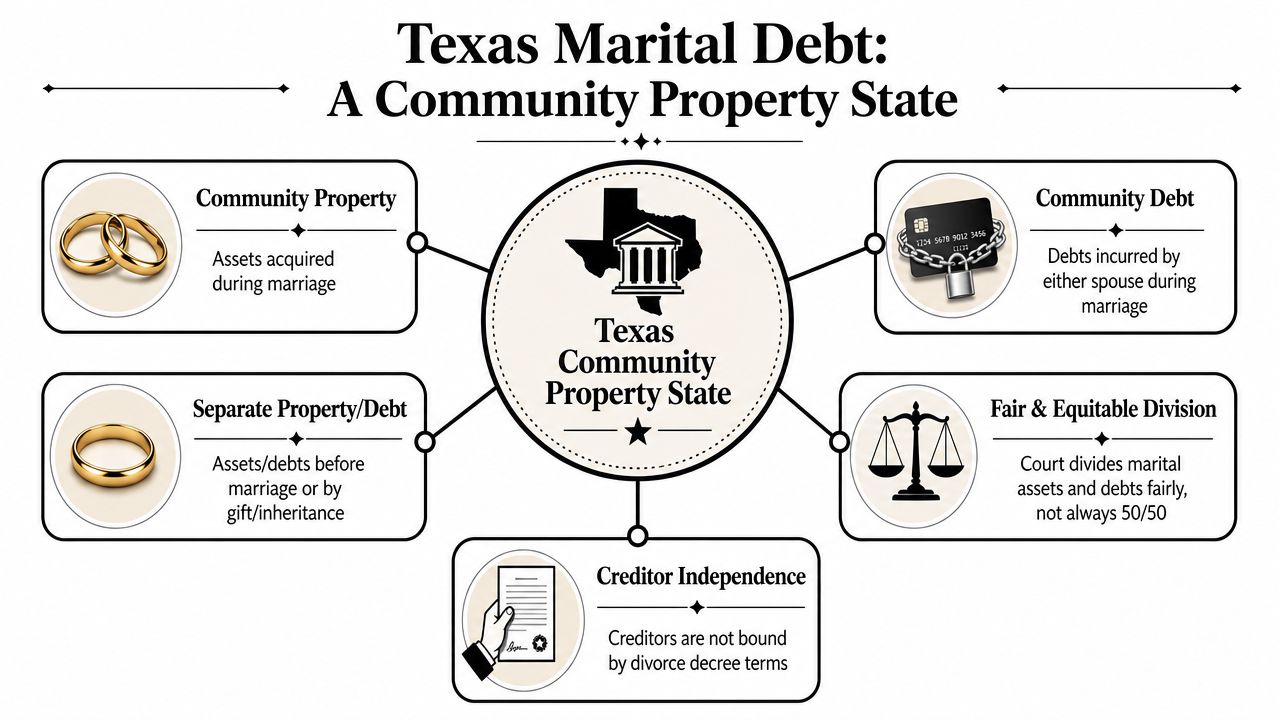
Texas treats marriage as a financial partnership. That idea sits underneath a lot of divorce law, and it helps explain why debt can become a shared issue even when only one spouse used the card.
A simple way to think about it is this. During the marriage, most income, purchases, and obligations go into a shared household financial pot. If that pot paid for groceries, school clothes, repairs, medical bills, or family travel through a credit card, the debt often gets looked at as part of the marriage too.
Texas is one of 9 U.S. community property states, and debts incurred during the marriage are generally treated as shared obligations even if only one spouse's name appears on the account, as explained in Experian's discussion of divorce and credit card debt.
The shared pot idea
That doesn't mean every debt is automatically split down the middle. It means the law starts from the idea that marriage creates shared financial consequences.
For many families in Humble, that comes as a surprise. One spouse may say, "That card is only in your name." The other may respond, "Yes, but we used it for the family." In Texas, that second point often matters a great deal.
If you want a fuller picture of how courts approach this issue, our page on Texas divorce property division gives more local context for Harris County families.
Practical rule: If a card was used during the marriage for ordinary household life, don't assume the name on the statement settles the issue.
What usually stays separate
The shared pot doesn't include everything. Debt from before the marriage is usually treated differently. So are certain obligations tied to separate circumstances.
That distinction matters because people often combine old and new charges on the same account over time. A card may have started before the wedding, then later been used for family expenses after the marriage. When that happens, the timing and purpose of the charges become important.
Three basic questions usually help people make sense of the mess:
- When was the debt created: Before marriage, during marriage, or after separation?
- What was the money used for: Household needs, family spending, or one person's personal use?
- Who benefited from it: The family unit, one spouse, or neither in a clear way?
Those questions don't answer every dispute, but they give you a strong starting point. And when emotions are high, having a starting point matters.
Distinguishing Community Debt from Separate Debt
Most divorce debt disputes come down to sorting. Not arguing first. Sorting first.
When I talk with families in Kingwood or Atascocita, I usually suggest they stop looking at "all debt" as one big lump. Break it apart account by account, and sometimes charge by charge. That's often where confusion starts to clear.
The two buckets that matter
Community debt usually means debt tied to the marriage. Separate debt usually means debt that belongs to one spouse alone. But real life is messy, so the same account can contain both types of issues.
Here is a simple working chart:
| Type of Debt | Likely Classification | Example |
|---|---|---|
| Credit card used for groceries during marriage | Likely community debt | A Visa used for H-E-B runs and school supplies in Humble |
| Home improvement card opened during marriage | Likely community debt | A Home Depot card used for roof or plumbing repairs on the marital home |
| Credit card balance from before the wedding | Likely separate debt | One spouse entered the marriage already carrying a personal card balance |
| Personal spending after separation | Potentially disputed | One spouse uses a card for nonessential solo travel after moving out |
| Card used for undisclosed luxury purchases | May be treated differently by the court | Charges for hidden spending that didn't benefit the household |
Texas doesn't require a mandatory equal split. Texas follows a "just and right" division standard, and courts may weigh income disparity, spending behavior, and whether a debt was incurred for family necessities or unilateral luxury spending, as described in Sandoval Family Law's discussion of debt in divorce.
Why timing and purpose matter
A pre-marriage student loan is often easier to identify as separate. A joint hardware-store card used to fix a leaking water heater during the marriage looks very different. So does a card one spouse secretly used for personal luxury spending that never helped the family.
That's why your documents matter more than your memory. Judges and mediators usually need something concrete to work from.
Helpful records include:
- Monthly statements: These show dates, merchants, and patterns.
- Receipts or account notes: These can help explain whether a charge was for the household.
- A written timeline: Mark when you married, when you separated, and when unusual spending started.
For a broader explanation of how this area works, our page on community property in Texas can help you connect the debt issue to the bigger property picture.
When spouses stop arguing about labels and start organizing records, they usually make better decisions in mediation.
A local example
Take a couple in Atascocita. One spouse has a card from years before the marriage. After the wedding, they use that same account for groceries, a family appliance purchase, and a child's camp fee. Later, after separation, one spouse adds a string of personal entertainment charges.
That's no longer a simple "my card" or "your card" issue. It's a mixed record. The older balance may be treated one way, the family spending another way, and the later personal charges another way still.
Why Your Divorce Decree Does Not Bind Creditors
This is the point many people miss, and it's the one that causes some of the worst surprises after divorce.
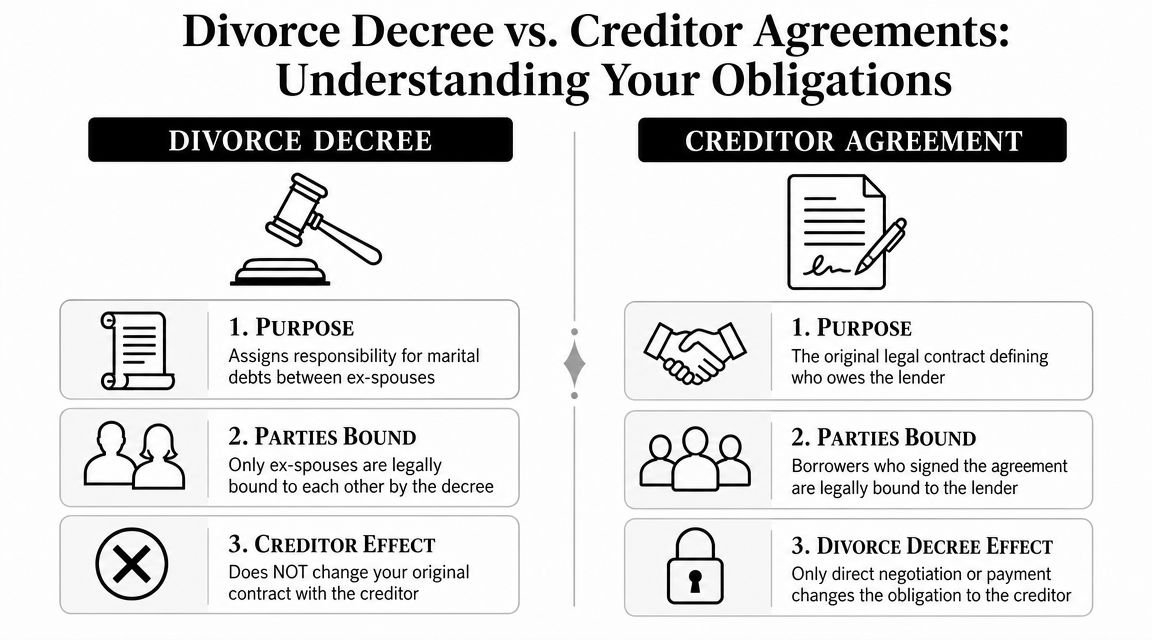
A divorce decree is a court order between you and your former spouse. A credit card agreement is a contract with the lender. Those are not the same thing.
The court can assign responsibility, but not rewrite the contract
A divorce decree can allocate responsibility between spouses, but it cannot rewrite the underlying contract with the credit card issuer. Creditors are not bound by the divorce order if both spouses are legally liable on the account, as explained in McNamara Lawyers' discussion of credit cards in divorce.
That means a judge may say your ex must pay a certain joint card. But if your name is still legally tied to that account, the lender may still pursue you if payments stop.
Here's the distinction. The family court can decide who should carry the backpack after the divorce. The bank still looks at who signed for the backpack in the first place.
Here's a short video that helps frame the issue in practical terms:
Why this catches people off guard
A lot of divorcing spouses breathe a sigh of relief when they see a debt assigned to the other person in the final papers. I understand why. It feels resolved.
But if the account remains joint, the lender didn't agree to your divorce terms. The lender agreed to the original credit contract.
That creates two separate realities:
- Internal responsibility: What the decree says you and your ex must do.
- External liability: What the creditor may still do based on the account agreement.
Your decree may protect you in court against your ex. It doesn't automatically protect you from the bank.
What this means in real life
For families in Humble and Northeast Houston, this issue often shows up months later. An ex misses a payment. Then the late notice appears on both credit files, or collection calls start reaching the spouse who thought the matter was finished.
That's why debt division isn't just about assigning a bill on paper. It's also about closing accounts, removing users, refinancing when possible, and making sure the paperwork matches the reality.
If you remember only one thing from this article, remember this: the divorce order and the creditor contract operate on separate tracks.
Steps to Protect Your Credit Before and During Divorce
Once you understand the gap between the decree and the lender, the next move is practical. You need to reduce exposure early.
This part doesn't require you to predict every outcome of the divorce. It requires you to gather information and stop preventable damage.
Your immediate checklist
Texas Law Help explains that credit card balances incurred during the marriage are generally treated as community debt, but the creditor's collection rights are independent of the divorce decree. That's why family-law practitioners often pair debt allocation with steps such as removing authorized users and freezing joint accounts in its guide to dividing property and debt in divorce.
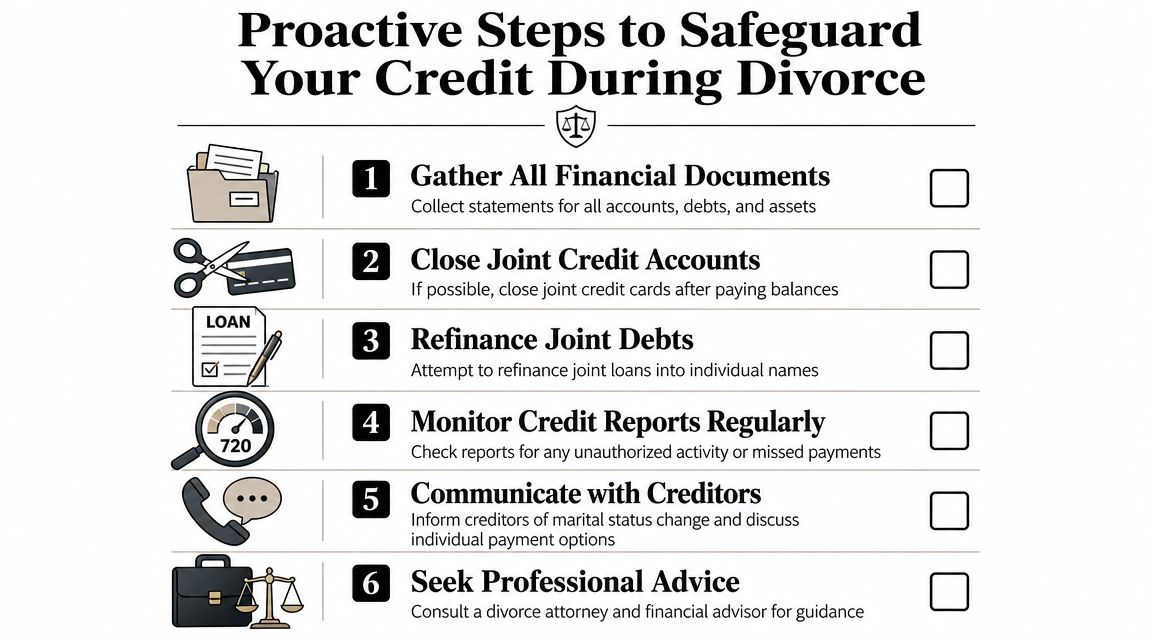
Start with these actions:
Pull your credit reports
You need to know every open account tied to your name. Many people discover store cards, old joint accounts, or authorized-user arrangements they forgot about.
Make a debt inventory
List each account, whose name is on it, the approximate balance, and whether the charges look marital, separate, or mixed.
Preserve statements
Download statements before passwords change or access disappears. If there are disputed charges, save the records now.
Remove authorized users where appropriate
If one spouse is only an authorized user, that status should be reviewed right away.
Freeze or close joint cards if possible
This can help stop new charges while the divorce is pending.
Communicate carefully
If you and your spouse can still have calm conversations, confirm in writing who is paying what during the case.
Why these steps matter
These tasks may feel administrative, but they are protective. They help your attorney argue classification, help you spot risk early, and help prevent a bad month from becoming a long credit problem.
If you're also working on improving your family's credit, it helps to understand how lenders view reliability, payment history, and open obligations. Divorce doesn't erase those factors, so managing them early can make life easier later.
For readers worried about property and financial exposure more broadly, our page on how to protect assets in a divorce may be useful alongside this debt checklist.
Next best step: Gather the records first. Decisions get better when the paperwork is in front of you.
Managing Debt and Creditors After the Divorce Is Final
The divorce is over. The papers are signed. Then a bill arrives that your ex was supposed to pay.
Legal theory encounters real life.
If your ex stops paying
Some divorce decrees assign a debt clearly, but the account itself never gets refinanced, transferred, or closed. That leaves a dangerous gap. One spouse thinks the matter is settled. The creditor still sees an open contractual obligation.
An often-missed question is not just who gets assigned the debt in the decree, but what happens when the creditor still pursues the non-signing spouse after divorce. That is why refinancing, balance transfers, or formal account closure can be critical post-divorce actions, as discussed in Haugen Law Firm's article on debt in Texas divorce.
If your ex defaults, focus on two tracks at once:
- Deal with the creditor problem quickly: Find out whether your name is still attached and what options exist for payoff, transfer, or account closure.
- Review your decree for enforcement options: Your decree may include remedies if the other spouse fails to do what the court ordered.
Practical options that may help
Not every option fits every family, but these are the most common paths people discuss after divorce:
- Refinancing into one name: This is often the cleanest fix when it works.
- Balance transfer: Sometimes a spouse can move a debt to an account solely in that spouse's name.
- Formal account closure: Closing the account can prevent new charges, though it won't erase an existing balance.
- Indemnity language in the decree: This can provide a legal basis to seek reimbursement or enforcement if the other spouse doesn't pay as ordered.
The calm response matters
When collection calls start, people often freeze or assume the creditor will eventually realize the divorce decree exists. That's usually not a safe assumption.
Instead, gather:
- The final decree
- Recent statements
- Any notices of missed payment or collection activity
- Written communication with your ex about the debt
Then talk to a family law attorney about enforcement and to the lender about account status. Those are different conversations, and both matter.
A missed payment after divorce can create two problems at once. A creditor issue and a court-enforcement issue.
How a Humble Divorce Attorney Can Help with Your Debt
A lot of people reach this stage after the divorce papers are drafted and think the hard part is over. Then practical questions start. Why is your credit score dropping if the decree says your ex was supposed to pay that card? Why is a collector calling you about an account the judge assigned to someone else?
That gap between the court order and the credit card company's rights is where legal help often matters most.
A Humble divorce attorney can help you sort out which debt problems belong inside the divorce case, which problems need direct action with the lender, and which ones may require enforcement after the divorce is final. That distinction saves people from wasting time on the wrong fix. A decree can divide responsibility between spouses, but it does not rewrite the contract you signed with a creditor.
An attorney also helps build the paper trail. In debt disputes, details matter. Statements, account applications, payment histories, business records, and spending patterns can change how a debt issue is presented in mediation or in court. If one spouse handled all the money, mixed business and personal charges, or kept cards hidden, your lawyer can help pull those facts into a clear timeline that makes sense to a judge.
Local context matters too. Families in Humble, Atascocita, Kingwood, and nearby parts of Harris County often need advice that fits daily life after divorce, not just legal theory. The question is usually not only who should pay. It is also how to lower the chance of late notices, collections, account misuse, and credit damage while you are trying to keep up with rent, groceries, child-related expenses, and a second household.
Some cases also call for a wider financial plan. If the debt load is bigger than either spouse can realistically manage, it may help to read BDJ Express Law on bankruptcy for debt. Bankruptcy and divorce are separate areas of law, but they can affect each other in ways that need careful timing.
The Law Office of Bryan Fagan handles Texas family law matters, including divorce, property division, and related financial issues. For someone dealing with large credit card balances, disputed charges, or concern that an ex will not follow the decree, early legal advice can help you avoid mistakes that are expensive to fix later.
Frequently Asked Questions About Divorce and Debt
What if I discover hidden credit card debt during the divorce
Bring the statements and any account records to your attorney immediately. Hidden or concealed spending can affect how a court views responsibility for that debt, especially if the spending didn't benefit the household.
Does a credit card in only one spouse's name always belong to that spouse
No. The account name matters, but it doesn't automatically settle the question in a Texas divorce. Timing, purpose, and who benefited from the charges often matter too.
What about business credit card debt
That can get complicated quickly. If the card was used for both business and personal expenses, sorting it out usually requires close review of statements and supporting records.
Should I consider bankruptcy after divorce if the debt is too much
Maybe, but that's a separate legal analysis. Family law and bankruptcy can affect each other, so it's wise to get advice before making major decisions.
What should I bring to a consultation
Bring credit card statements, your credit report, any list of joint debts, your divorce paperwork if already filed, and notes about who made which charges and when.
If you're dealing with divorce and credit card debt in Texas, you don't have to sort it out alone. The team at Law Office of Bryan Fagan works with individuals and families in Humble, Atascocita, Kingwood, and Northeast Houston who need clear answers about debt, divorce, and protecting their financial future. Schedule a free consultation with our Humble office to talk through your situation and your next steps.