Divorce often starts with paperwork, deadlines, and hard conversations. But for many people in Humble, Kingwood, and Atascocita, there's another problem sitting in the background. Something about the money doesn't add up.
Maybe your spouse suddenly says the business is struggling, even though spending at home never changed. Maybe statements stopped coming to the house. Maybe a retirement account you remember hearing about no longer appears in the financial documents. That uneasy feeling matters. In a Texas divorce, financial secrecy can change the outcome of property division in a serious way.
If you're searching for what happens if spouse hides money in divorce texas, you're probably not looking for abstract legal theory. You want to know what the court can do, what you should gather, what mistakes to avoid, and whether there's still a remedy if the truth comes out late. That's especially true for families moving through the Harris County system, where deadlines, disclosure, and credibility can shape everything from temporary orders to the final decree.
In my experience, people often second-guess themselves at the start. They worry they'll sound paranoid or vindictive if they raise concerns about hidden money. Usually, the better approach is simple. Stay calm, get organized, and let documents do the talking.
Residents across Northeast Houston face this issue in different forms. A spouse may underreport cash income, move funds to a relative, delay bonuses, hide business value, or build up accounts the other spouse never sees. Texas law gives courts tools to respond when that happens, and those tools matter.
The process itself can also feel overwhelming. If you're just beginning, this guide on how to start a divorce in Humble Texas can help you understand the first steps before the financial investigation begins.

Introduction A Gut Feeling in Humble Something Isn't Right
A lot of divorce cases don't begin with one dramatic discovery. They begin with small things that feel off.
One spouse becomes unusually defensive about online banking. Tax returns are suddenly hard to find. A business owner starts saying the company has no value, even though it paid for family trips, vehicles, or private school. In Humble and nearby communities like Atascocita and Kingwood, those facts show up in real households, not just courtroom stories.
Practical rule: If your spouse controlled most of the finances during the marriage, lack of information is not the same thing as lack of assets.
That distinction matters. Texas courts expect honesty about community property, and a spouse who conceals money can face consequences that go well beyond embarrassment. The issue is not whether you can prove every suspicion on day one. The issue is whether there are enough warning signs to justify careful investigation.
What people usually notice first
Most clients don't walk in saying, “I found a hidden account.” They say things like:
- Missing records: Statements, passwords, or tax documents have become harder to access.
- Strange transfers: Money moves between accounts with no household explanation.
- Changed routines: A spouse who never cared about bookkeeping suddenly watches every transaction.
- New secrecy: Mail is redirected, devices are locked down, or financial apps are removed.
- Business confusion: Income seems lower on paper than the lifestyle you both lived.
Those patterns don't automatically prove fraud. But they often justify a closer look, especially in Harris County divorces involving businesses, commissions, cash income, or complex accounts.
Why your concern deserves attention
Many people try to keep the peace and assume the truth will come out on its own. Sometimes it does. Sometimes it doesn't. Hidden money cases usually turn on timing, documents, and how quickly your legal team acts once questions appear.
For families in Northeast Houston, local reality matters too. Some cases involve closely held businesses, side work, oil and gas interests, investment accounts, or family transfers that aren't obvious from one paycheck stub. A court can address those issues, but only if someone raises them with enough detail and support.
The Foundation of Texas Divorce Community Property and Fiduciary Duty
Texas treats most property acquired during marriage as part of the marital estate. That starting point shapes nearly every hidden asset dispute. If a spouse earned it, bought it, or built it during the marriage, there is usually a strong reason to ask whether it belongs in the property division.
Texas is a community-property state, which means assets acquired during marriage are generally subject to division upon divorce. When concealment is proven, courts can respond by shifting a larger share of the community estate to the innocent spouse, and Texas law also allows a post-divorce suit to divide “undivided property” if hidden assets are discovered after the decree, provided the property existed during the marriage and was not properly disclosed, as explained in this discussion of hiding assets in a Texas divorce.
Think of the marriage estate as a shared jar
A simple way to understand community property is to think about a shared family jar. During the marriage, paychecks, savings, business growth, and many investments go into that jar. At divorce, the court's job is not to rely on one spouse's memory or goodwill. The court needs a truthful picture of what's inside.
That doesn't mean every asset is automatically split down the middle. Texas courts divide community property in a manner the judge considers just and right. But the judge can't do that fairly if one spouse keeps scooping things out of the jar and pretending they were never there.
If you need a basic primer before digging deeper, this page on community property in Texas gives a useful overview for local families.
Why honesty is more than a personal obligation
Spouses also owe each other duties of fairness when dealing with community property. In practice, that means a spouse can't secretly transfer, waste, or conceal marital assets and then expect the court to shrug it off as aggressive divorce behavior.
That's why hidden money cases often overlap with concerns about spotting financial misconduct. If you want a broader explanation of how dishonesty in financial relationships can work, this article on spotting financial misconduct gives helpful context outside the divorce setting.
A spouse who hides money usually creates two problems at once. The missing asset itself, and a credibility problem that affects the whole case.
What works and what doesn't
Some people assume they should wait until they have airtight proof before saying anything. That usually doesn't work. Hidden asset cases are often built through a pattern of inconsistencies, then confirmed through formal discovery.
What does work is a focused review of records, a clear timeline, and careful attention to property that existed during the marriage. The strongest claims often involve one of these situations:
- Accounts that existed but weren't disclosed
- Business income that appears reduced without a clear reason
- Property transferred to friends or family before filing
- Cash withdrawals or unusual payments
- Investments or digital assets that don't match sworn disclosures
The legal system in Texas treats this as a property-division issue with real remedies. That gives suspicious spouses something important. A path forward rooted in records, not guesswork.
Uncovering the Truth How to Find Hidden Assets in Your Divorce
Finding hidden money usually starts with careful observation. You compare what your spouse says with what the documents show. Then, if the case requires it, your attorney uses formal tools that force answers and produce records.
Harris County courts see both simple and complicated versions of this problem. Some cases involve one missing savings account. Others involve a small business, multiple payment apps, contract income, or property placed in someone else's name.
Start with informal discovery at home
Before subpoenas and sworn testimony, there is basic detective work you can do lawfully and carefully. The goal is not to hack accounts or break privacy laws. The goal is to preserve information you already have legitimate access to and organize it in a way your lawyer can use.
Look for patterns across:
- Tax returns: W-2s, 1099s, interest income, dividends, capital gains, and business schedules can reveal accounts or revenue streams.
- Bank and credit card statements: Repeating transfers, unknown account numbers, and unusual cash withdrawals often matter.
- Loan applications: People are often more complete when applying for a mortgage or credit than when filling out divorce paperwork.
- Mail and email notices: Investment confirmations, bonus notices, or banking alerts may point to hidden assets.
- Business records: Profit-and-loss statements, payroll records, vendor payments, and expense reimbursements may tell a different story than your spouse's summary.
If the documents are overwhelming, even basic organization helps. Some clients export transactions into spreadsheets so patterns are easier to sort and compare. A tool like AI bank statement conversion can be useful for turning statements into something searchable before an attorney or accountant reviews them.
Common red flags of hidden assets
| Red Flag | What it Could Mean |
|---|---|
| Large cash withdrawals | Funds may be moved off the books or held outside normal accounts |
| Transfers to relatives or friends | Property may be parked temporarily to avoid division |
| Income suddenly drops before divorce | A spouse may be delaying payments or underreporting earnings |
| Missing pages from statements | An account, transfer, or payment may be intentionally concealed |
| New business expenses that don't make sense | Personal spending may be disguised as company costs |
| Unexplained debt claims | A spouse may be inventing liabilities to shrink the estate |
| App-based payment activity | Money may be moving through less obvious channels |
Formal discovery creates pressure
Once the case is filed, your attorney can use formal discovery tools. These matter because hidden asset cases often turn when a spouse must commit to a position in writing or under oath.
Here's what those tools commonly do:
Interrogatories ask written questions that require sworn answers. They can pin down where money was held, whether transfers occurred, and who has access to specific accounts.
Requests for Production require documents. These may include statements, tax records, business books, contracts, deeds, or account opening records.
Depositions let attorneys ask questions under oath, in person or by remote appearance. Depositions are useful when a spouse's explanations keep changing.
Subpoenas go directly to banks, employers, or third parties. They help when you suspect records won't be handed over voluntarily.
Hidden money is often uncovered when two documents that should match do not match. A tax return may point to an account omitted from an inventory. A bank statement may show transfers to an institution never disclosed.
When a business is part of the problem
Small business cases in Humble and Northeast Houston need special attention. Owners can blur personal and business spending, postpone receivables, run family expenses through the company, or carry value that doesn't appear in a simple bank balance.
If your spouse owns or controls a company, this guide to divorce involving a small business in Humble Texas is a useful starting point.
In more complex cases, attorneys may involve a forensic accountant. That kind of expert can trace funds, review ledgers, compare reported income to actual cash flow, and test whether the business story matches the paper trail. That doesn't mean every divorce needs an expert. It means some cases become far clearer once a neutral financial professional follows the numbers.
The Legal Consequences of Hiding Money in a Texas Divorce
Once hidden money is proven, the court has options. And those options are not limited to “just divide the account now.”
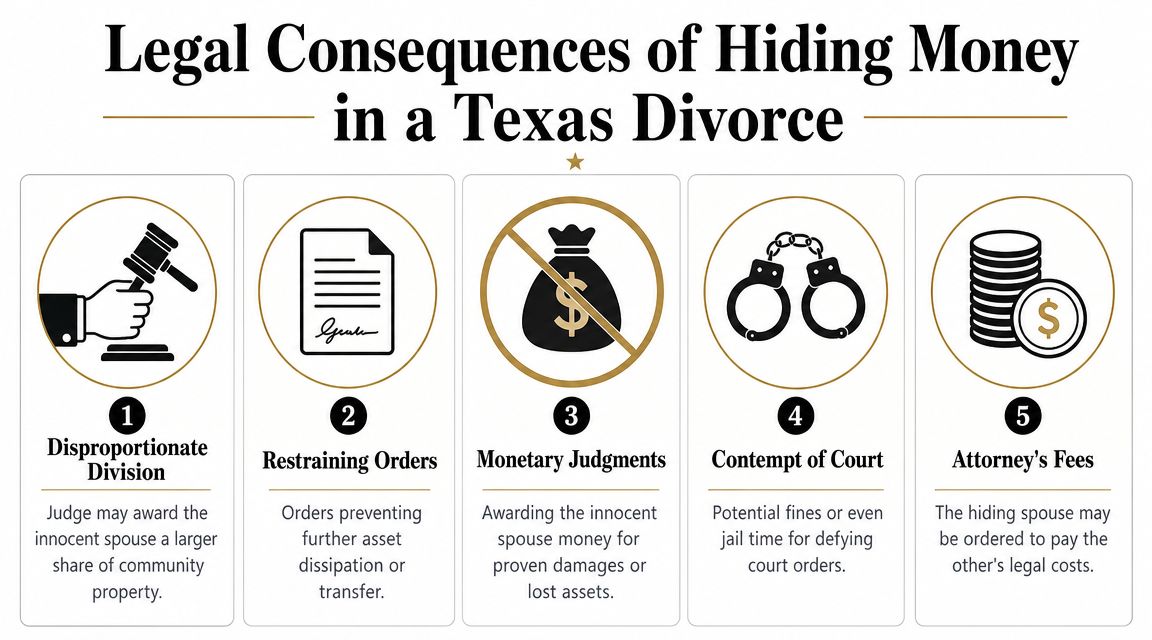
Texas family-law guidance explains that the consequences can escalate beyond ordinary civil issues into sanctions, attorney-fee shifting, contempt, and even criminal exposure in serious situations, particularly where false statements are made under oath or financial disclosures are falsified. This overview of legal steps when a spouse hides assets in a Texas divorce describes those risks in practical terms.
Property division can shift hard
In Harris County, judges expect candor. If one spouse intentionally conceals community assets, the court may award the innocent spouse a larger share of the community estate. That's a practical response to fraud because it tries to correct the imbalance created by the concealment.
This is why hiding money is usually a terrible strategy. A spouse may think they are protecting one account or one stream of income. Instead, they may damage the division of the entire estate.
Other penalties can stack up
The legal consequences often go beyond property division. Depending on the facts, a judge may also use other tools to address misconduct.
- Attorney's fees: The court may order the offending spouse to pay the other side's legal fees.
- Fines or sanctions: Courts can punish discovery abuse or failure to obey orders.
- Contempt: In serious cases, contempt of court can include jail time.
- Credibility damage: A spouse caught lying about money often struggles to regain the judge's trust on other disputed issues.
- Fraud or perjury exposure: False testimony and falsified financial disclosures can create additional legal risk.
Harris County judges also have temporary tools during a pending case. They can enter restraining provisions or temporary orders designed to stop further transfers, waste, or account manipulation while the case moves forward.
A short overview can help if you want to hear this issue discussed in plain language:
What actually persuades a judge
Judges respond to proof, not outrage. The strongest presentations usually include a timeline, clean financial exhibits, and a clear explanation of what happened to the money.
What tends to work:
- Documented transfers that show funds leaving known accounts
- Sworn testimony that conflicts with records
- Business records that undercut the spouse's explanation
- Third-party documents from banks, employers, or vendors
- A calm presentation focused on facts and remedies
What usually doesn't work:
- Broad accusations without records
- Screenshots with no context
- Arguments based only on lifestyle assumptions
- Waiting too long to raise the issue after signs become obvious
Courts can correct honest mistakes. They react much more sharply when the evidence shows intentional concealment.
For families in Humble, Kingwood, and Atascocita, that distinction matters. People make bookkeeping errors. But when a spouse hides accounts, shifts funds, or lies under oath, the court can treat that conduct as a serious attack on a fair division.
Real-World Scenarios in Northeast Houston
The rules become easier to understand when you put them into real situations. These examples are fictional, but they reflect the kinds of patterns lawyers in Northeast Houston regularly watch for.
A Kingwood business owner trims the books
A spouse in Kingwood runs a service company. During divorce, he claims the business barely breaks even and says there is little value to divide. But the bank statements show regular payments to a person listed as an employee, and no one in the family has ever heard of that employee.
During discovery, payroll records and account statements raise more questions. A deposition forces the owner to explain who received those payments and why. If the evidence shows the “employee” was just a way to move community money out of sight, a Harris County judge could treat that as concealment and adjust the property division accordingly.
An Atascocita professional builds a secret digital account
A spouse in Atascocita works in a high-income profession and handles most of the household finances. The initial disclosures include checking, retirement, and brokerage accounts, but one tax document suggests transactions that do not match the inventory.
The missing piece turns out to be a separate digital investment account funded in small transfers over time. The account was not listed in the sworn paperwork. In a case like that, the issue is not only the account itself. The failure to disclose it can damage the spouse's credibility across the whole property dispute.
A hidden asset doesn't have to be dramatic to matter. Small, repeated transfers can become very important once they form a pattern.
A Humble spouse “gifts” property to family
A couple in Humble owns a valuable vehicle that has been part of the family for years. Right before filing, one spouse signs it over to a brother and says it was a gift. The timing is suspicious, and there is no convincing reason for the transfer.
Once records are gathered, the court may view the transfer as an attempt to remove community property from the estate. If that happens, the judge can factor the misconduct into the final division and may also address related fees or sanctions if the transfer violated court orders.
These examples show why hidden asset cases are often about behavior as much as balance sheets. The key question is usually simple. Was this a real transaction, or was it an effort to keep marital property off the table?
After the Divorce Can You Still Recover Hidden Assets
A final divorce decree feels final because, in many ways, it is. But hidden property creates an important exception in Texas law.
Texas-focused family-law sources note that there may be a post-divorce suit to divide undivided property if hidden assets are discovered after the decree, but only if the property existed while the divorce was pending and the decree did not block later claims. Those sources also note that a court may be asked to assume jurisdiction or reopen the decree in some situations, and the timing can be limited and fact-specific, as discussed in this explanation of recovering hidden assets after divorce in Texas.
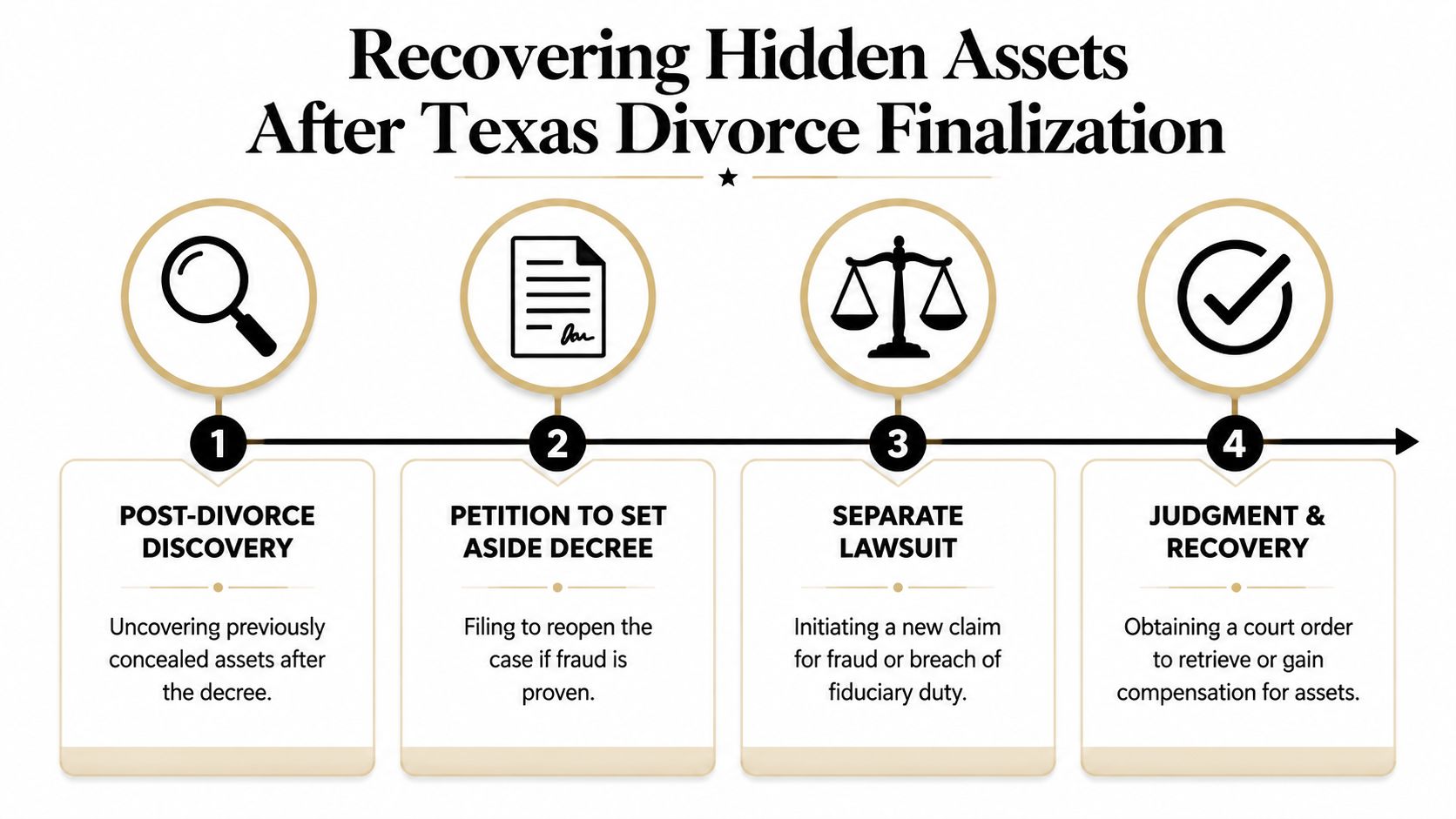
The decree may not end the issue
This is one of the biggest misunderstandings in divorce law. Some people assume that once the judge signs the decree, any hidden account is lost forever. Others assume any later discovery automatically means the case will be reopened and re-divided. Neither assumption is safe.
The answer depends on details such as:
- Whether the asset existed during the marriage and during the divorce
- Whether it was omitted from division
- How the decree was written
- How quickly the issue is raised after discovery
- Whether the facts support fraud, nondisclosure, or an undivided property claim
What to do immediately after discovery
If you find a hidden asset after divorce, speed matters. Delay can make a good claim harder.
Take these steps:
Preserve the documents. Save statements, emails, screenshots, tax forms, transfer records, and any notices that point to the asset.
Read the decree carefully. Some decrees contain language that affects later claims involving omitted or undisclosed property.
Build a timeline. Identify when the asset existed, when you discovered it, and what your spouse said about finances during the divorce.
Speak with a Texas family-law attorney quickly. Post-divorce remedies are procedural. Missing a deadline or choosing the wrong type of filing can hurt the case.
The most common post-divorce mistake is waiting too long because you're still hoping your former spouse will “do the right thing.”
What recovery may look like
A post-divorce case usually focuses on the newly discovered property rather than relitigating every issue from the divorce. That can be helpful because it narrows the dispute. But it also means precision matters. The court will want to know exactly what property was omitted, why it qualifies, and what remedy fits the facts.
For some families in Humble, Kingwood, or Atascocita, the challenge is proving the asset existed during the relevant period. For others, the issue is whether decree language prevents a later claim. That is why quick legal review is so important. A strong claim can weaken fast if records disappear or waiver arguments gain traction.
Your Next Steps Protecting Your Rights with The Law Office of Bryan Fagan
A hidden-money case rarely feels dramatic at first. In Humble, Kingwood, and Atascocita, it often starts with something small: a bank statement that stopped coming to the house, a tax return that does not match what you were told, or a business account your spouse insists is “nothing important.” In Harris County court, those details matter if they are documented and presented the right way.
Texas law gives spouses ways to address concealed assets, but results usually turn on proof, timing, and discipline. Good cases are often built from ordinary records, clear timelines, and smart use of formal discovery. Weak cases often start with a real concern but no organized paper trail.
A practical plan for families in Northeast Houston
Start with the work you can control.
- Gather the financial paper trail: Pull tax returns, bank and credit card statements, payroll records, loan applications, retirement account statements, property records, and business documents if you have lawful access to them.
- Write out the problem clearly: Note what account, transfer, property, or income source seems off, when you noticed it, and why it does not fit the financial story you were given.
- Preserve what you find: Save copies, screenshots, emails, and notices in a safe place. Keep the records intact. Do not edit documents or try to create evidence.
- Prepare for formal discovery: In many Harris County divorce cases, actual progress comes from requests for production, interrogatories, subpoenas, depositions, and, where appropriate, forensic accounting work.
- Get case-specific advice early: Some facts support a strong claim. Other facts create problems involving access, tracing, or proof. It is better to know that early than after money has changed hands again.
Why local court practice matters
Judges in Harris County see plenty of accusations about hidden money. What gets attention is a focused claim backed by records, dates, and a sensible explanation of why the asset belongs in the marital estate. General suspicion usually is not enough.
That is where experienced case preparation matters in real life. A lawyer may need to trace transfers between accounts, compare tax returns to claimed income, review business books, or test whether a property transfer was legitimate or designed to keep money out of view. The Law Office of Bryan Fagan states that it works on hidden-asset issues in Texas divorce cases and may use forensic accountants to review bank records, tax returns, business financials, and real estate records where the facts justify that expense.
Where to turn next
If you want to understand your options in more detail, these pages may help:
- Learn more about the firm's divorce representation
- Review how property division cases are handled
- Reach out through the contact page to speak with the Humble office
You do not need every answer before you talk to a lawyer. You need enough information to protect records, avoid mistakes, and make a sound decision about what to do next. That is especially true if your spouse controlled the books, the online logins, or the family business.
If something feels off, treat that concern seriously and get it reviewed. A prompt, local assessment can tell you whether you are dealing with poor recordkeeping, a hard-to-value asset, or an actual effort to hide marital property.