Skip to content
You've just driven home from a night out, perhaps along FM 1960 or Beltway 8, when flashing lights appear behind you. Now you're back in Humble, Atascocita, Kingwood, or Northeast Houston, staring at paperwork that could affect your license, job, family schedule, and finances. A first DWI arrest is frightening, but it isn't the end of your future. The right response is organized, fast, and focused on both the criminal case and the separate license action.
What a First DWI Means for Humble Drivers Right Now
Texas treats a first DWI seriously even when you've never faced criminal charges before. A standard first-offense DWI is generally a Class B misdemeanor, with possible exposure to up to a $2,000 fine, up to 180 days in jail, and a mandatory three-day minimum confinement. A driver's license suspension can also last up to one year, according to Texas Department of Transportation guidance on impaired driving.
That means your first priority shouldn't be guessing whether the charge will disappear. Your priority should be protecting every available option. The case has two tracks: the criminal prosecution in Harris County court and the administrative license process handled through DPS. Those tracks can move independently, and a favorable development in one doesn't automatically resolve the other.
The situation many local families face
Consider a Humble parent who's arrested after leaving dinner near Atascocita. The criminal case may affect court appearances, legal strategy, and possible punishment. The license case may threaten the ability to commute through Northeast Houston, take children to school, or reach work in Kingwood or downtown Houston.
A driver who waits for the first criminal court date before addressing the license can lose valuable time. The paperwork received after arrest may contain a temporary permit and information about the administrative process. A first offense DWI lawyer in Humble, TX should review those documents immediately, identify the deadlines, and determine whether a hearing should be requested.
The practical reality: Your license problem may begin before your criminal case has meaningfully moved forward.
Your arrest also creates an evidence problem. Dashcam or body-camera footage, officer reports, breath or blood testing records, dispatch information, and nearby surveillance may all matter. Your own memory matters too, especially when the report leaves out road conditions, footwear, fatigue, medical concerns, or the exact instructions given during roadside testing.
For a plain-language overview of defense options, review how to fight a DWI charge in Texas. Then gather your paperwork and speak with counsel rather than trying to explain the incident publicly or negotiate with the prosecutor yourself.
Immediate Actions to Protect Your License and Your Case
The first days after arrest call for a checklist, not panic. Start with the license paperwork, preserve evidence, and avoid statements that can make the case harder.
Start with the administrative license track
Find every document provided after the arrest, including the notice connected to your license and any temporary driving permit. The administrative process is separate from the criminal court case. Texas guidance states that a first refusal can trigger a 180-day suspension, while a failed test can trigger a separate administrative suspension process, as explained in Texas guidance on refusing a breath or blood test.
Requesting an ALR hearing promptly can preserve an opportunity to challenge the suspension and examine the state's evidence. Don't assume your criminal court date controls the license deadline. It doesn't.
Preserve the facts before they disappear
Write a private timeline while your memory is fresh. Include where you were, who was with you, what you ate or drank, when you left, where the stop occurred, what the officer asked you to do, and what happened during any breath or blood testing.
Then identify evidence that may be overwritten or misplaced:
- Video: Tell your lawyer about dashcam footage, body-camera footage, restaurant or gas-station surveillance, and nearby security cameras.
- Records: Preserve receipts, toll records, rideshare information, location history, and relevant call logs.
- Witnesses: Write down names and contact information for anyone who saw you before, during, or after the stop.
- Medical details: Record injuries, balance conditions, medication issues, fatigue, anxiety, or other facts that could affect roadside performance.
- Vehicle information: Keep tow, impound, and vehicle paperwork together with the arrest documents.
Don't delete social media posts or messages, and don't publish explanations, apologies, jokes, or claims that you were fine to drive. Tell your lawyer the complete story, including anything you said to the officer. Hiding an unfavorable fact prevents counsel from planning for it.
Get help with driving needs
If losing your license would interfere with work, school, medical appointments, or childcare, ask counsel about lawful driving options and the requirements that may apply. Information about an occupational driver's license after a DWI in Humble can help you understand the type of issue to raise during your consultation.
A separate legal issue may also be affecting your household. For example, a Divorce Lawyer in Humble, TX provides divorce representation for clients in Humble and Harris County. Keep those matters organized separately, but tell your attorney if a DWI arrest intersects with custody, transportation, or family-court concerns.
Texas First Offense DWI Penalties and License Consequences Explained
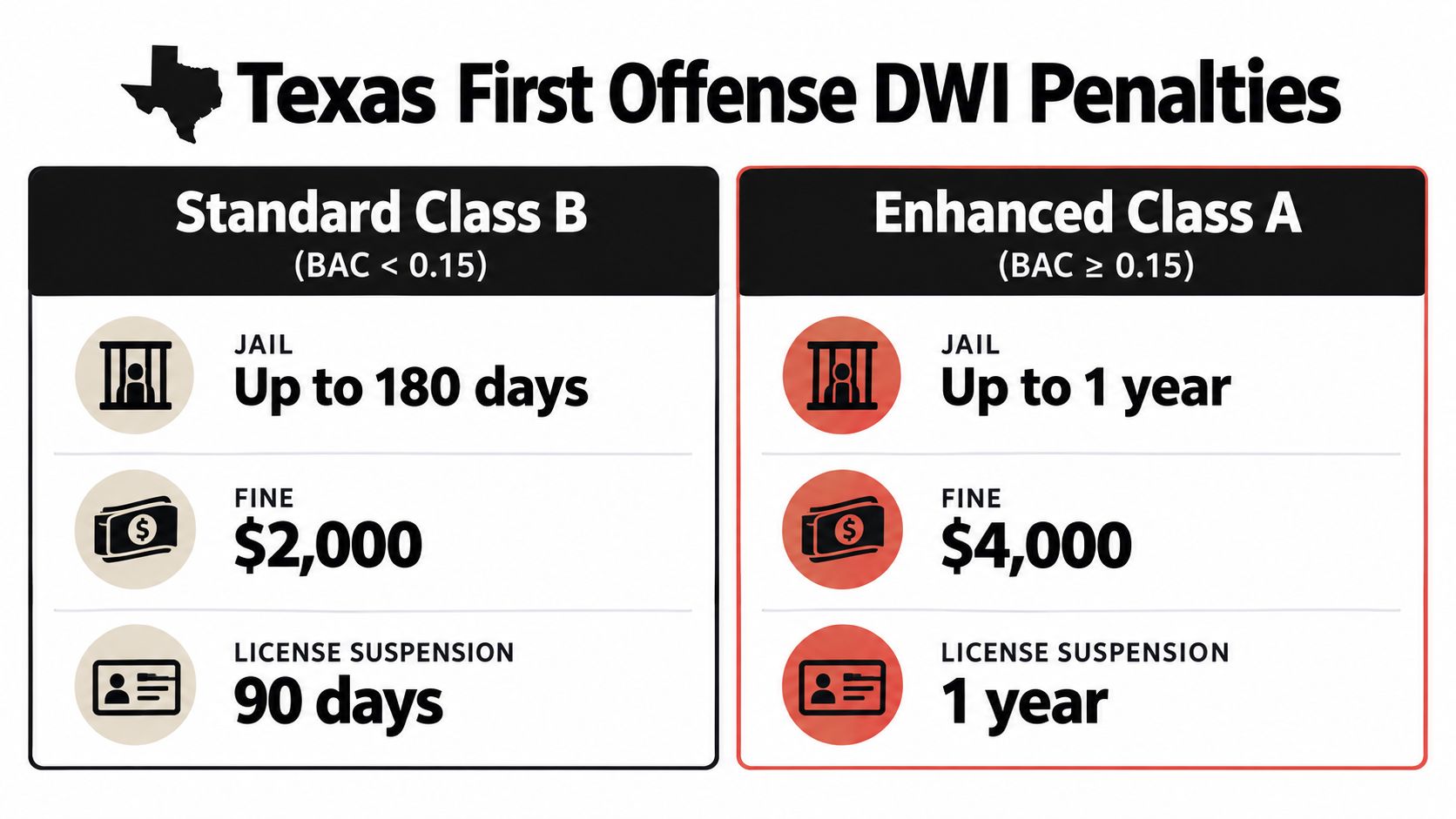
The legal exposure depends heavily on the alleged BAC and the evidence supporting intoxication. Under the standard Texas structure, a first offense is generally a Class B misdemeanor. The possible punishment includes 72 hours to 180 days in county jail and a fine of up to $2,000, according to this Texas DWI defense guide.
When the alleged BAC is 0.15% or higher, the charge can be enhanced to a Class A misdemeanor. That raises the maximum jail exposure to one year and the maximum fine to $4,000, as described in Texas information about first-offense DWI charges.
First offense DWI penalties at a glance in Texas
| Penalty Area | Standard First Offense | Enhanced 0.15 BAC or Higher |
|---|---|---|
| Classification | Class B misdemeanor | Class A misdemeanor |
| Jail exposure | 72 hours to 180 days, with a three-day minimum | Up to one year |
| Maximum court fine | Up to $2,000 | Up to $4,000 |
| License consequences | Administrative consequences may apply | More serious exposure may apply, with administrative consequences separate from court |
| Testing and driving requirements | May include license-related conditions | May include enhanced license-related conditions |
The court fine isn't necessarily the entire financial burden. Texas law and state guidance distinguish criminal punishment from separate state-level financial consequences. A first DWI conviction can involve a separate state fine or assessment in addition to the court-imposed fine, as explained by this Texas first-offense DWI cost overview.
Why the year-long cost matters in Northeast Houston
Commuters often focus on the headline fine and overlook the continuing cost of keeping a license or regaining driving privileges. Ignition-interlock installation, calibration, reinstatement requirements, SR-22 insurance, attorney fees, and increased premiums may all add to the financial pressure. Recent Texas-focused summaries commonly place interlock service at about $60 to $150 per month, with installation and calibration adding more, according to this Texas ignition-interlock cost guide.
For someone commuting between Humble, Kingwood, Atascocita, and Northeast Houston, transportation disruption can also affect childcare and attendance at work. That's why a lawyer should evaluate the license strategy and the criminal strategy together, not treat the license as an administrative footnote.
If you're considering negotiated resolutions, review deferred adjudication for Texas DWI cases with counsel. The correct decision depends on the evidence, the alleged BAC, the legal options available, and the long-term consequences for your record and license. Information about Harris County Family Courts can also help Humble residents understand how separate family-law cases proceed in the Harris County courts serving the area.
Common Defenses a Humble DWI Lawyer Evaluates
A DWI defense isn't built from one magic argument. It comes from comparing the officer's account with the video, the testing protocol, the physical setting, and the legal basis for the stop and arrest.

Roadside testing versus validated procedure
Standardized field sobriety tests can look persuasive in a police report, but they aren't automatically conclusive. The NHTSA manual reports that HGN was 77% accurate, Walk-and-Turn was 68% accurate, and One-Leg Stand was 65% accurate at identifying subjects at or above 0.08 BAC. Later validation materials reported 83% accuracy for the full SFST battery, according to the NHTSA 2023 SFST participant manual.
Those figures don't decide your case. They show why a lawyer should examine each clue instead of treating roadside performance as proof of intoxication. The review should include:
- Instructions: Did the officer give the standardized directions clearly and completely?
- Environment: Was the surface level, dry, illuminated, and safe?
- Physical factors: Did footwear, injury, balance conditions, fatigue, or medical issues affect performance?
- Recording quality: Does the video confirm the report, or does it show something different?
- Officer additions: Did the officer use cues or scoring methods outside the validated protocol?
Testing evidence and legal procedure
Breath and blood evidence requires technical review. Counsel may examine calibration and maintenance records, collection procedures, chain of custody, timing, and whether the report accurately describes the test. A medical or roadside condition may not defeat the charge by itself, but it can change how the evidence should be interpreted.
The stop and arrest also matter. A lawyer should ask why the officer initiated the traffic stop, what facts supported continued detention, and when the officer claimed probable cause existed. If the legal basis is weak, the defense may challenge evidence obtained afterward.
This video provides a visual overview of DWI defense concepts. Review it as general information, then discuss your own facts with counsel.
Report and recording inconsistencies
The police report is one account. Body-camera and dashcam recordings may reveal pauses, incomplete instructions, uneven pavement, a different tone, or conduct that the report summarizes selectively. None of those facts guarantees dismissal, but each can affect negotiations, suppression arguments, witness examination, and trial preparation.
The strongest approach is comparative. Don't argue that one roadside clue proves innocence. Ask whether the entire record supports the state's interpretation, and whether the officer followed reliable procedures before drawing conclusions.
How Your DPS Hearing and Harris County Court Case Unfold
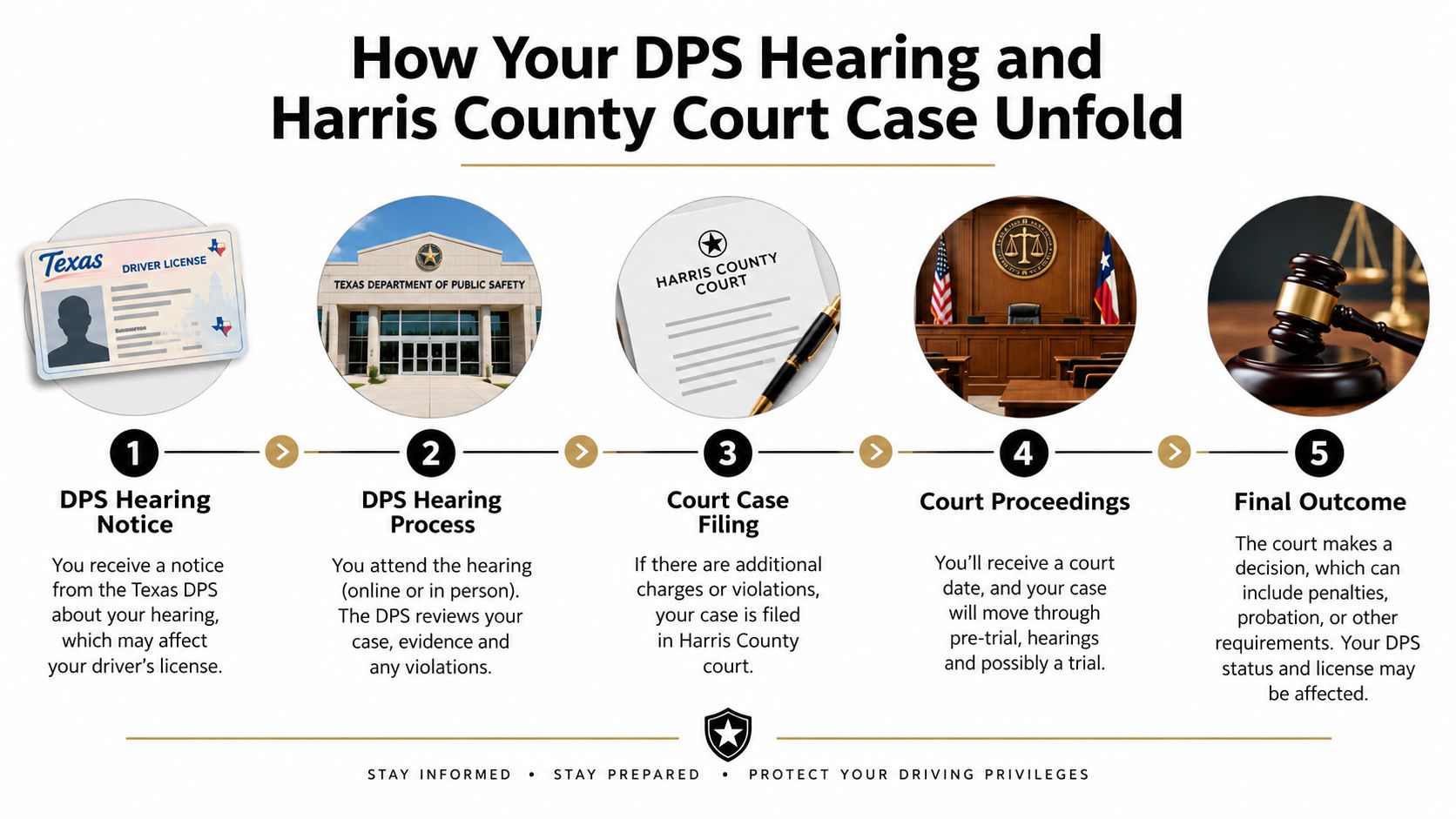
The administrative and criminal matters develop on different tracks, so your calendar may contain separate deadlines, hearings, and court settings. Your lawyer should help you keep each obligation distinct.
The DPS hearing process
The first task is identifying the notice tied to the license action and determining whether an ALR hearing request is appropriate. At the hearing, the state and the driver address the legal and factual basis for the proposed suspension. Counsel may examine the officer's observations, the alleged refusal or test result, and whether required procedures were followed.
The hearing can also provide early information for the criminal defense. That doesn't mean the ALR result determines guilt in criminal court. It means the two proceedings may involve overlapping facts and evidence, which makes early preparation important.
The Harris County criminal case
The criminal case begins with the charge and proceeds through court settings where counsel reviews discovery, addresses legal issues, and discusses possible resolutions with the prosecutor. Depending on the evidence and circumstances, the defense may evaluate negotiation, treatment-related options, suppression issues, or trial.
A local attorney should explain what each setting accomplishes instead of telling you only to appear. Court dates can affect work schedules, transportation, and childcare, especially for families traveling from Kingwood, Atascocita, or Northeast Houston. Ask about expected attendance, required documents, and what may happen before leaving for court.
Prepare for productive communication
Bring the arrest paperwork, temporary license documents, bond conditions, and your private timeline. Add witness information, receipts, medical records relevant to roadside performance, and any information about breath or blood testing.
Use one communication channel for case updates, respond promptly, and ask questions when instructions are unclear. Don't contact the prosecutor or officer to explain your side without legal advice. Your lawyer needs accurate facts, not a polished version of events.
Bring this to your consultation: arrest paperwork, license documents, bond conditions, a timeline, witness names, and every record that may establish where you were and when.
The court process can take time, and no responsible lawyer should promise a particular result. What counsel can do is track both proceedings, preserve evidence, explain choices, and prepare for the next event instead of letting deadlines control the case.
Choosing Your Advocate and Moving Forward in Humble
Choosing a first offense DWI lawyer in Humble, TX should involve more than searching for a firm that mentions DWI. You need an advocate who understands the criminal case, the DPS license action, the testing evidence, and the practical effect of transportation problems on local families.
Start with four questions:
- Local familiarity: Does the lawyer regularly work with Harris County criminal cases and understand the needs of residents in Humble, Atascocita, Kingwood, and Northeast Houston?
- Two-track planning: Will the firm address the license proceeding and criminal prosecution as connected but separate matters?
- Evidence review: Will counsel examine video, reports, testing records, roadside conditions, and medical factors?
- Fee clarity: Will the agreement explain what representation includes and what additional work may require separate discussion?
A consultation should leave you with a clear list of immediate actions. You should know which documents to provide, which deadlines matter, what not to discuss publicly, and how your driving needs may affect the strategy.
The Law Office of Bryan Fagan handles criminal defense matters, including DWI and other misdemeanor or felony charges, while also serving local families with family law and estate-planning services. Its Humble office serves residents across the surrounding community, so a consultation can address the legal issue in the context of work, family, and transportation responsibilities.
If a DWI arrest overlaps with custody, divorce, child support, or another family concern, tell your lawyer early. A criminal defense plan should protect your rights without ignoring the consequences that may reach your household.
You don't need to solve the entire case tonight. Put the paperwork together, protect the license deadline, preserve evidence, and schedule a focused consultation. Those steps give you a practical foundation for deciding whether to challenge the evidence, negotiate, pursue another lawful resolution, or prepare for trial.
The Law Office of Bryan Fagan offers consultations for Humble-area residents facing DWI charges, related license issues, and other legal concerns. Contact the firm to discuss your arrest, protect your immediate options, and build a clear plan for your case.