Skip to content
You finished probation, paid what the court required, and believed the case was behind you. Then a job application asks whether you've ever been arrested, or a background check returns a record you thought had disappeared. For many people in Humble, Atascocita, Kingwood, and Northeast Houston, that surprise leads to the same question: can an order of nondisclosure protect the record without pretending the case never existed?
Texas record relief is highly dependent on the charge, the way the case ended, the waiting period, and your history afterward. An order of nondisclosure can provide meaningful privacy, but it isn't the same as expunction, and it doesn't make every government agency or licensing board forget the case. The practical issue is choosing the right remedy and filing it correctly in Harris County.
When a Humble Resident Decides to Seal a Record
Maya graduated from Humble ISD and accepted deferred adjudication for a Class B misdemeanor. She completed supervision, finished the required conditions, and watched the case get dismissed. Two years later, while applying for a new job, she learned that the dismissal didn't automatically remove the arrest and court history from every background-check system.
That moment is common. A dismissal may close the criminal case in court, but the underlying arrest and disposition can remain available in public records or commercial databases. Deferred adjudication can be an important resolution, but it usually isn't the final record-clearing step. A person often still needs to pursue an order of nondisclosure if the goal is to limit public access.
Maya's concern wasn't unusual or unreasonable. She didn't want to deny what happened to a licensing board or law-enforcement agency. She wanted ordinary employers, landlords, and other private decision-makers to stop treating an old case as an open question.
Practical rule: A completed case and a sealed record are separate legal milestones.
For Northeast Harris County residents, the first task is separating three questions:
- Was the case dismissed or otherwise completed? The final disposition controls what relief may be available.
- Has the required waiting period passed? Texas uses different periods for different offenses and case outcomes.
- Who needs to be unable to see the record? A private employer and a professional licensing board may not have the same access.
A careful order of nondisclosure lawyer in Humble, TX starts with those facts rather than promising that the record will vanish. The rest of the decision turns on eligibility, filing procedure, and the privacy limits Texas law preserves.
What an Order of Nondisclosure Really Does
An order of nondisclosure is a court order governed through Texas Government Code Chapter 411. In plain English, it tells covered public entities and private parties not to disclose the protected criminal record to the general public. Texas's framework developed through statutory changes that began with nondisclosure provisions under Government Code Chapter 411 and later protective-order developments under the Family Code, creating a layered system that requires close attention to the particular statute. The Texas protective-order framework is described in the Texas Family Code provisions on protective orders.
Think of the record as a folder in a courthouse file cabinet. Nondisclosure locks the drawer against ordinary public access. It doesn't shred the folder. The information remains available to criminal justice agencies and certain government entities, subject to the exceptions written into Texas law.
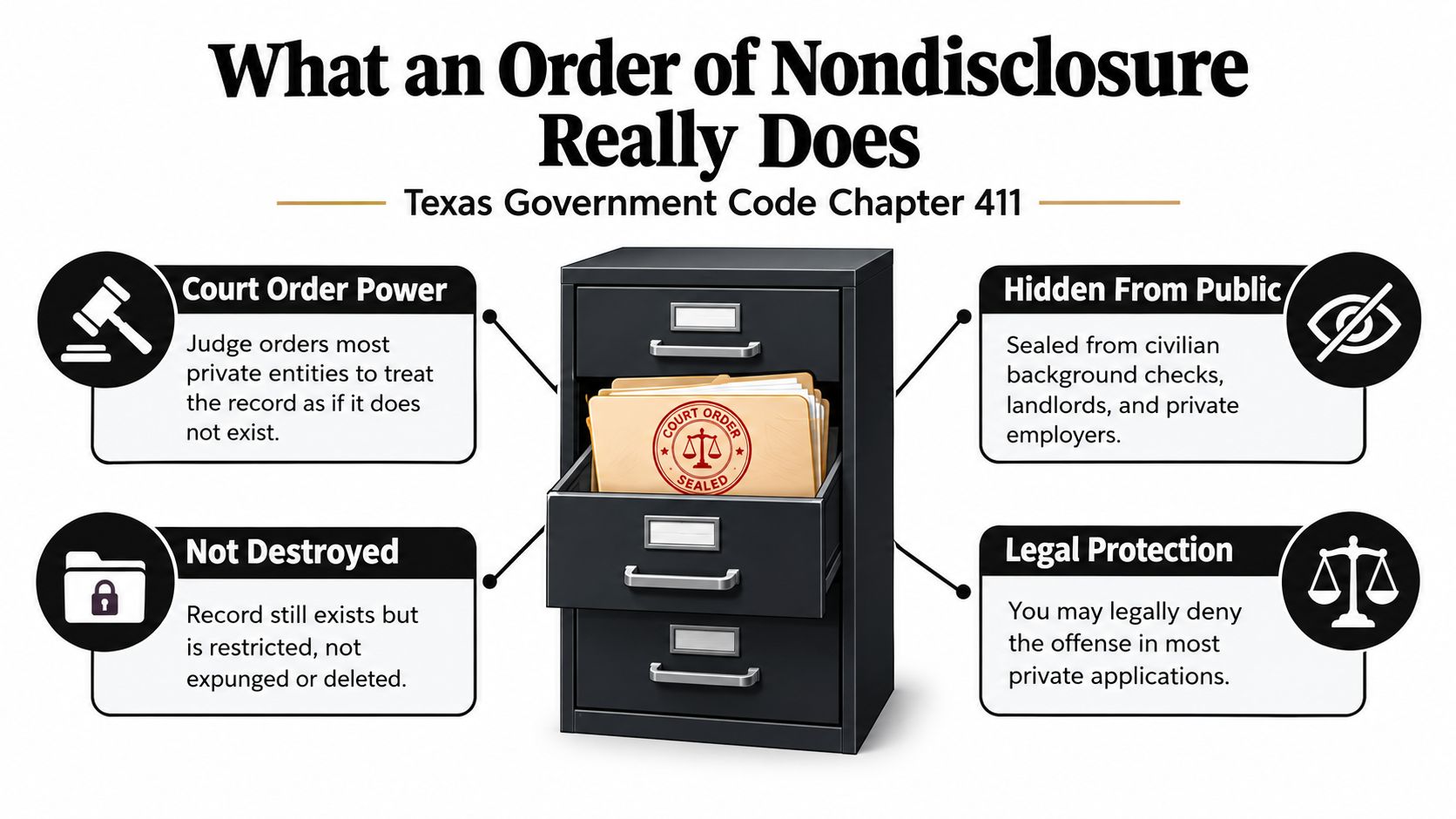
Sealing is different from expunction
Expunction is the more complete remedy. When a person qualifies, the law directs agencies to destroy or remove the covered records, subject to the applicable legal process. Nondisclosure instead restricts disclosure. That distinction affects background checks, licensing applications, future criminal cases, and the way a person should answer questions from an authorized agency.
Deferred adjudication also isn't the same thing as nondisclosure. Deferred adjudication may lead to dismissal after successful completion, but the record can remain accessible until a separate nondisclosure order is obtained. Eligibility depends on the offense and disposition, and the law includes exceptions for offenses that can't receive this relief.
An order of nondisclosure also doesn't vacate a conviction, restore firearm rights, or guarantee that every employer or agency will be unable to learn about the case. The order's benefit is narrower and more practical. It can reduce public exposure while preserving access for criminal justice and other authorized purposes.
Who Qualifies Under Texas Law
Eligibility is statute-driven. A person can't determine qualification from the label “misdemeanor” or from the fact that probation ended. The lawyer must compare the final disposition, offense classification, waiting period, later criminal history, and statutory exclusions. Texas guidance describes waiting periods ranging from 180 days to five years, and a Texas Law Help explanation of nondisclosure orders emphasizes the importance of obtaining a DPS criminal history report before filing.
For some deferred-adjudication matters under Government Code Section 411.072, the court generally can't issue the order until the person has remained on deferred adjudication for at least 180 days. If the case is dismissed sooner, the court still must wait until that 180th day before acting, as reflected in the Texas statute discussion of Section 411.072.
The waiting period begins from the legally relevant discharge or disposition date, not the arrest date. A later conviction, new disqualifying event, active charge, or pending deferred-adjudication matter can change the analysis. Out-of-state convictions may also matter when reviewing the applicant's complete criminal history.
| Offense Category | Waiting Period | Eligible? | Key Notes |
|---|---|---|---|
| Certain deferred-adjudication misdemeanors | 180 days | Sometimes | The period is measured from the legally relevant deferred-adjudication date, and the specific statute controls. |
| Other qualifying misdemeanor matters | 2 years | Sometimes | The offense, disposition, and later record must satisfy the applicable statute. |
| Certain qualifying felony deferred-adjudication matters | 5 years | Sometimes | A felony requires careful review of the offense and statutory eligibility. |
| Certain DWI-related matters | 5 years may apply | Limited | DWI-related relief has additional restrictions and must be evaluated from the exact case history. |
| Family-violence-related offenses | No relief under barred provisions | Generally no | Section 411.074 contains important exclusions. |
| Sex offenses requiring registration | No relief under barred provisions | Generally no | Registration-related offenses are among the major statutory exclusions. |
| Aggravated offenses and offenses involving vulnerable persons | No relief under barred provisions | Generally no | The underlying facts and statutory classification matter. |
A dismissed charge with no finding of guilt may point toward expunction rather than nondisclosure, depending on the circumstances. That's why the final judgment, dismissal paperwork, and DPS record should be reviewed together. The Texas deferred adjudication overview can help explain why deferred adjudication and later record sealing are related but separate steps.
Nondisclosure Compared to Expunction and Other Options
The strongest remedy depends on how the case ended and who needs access to the record. Expunction may offer broader destruction of records, but its eligibility rules are narrower. Nondisclosure is often more realistic after successful deferred adjudication, although it preserves authorized access.
| Feature | Order of Nondisclosure | Expunction | Private Confidentiality |
|---|---|---|---|
| What happens to the record | The record remains but public disclosure is restricted. | Eligible records are ordered destroyed or removed through the statutory process. | The agreement controls the parties that signed it. |
| Public background checks | The offense is generally sealed from ordinary public access. | The covered arrest or records can be removed from official systems. | A private agreement doesn't automatically change court or DPS records. |
| Typical eligibility | Depends on the disposition, offense, waiting period, and statutory exceptions. | May apply after an acquittal, qualifying dismissal, identity-theft situation, or other specific statutory circumstance. | Depends on the agreement or diversion terms, not the nondisclosure statutes. |
| Government access | Law enforcement, courts, prosecutors, and certain agencies may still access it. | Access is restricted under the expunction order and governing law. | Government agencies aren't necessarily bound by a private promise. |
| Best fit | Someone seeking privacy after a qualifying disposition. | Someone who meets the narrower requirements for record destruction. | A limited confidentiality issue between identified parties. |
A private confidentiality clause shouldn't be confused with criminal-record nondisclosure. Texas also enacted a 2025 law, effective September 1, 2025, addressing nondisclosure clauses in settlement and employment agreements involving sexual-abuse-related disclosures. That employment or settlement rule is separate from a court order under Chapter 411.
For a practical comparison focused on local filing choices, review expunction versus nondisclosure in Humble, Texas. Start with the outcome of the criminal case, then ask whether your goal is destruction, limited public privacy, or only a private promise not to disclose.
Filing in Harris County Step by Step
A Harris County filing begins with records, not a generic form. The first useful document is the Texas Department of Public Safety Computerized Criminal History, commonly called the DPS CCH. A person can request it through the DPS process or online portal, and the report helps identify the arrest, charge, disposition, and other history that may affect eligibility.
- Pull the DPS record. Compare the CCH with the clerk's file, judgment, dismissal, and supervision records.
- Confirm the waiting period. Calculate from the legally relevant discharge or disposition date, not merely from the arrest.
- Prepare the verified petition. The petition should identify the correct offense, court, agencies, and statutory basis, with supporting documents and the required filing fee.
- File in the proper Harris County court. The petition is filed where the case was handled, and service is arranged on the Harris County District Attorney's Office and other required parties.
- Address review or hearing. The State may object within the statutory process. The judge may review the petition, request additional information, or set a hearing before signing an order.
Harris County cases may proceed through the 174th, 176th, 178th, or 339th District Courts, depending on where the underlying case was filed and how the court manages its docket. A client should bring identification, copies of the final disposition, proof that supervision terms were completed, and any documents the lawyer requested. Misdemeanor petitions often move differently from felony petitions, and no responsible lawyer should promise a fixed timeline before reviewing the docket and court requirements.
The Texas criminal-record sealing process includes the practical filing issues that can determine whether the petition is accepted and processed. After signature, obtain a certified copy of the order and confirm that DPS and the affected agencies received and entered it.
For comparison, The Divorce Process in Humble: What to Expect provides a step-by-step look at filing for divorce in Humble and Harris County.
The court workflow is easier to understand visually:
Who Can Still See a Sealed Record
Nondisclosure creates a privacy ceiling, not complete invisibility. Private employers, landlords, and ordinary civilian background-check users generally shouldn't receive the protected record through public disclosure. But Texas DPS, law enforcement agencies, prosecutors, courts, and certain government entities can retain access for authorized purposes, as described in Texas guidance on sealing a criminal record through nondisclosure.
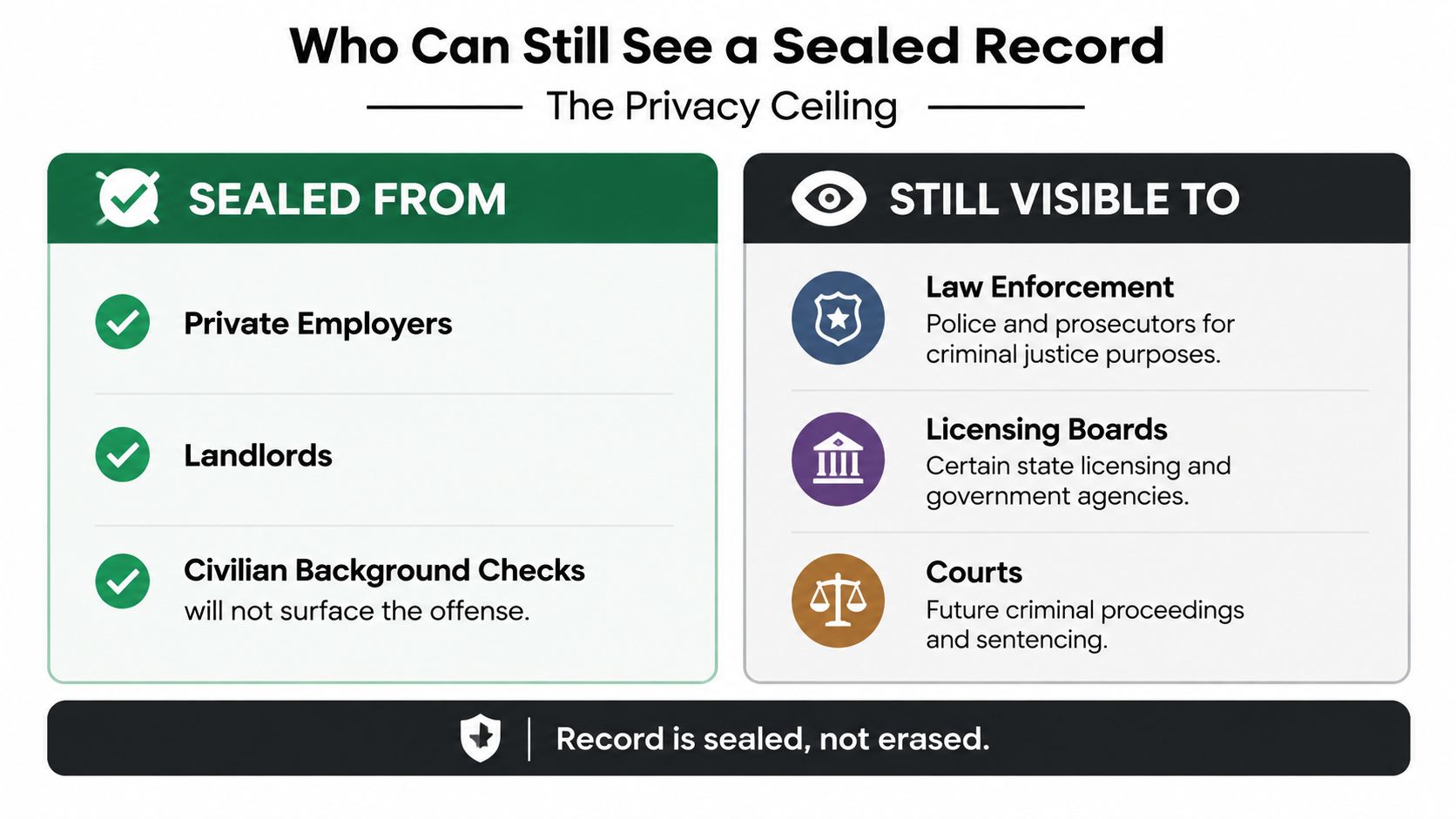
The people and agencies that may retain access
- Law enforcement and prosecutors may use the record for criminal justice purposes.
- Courts may consider authorized information in a later criminal proceeding.
- Professional licensing boards may access records when evaluating regulated professions, including fields such as nursing, education, real estate, law, and financial services.
- Federal agencies aren't automatically bound in the same way as ordinary private background-check users.
- Sensitive-sector employers may have access through special screening requirements, particularly in child care or elder care.
Licensing questions require careful reading. An application might ask about convictions, arrests, deferred adjudication, or any criminal history. Those questions aren't interchangeable. A sealed record may legally be omitted from many private applications, while a licensing board's disclosure question may require a fuller answer.
Future criminal proceedings create another limit. A later case can bring the old history back into the court's view, and a judge may address access under the governing law. Nondisclosure doesn't rewrite the underlying events or guarantee that every decision-maker must treat them as nonexistent.
People who work around children, vulnerable adults, or regulated facilities may also encounter specialized screening rules, including requirements associated with sex-offender registries. The right response is to read the application exactly and obtain legal advice before submitting an incomplete or inaccurate answer.
How a Humble Lawyer Guides the Process
A local lawyer's value usually appears before the petition reaches a judge. The work starts with a full record audit, including the DPS CCH, the original charge, the final disposition, the court's classification, supervision completion, and any later convictions or pending matters.
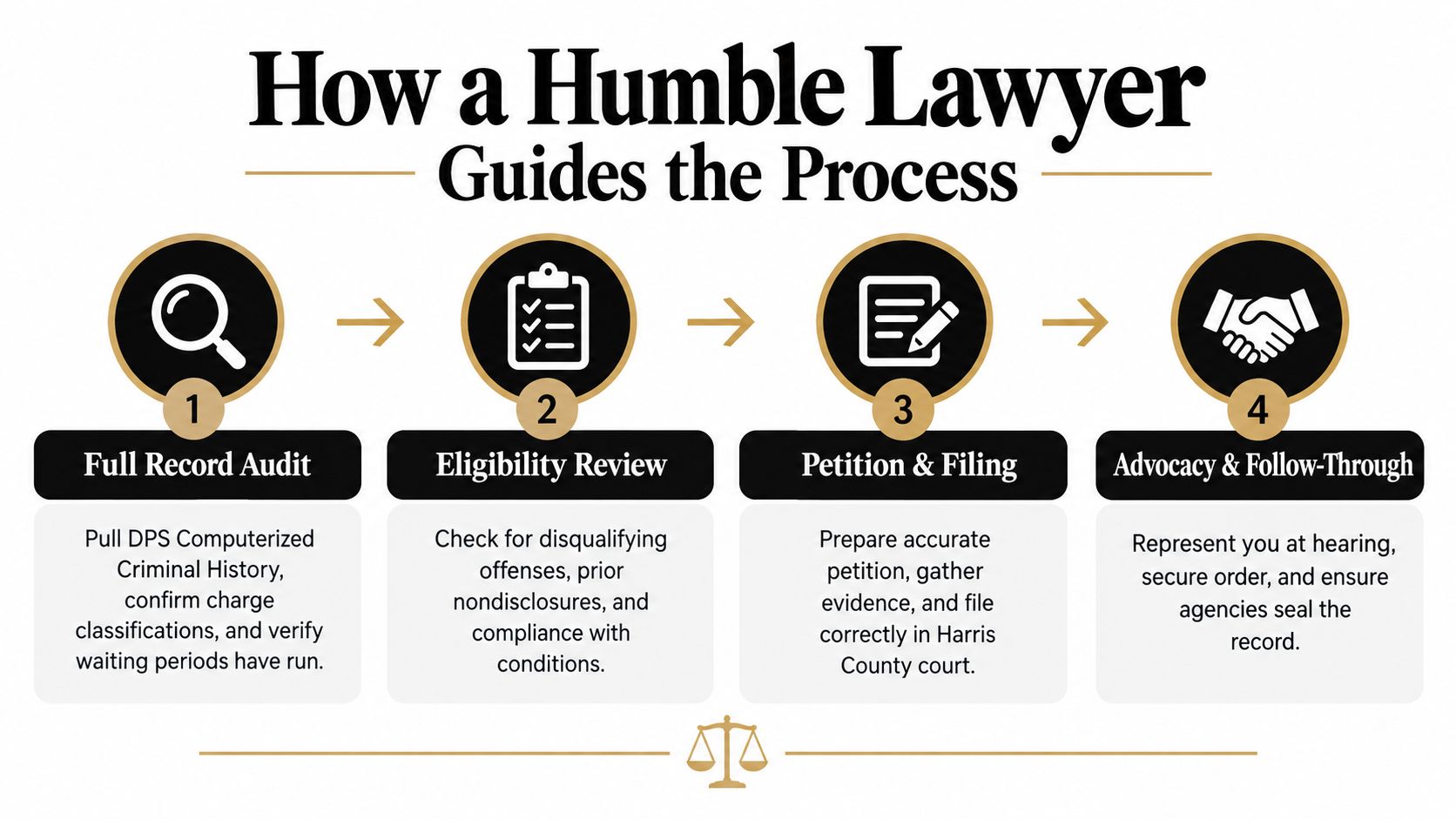
The review that prevents avoidable denials
An attorney checks whether the waiting period has fully run and whether the offense falls within a qualifying statute. This step matters because a petition filed too early can fail even when the person eventually would have qualified. The review also identifies mismatches between a DPS record and the clerk's file, such as a charge description that changed during the case.
The filing work behind the scenes
The lawyer prepares a petition for the correct Harris County court, attaches certified judgments and proof of completed conditions, and serves the State and any required agencies. The proposed order must accurately identify the record and the entities covered by the statute. A filing that leaves out an agency or uses the wrong disposition can create unnecessary delay.
At the hearing, counsel explains the legal basis, responds to objections, and prepares the client for questions about the case history. If the judge signs the order, follow-through still matters. The lawyer can obtain a certified copy and confirm that DPS received the order so the seal has a practical chance of appearing correctly in later checks.
The Law Office of Bryan Fagan offers criminal-defense support from its Humble office, including assistance with evaluating record relief and related criminal matters. A local attorney also understands that many clients are managing broader family or estate concerns at the same time, so the advice should stay focused on the immediate legal objective.
Costs, Common Obstacles, and Your Next Step
The cost of a nondisclosure petition usually has more than one component. A person may encounter attorney fees, a filing fee of roughly $300, and certified-copy charges. The filing-fee figure is a practical estimate, not a guarantee, because court costs and local procedures can change. Confirm the current amount with the Harris County clerk or your lawyer before filing.
A 2025 statutory change also affects certain settlement and employment-agreement clauses involving sexual-abuse-related disclosures. That rule shouldn't be treated as a substitute for a Chapter 411 court order. A private agreement and a criminal-record nondisclosure solve different problems.
Common obstacles include:
- An incomplete DPS report: The record may not show every document needed to calculate eligibility.
- Unresolved financial or supervision issues: Restitution, fees, or other court conditions may need documentation showing completion.
- A later arrest or conviction: New criminal history during the relevant period can affect qualification.
- Missing completion paperwork: Probation or deferred-adjudication records may be necessary to prove discharge and compliance.
- The wrong court: Filing outside the court connected to the underlying case can create a procedural problem.
- Multiple offenses: One order applies to one offense, so separate cases may require separate requests under the applicable statutes.
Residents of Humble, Atascocita, Kingwood, and Northeast Houston don't have to guess whether a record can be sealed. Gather your DPS history, final disposition, supervision paperwork, and any licensing or employment application that prompted the concern. Then schedule a free consultation with the Law Office of Bryan Fagan to review the record, identify the correct remedy, and discuss the Harris County filing path.
The Law Office of Bryan Fagan helps Humble-area clients evaluate orders of nondisclosure, expunction, and related criminal-defense issues with practical guidance suited to the underlying record. Visit Law Office of Bryan Fagan to schedule a free consultation and discuss your next step.