Skip to content
You've just left the Harris County Family Law Center with a signed divorce petition, and the clerk told you the next step is service. You may be wondering whether the Harris County Constable Precinct 4 office files the divorce, schedules your hearing, or just hands papers to your spouse. The answer is narrower and more important: service of process is a separate legal event from filing for divorce.
For families in Humble, Atascocita, Kingwood, and Northeast Houston, Precinct 4's Civil and Writs Division can be a practical county channel for serving civil papers. But the process works only when the divorce case has been filed correctly, the citation has been issued, and the server receives accurate instructions. A missed address, an incomplete packet, or confusion about which court handles the case can leave your divorce stuck before it reaches the next stage.
What Service of Divorce Papers Actually Means in Texas
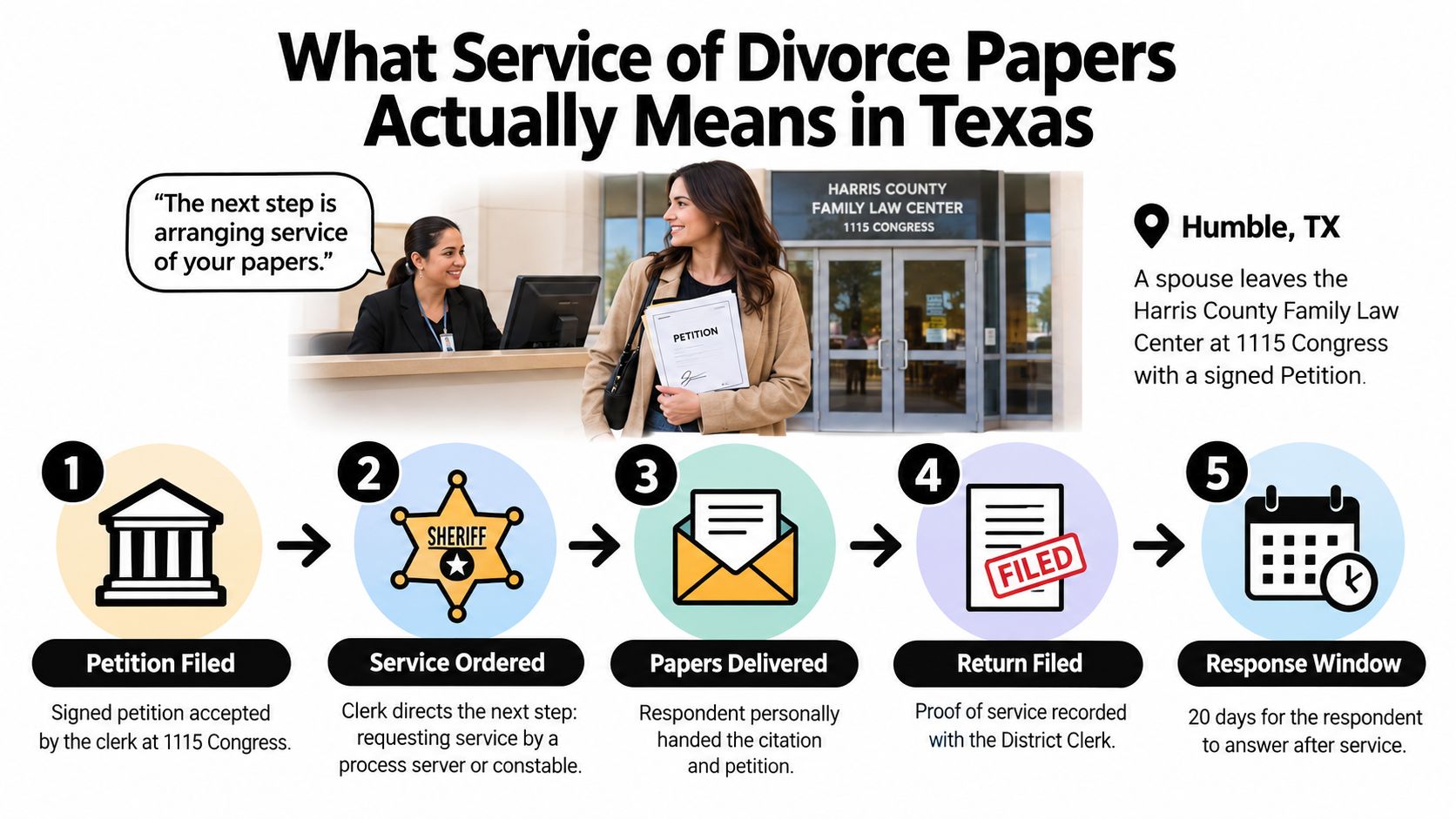
A Humble spouse walks out of the Harris County Family Law Center at 1115 Congress holding a signed Original Petition for Divorce. The clerk has accepted the filing, but there's no hearing that day. Instead, the clerk explains that the next step is arranging service on the other spouse. That moment causes confusion because filing feels like the start of the case, while service is what gives the respondent formal notice and an opportunity to respond.
Service of process means delivering the citation, the petition, and any required filed documents to the respondent through a person legally authorized to serve them. Texas due-process rules limit who may perform this task. The Texas State Law Library explains the process and the usual packet in its Texas guidance on serving divorce papers. Authorized servers can include a constable, sheriff, private process server, or another person allowed by law or court order.
The respondent is the spouse who has not filed the petition. Service tells that person that a district-court divorce case exists and that a response is required within the deadline stated in the citation. It also creates the record the court relies on before entering orders affecting the respondent's rights.
Filing and service are different events
You file the divorce in the appropriate district court. You don't file a divorce case in justice court, because justice courts don't have jurisdiction over divorce. After filing, the clerk issues the citation, and the petitioner arranges for lawful service.
The court generally can't grant a default divorce or other relief against an unserved respondent until valid proof of service has been filed. Texas Law Help describes the initial papers that normally need to be served as the citation, the Original Petition for Divorce, and any other forms filed with that petition in its explanation of serving initial divorce papers.
A properly completed service also starts the respondent's answer period. The Texas Family Code waiting period and the respondent's answer deadline are separate procedural matters, so don't assume that filing alone puts every deadline into motion. If service is defective, the case may remain open but cannot safely move toward a final judgment.
Practical rule: Treat service as the gateway to the rest of the divorce case. Protect the citation, use an authorized server, and keep the filed return.
What Goes in the Service Packet Filed With the Court
Precinct 4 can't serve a divorce petition that hasn't been filed and issued. Before contacting the Civil and Writs Division, confirm that the Harris County district clerk's file contains the Original Petition for Divorce and that the clerk has issued the citation for service.
The citation is the court document that identifies the case and directs the respondent to answer. The service packet usually includes:
- Issued citation: Use the citation issued by the clerk, not an informal notice you prepared yourself.
- Filed petition: Include a copy of the Original Petition for Divorce with the clerk's filing information.
- Other filed forms: Include temporary orders, protective orders, or other documents the clerk filed with the petition when those documents require service.
- Written instructions: Give the server the respondent's full name, likely addresses, work information, vehicle description, photograph if available, and known schedule.
- Safety information: Disclose protective-order concerns, restricted addresses, weapons concerns, or other facts that affect where and how service should occur.
The purpose of the instructions is practical. A process server needs enough information to identify the right person and choose a realistic location. Serving a roommate, relative, or unrelated person can create a serious defect. The Texas justice court citation-service guidance also helps clarify a point that trips up many filers: a citation-service request is not the same thing as filing the divorce itself.
Check the packet before handing it over
Ask the clerk or your attorney to verify the cause number, court designation, respondent's legal name, and every document listed for service. If children, temporary relief, or safety issues are involved, don't assume a generic packet covers everything. A missing document can require another service attempt and can create problems later when the court reviews notice.
The court's later enforcement work is different from initial service. For example, Enforcement of Court Orders in Humble addresses enforcing divorce decree and custody order provisions in Harris County, not initiating service of the divorce petition.
Give the constable clear written directions and retain copies of everything delivered. If an attorney filed the case, ask the attorney's office to coordinate the conformed documents and transmission so the service request matches the clerk's file.
Working With Precinct 4's Civil and Writs Division
Precinct 4's Civil and Writs Division is the local operational contact many Humble-area residents consider after filing. The precinct's public information identifies an office at 6831 Cypresswood Drive, Spring, Texas 77379, serving communities that include Humble, Atascocita, Kingwood, and parts of Northeast Houston. Its public contact page lists a 24-hour dispatch number, 281-376-3472, and a separate Records Division number, 832-927-6230, available Monday through Friday from 8:00am to 5:00pm. Confirm current procedures directly before sending your packet through the Harris County District Clerk JIMS family case lookup.
Start with the case information
Have the following information ready when you call:
- Cause number, exactly as it appears on the citation.
- Court name, such as the assigned Harris County district court.
- Respondent's identity, including a physical description or photograph.
- Service addresses, including home, work, and likely locations.
- Written instructions, especially schedule details and safety concerns.
The dispatcher or civil-process staff may direct you on acceptable payment and packet delivery. The public Harris County fee information identifies citation service at $85 in-county, so don't rely on informal estimates or unrelated service fees. Verify the current amount and payment method before you go. If payment is required, ask whether the office accepts a money order or cashier's check and how it should be made payable.
Precinct service depends on geography and workload. A constable is a county officer working within defined authority, not a nationwide process server. If the respondent lives outside the service area or outside Harris County, ask before submitting the request. The request may need to go through another county's sheriff or constable, or you may need a private process server.
Give the deputy useful facts
“Please serve my spouse” isn't enough. Tell the office when the respondent is likely to be home, where the vehicle is usually parked, whether the property is gated, and whether there are safety restrictions. Don't confront the respondent yourself or create a scene at a workplace. Your job is to provide accurate information and let the authorized server handle delivery.
The office may have closures, schedule limits, or special procedures for after-hours calls and holidays. A 24-hour dispatch number doesn't necessarily mean every civil-process task is performed at every hour. Ask when the packet must be delivered, how attempts are documented, and how you'll learn whether service succeeded.
Constable Versus Private Process Server in Harris County
After filing, a Northeast Houston petitioner usually has two practical paths: request service through Precinct 4 or hire a private process server. Neither option files the divorce. Both options exist to complete lawful notice and produce proof for the district court.
| Option | Strengths | Limitations |
|---|---|---|
| Precinct 4 Civil and Writs Division | Government civil-process channel, established local office, and in-county citation service | Geographic limits, office procedures, and workload can affect timing |
| Private process server | More flexible scheduling, including evenings or weekends, and focused attempts at difficult locations | Private pricing varies, and the server must still follow Texas service rules |
| Out-of-county route | Can reach a respondent outside Precinct 4's area through the appropriate authority | Requires correct routing and may involve a different county or jurisdiction |
Precinct 4's public fee schedule lists $85 for in-county citation service. That government fee is useful when the respondent lives locally and can likely be found through ordinary attempts. A constable is often a sensible first choice for a straightforward Humble, Atascocita, Kingwood, or Northeast Houston address.
A private process server can make more sense when timing, privacy, or difficulty matters. Private servers may offer evening and weekend attempts, coordinate skip-tracing when an address is questionable, or concentrate several attempts into a shorter period. They don't operate under a flat government fee, so obtain the terms in writing before authorizing work.
Match the server to the facts
Choose Precinct 4 when the respondent's address is stable, inside the service area, and there's no urgent concern about evasion. Choose a private server when the respondent works unusual hours, travels, avoids official contacts, or has moved repeatedly. For an out-of-county respondent, call before assuming Precinct 4 can act. The correct route may be the other county's sheriff, constable, or a private server authorized to work there.
The most expensive mistake isn't always the service fee. It's selecting a channel that can't reach the respondent, then losing time while the case waits for a new request.
How Proof of Service Gets Filed and Used
A deputy's delivery does not finish the service process. The court needs a signed Return of Service that records what occurred. Texas Rule 107 requires key details, including the cause number, case name, court, documents served, when the server received the papers, and the person served. It also addresses when a default judgment may be considered, as explained in the Texas Rule of Civil Procedure 107 text.
The return should state whether service occurred, where and when it happened, and how the server identified the respondent. A Precinct 4 deputy or private process server signs the document and files it with the district clerk, often through the electronic filing process used in the case.
Use the citation and the return to calculate the response deadline. The filing date of your divorce petition and the day you contacted the precinct do not control that deadline. Confirm the service date shown on the return, then calendar the answer deadline immediately.
If the respondent does not answer, the petitioner still must show that service was valid and that the required time has passed before requesting a default judgment. Rule 107 requires proof of service to remain on file for 10 days, excluding the filing day and judgment day, before a default judgment may be granted. Confirm the court's current filing procedures before setting a default hearing.
Personal service usually creates the clearest record. Substituted or alternative service requires court authorization when ordinary delivery cannot be completed. A return showing non-service does not end the divorce, but it does show that this attempt did not properly bring the respondent into the case.
For a broader procedural overview, use this guide to what happens after a divorce is filed to organize the next court and filing steps.
Common Complications and How Harris County Handles Them
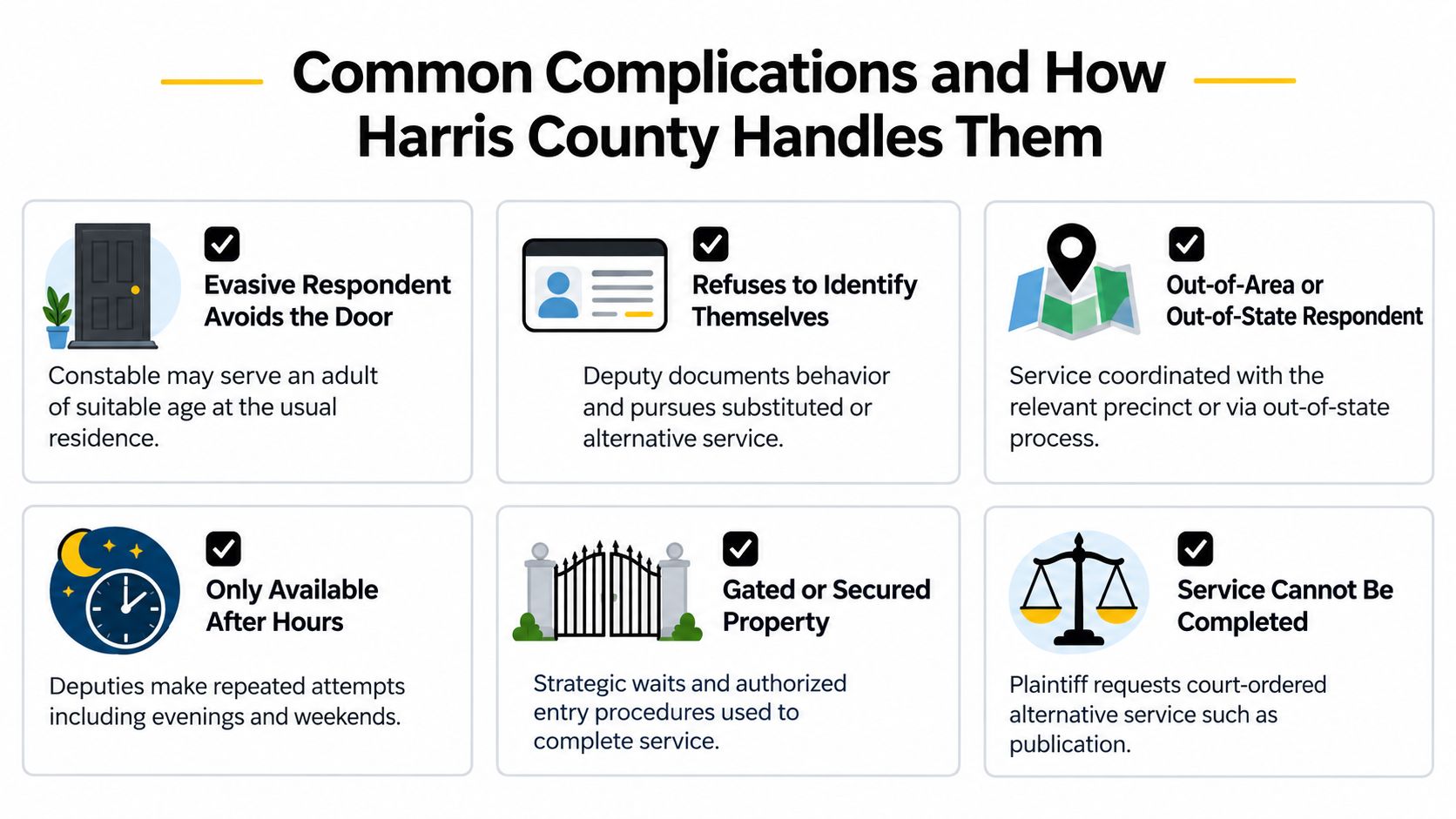
People often assume that a respondent's refusal to open the door defeats service. It doesn't automatically do so, but the deputy must still follow the law and accurately document what happened. Your instructions should help the server distinguish the respondent, identify the residence, and decide whether a court-authorized alternative method is needed.
The respondent avoids the door
A constable may document repeated unsuccessful attempts, but you shouldn't treat a failed attempt as permission to serve anyone nearby. Give the office additional schedule information, workplace details, or a better address. If ordinary diligence doesn't work, your attorney may need to request substituted service from the court.
A respondent who refuses to identify themselves creates a similar problem. The server may record the conduct and return the result to the court, but the return must support the method used. Don't ask a neighbor to pressure the respondent or attempt delivery yourself.
The respondent moved or lives elsewhere
If the respondent no longer lives at the listed address, stop sending the same packet to the same location. Provide updated information and determine whether the respondent is in another Harris County precinct, another Texas county, or another state. Precinct 4 can't exercise local authority everywhere a spouse might be found.
Out-of-county service usually requires routing the papers through the proper county authority or hiring a private server permitted to work in that location. An out-of-state respondent may require compliance with that state's service rules. The filing remains active, but the court needs legally sufficient notice before it can proceed against that person.
Safety and restricted-address concerns
Protective orders, gated communities, sealed addresses, and workplace restrictions change the service plan. Tell the civil-process office about these facts before an attempt occurs. The server's safety and the respondent's legal rights both matter.
If ordinary service fails despite documented diligence, ask your attorney about a motion for substituted service. Certified mail, service on another authorized person, or publication may require a court order and specific findings. Never assume that leaving papers at a door or mailing them informally is enough.
Safety comes first: Don't use the service process to confront, track, or intimidate a spouse. Give the authorized server accurate information and follow any protective order exactly.
Next Steps After Service and How a Humble Attorney Helps
Once service is complete, the case moves into response, temporary-order, and finalization stages. The respondent's answer deadline comes from the citation and the date of service. A Texas family-law case also has a statutory waiting period before final divorce, subject to limited exceptions, so service and waiting time should be calendared as separate events rather than treated as one deadline.
If the respondent answers, the case becomes an active contested or potentially uncontested matter. The parties may need temporary orders addressing possession of the home, support, parenting time, or financial responsibilities, followed by discovery, negotiation, mediation, or trial preparation. If the respondent doesn't answer, you still need a valid return on file and must satisfy the court's requirements before seeking a default judgment.
The safest move is to review the return as soon as it appears in the clerk's file. A wrong name, incomplete address, missing signature, or inaccurate service description can create a challenge later. If the respondent has been served and filed an answer, use the resource on what to do after being served with divorce papers in Humble to organize the immediate response, but get legal advice for facts specific to your case.
A Humble family-law attorney can coordinate with the civil-process office, evaluate whether the return supports the relief you want, prepare for temporary-orders hearings, and take the case through an uncontested prove-up or final trial. The Law Office of Bryan Fagan is one local option for families in Humble, Atascocita, Kingwood, and Northeast Houston. If you need help with administrative tasks around a case, a resource on legal assistants may also help you understand the difference between support work and legal representation.
Bring the filed petition, issued citation, service instructions, return paperwork, protective orders, and every court notice to your consultation. Ask the attorney to confirm whether service was valid, identify the next filing or hearing, and calendar the respondent's deadline.
The Law Office of Bryan Fagan helps Humble-area families coordinate divorce service, review returns of service, prepare for temporary orders, and move toward a final divorce. Visit the Law Office of Bryan Fagan to schedule a free consultation and bring your Precinct 4 paperwork so the team can identify the next step for your case.