A family in Humble finds the original will in a desk drawer after a parent's passing. The estate appears straightforward, the home may be the main asset, and everyone wants to honor the will. But one question stops the process before it starts: where do we take these papers?
That uncertainty is understandable. Grief, property records, court forms, and unfamiliar legal terms create a heavy burden at a difficult time. For families in Atascocita, Kingwood, and Northeast Houston, the answer becomes clearer when the process is separated into two stages.
A muniment of title is a Texas probate procedure that allows a court to admit a valid will without opening a full administration when the estate meets the statutory requirements. The first stage is filing the application with the Harris County Clerk's Probate Department. The second is recording the signed probate order and certified will in the property records of every county where the estate owns land.
Introduction
The most important practical point is this: probate filing and property-recording are not the same step. You don't take the initial application to a real-estate records office, and you shouldn't assume that obtaining a probate order automatically updates the deed records.
For a Humble family handling a parent's estate, the path generally looks like this:
- Confirm that the estate may qualify for a muniment of title.
- File the application and original will through the Harris County Probate Department.
- Prepare for the hearing and provide the required proof.
- Obtain certified copies after the judge signs the order.
- Record those documents wherever the estate owns real property.
- Track the required post-order affidavit deadline.
The Harris County filing location is the Harris County Civil Courthouse, 201 Caroline Street, Suite 800, Houston, Texas 77002. The county lists the Probate Department as the clerk for Harris County's statutory probate courts, so the application does not belong with the District Clerk.
That distinction matters for families in Kingwood and Northeast Houston who may be searching online for the closest courthouse. The location where a person died isn't necessarily the correct probate venue. Texas generally looks to the decedent's Texas residence, even if the person died in a hospital, nursing facility, or another county.
The process can feel complicated when all the steps are mixed together. Once you separate the probate-court filing from the later recording of title documents, the route becomes much easier to manage.
Qualifying for a Muniment of Title in Texas
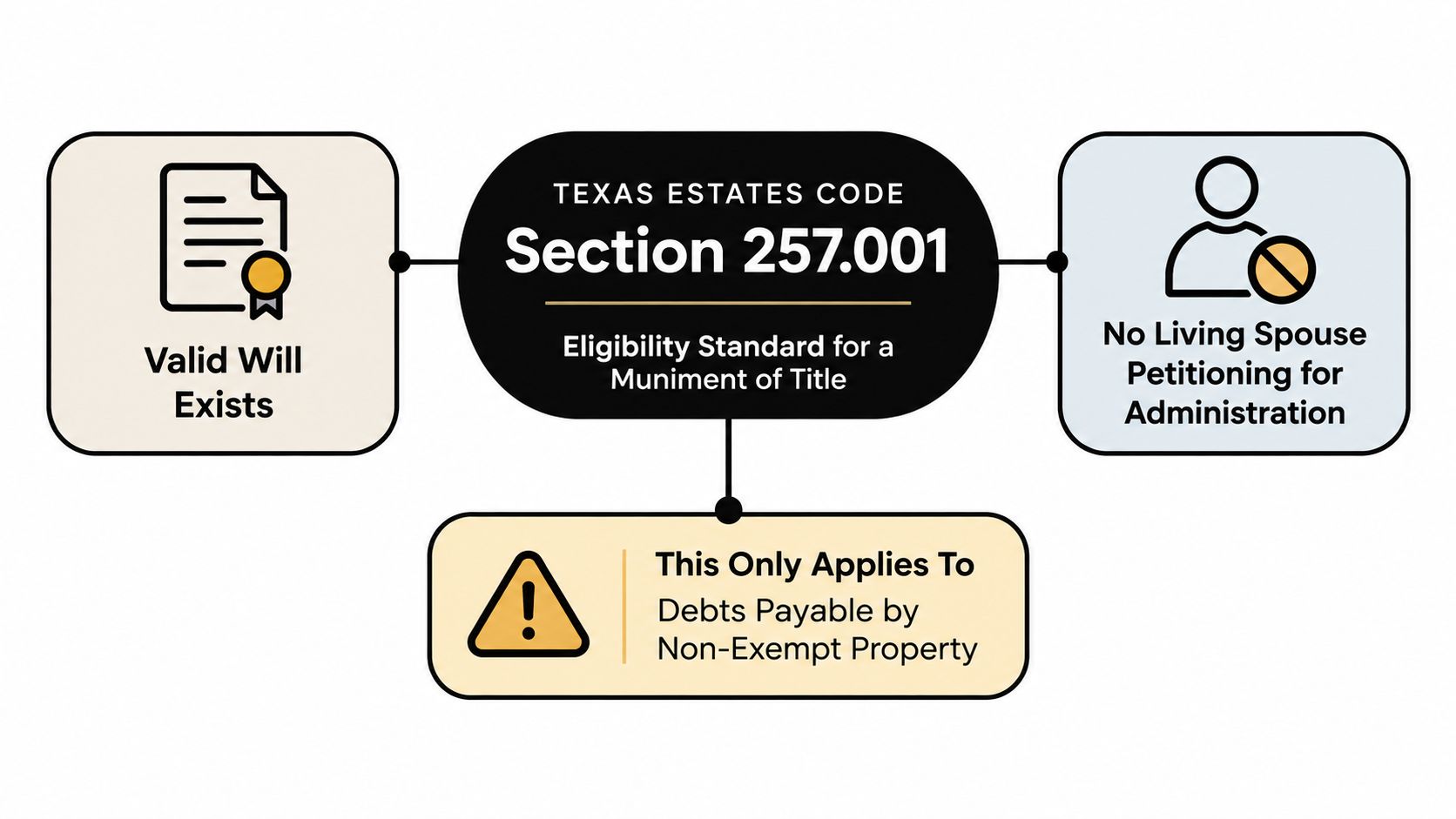
Before making a courthouse trip, look at whether the estate fits Texas Estates Code Section 257.001. The court must determine two things. First, the will should be admitted to probate. Second, either the estate has no unpaid debt other than a debt secured by a real-estate lien, or administration is unnecessary for another legally sufficient reason. The statute provides the governing standard in Texas Estates Code Section 257.001.
Start with the will
The court must be satisfied that the will can be admitted to probate. That usually means the family has the original will and can provide the facts needed to establish its validity. A photocopy may create a separate evidentiary problem, so don't treat a copy as interchangeable with the original.
A paid-off home with no known credit-card, personal-loan, or medical debt may appear suitable for this procedure. By contrast, an estate with unresolved unsecured balances may require a form of administration that gives someone authority to address creditors and manage estate property.
Separate secured and unsecured debt
A mortgage or another debt secured by a lien on real estate is treated differently under the statutory standard. The existence of that lien doesn't automatically prevent a muniment proceeding. Unpaid unsecured debt, however, can change the analysis.
Ask practical questions before filing:
- What bills remain open? Review credit cards, medical accounts, personal loans, and other obligations.
- Does the estate need a person appointed to manage property? If someone must gather assets, handle claims, or take continuing action, a full administration may be more appropriate.
- Are Medicaid issues present? Medicaid-related provisions can affect the proposed order and the court's review.
Once the will is admitted, Section 257.102 gives the order meaningful transfer authority. People holding estate property, money, or title records may transfer or pay those assets without a full administration, and beneficiaries may treat the property as though title were vested in their names.
That legal effect is different from finding a will at home. The court order supplies authority, while later recording helps establish the public chain of title. Families comparing ownership problems in other jurisdictions may also find this explanation of clouded title in California useful, although Texas probate rules control a Harris County filing.
For a Texas-focused overview of the procedure, see the muniment of title resource. Families dealing with separate family-law matters can also consult Harris County Family Courts: A Humble Resident's Guide for information about how family law cases proceed in the Harris County courts serving Humble.
Where to File Your Muniment of Title Application
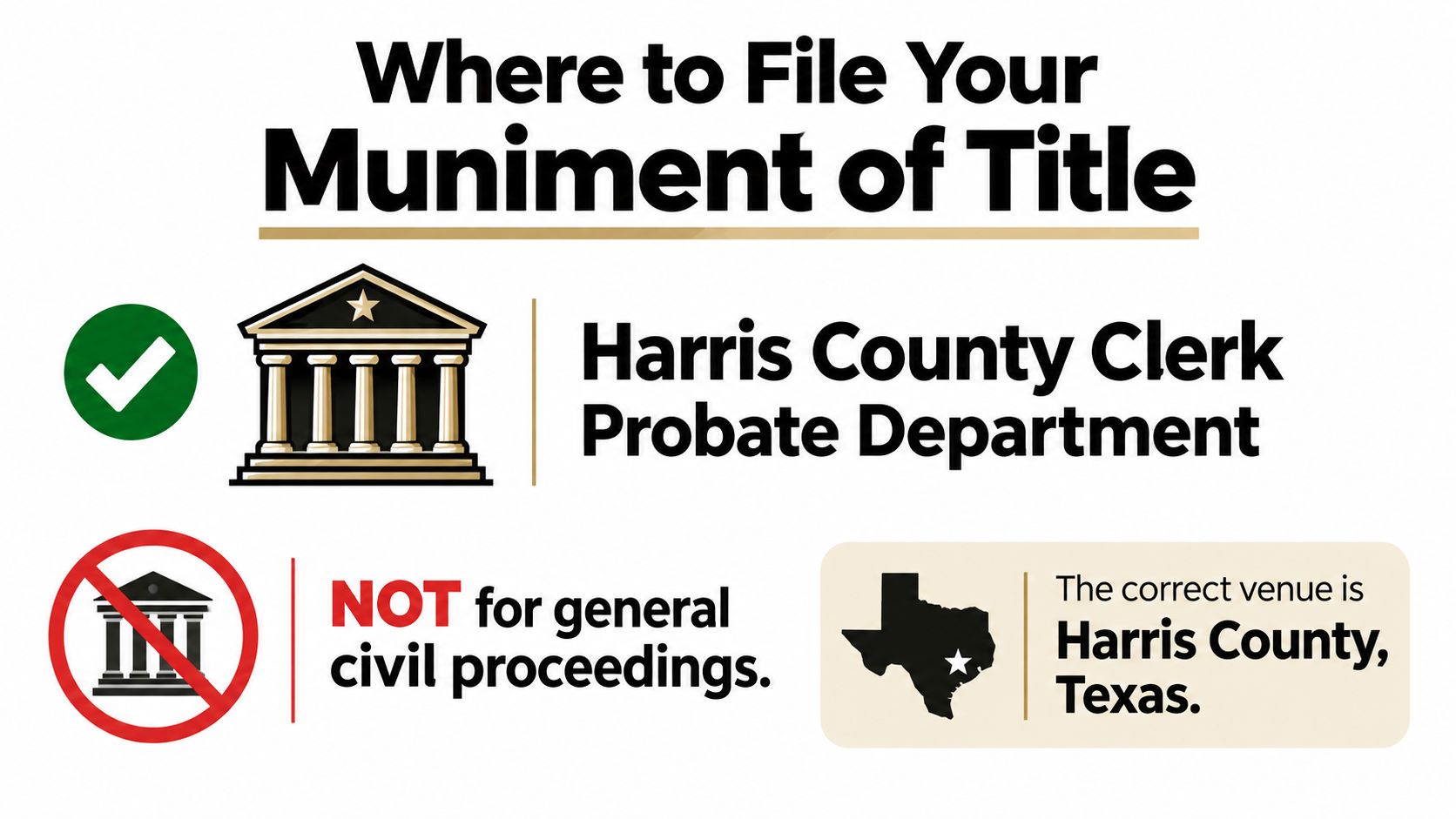
The direct answer to Harris County muniment of title where to file is the Harris County Clerk's Probate Department, not the District Clerk and not a real-estate records office. Harris County identifies this department as the clerk for the county's four statutory probate courts.
The primary filing location is:
Harris County Civil Courthouse
201 Caroline Street, Suite 800
Houston, Texas 77002
Telephone: 713-274-8585
Hours: Monday through Friday, 8:00 a.m. to 4:30 p.m.
The county also publishes this mailing address:
Harris County Clerk
P.O. Box 1525
Houston, Texas 77251-1525
A late-filing drop box is available outside the County Civil Courthouse. Before relying on mailing or the drop box, confirm the current procedure with the county because local filing practices can change. The county's probate court information for Humble families can help orient you to the court system, but the Harris County Clerk remains the filing destination for the probate application.
Confirm the correct venue
A decedent's legal residence generally determines the Texas county where the probate application belongs. If a person lived in Harris County but died in a hospital or nursing facility in another county, the death location doesn't automatically move the probate case.
That rule matters for residents of Humble, Atascocita, Kingwood, and Northeast Houston. Check where the decedent had a home and legal residence before assuming that the courthouse nearest the death location is correct.
Probate Courts 1 through 4 are located at 201 Caroline Street, Houston, Texas 77002. Probate Court No. 5 is located at 1115 Congress Street, Fifth Floor, Houston, Texas 77002. The clerk's filing department and the assigned court are connected, but they are not interchangeable destinations for every document.
The county's official probate materials list these forms:
- Affidavit for Probate of Will as Muniment of Title
- Decree on Muniment of Title
Those names can help you ask for the correct materials instead of requesting a general probate packet. If you're handling property-tax matters separately, an outside 2026 Harris County protest guide may provide useful background, but a property-tax filing is different from probate.
A local family may also speak with a Probate Lawyer in Humble, TX about probate administration and estate settlement in Harris County. The key point remains simple: file the probate application through the Harris County Probate Department first. Property records come later, after the judge signs the order.
Filing the Application and Preparing for the Hearing
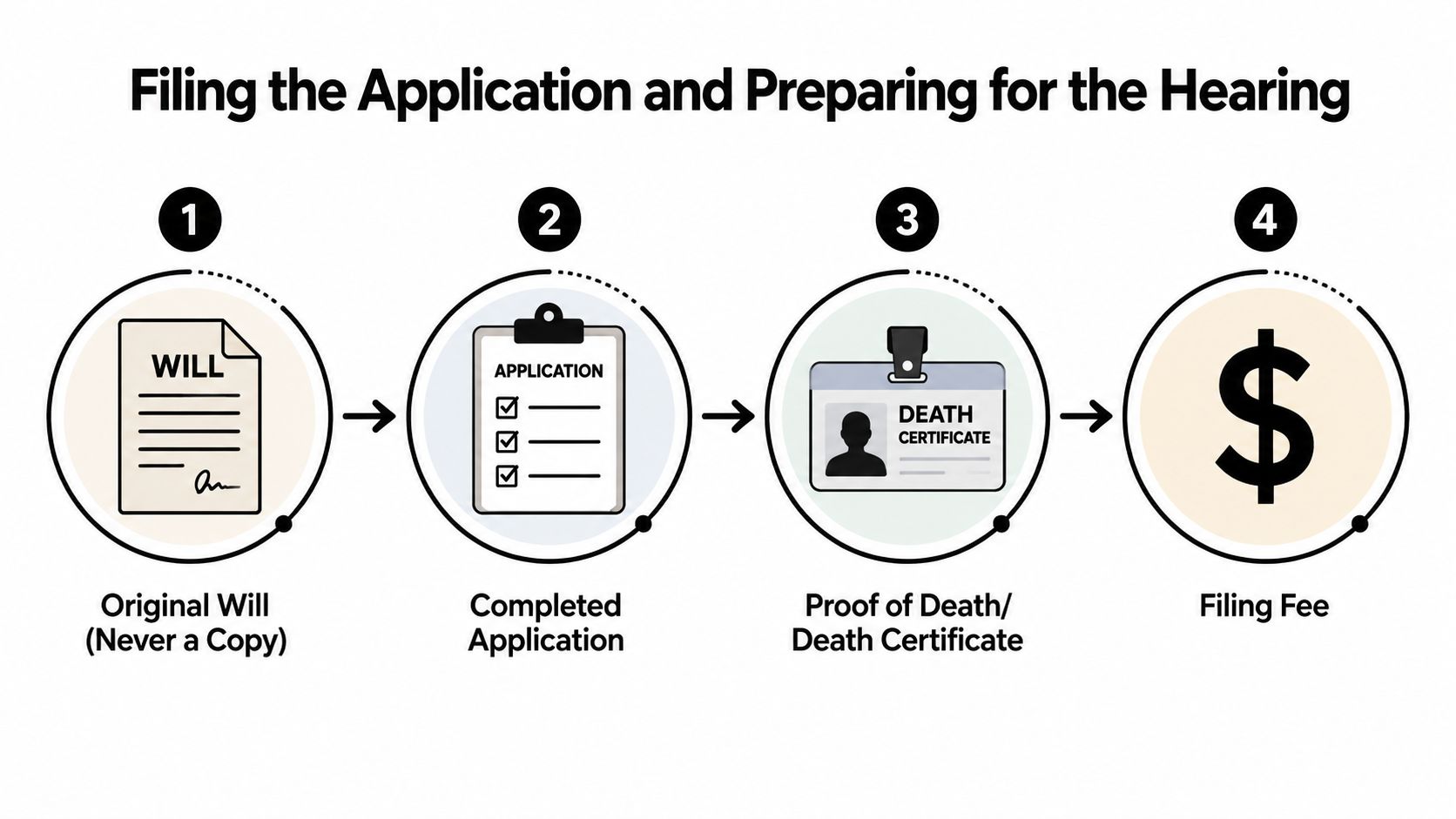
Once you've confirmed venue and eligibility, organize the filing package in the order the court will need it. The central document is the original will. Don't submit a photocopy when the original is available, and don't place the original in a folder without protecting it from damage.
The initial package ordinarily includes:
- Original will: The court needs the document the decedent signed.
- Completed application: The application asks the court to admit the will as a muniment of title.
- Proof of death: A death certificate or other proof accepted by the court may be required.
- Filing fee: Harris County lists $360.00 for a new probate matter in its posted materials. Additional charges may apply depending on service, citation, or other case requirements. See the county's probate forms and filing information for current details.
Prepare for the hearing, not just the filing
Filing the application starts the case, but it doesn't finish it. The court schedules a hearing, and you should confirm whether the hearing will occur in person or remotely. Don't assume the format from an older case or another Harris County court.
Harris County court guidance identifies hearing materials that may include:
- An oath concerning estate debts.
- Proof of death or witness testimony.
- A proposed order addressing Medicaid benefits and unpaid-debt provisions.
The proposed order deserves careful attention. Missing language concerning debts or Medicaid benefits can cause the court to request changes or reset the hearing. The wording isn't decorative. It addresses issues the judge must consider before admitting the will through this limited procedure.
Practical rule: Keep the original will, death proof, application, hearing materials, and proposed order together, but don't send the original anywhere without confirming how the clerk wants it delivered.
Know the limits of self-representation
Harris County guidance indicates that a person may proceed without counsel in a muniment-of-title application only when all beneficiaries are co-applicants. Even in that limited situation, legal representation is recommended.
Self-representation becomes more difficult when beneficiaries live in different places, a beneficiary won't cooperate, the will is unclear, debts are disputed, or Medicaid questions arise. Families who are also trying to manage files for life may find it helpful to create a dedicated estate folder containing the original will location, death records, account statements, property information, and court correspondence.
A hearing is not an automatic approval event. The judge still has to evaluate the will, the debt situation, the evidence, and the proposed order. Preparation gives the court a complete record and gives your family a clearer answer about what happens next.
Recording the Order and Meeting the 180-Day Deadline
The most commonly missed step comes after the hearing. Once the judge signs the order admitting the will as a muniment of title, obtain certified copies of both the will and the signed order. These documents must then be recorded in the official public records of every county where the estate owns real property, as explained in Texas court guidance on post-order compliance.
Filing only in Harris County may be insufficient. For example, if a parent owned a home in Harris County and land in another Texas county, the family should plan for recording in both counties. The probate case may be filed in Harris County because of the decedent's residence, while the title documents must also reach the county where the additional property sits.
Use a county-by-county checklist
For each parcel, identify the county where the property is located, confirm the recording office's requirements, and ask whether certified copies are required. The Texas Supreme Court guidance supports obtaining certified documents before recording, which is a safer approach than assuming an ordinary photocopy will be accepted.
| Action | Where | Deadline |
|---|---|---|
| Obtain a certified copy of the will | Harris County Probate Department or clerk process | After the judge signs the order |
| Obtain a certified copy of the signed order | Harris County Probate Department or clerk process | After the judge signs the order |
| Record the certified will and order | Official real-property records in every county where the estate owns real property | After the order is signed |
| File the sworn affidavit of compliance, unless waived | Harris County court clerk | No later than the 180th day after the will is admitted |
The affidavit of compliance is separate from recording. Under Texas Estates Code Chapter 257, unless an exception applies, the applicant must file a sworn affidavit with the court clerk no later than the 180th day after admission. The affidavit identifies which will terms have been fulfilled and which have not. The Texas Supreme Court guidance similarly refers to an affidavit of compliance due within 180 days after the order is signed when the court hasn't waived the requirement.
Calendar the 180-day deadline immediately after the judge signs the order. Waiting until the property transfer is complete can make this filing easy to overlook.
For a Humble or Northeast Houston family, the working checklist is:
- Confirm every county where the estate owns real property.
- Request certified copies of the will and order.
- Record those documents in Harris County and each additional property county.
- Ask each recording office about formatting and certification requirements.
- Calendar the 180-day affidavit deadline.
- Keep stamped recording evidence with the probate file.
Recording creates the public title trail that institutions, title professionals, and future purchasers may need. The court order is powerful, but the property records still need to reflect it.
Common Pitfalls That Derail Muniment of Title Filings
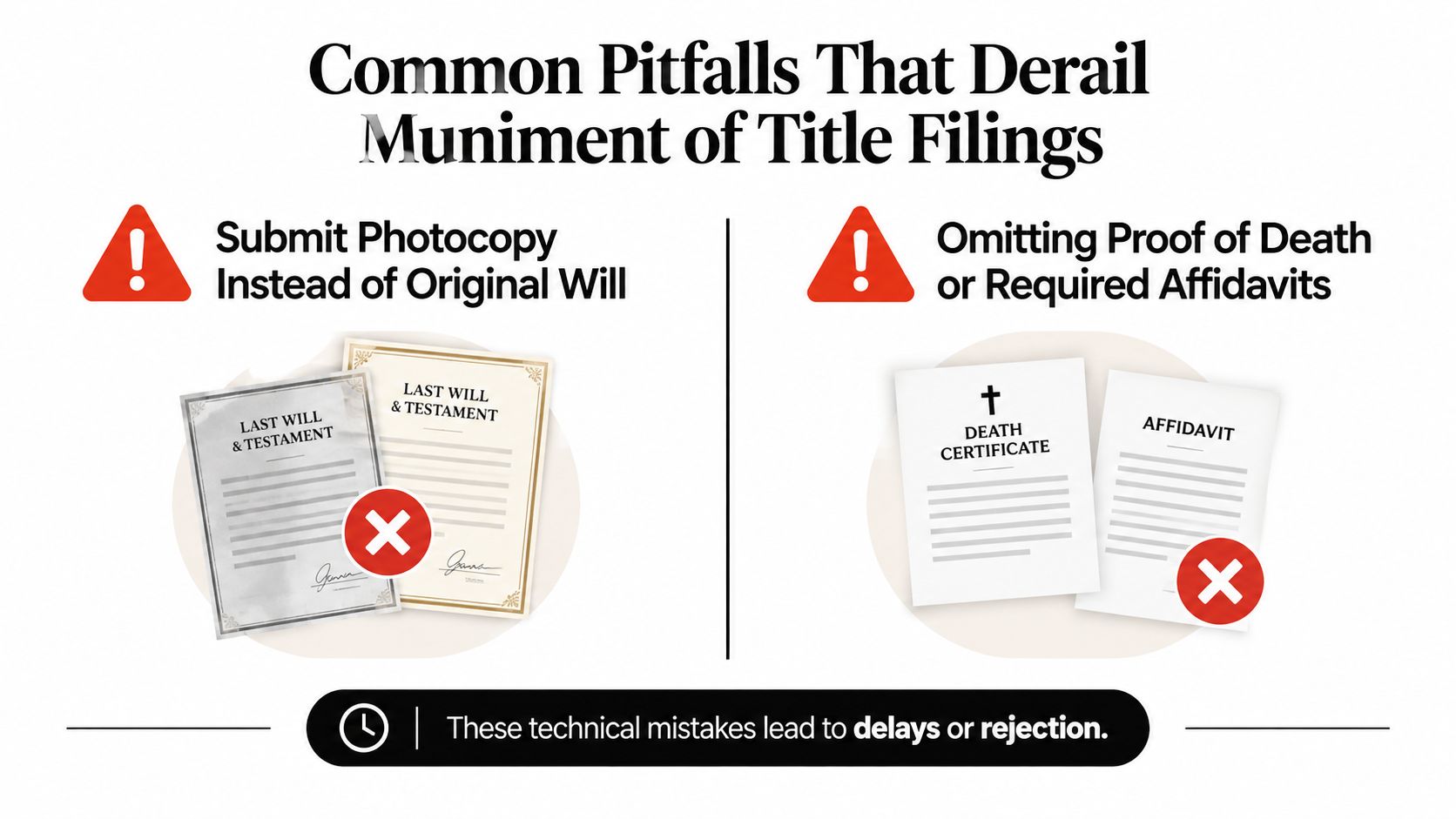
A straightforward estate isn't the same thing as an automatic approval. Small technical errors can cause a filing problem, a hearing reset, or a title company to refuse to close until the record is corrected.
Mistake one, submitting a copy instead of the original will
What the family notices: The clerk asks for the original, or the court cannot move forward on the evidence presented.
How to correct it: Locate and protect the original before filing. If the original can't be found, don't assume the copy will receive the same treatment. A copy can raise separate proof issues that require careful legal preparation.
Mistake two, leaving required language out of the proposed order
What the family notices: The judge or clerk requests revisions, or the hearing is reset.
How to correct it: Review the proposed order for the required provisions concerning unpaid debts and Medicaid benefits. Those provisions address the statutory concerns that distinguish a muniment proceeding from a full administration.
Mistake three, failing to coordinate beneficiary co-applicants
What the family notices: One beneficiary hasn't signed, won't appear, or doesn't understand the filing.
How to correct it: Contact every beneficiary early and confirm who must participate. Self-representation is limited when all beneficiaries are co-applicants, so a disagreement or missing participant may make attorney guidance especially important.
Mistake four, treating the probate order as automatic title transfer
What the family notices: A title company, lender, or buyer says the property records don't show a complete chain of title.
How to correct it: Obtain certified copies and record them in every county where the estate owns real property. Probate admission and public title recording are connected, but they aren't identical.
Government guidance doesn't publish a dependable success-rate or average-processing-time benchmark for these cases. Approval shouldn't be described as automatic where the will is contested, beneficiaries are missing, debts exist, or Medicaid-related issues are present. The Harris County court's muniment-of-title FAQ supports a case-specific approach.
An attorney's involvement can save money when a family is about to file the wrong proceeding, has scattered beneficiaries, discovers debt, or owns property in multiple counties. Paying attention before filing is often easier than repairing a rejected application or incomplete title record afterward.
Conclusion and Free Consultation
For families in Humble, Kingwood, Atascocita, and Northeast Houston, the answer to where to file a Harris County muniment of title begins with the probate court, not the deed records office. Confirm that the estate meets the Texas eligibility standard, then file the original will and application through the Harris County Clerk's Probate Department at 201 Caroline Street, Suite 800, Houston, Texas 77002.
Prepare the hearing materials, including proof of death, the debt oath, and the proposed order addressing Medicaid and unpaid-debt provisions. After the judge signs the order, obtain certified copies of the will and order, record them in every county where the estate owns real property, and track the 180-day affidavit deadline unless the court has waived it.
Some families can manage a simple filing when every beneficiary is a co-applicant, the original will is available, debts are understood, and the property is easy to identify. Other situations deserve legal help from the beginning, especially contested wills, unresolved debts, Medicaid concerns, missing beneficiaries, or land in multiple counties. A lawyer can help determine whether muniment of title is the right procedure before filing fees and hearing preparation begin.
The Law Office of Bryan Fagan provides local support with estate planning, wills, trusts, probate, and related family-law matters. Families seeking focused help with a Harris County probate issue can review the firm's Harris County probate attorney resource near Humble and decide whether a consultation fits their needs.
The Law Office of Bryan Fagan helps Humble-area families review wills, evaluate muniment-of-title eligibility, prepare probate filings, and address recording and compliance questions. Schedule a free consultation with the Humble office by visiting Law Office of Bryan Fagan to discuss your family's next step.