Skip to content
A Humble parent can spend the drive from Atascocita to downtown Houston preparing to speak with a district judge, only to see “Associate Judge” on the docket. The question is immediate: does that judge have the same authority, will the ruling count, and will the case have to start over if the parent disagrees?
The answer matters for families from Humble, Kingwood, Atascocita, and Northeast Houston because the judge assigned to a hearing affects preparation, timing, settlement position, and the cost of presenting evidence. The Harris County associate judge vs district judge family docket is not a choice between a "real" judge and an unimportant one. It's a system with two judicial roles, different limits, and a built-in review process.
Hearing a Name You Did Not Expect on Your Family Case
You arrive at the Family Law Center after leaving Humble early, allowing for the drive in from Atascocita, downtown traffic, the parking line, and the possibility that your case won't be called immediately. You've organized messages, school records, support-payment information, and a proposed possession schedule. Then you look at the docket and see an associate judge listed instead of the district judge you expected.
That moment can feel like the court has downgraded your case. It hasn't. An associate judge is a judicial officer assigned to handle referred family-law matters, and Texas law gives that judge meaningful authority over hearings, evidence, witnesses, and many orders. The important question isn't whether the associate judge is legitimate. It's what authority was referred and whether the ruling is final or subject to action by the referring district judge.
The courtroom question most parents actually have
A parent may wonder whether a temporary-orders hearing is less important because it's before an associate judge. That's the wrong way to think about it. Temporary support, possession, injunctions, enforcement, and other interim decisions can shape the family's daily life while the case continues.
The associate judge can conduct substantial courtroom work within the referral. Under Texas Family Code Section 201.007, that can include hearing evidence, ruling on admissibility, examining witnesses, issuing witness summonses, compelling relevant evidence, and regulating the proceeding. The referral order still matters because it defines the limits of that authority.
You also don't automatically start over because the associate judge handled the hearing. The law provides a route for a fresh hearing before the referring district judge when the statutory requirements are met. That process can be powerful, but it requires close attention to notice, deadlines, evidence, and the practical cost of presenting the case again.
Practical rule: Treat an associate-judge hearing as a consequential court event. Prepare as though the judge's decision will affect your family immediately, while preserving every available review option.
The rest of the issue comes down to the bench's role. The associate judge often handles the working docket. The district judge remains the constitutional trial judge and the final decision-maker in the situations Texas law reserves to that court. Understanding that division is more useful than reacting to the title on the docket sheet.
How Harris County Built a Two-Tier Family Court System
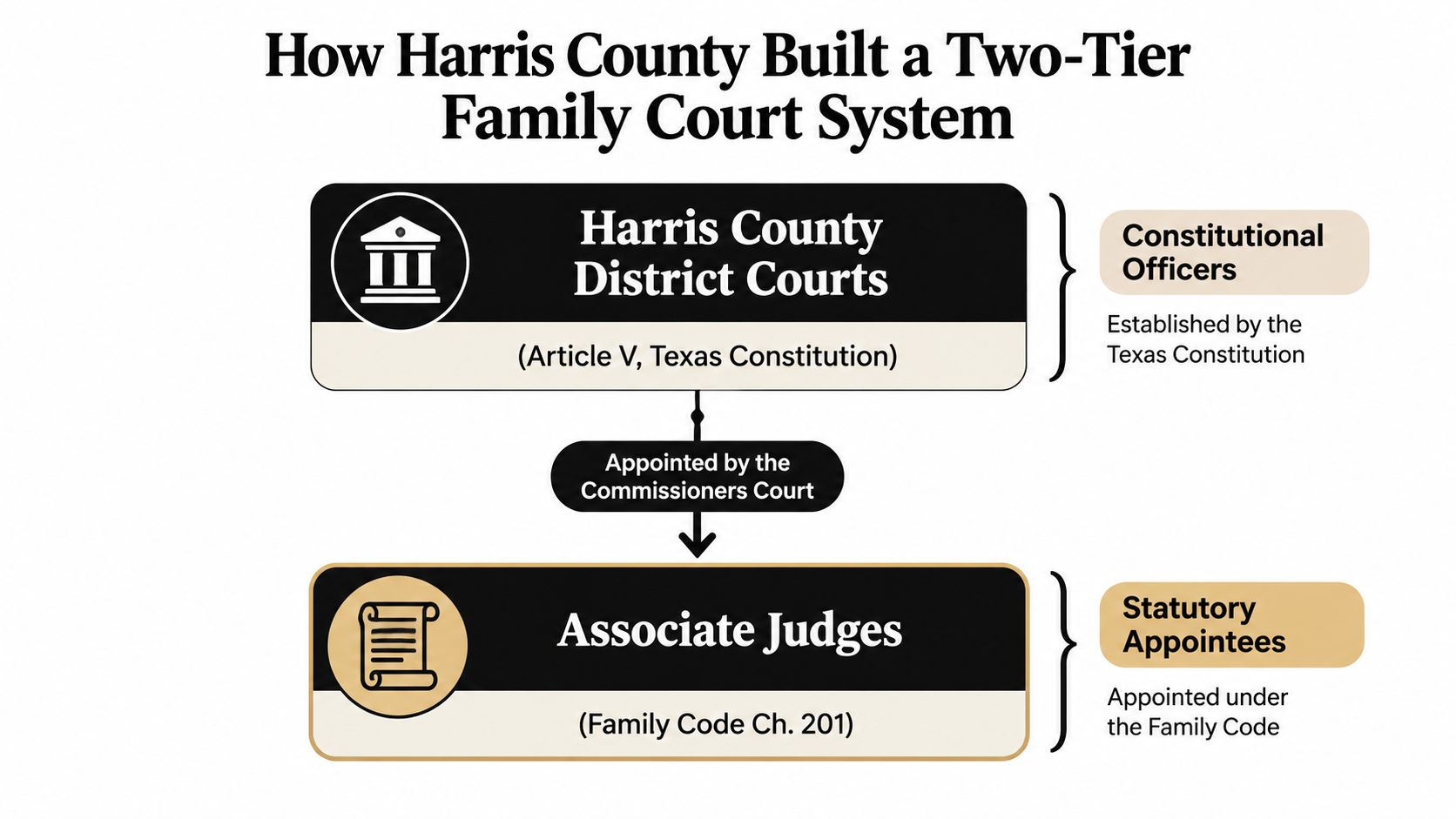
Harris County currently funds 10 Family Division Associate Judges, and county materials describe those positions as full-time and permanent under Texas Family Code provisions including Sections 201.001, 201.101, and 201.003. The county materials also explain that associate judges receive about 90% of a district court judge's salary for 0 to 4 years of service. In 2024, the materials stated that if district-judge salaries rose to a $193,000 minimum with a possible $200,000 maximum, the associate-judge range would reset to $173,700 to $180,000. Those figures appear in the Harris County legislative materials concerning Family Division Associate Judges.
The salary relationship tells you something about the structure. A district judge is a constitutional trial judge. An associate judge is a county-funded judicial officer created to handle referred family-law matters and help manage the volume moving through Harris County's family courts. The difference isn't a statement about whether one person is intelligent, experienced, or committed. It's a difference in the source of authority and the finality of decisions.
Referral creates capacity without replacing the district court
Texas Family Code Chapter 201 allows a family district court to refer aspects of a family-law case to an associate judge. That referral system lets the associate judge handle hearings and other work while keeping the district judge connected to final authority, objections, and de novo review.
The Texas Courts overview of associate judges describes associate judges as assisting courts in family-law matters under Chapter 201, including matters within Titles 1, 4, and 5 of the Family Code. In practical terms, the associate bench is part of the court's operating system. It isn't a separate courthouse where families receive a weaker form of justice.
Harris County's own docket search reflects this separate layer. The Harris County District Clerk docket system lists dedicated “ASSOCIATE JUDGE DOCKET” calendars alongside other family docket types. That arrangement shows how the county processes family cases: district courts retain their constitutional role, while associate judges handle referred work within the statutory framework.
A parent should therefore ask three questions before a hearing:
- What was referred? Identify whether the referral covers the entire hearing, particular issues, or a defined category of relief.
- What can be signed? Determine whether the associate judge can issue an order, make a recommendation, or conduct the hearing subject to district-court action.
- What review is available? Track notice and objection deadlines before deciding whether to accept the result or seek a new hearing.
Side-by-Side Comparison of Authority on the Family Docket
A Humble parent can spend most of a hearing before an associate judge and still have the district judge control the case's final direction. The practical question is not which title sounds more powerful. It is what the referral order permits that judge to hear, decide, and sign.
| Authority Area | Associate Judge | District Judge |
|---|---|---|
| Referred hearings | May hear evidence, question witnesses, manage the proceeding, and decide matters within the referral | May hear the matter directly and controls the referral relationship |
| Temporary family-law disputes | Commonly handles referred temporary orders and related hearings | May hear the dispute directly or review it through the statutory process |
| Evidence and witnesses | May rule on admissibility, require relevant evidence, and issue summonses within the referral | Exercises district-court authority over the case and its final disposition |
| Final merits rulings | Generally recommends a disposition or issues orders subject to Chapter 201 limits | Enters final merits rulings and postjudgment orders in matters reserved to the referring court |
| Objection and review | A timely objection can prevent the associate judge from conducting a trial on the merits | Hears the case when a timely objection requires it and may conduct a de novo hearing |
| Docket function | Handles a separate, referred layer of family-case processing | Remains the constitutional trial court and final judicial authority |
The referral, not the title, controls
A timely objection can prevent an associate judge from hearing a trial on the merits. Texas Family Code Section 201.005 gives a party 10 days after notice to object to the associate judge hearing that trial. If the objection is timely, the referring district judge must hear the case.
Section 201.104 sets another boundary. An associate judge may hear evidence, issue many nonfinal orders, and recommend a disposition. The referring court enters final merits rulings and postjudgment relief orders in the situations covered by the statute. The Texas Attorney General opinion discussing Chapter 201 referral and de novo procedures explains why the district judge remains the backstop for review.
That distinction affects custody, support, and property disputes. An associate judge may control the evidence, set the pace, and issue a ruling that immediately changes a family's position. If a party properly objects or requests available statutory review, the district judge becomes the decision-maker for that next stage.
The hearing type also matters. A Title IV-D child-support matter may be placed on an associate judge's docket, while a broader divorce dispute may involve property division, contested conservatorship issues, or other matters requiring district-court attention. The Harris County Title IV-D associate judge child support docket gives local parents useful context about that specialized docket.
For a Humble or Northeast Houston family, review the referral before choosing a courtroom strategy. A parent may save time and expense by presenting a focused issue to the associate judge. A party facing a merits trial, complicated property evidence, or a serious credibility dispute should prepare for district-court involvement instead of assuming the associate hearing ends the case.
A guide to divorce representation options in Humble and Harris County can help a client assess whether the dispute belongs in an associate setting, needs district-court attention, or is better resolved by agreement.
Child-protection cases require even closer attention. Associate judges may hear emergency CPS matters and sign orders involving state custody when the governing referral and law authorize that action. The referral order, requested relief, and review procedure should be identified before the first appearance.
What Happens at Hearings in Front of Each Judge
For a Humble parent, the courtroom often depends on the issue listed for hearing. A temporary-orders dispute, support review, enforcement matter, or uncontested prove-up may reach an associate judge's docket. A final custody trial or complicated property dispute is more likely to require district-court attention. Check the referral and notice before preparing for the wrong kind of hearing.
An associate docket usually moves quickly. Several matters may be ready for decision that day, so each side should identify the legal issue, offer admissible proof, and state the requested relief without burying the judge in relationship history. Focused preparation can reduce attorney time and hearing expense, especially when the dispute turns on records rather than extended testimony.
A parent may address temporary possession, child-support information, missed reimbursements, or an enforcement allegation. Live testimony and exhibits remain possible, but the presentation must connect each fact to the order requested. Payment records, calendars, messages, and relevant financial documents carry more weight than a long account of why the relationship failed.
The district setting has a different texture
A district-court hearing generally allows more room for a contested trial, detailed evidentiary disputes, property testimony, and credibility questions. A parent who claims the other party is unreliable still needs admissible facts, corroborating records, and witnesses describing what they personally observed. More courtroom time can mean higher preparation and representation costs, but a fuller record may matter when the court must decide final relief.
The Harris County family-court hearing guide explains the basic experience of appearing in family court. The preparation principles remain consistent, while the depth of proof and time available can change with the judge and referral.
| Hearing Type | Associate Judge | District Judge |
|---|---|---|
| Temporary orders | Focused presentation of immediate support, possession, or protective relief | May hear the issue directly or receive it through referral and review |
| Enforcement | Evidence of the existing order, alleged violation, and requested remedy | Handles the matter directly when it stays with the district court or comes through review |
| Child-support review | Financial records and payment history within the referred proceeding | May decide it directly or use the statutory review structure |
| Uncontested prove-up | Streamlined presentation when the requirements are met | May enter the final order when the case is before the district court |
| Contested custody trial | May hear referred evidence within the referral's limits | Common forum for a full trial and final disposition |
| Complex property dispute | May address referred issues, subject to confirmed authority and finality | More likely to control the full trial and final merits ruling |
Bring a labeled binder or organized digital file. Separate financial records from parenting evidence. Include a proposed order the judge can review quickly, and list witnesses with personal knowledge rather than people who only know that you are upset.
A persuasive family-court presentation answers three questions quickly: what happened, what proof establishes it, and what exact order should the judge sign?
Objecting, Appealing, and Getting a De Novo Review
A de novo hearing gives the referring district judge a fresh opportunity to hear the matter. It is not a quick check of whether the associate judge's ruling “looks right.” In a Humble or Northeast Houston case, that difference can mean preparing the witnesses, exhibits, and legal arguments again, then waiting for another district-court setting.
The process in plain English
Read the notice carefully. The deadline may run from notice of the associate judge's ruling or from the relevant hearing event. Do not assume the clock starts when you first have time to review the order.
File a written objection on time. Under Texas Family Code Section 201.005, a party has 10 days after notice to object to an associate judge hearing a trial on the merits. A timely objection requires the referring judge to hear the case.
Request the appropriate de novo hearing. When the statute permits de novo review, the referring district judge must hear a timely request within 30 days. The Texas Attorney General's explanation of Chapter 201 review procedures explains the district judge's role in reviewing an associate judge's determination.
Prepare for a new presentation. De novo review allows the district judge to consider the matter anew under the governing procedure. Your attorney should identify which witnesses, exhibits, objections, and legal arguments must be presented again rather than assuming the first record will carry the case.
The practical cost can be substantial. A parent may need to prepare witnesses twice, reorganize financial or parenting evidence, and wait for a district-court date. For a family near Humble, that delay can affect school transportation, possession exchanges, child-support payments, and attorney fees. It can also keep an unstable temporary arrangement in place longer than expected.
Objecting automatically is rarely a sound strategy. A fresh hearing may be justified when the associate judge made a serious legal or factual error, misunderstood key evidence, or entered relief that creates immediate problems. The decision should also account for whether the current ruling is favorable, whether the available evidence will improve on review, and whether the added expense is worth the likely result.
The direct-appeal route is separate from de novo review. Its availability depends on the order involved and the statutory grounds that apply. When Chapter 201 provides an objection or de novo remedy, an appeal does not replace that step. Missing the first deadline can eliminate options that cannot be restored later.
Choosing the Right Path for Humble and Northeast Houston Families
For routine family matters, the associate path is usually the sensible path. If both parents agree on a modification, the divorce is uncontested, or the dispute concerns a focused temporary issue, a referred hearing can resolve the problem without treating a narrow disagreement like a full trial.
That doesn't mean a parent should rush. It means the parent should match the preparation to the dispute. A focused hearing requires focused evidence, a workable proposed order, and a clear explanation of the relief requested.
Accept the associate setting when the dispute is narrow
The associate bench often makes sense when:
- The parties agree. An agreed modification or uncontested prove-up usually doesn't need the same trial strategy as a credibility-heavy custody fight.
- The relief is temporary. Temporary orders can be important, but the immediate issue may be limited enough for a referred hearing.
- The records tell the story. Payment histories, reimbursement records, calendars, and written agreements can support a concise presentation.
- Settlement remains realistic. A prompt, well-prepared hearing can help both sides understand the risk of continuing to litigate.
Push for district-court involvement when the case turns on a final merits decision, complex property evidence, a contested custody trial, or witness credibility that cannot be evaluated fairly from a short presentation. A district setting may take more preparation and patience, but finality and a fuller trial record can justify that investment.
Use a simple decision rule
Ask yourself: Can the judge decide this dispute from a defined set of documents and short testimony, or does the outcome depend on a full evaluation of people, property, and competing narratives?
The first answer points toward an associate setting, assuming the referral covers the issue. The second points toward district-court strategy or careful consideration of objection and de novo rights. For families leaving Chenault or traveling from Kingwood and Northeast Houston, that question is more useful than choosing a bench based only on the judge's title.
Working With a Local Family Attorney Through Either Court
A local lawyer should help you identify the assigned bench, review the referral, isolate the legal issue, and prepare evidence for the actual hearing format. That preparation looks different for a focused associate setting than for a district-court trial involving extensive testimony, property records, or contested custody evidence.
Bring the operative orders, pleadings, notices, financial records, relevant communications, school or medical records, and a short chronology. Don't bring a disorganized phone full of screenshots and expect the judge to build the case for you. A lawyer should explain which documents matter, which witnesses have personal knowledge, and what fee structure applies before substantial work begins.
A practical consultation checklist
- Confirm the setting. Ask whether the matter is before an associate judge, a district judge, or a referring court after review.
- Protect deadlines. Mark the notice date and ask counsel to evaluate any 10-day objection period immediately.
- Define the requested order. Write down the exact possession, support, enforcement, or other relief you want.
- Discuss cost and timing. Compare resolving the issue in the assigned setting with the cost and delay of seeking a new district-court hearing.
- Plan for settlement. A strong hearing plan can improve negotiations even when the case doesn't reach trial.
The Law Office of Bryan Fagan provides family-law guidance for Humble, Atascocita, Kingwood, and Northeast Houston residents dealing with divorce, custody, child support, and property disputes. Families researching how a firm communicates its legal services online may also find law firm AI visibility strategies useful as a separate resource, but courtroom preparation still depends on the facts, pleadings, orders, and deadlines in the individual case.
The Law Office of Bryan Fagan offers consultations for Humble-area families who need to understand an associate-judge referral, district-court strategy, or de novo review deadline. Visit Law Office of Bryan Fagan to schedule a consultation and discuss the next practical step in your Harris County family case.