Skip to content
The Harris County protective order process typically takes four to six weeks from intake to obtaining an order. Residents should call the Protective Orders Section at 713-274-0212 to begin.
If you're in Humble, Atascocita, Kingwood, or another Northeast Houston community and worried that a former partner or family member may hurt you or your children, the next step can feel unclear. The Harris County District Attorney protective order division intake process isn't a standard walk-in filing at a clerk's counter. It's a structured intake pipeline that starts with trained domestic-violence professionals who help document what happened and prepare the matter for review.
That human review matters. You don't have to know every legal term or present a perfect courtroom argument on your first visit. You do need to explain the situation accurately, bring what information you have, and understand what happens before a judge considers the request.
Understanding Your Options for Safety in Harris County
A Humble parent may be sitting in a parked car outside work, checking the phone repeatedly because a former partner has sent threatening messages. Another person in Kingwood may be trying to decide whether repeated unwanted contact has crossed into conduct requiring court protection. In Atascocita, a family may be weighing safety concerns involving children, housing, and school routines all at once.
Fear often makes ordinary decisions difficult. You may wonder whether calling law enforcement is enough, whether you qualify for a protective order, or whether asking for court protection will make the situation worse. Those concerns are understandable, but you don't have to solve the entire legal process before seeking help.

What a protective order can do
A protective order is a court order designed to address conduct that threatens a person's safety. Depending on the facts and the order issued, it may establish legally enforceable restrictions involving contact, harassment, threats, or proximity. The specific protections depend on the allegations, the evidence, and the court's findings.
The Harris County District Attorney's Office describes its protective-order framework as serving victims of family violence, stalking, sexual assault, sexual abuse, and human trafficking. That broad framework recognizes that safety concerns don't all arise from the same relationship or pattern of conduct. A person may need help after violence in a household, repeated stalking by a dating partner, or another qualifying situation.
Your immediate safety comes first. If you're in immediate danger, contact emergency services and move to a safer location if you can do so safely. A protective-order application is a legal step, not a substitute for emergency assistance.
Residents in Northeast Houston also have different legal and community resources available depending on the circumstances. A protective order may be part of a larger safety plan involving law enforcement, trusted relatives, advocates, housing support, and legal counsel. You don't need to wait until you have every document assembled before asking the Protective Orders Section how to begin.
Navigating the DA Protective Order Intake Process
The Harris County process works as a structured intake pipeline, not a simple walk-in filing system. The county explains that applicants first meet with a specially trained domestic-violence caseworker or social worker. That professional helps document the applicant's statement and assemble a file for review by a domestic-violence prosecutor. If the matter is approved, it's filed in family court, and the applicant is notified of the hearing date. The official Harris County protective-order guidance provides the county's process information.
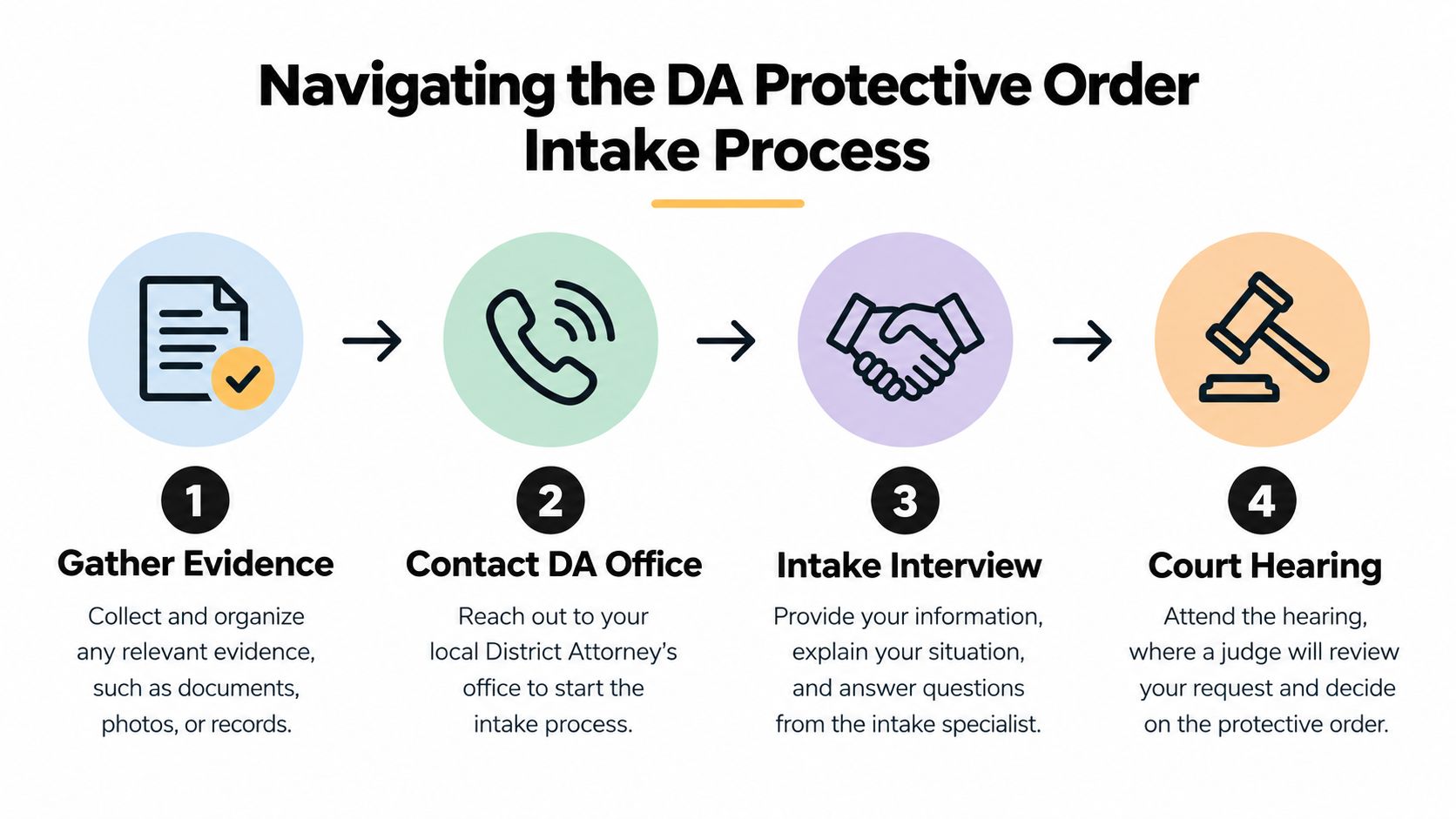
Four practical steps
Call the Protective Orders Section. The division can be reached at 713-274-0212. Calling helps you identify the correct access point and understand what to bring before traveling from Humble, Kingwood, Atascocita, or another part of Northeast Houston.
Attend the intake interview. Protective-order interviews are handled first-come, first-served, Monday through Friday from 8 AM to 3 PM in the Family Criminal Law Division, according to the Harris County District Attorney's Office office information. Arrive prepared to explain the relationship, incidents, threats, injuries, unwanted contact, and safety concerns in chronological order.
Work with the caseworker or social worker. The intake professional isn't the judge and doesn't issue the final order. Their role is to help document your statement and organize the file so a domestic-violence prosecutor can review the facts. Clear details are more useful than legal conclusions. Explain what happened, when it happened, who witnessed it, and why you're afraid now.
Prepare for family court if approved. If the prosecutor approves the case, it's filed in family court. The county then notifies the applicant of the hearing date. The process typically takes four to six weeks from intake to obtaining an order, so ask about safety planning during the waiting period rather than assuming protection begins immediately.
Small administrative habits can help during a stressful process. Keeping documents in a secure folder, labeling messages by date, and writing down follow-up questions can reduce confusion. For general small firm efficiency tips, administrative support resources may also offer ideas for organizing information, although they don't replace legal advice or the county's intake process.
For court scheduling questions, review the Harris County 280th District Court protective order docket and confirm current information with the appropriate court or DA office. Residents can also learn about Protective Orders in Humble in domestic violence and family safety matters.
Eligibility and Types of Protective Orders Explained
Texas protective-order law uses different categories because not every safety situation involves the same relationship or conduct. The first question usually concerns what happened, followed by who the other person is and what protection is needed.
A family-violence protective order may be relevant when the alleged conduct involves a family member, household member, or dating partner, depending on the facts. Family relationships can include people related by blood or marriage, while household and dating relationships raise different questions about shared living arrangements or the nature of the relationship. The legal analysis depends on the specific circumstances, so a person shouldn't assume that the absence of a current marriage ends the inquiry.
A stalking protective order addresses a different pattern. Repeated unwanted conduct, surveillance, threats, or contact may raise stalking concerns even when the parties don't share a household or family relationship. The intake team needs concrete details about the conduct, not only a description such as “I feel uncomfortable.” Dates, messages, locations, witnesses, and changes in behavior can help explain the pattern.
Temporary and longer-term protection
People often confuse an emergency temporary order with a protective order that follows a fuller court process. An emergency measure is intended to address urgent safety concerns for a limited period while the court considers next steps. A longer-term protective order requires the court to evaluate the evidence and determine what restrictions are legally appropriate.
The order may also address children and practical safety issues, but the court's authority depends on the pleadings, evidence, and statutory requirements. Don't assume that an order automatically resolves custody, divorce, housing, or every communication issue. Those matters may require separate family-law action.
The difference between these remedies and other court orders can be confusing. A plain-language comparison of a protective order versus a restraining order in Humble can help you identify which legal tool may fit your situation, but a lawyer should evaluate the facts before you rely on a particular filing strategy.
Criminal vs Civil Protective Orders in Houston
The word “protective order” can describe paths that involve different offices, procedures, and responsibilities. That's why a person in Humble or Northeast Houston shouldn't choose a filing route based only on a form found online.
The DA intake path begins with the Harris County District Attorney's protective-order program. A trained caseworker or social worker documents the applicant's statement and assembles information for a domestic-violence prosecutor. If approved, the matter is filed in family court, and the applicant receives notice of the hearing date. The DA's office provides an important intake and prosecution function, but it doesn't act as the applicant's private attorney.
A civil protective-order path may involve filing through a court or clerk under the applicable Texas procedures, including a Justice of the Peace or county-level court in circumstances where that court has authority. The person seeking protection generally must present the allegations, request the appropriate relief, follow service requirements, and prepare for the court's questions. Because the correct court and procedure depend on the facts, filing in the wrong place can create delay and confusion.
Choosing the path responsibly
| Question | DA intake path | Civil filing path |
|---|---|---|
| Starting point | Protective Orders Section and its intake professionals | Appropriate civil court or clerk |
| Initial support | Caseworker or social worker helps document the statement | Applicant or private counsel prepares the filing |
| Review | Domestic-violence prosecutor reviews the assembled file | Judge evaluates the pleadings and evidence |
| Representation | The DA's office represents the government's interests | The applicant may seek private legal representation |
| Court connection | Approved matter is filed in family court | Court and filing route depend on jurisdiction and facts |
These paths aren't interchangeable, and one may be more appropriate than the other depending on the relationship, allegations, urgency, and evidence. A private attorney can help you understand whether the DA intake process, a civil filing, or another safety-related legal step is worth pursuing.
The key practical distinction is responsibility. County intake professionals can guide the program's process, but you remain entitled to seek independent advice about your rights, children, evidence, and hearing preparation.
Preparing for Your Intake Interview and Hearing
Preparation doesn't require a perfect file. It means gathering information that helps another person understand the pattern and assess the immediate safety concern.
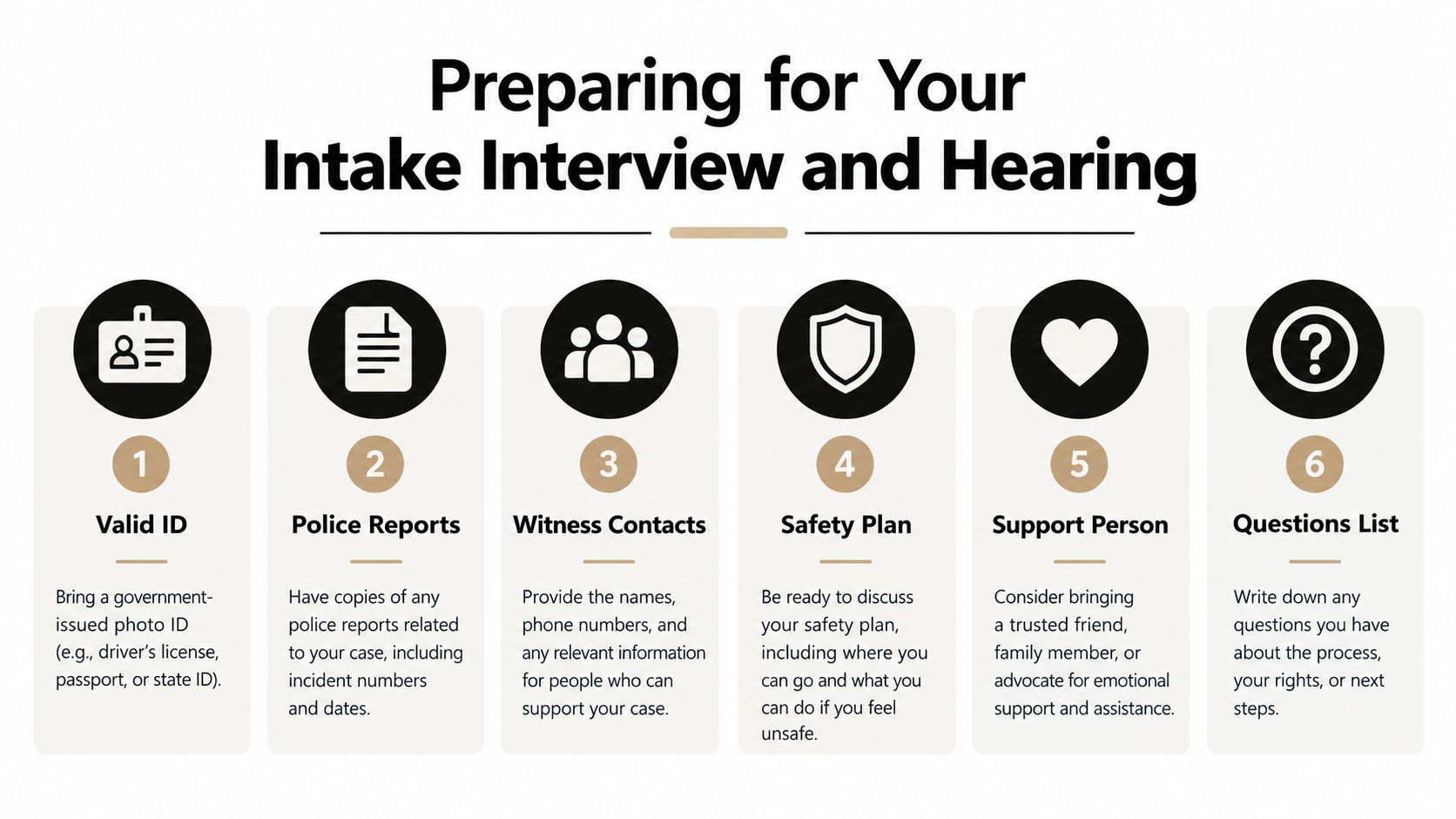
Build a clear factual record
Start with a written timeline. For each important event, note the date, location, people present, what was said or done, injuries or property damage, police involvement, and any continuing contact. If you don't know an exact date, say that it's approximate rather than guessing.
Bring or securely organize materials such as:
- Police reports: Include report information and the agency involved when available.
- Medical records: Identify treatment connected to the alleged violence or injury.
- Text messages and emails: Preserve complete conversations where possible, including dates and sender information.
- Photographs or recordings: Keep original files and note when they were created.
- Witness information: Write down names and safe contact details for people who personally observed relevant events.
- Child-related concerns: Explain threats, attempted contact, school issues, or conduct affecting the children.
Don't edit threatening messages or delete information because it seems embarrassing. Tell the caseworker what you have and ask how it should be submitted. Also consider whether the other person can access your phone, email, cloud storage, or location settings. Use a safer device or account when necessary.
Understand what follows approval
If a domestic-violence prosecutor approves the matter, the case is filed in family court. The applicant is then notified of the hearing date. Use the waiting period to review your timeline, identify the specific protections you need, and plan transportation, childcare, and safe communication.
The Harris County Family Law Center location and floor information can help you plan for a court visit. Confirm current location and scheduling details before traveling, and keep your identification, notices, and organized evidence together.
At the hearing, answer questions directly. Don't exaggerate, speculate about the other person's intentions, or argue with the opposing party. A focused explanation of the conduct and your safety concerns is more helpful than a long account of every conflict in the relationship.
Why Local Legal Support Matters in Humble
A protective-order intake interview is important, but it isn't the same as having your own lawyer. The DA's office has its role in reviewing and prosecuting qualifying matters. Your private attorney can focus on your interests, help you organize the statement, identify legal issues, and prepare you for questions that may arise in family court.
That support can be especially valuable when the situation overlaps with divorce, child custody, criminal allegations, housing, or financial concerns. A safety decision involving a child may affect parallel family-law proceedings, while a criminal case may create additional communication and evidence issues. Residents of Humble, Atascocita, Kingwood, and Northeast Houston often need a coordinated explanation of how those matters may interact.

What a lawyer can help you do
A local attorney may help you:
- Prepare the narrative: Organize events in a factual timeline without minimizing threats or overstating uncertain details.
- Identify the right remedy: Compare DA intake, civil protective-order procedures, emergency relief, and related family-law options.
- Prepare for court: Review testimony, documents, witnesses, and the restrictions you're asking the judge to consider.
- Protect related interests: Address custody, divorce, criminal-defense, or enforcement concerns that may arise alongside the safety matter.
You don't need to face the Harris County system without guidance. Legal support won't guarantee a particular result, but it can give you a clearer plan and help you make informed decisions during an emotionally difficult process.
The Law Office of Bryan Fagan offers family-law and criminal-defense guidance for Humble residents navigating protective orders, custody concerns, and related legal challenges. Visit Law Office of Bryan Fagan to request a free consultation with the Humble office and discuss practical next steps for your safety and legal interests.