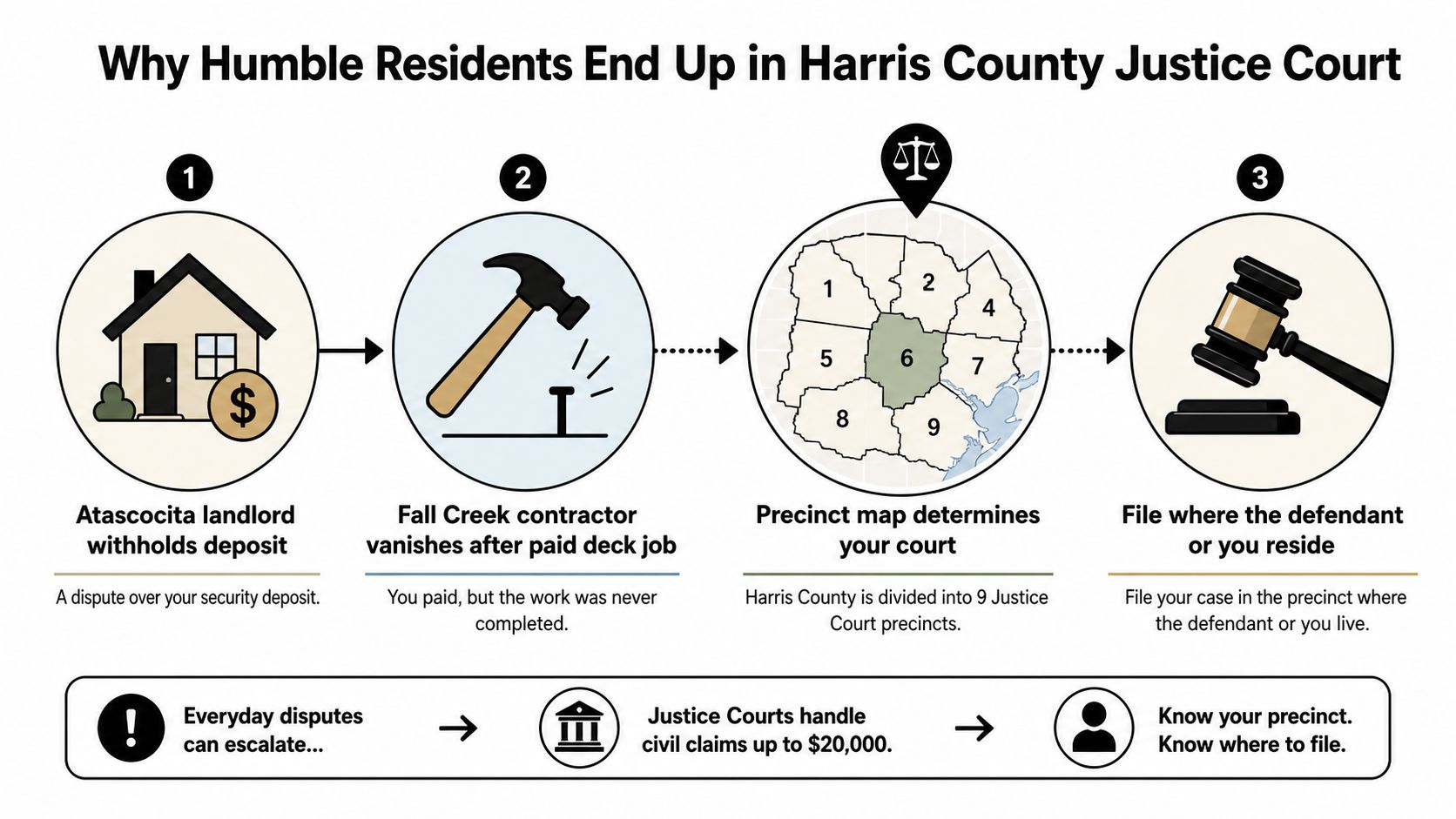
You're in Humble because someone owes you money, not because you wanted a courtroom project. Maybe an Atascocita landlord kept a deposit without a convincing explanation. Maybe a contractor accepted payment for a deck in Fall Creek and stopped answering. The practical question is simple: which Harris County Justice of the Peace precinct should receive your small-claims case, and what happens after you file?
The answer isn't always determined by the word “Humble” in your address. Harris County uses precinct boundaries to organize its Justice of the Peace courts, and venue usually depends on where the defendant lives, where the dispute happened, where a contract was to be performed, or where property involved in the claim is located. The courthouse address matters, but it's only the first step.
Why Humble Residents End Up in Harris County Justice Court
Harris County Justice of the Peace courts are organized into eight precincts, with two justices of the peace in each precinct. Those boundaries affect where many small claims and other civil cases must be filed, including disputes involving residents of Humble, Atascocita, Kingwood, and Northeast Houston. Harris County's Justice of the Peace precinct directory explains the locations and contact information you need to identify the correct court.
For many Humble-area residents, the relevant location is Justice of the Peace Precinct 4, Place 2, at 7900 Will Clayton Parkway, Humble, Texas 77338. That's different from a downtown criminal courthouse or a county civil court. Justice Court is designed for certain lower-value civil disputes and uses procedures intended to be manageable for people who represent themselves.
The key is to identify the precinct before preparing a filing. A case generally belongs where the defendant resides, where the incident occurred, where the contract was to be performed, or where the relevant property is located. Filing in the wrong place can create a procedural problem before the judge ever considers whether the defendant owes you money.
Why the precinct map matters
The map is more important than the city label. Humble sits near the eastern and northeastern Harris County court network, and Precinct 4's Humble courthouse serves as a concrete administrative anchor for many local civil filings. Nearby Precinct 3 locations, including East Houston and Baytown facilities, may be relevant when the defendant or dispute connects to those areas.
Harris County's justice-court precinct lines haven't been redrawn since 1973, despite population growth and development that have produced different workloads across the county. Harris County's civil Justice Court information provides the official starting point for understanding the system.
A small-claims case has a lifecycle. You'll need to confirm eligibility and venue, complete the petition, arrange service, prepare evidence, attend the hearing, and understand what to do if the judgment is unpaid or challenged. Treat the courthouse address as one piece of the plan, not the entire plan.
Small Claims Eligibility and Venue in the Humble Precinct
Justice Court small claims are for money disputes, not every kind of legal problem. In Harris County, the small-claims limit is $20,000, excluding statutory interest and court costs, as explained by the county's small-claims filing guidance. The court can award money, but it generally can't order a defendant to transfer property, perform work, or stop an activity through an injunction.
That distinction changes how you frame your case. If a landlord kept a security deposit, your claim may seek the amount you believe should have been returned. If a contractor took payment and failed to complete the agreed work, your claim may seek money damages supported by the contract, invoices, photographs, and communications. You can't use small claims to obtain a divorce, and you shouldn't file there when your primary remedy is an order requiring someone to return specific property or take a non-monetary action.
Choosing the proper venue
Venue is the technical issue that Humble filers must solve first. Harris County states that a small-claims suit generally belongs in the precinct where the defendant resides, where the incident occurred, where the contract was to be performed, or where the property is located when the claim concerns personal property. The county's venue guidance for small claims should be checked against the facts of your dispute.
The Humble precinct commonly serves residents connected with ZIP codes 77338, 77346, 77396, and parts of 77339, but a ZIP code alone doesn't decide venue. If the defendant lives outside the precinct, look at where the cause of action accrued, where the promised work was supposed to occur, or where the disputed property is located.
| Case Type | Proper Venue |
|---|---|
| Security-deposit dispute | Precinct connected to the defendant's residence or the location tied to the rental dispute |
| Unpaid contractor work | Precinct where the contract was to be performed or where the defendant resides |
| Damage from an incident | Precinct where the incident occurred or where the defendant resides |
| Personal-property claim | Precinct where the property is located or where the defendant resides |
If your dispute involves divorce, custody, or another family-law matter, it belongs in the Harris County family-court system rather than small claims. The Harris County Family Courts: A Humble Resident's Guide describes how family-law cases proceed in the Harris County courts serving Humble.
For a contract dispute, review how to sue for breach of contract before reducing the issue to a small-claims petition. The right court and the right legal theory need to match.
Filing Your Petition at the Humble Courthouse
Once venue is clear, make the filing factual and organized. At the Humble Justice Center on Will Clayton Parkway, you'll need the Justice Court Civil Case Information Sheet and the petition itself. The petition should identify the parties, explain what happened, state the amount sought, and show why the chosen precinct is proper.
Your sworn statement matters. The court needs a clear account of the claim, not a collection of angry messages or a long personal history. Attach or organize documents that support each important point:
- Written agreements: Include the contract, lease provisions, estimates, or signed work orders.
- Payment proof: Gather invoices, receipts, bank records, canceled checks, or electronic payment confirmations.
- Condition evidence: Use dated photographs, inspection records, repair estimates, and messages describing damage or incomplete work.
- Demand communications: Keep a concise demand letter or written request for payment and any response.
Filing fees and timing
The official fee depends on the amount claimed. Harris County's filing materials identify different fees for claims up to $10,000 and claims between $10,000 and $20,000, along with a separate constable service fee when you request personal service. Confirm the current amounts with the clerk before filing because court charges can change.
The court will set a hearing after filing, often roughly 30 to 45 days later. Service must be completed at least three days before the hearing, and your documents need to reach the court within the required deadline. Don't wait until the hearing week to discover that the defendant hasn't been served.
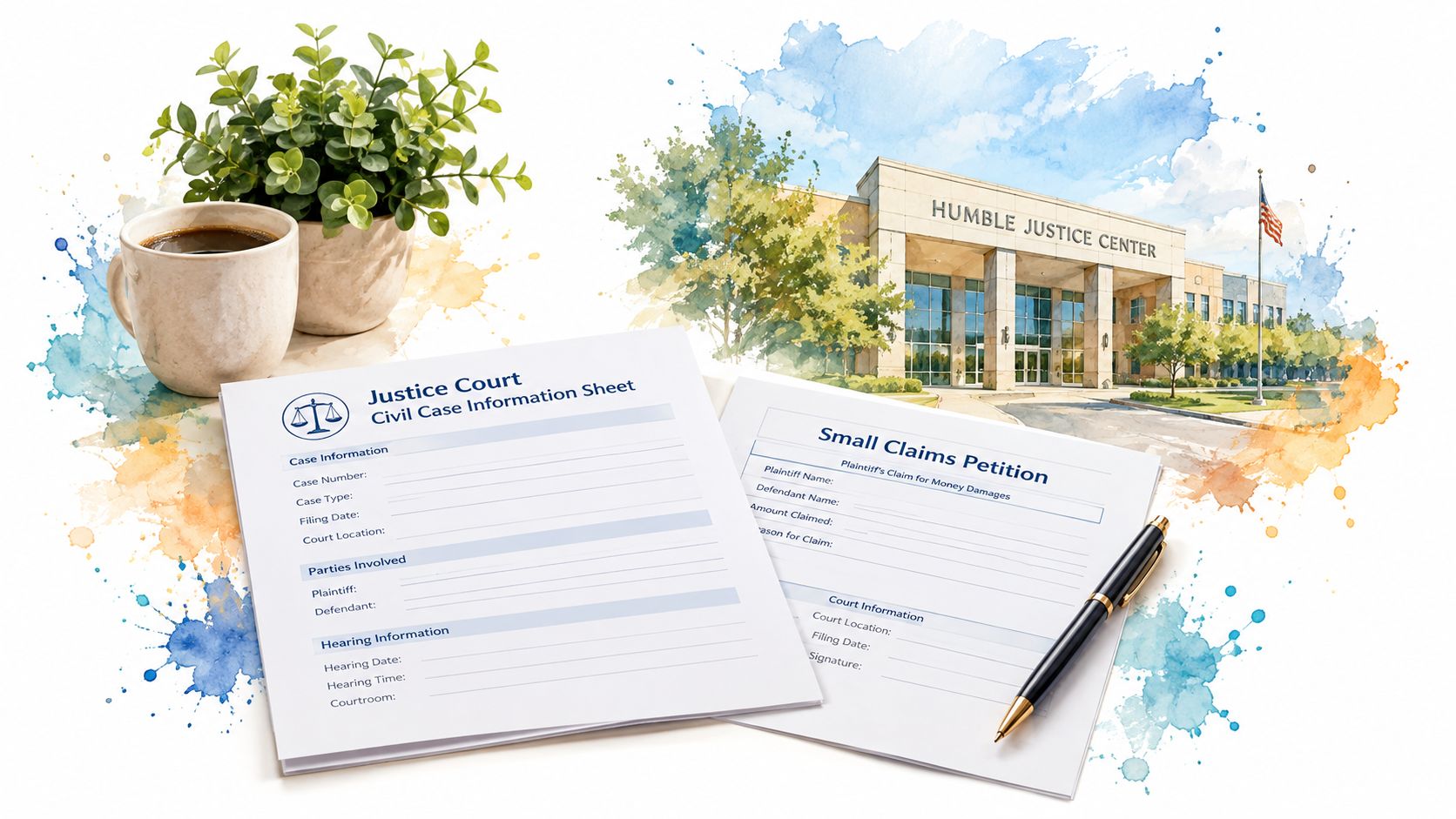
Ask the clerk about current hours, accepted payment methods, and whether your filing can be submitted through eFileTexas. Online filing can reduce a courthouse trip, but it doesn't eliminate your responsibility to verify the precinct, provide accurate party information, pay the required charges, and monitor service.
Practical rule: File a short, specific petition that a stranger could understand without asking you follow-up questions.
Justice Court is built for standardized processing. The Texas State Law Library reports 246,850 small-claims cases on Texas justice-court dockets in FY 2022, which illustrates why a clean petition and properly labeled evidence help the court move efficiently. See the library's small-claims procedural overview for the basic structure of these cases.
Serving the Defendant and Preparing Before the Hearing
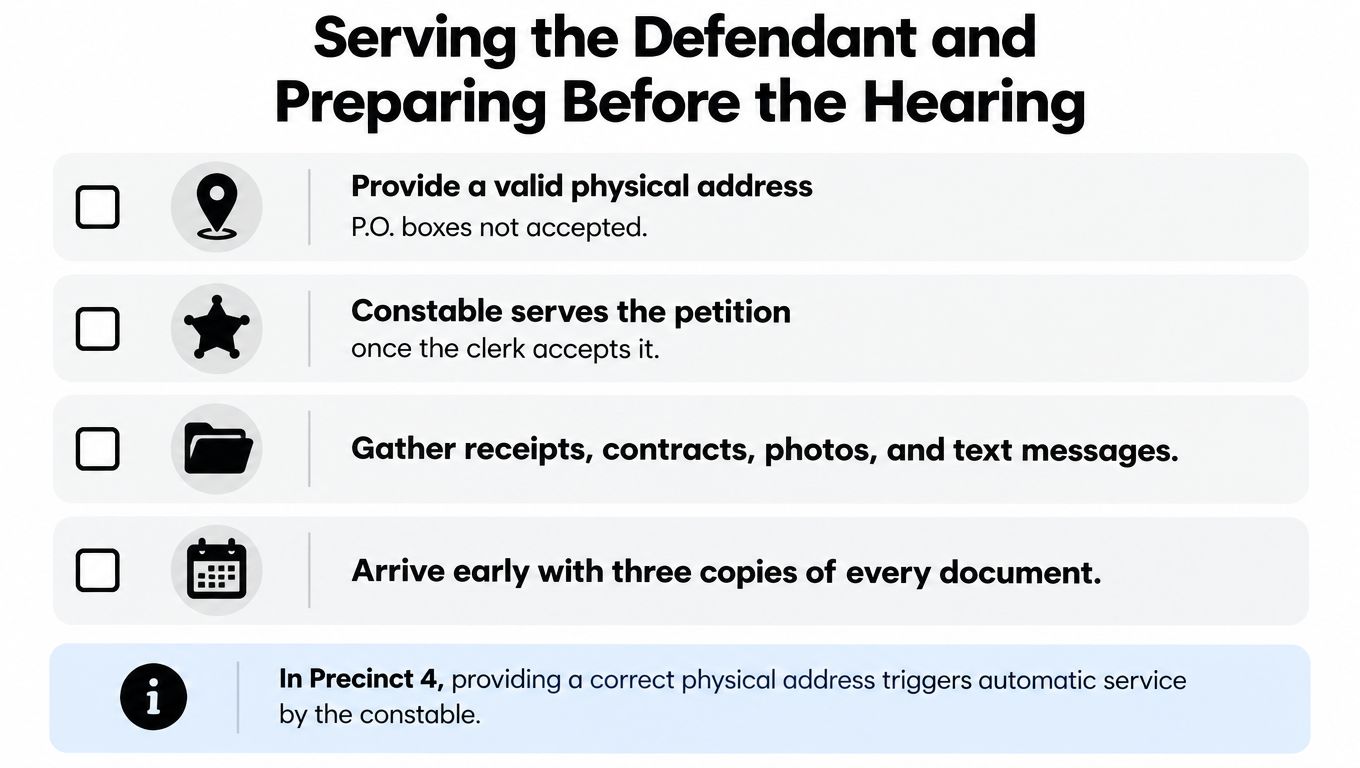
The clerk can't make a judgment against someone who hasn't received legally sufficient notice. In Precinct 4, service is commonly handled after the petition is accepted, but only when you provide a usable physical address. A P.O. box generally won't give a constable what is needed to locate and serve the defendant.
You may request personal service by a constable or use certified mail where the court permits it. The plaintiff normally pays the applicable service charge, and the method affects what happens next. If service fails, don't assume the case is ready for trial. Find out why it failed, provide a better address if you have one, and ask the clerk what procedural step is required.
Build the hearing file early
Your preparation should make the facts easy to follow. Put documents in the order you plan to discuss them, mark the important pages, and prepare three copies of each exhibit when possible. One copy is for you, one may be used by the judge, and another may be needed for the opposing party.
Write a short chronology with dates, payments, promises, missed deadlines, and your attempts to resolve the dispute. Bring bank records, photographs of damaged property, contracts, invoices, and text messages. List witnesses and write out the questions you need to ask, especially questions that establish what was promised, what was paid, and what remains unpaid.
The order setting the hearing date controls your schedule. Read it carefully, note the courtroom and appearance requirements, and arrive early enough to pass security and find the clerk's office. If your legal research involves unfamiliar procedure, a resource on advanced legal research with AI can help you organize questions, but it doesn't replace the court's forms or legal advice.
If you're dealing with service of family-court documents rather than a small-claims defendant, that's a different process. The Harris County Constable Precinct 4 service of divorce papers resource addresses that separate issue. Likewise, The Divorce Process in Humble: What to Expect provides a step-by-step look at filing for divorce in Humble and Harris County.
What to Expect on Hearing Day in the Humble JP Courtroom
Start at the Willis C. Madsen Justice Center with enough time for security screening, parking, and locating the correct courtroom. Check in with the clerk, keep your hearing notice accessible, and wait for the docket to be called. Bring your identification, organized exhibits, and a pen for notes.
The courtroom may feel more formal than the paperwork suggested. Address the judge respectfully as “Judge” or “Your Honor,” speak when recognized, and don't interrupt the defendant. The judge may first encourage the parties to resolve the dispute or narrow the issues. If no agreement is reached, the judge hears evidence and arguments.
Present the story, not a speech
Use a simple order:
- Explain the agreement or event.
- Identify what you paid, delivered, or were promised.
- Show the defendant's failure to perform or pay.
- Connect each amount requested to a document.
- State the judgment you want.
Hand up exhibits in order and identify what each one proves. Don't bring evidence that has no connection to the claim, and don't expect the judge to search through a phone for the important message. A representative case may take only a short time, so preparation matters more than dramatic presentation.
Dress neatly and conservatively. If the defendant doesn't appear after proper service, the judge may consider a default judgment, but you still need to prove the basis and amount of your claim. The judge may rule orally and then issue a written judgment, which you should read carefully before leaving.
Self-representation can feel uncomfortable, especially when the opposing party disputes facts or brings a lawyer. If the amount or legal issues justify help, review the small-claims lawyer Houston resource before the hearing. A calm, organized presentation gives the judge something useful to decide.
After the Judgment Collections Appeals and Post-Judgment Motions
Winning the hearing isn't the same as receiving payment. Treat the judgment as the beginning of the collection decision, not the end of the dispute.
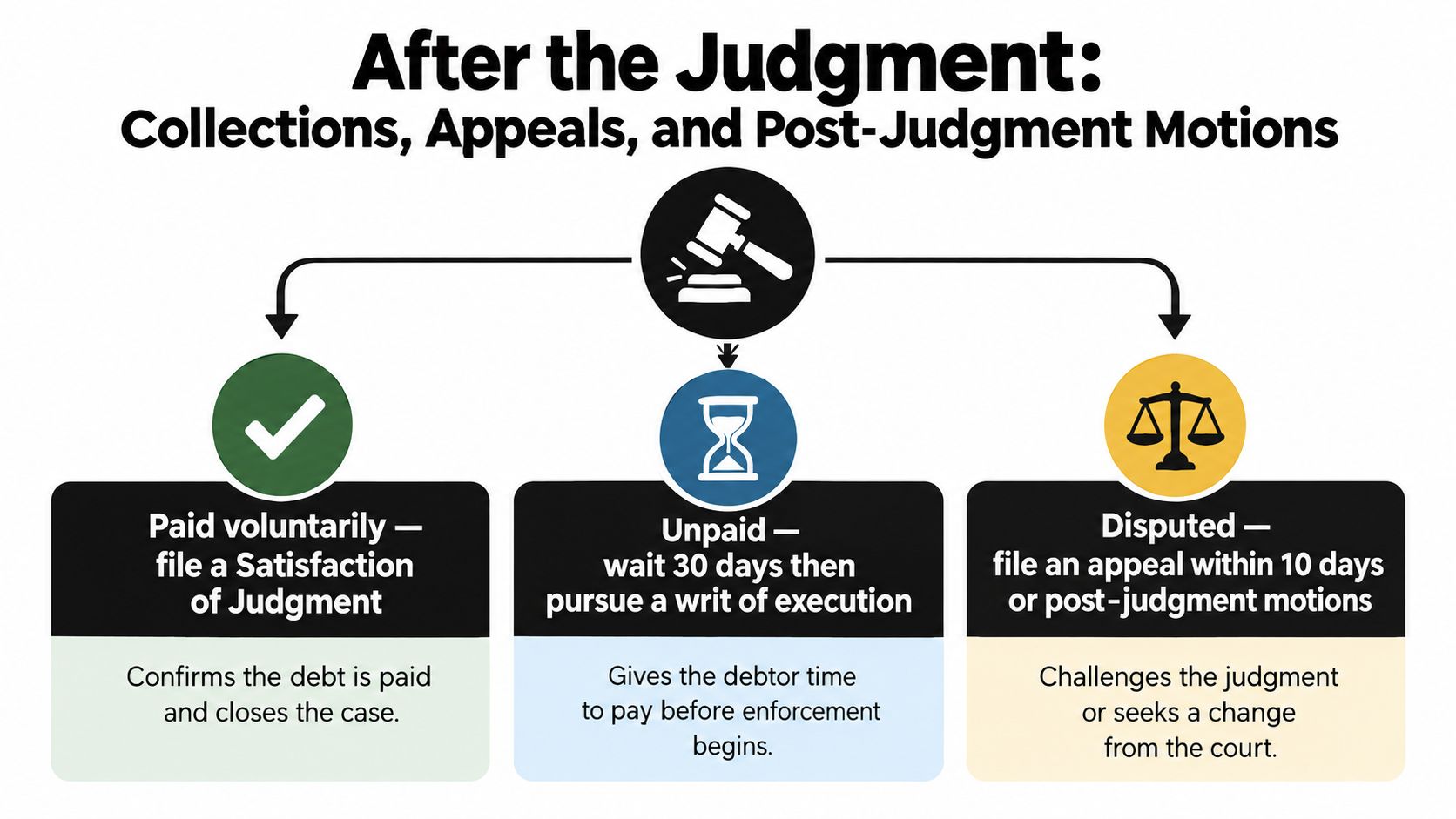
If the defendant pays voluntarily, confirm the amount and file a satisfaction of judgment so the court record reflects that the obligation has been paid. Keep proof of payment and copies of anything filed with the clerk.
If the defendant doesn't pay
Ask the same Humble Justice Court clerk about post-judgment collection tools. A writ of execution can direct law enforcement to levy eligible, non-exempt property. You'll need useful information about assets, and the constable's ability to collect depends on what property can legally be reached.
Other procedures may include an abstract of judgment, post-judgment discovery, or a turnover request. These tools have different requirements and can become complicated when the debtor changes addresses, claims exemptions, or operates through a business. Don't threaten the defendant or attempt self-help seizure. Use the court process.
Motions and appeals
A losing party may pursue a motion for new trial, a motion to set aside a default judgment, or an appeal. For most non-eviction Justice Court cases, Texas Law Help identifies a 21-day appeal window from the date the judgment is signed, with the deadline tied to the denial of certain post-judgment motions when one is properly filed. Review the Texas Justice Court appeal guidance immediately after judgment because deadlines are short.
An appeal from Justice Court proceeds as a new trial in the county court rather than merely asking another judge to review the same record. Enforcement may be affected by required appeal paperwork and any supersedeas requirements. Don't rely on an informal statement that the other side “plans to appeal.” Check the docket and filing requirements.
Texas justice-court guidance also identifies forms involving statements of inability to pay, motions to reinstate, motions for new trial, subpoenas, and writs of execution. These remedies matter when a case is dismissed, a witness is necessary, or a judgment remains unpaid. Once the matter moves beyond the original hearing, an attorney can help prevent a valid judgment from becoming uncollectible.
When Filing Alone Makes Sense and When to Call a Humble Attorney
Self-representation makes sense when the dispute is straightforward, the evidence is mostly documentary, and the amount is comfortably below the court's limit. A basic security-deposit claim, unpaid personal loan, or uncomplicated contractor dispute may be manageable if you can explain the agreement and prove the amount with records.
Filing alone is less attractive when the other side has counsel, raises a counterclaim, disputes the meaning of a detailed contract, or turns a simple payment dispute into a broader business conflict. Personal-injury claims and cases approaching the $20,000 jurisdictional ceiling deserve careful legal review because the consequences of pleading, evidence, and valuation mistakes become more serious. The Texas Justice Court limit is explained in the county's overview of small-claims cases.
Use a practical screening test
Ask yourself:
- Can I prove the agreement? A signed contract, messages, invoice, or payment record should tell a consistent story.
- Can I prove the amount? Separate the money you can document from estimates, frustration, or unrelated losses.
- Is venue correct? Confirm the defendant, event, contract, or property connection before paying to file.
- Can I handle the next stage? Collection, motions, subpoenas, and appeal procedures require follow-through.
- What happens if the other side counters? A simple claim can become more demanding once new issues enter the case.
Humble residents can also explore mediation through the Harris County Dispute Resolution Center, legal-aid eligibility through Lone Star Legal Aid, or limited-scope representation. An attorney may review a petition, assess venue, organize exhibits, or coach you for the hearing without taking over the entire case. Before hiring anyone, prepare a focused list of questions to ask a lawyer.
Your goal may be getting a deposit back, recovering a payment, or deciding that further effort isn't worthwhile. Choose the path that protects that goal, not the one that feels most forceful.
The Law Office of Bryan Fagan helps Humble, Atascocita, Kingwood, and Northeast Houston residents evaluate civil disputes, court procedures, and related family, criminal, and estate-planning needs. Visit Law Office of Bryan Fagan to schedule a free consultation with the Humble office and discuss the next practical step.