Skip to content
A school counselor calls a mother in Humble after noticing a bruise. By the next morning, she's driving her child past Deerbrook Mall toward the Harris County Children's Assessment Center on Chimney Rock, unsure who will be in the room, whether the interview will be recorded, and what CPS already knows. That fear is normal. The CAC process can feel intimidating when your family has never dealt with Child Protective Services.
The most important thing to understand is this: a Harris County Children's Assessment Center CPS interview is a structured child-protection process, not a surprise courtroom appearance. The center coordinates information gathering and services so the child doesn't have to repeat a difficult account to several adults in separate offices. Parents in Humble, Atascocita, Kingwood, and Northeast Houston should prepare carefully, stay calm, and get legal advice before making statements or signing documents.
When a Humble Family Ends Up at the Children's Assessment Center
A referral to the CAC doesn't automatically mean a parent will lose custody or that someone has already decided the allegation is true. It usually means CPS, law enforcement, or another investigating agency believes a child-focused setting is appropriate for gathering information and coordinating services.
Harris County's CAC has served as the county's only children's advocacy center since its founding in 1995. Its work includes forensic interviews, medical care, therapy, advocacy, and multidisciplinary case review for abuse investigations, according to the CAC's 2023 annual report.
The scale matters because it puts your appointment in context. In 2023, Harris County received 38,136 DFPS reports of abuse and neglect, including 10,799 reports involving child sexual abuse and child sex trafficking. During that same year, the CAC conducted 3,375 forensic interviews, delivered 1,039 medical evaluations, and formally reviewed 306 cases through its multidisciplinary team process, as reported in the same annual report.
What the referral means for a parent
For a family in Humble, the CAC may become the place where a CPS investigator and law-enforcement officer coordinate the child's interview. Families from the broader Northeast Houston area may be directed there even when the original concern arose at a Humble school, daycare, medical office, or home.
The center's purpose is to reduce repeated questioning and place the child in a setting designed for fact-finding. A parent may still feel scrutinized, but the building isn't designed as an adult interrogation room. It's intended to support a careful interview, medical evaluation when appropriate, mental-health services, victim advocacy, and case review.
Practical rule: Don't coach your child, rehearse an answer, or press for a detailed account before the appointment. Tell your child to be truthful, explain that they can say when they don't understand a question, and get advice about the rest.
Parents also need emotional support. If your child is struggling with fear, confusion, or changes in behavior, a qualified youth counselor may help with coping without turning preparation into coaching. A community resource such as Interactive Counselling Kelowna youth illustrates the kind of youth-focused support families may consider, although a Humble parent should confirm that any provider is appropriate for the child's location and situation.
What the Harris County Children's Assessment Center Does
For a Humble family, the Harris County Children's Assessment Center (CAC) brings information gathering, care coordination, and case decisions under one roof. The setting is organized around the child's account and needs while CPS, law enforcement, medical professionals, advocates, and other participants coordinate their roles.
The center's work generally follows four connected tracks:
- Forensic interviewing: A trained interviewer speaks with the child in a developmentally appropriate setting focused on gathering facts.
- Medical evaluation: Medical professionals assess the child when the allegations or the child's condition make an evaluation appropriate.
- Mental-health support: The CAC connects children and families with therapy and related services.
- Victim advocacy and case review: Advocates explain available services, and participating agencies review relevant cases through a multidisciplinary process.
The center's 2023 annual report records 3,375 forensic interviews, 1,039 medical evaluations, and 306 formal multidisciplinary case reviews. Those figures show the CAC's role as a major Harris County setting for evidence gathering, care coordination, and agency review. Parents should approach the appointment as a coordinated investigation and support process, not as a routine office visit. The 2023 annual report documents the center's reported activity.
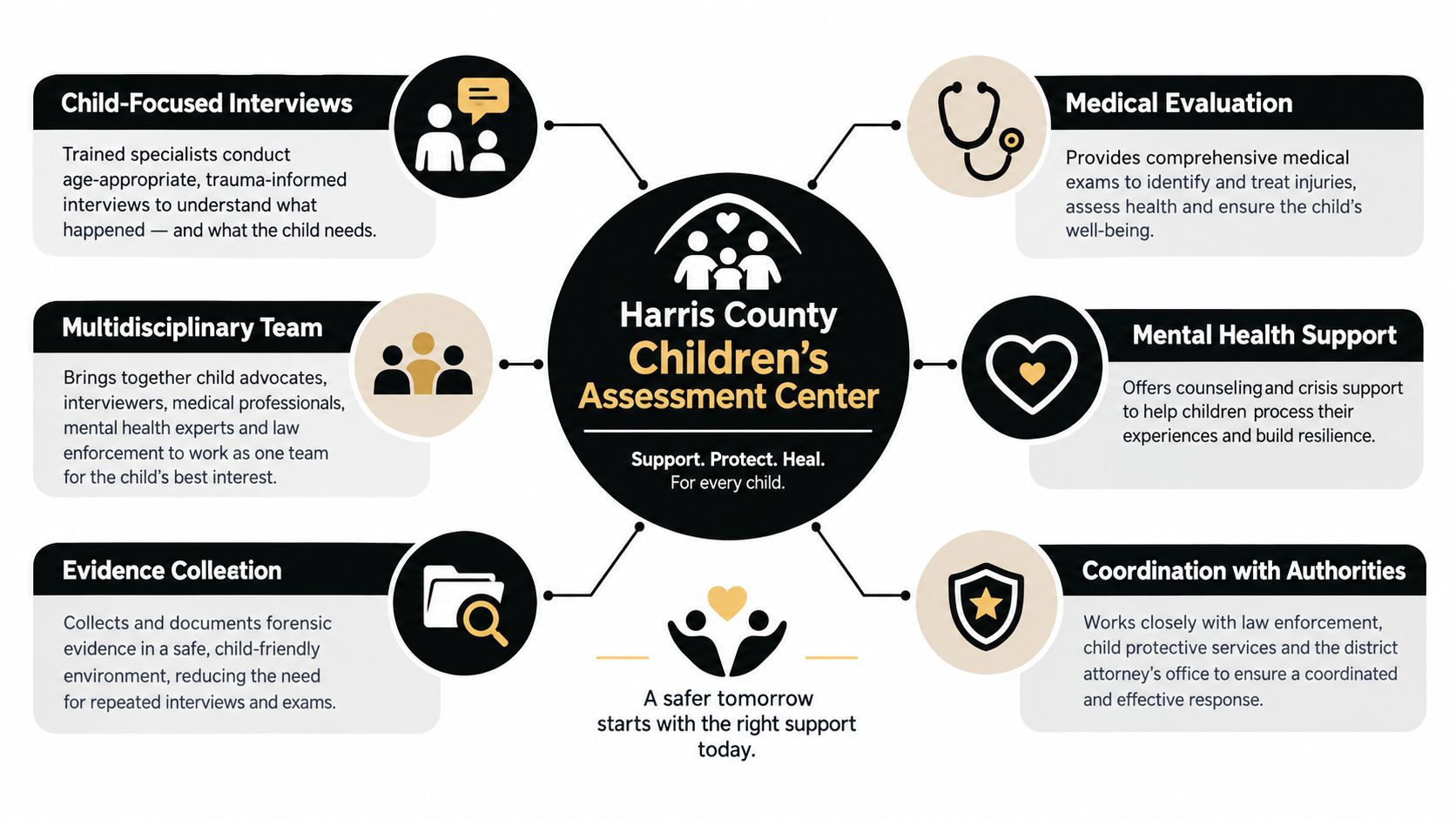
The CAC's service model can include the child's interview, medical care, counseling referrals, advocacy, and case discussion. This arrangement limits the need for separate adult interviews that force a child to repeat difficult information to several agencies.
A Humble parent should also understand who makes which decision. CPS and law enforcement may use information from the process in their investigations. Medical and mental-health professionals address care. Advocates help the family understand services. The CAC itself does not issue a custody order, replace a judge, or automatically determine that abuse occurred.
The process may involve CPS and law enforcement observing the interview from another room while the interviewer speaks with the child. That structure keeps the child's conversation focused and lets investigators receive the same account. Ask the assigned professionals how the interview will be recorded, who may access the recording, and what consent or authorization applies in your child's situation. Texas recording rules and agency procedures matter, so do not guess about them.
The CAC referral also does not decide a separate divorce or custody case. For local family-law procedure, The Divorce Process in Humble offers a step-by-step overview of filing in Humble and Harris County. A divorce dispute and a CAC investigation can overlap, but one does not explain away or control the other.
Inside the Forensic Interview Room
Your child may walk into an ordinary room in Humble and still feel the weight of what is happening. Expect comfortable seating, a calm interview space, and none of the staging associated with a police interrogation room. The setting is arranged around the child's comfort so they can communicate in their own words.
The child generally speaks privately with the forensic interviewer. CPS and law enforcement may observe from an adjacent room, while a parent, CPS worker, detective, and prosecutor usually remain outside the interview space. This arrangement keeps several adults from asking competing questions and allows investigators to receive the same account.

What your child may notice
The interview is generally digitally recorded. Recording preserves the child's exact account for later review and can reduce repeated questioning. Before the appointment, ask the assigned CPS worker or investigator how the recording will be made, who may access it, and what consent or authorization applies under Texas procedures. Get those answers directly. Do not rely on assumptions about recording rules.
Your child may not realize that investigators are watching from another room. That protects the focus of the conversation while giving the investigating agencies access to the same interview. It also avoids separate interviews that can create confusion or require the child to repeat difficult information.
The length depends on the child, the allegation, the child's developmental level, and whether breaks are needed. Do not promise that the appointment will be quick. Tell your child that an adult will ask questions, truthful answers matter, and they can say when they need a break or do not understand.
The recording matters because a child's exact words, pauses, corrections, and answers can become important evidence. Treat the appointment as a formal investigative interview, not a casual conversation.
The CAC model helps limit the burden of repeated questioning. The academic analysis of Harris County CAC data found that, from January 1, 2005, through December 31, 2015, the center served 13,826 first-time suspected victims of child sexual abuse. It reported that 96.8% were abused by a non-stranger and 67.3% by someone likely related to them. The analysis also found that 47.4% of cases involved teenagers under 18, 24.9% involved pre-teens, and 77.2% of the children were female. Those figures come from the Houston-area academic analysis of CAC data.
How the Interviewer Gets the Truth Without Leading the Child
A sound forensic interview doesn't begin with the allegation. It begins by helping the child understand the rules of the conversation and become comfortable speaking with the interviewer.
Research on child forensic interviewing describes a phased structure:
- Introduction and ground rules
- Rapport building
- A practice narrative
- The substantive account
- Closure
The interviewer may explain that the child should correct the interviewer, say when they don't know an answer, and tell the interviewer when a question isn't understood. These instructions give the child permission to be accurate rather than agreeable.
Open invitations protect accuracy
During rapport building and the practice narrative, the interviewer may ask the child to describe a neutral event in detail. The point isn't to collect evidence about the allegation. It's to learn how the child tells a story and to reinforce that the child, not the adult, should supply the details.
The substantive phase should rely heavily on open-ended invitations such as:
- “Tell me everything that happened.”
- “What happened next?”
- “Tell me more about that.”
- “You said something happened in the bedroom. Tell me about that.”
The child-witness interviewing research explains why this matters. Open-ended invitations tend to produce more detailed and less contaminable disclosures than closed questions, and, on average, almost one-half of information comes from free-recall prompts. A question that asks “Did he touch you here?” supplies a detail the child may accept, reject, or misunderstand. “Tell me what happened” lets the child provide the detail.
Why parents shouldn't conduct their own interview
A worried parent often wants to ask the same question several ways. That impulse is understandable, but it can create problems. Repeated questions may make a child think the first answer was wrong, while leading questions can introduce details that were not originally part of the child's memory.
The interviewer may return to an unclear statement with a neutral prompt, follow the child's timing, and note spontaneous corrections. That process helps distinguish what the child recalls from what an adult may have suggested.
For parents: Your job is to provide safety and support. The interviewer's job is to gather the account. Keep those roles separate.
The process protects the child and also protects the fairness of the investigation. If the case reaches a Harris County courtroom, the recording and the method used to obtain the statement may matter. Parents should therefore avoid posting about the interview, discussing possible answers with the child, or asking the child to repeat the account to relatives.
CPS at Your Door Versus the CAC Process
A CPS visit at your Humble home and a CAC forensic interview are not the same event. Texas CPS guidance requires a caseworker to interview the child face-to-face in a developmentally appropriate way about the reported allegations and other safety concerns, as described in the Texas CPS investigation handbook.
The setting can change the tone. A home visit may involve questions in a familiar but emotionally charged environment. A CAC appointment uses a structured, child-focused setting and coordinates observation and services through the center. Texas guidance also recognizes that a child may be interviewed at a reasonable time and place, including home, school, or daycare, while parental consent rules can depend on where the interview occurs. The Texas parent resource guide explains those location-specific consent considerations.
| Factor | CPS Home Visit | CAC Forensic Interview |
|---|---|---|
| Primary setting | The child's home or another location arranged by CPS | A child-focused assessment center |
| Main participants | CPS investigator and family members or other adults present | Child and forensic interviewer in the interview room, with authorized investigators observing separately |
| Question style | Investigation questions about allegations and safety concerns | Structured, developmentally appropriate forensic questioning |
| Recording | Ask the investigator whether and how the interview is recorded and documented | The CAC process is designed around a digitally recorded forensic interview |
| Observation | Other participants may not be in a separate observation room | CPS and law enforcement may observe from an adjacent room |
| Related services | The investigator may provide referrals or safety instructions | The center coordinates interviewing, medical evaluation, mental-health support, advocacy, and case review |
What to bring and what to leave behind
Bring the appointment notice, a photo ID if requested, the caseworker's name and phone number, and any written safety plan you've signed. Ask in advance whether your child may bring a comfort item. Keep the appointment information organized, including the time, location, and names of participating agencies.
Don't bring other children who don't have an appointment unless the center has approved that arrangement. Leave food and personal recording devices in the car unless the CAC gives different instructions. Don't record the interview yourself or try to enter the observation area without permission.
The home visit and CAC interview are usually separate events. Treat both seriously, stay respectful, don't guess when you don't know an answer, and request legal advice before responding to questions that could affect your rights. If the case involves a custody dispute, an explanation of what a guardian ad litem does may also help you understand how a child's interests can be addressed in court, though a guardian ad litem is not the same as a CAC interviewer.
Your Rights as a Parent and When to Call a Lawyer
The safest approach is neither hostility nor blind cooperation. You can cooperate with a child-safety investigation while still protecting your legal position.
Texas DFPS guidance makes the child interview a required core step in the investigation, but the details of consent, location, timing, and the people involved matter. Parents should ask the caseworker what allegation is being investigated in general terms, where the interview will occur, who requested it, whether it will be recorded, and who will observe. Don't assume that a request for cooperation means you must answer every question immediately.
A parent may ask for time to consult counsel before answering investigator questions or signing a safety plan. A support person may be able to remain in the waiting area, but that person generally shouldn't expect to sit in the forensic interview room. Ask about breaks and communicate any medical, developmental, language, or accessibility needs before the appointment.
Why early advice matters
An attorney can review the notice and safety plan, identify issues that may affect the interview, explain what to say to CPS, and help you avoid conduct that could be characterized as coaching. Counsel can also prepare you for later hearings and communications with investigators.
If you're looking for a plain-language overview of representation focused on defense against CPS investigations for Humble families, CPS Defense Attorney in Humble is one local resource to review. You should still ask any attorney exactly who will handle your matter and what support is available.
Read practical guidance about responding to an allegation in what to do if falsely accused, but don't treat an online article as a substitute for advice about your specific facts. The allegation may be mistaken, incomplete, or serious, and the correct response depends on the evidence and the safety circumstances.
My rule for Humble parents: If CPS has contacted you, call a lawyer before you confirm, schedule, or cancel anything. A short conversation before a decision is usually more useful than damage control afterward.
Walking Forward with a Humble Attorney by Your Side
Start with a folder. Save the CPS notice, texts and emails, any signed safety plan, relevant school and medical records, prior DFPS correspondence, and the names of mandated reporters who contacted you. Write down what happened and when, but don't ask your child to create a statement or repeat the allegation for you.
Then schedule a consultation with a Humble family-law attorney who handles CPS matters. Ask whether counsel can communicate with DFPS, attend the CAC appointment or observation process when permitted, review the service plan, and prepare for any Harris County court hearing. If you need urgent custody guidance, an emergency custody lawyer near Humble, Texas may be a relevant starting point.
A CAC interview alone doesn't equal removal. The next step depends on the investigation, safety information, and decisions made by DFPS and the court. Prompt advice gives you a clearer way to respond while keeping your child safe and preserving your options.
You don't have to face the CAC process by guessing. Prepare the documents, protect the child from coaching, and get advice before you act.
The Law Office of Bryan Fagan offers family-law guidance for Humble parents dealing with CPS investigations, custody concerns, and related court proceedings. Schedule a free consultation through Law Office of Bryan Fagan to discuss the CAC interview, your safety plan, and the next practical step for your family.