Skip to content

A Harris County conservatorship dispute generally receives 2 hours total, or 60 minutes per side, while other temporary matters generally receive 1 hour total, or 30 minutes per side. Assigned courtroom settings can differ, and the 310th Court, for example, may use 45-minute-per-side temporary-orders settings.
You may be sitting at your kitchen table in Humble with a hearing notice, school records, pay information, and text messages spread in front of you. You know the hearing concerns your child, support, or possession, but you don't know how much time the judge will give you or which local rule controls.
That uncertainty creates a practical risk. A parent can prepare for a two-hour custody presentation and discover that the assigned courtroom uses a shorter docket setting. Another parent may assume every Harris County family court follows the same schedule, only to learn that the court coordinator applies a different procedure.
The safest approach is simple: identify the assigned court, confirm its current procedures, and prepare your evidence to fit the actual time allowed. The following Harris County temporary orders hearing time limits local rules matter to families in Humble, Atascocita, Kingwood, and Northeast Houston because the hearing date is not the time to discover that your exhibits, witnesses, and argument don't fit.
Understanding Your Temporary Orders Hearing in Harris County
Suppose a Humble parent receives notice of a temporary-orders hearing during a divorce. The hearing may address where the child lives, who makes decisions, how possession works, and whether one parent must pay temporary child support. The parent may also need temporary spousal support or orders concerning property while the divorce remains pending.
Temporary orders don't finally resolve every issue in a divorce or custody case. They establish workable rules while the larger case proceeds. That makes the hearing important even though the orders are temporary. A temporary possession schedule can shape the family's routine, and temporary financial orders can affect whether a parent can pay household expenses during the case.
Practical rule: Treat the temporary-orders hearing as a focused evidentiary presentation, not as an informal conversation with the judge.
Harris County's official family-court information identifies the Family Courts as handling divorce, custody, support, visitation, and related matters. The same local-rules material explains that, when child support or spousal support is at issue, the parties must complete and exchange Financial Information Statements, income-tax returns for the preceding two years, and the two most recent payroll stubs before the hearing begins. Harris County Family Court information and local rules therefore point to a document-driven process, not a hearing where a party can promise to provide financial records later.

Why the hearing date matters
The hearing date creates a preparation deadline for more than your testimony. You need to know what relief you're requesting, what facts support it, which documents prove those facts, and which witnesses can address the issues without using time on background that the judge doesn't need.
For a family in Atascocita, Kingwood, or Northeast Houston, the assigned Harris County court may be different from the courtroom the family expected. The local procedures may also distinguish between contested and uncontested parent-child issues. A useful local overview is Harris County Family Courts: A Humble Resident's Guide, which addresses how family-law cases proceed in the Harris County courts serving Humble.
Temporary orders can also involve mediation. In appropriate disputed custody or visitation matters, Harris County rules allow the court to refer parties to mediation through Family Court Services or a mutually agreed private mediator. That possibility doesn't eliminate the need to prepare. You should be ready to present your position if mediation doesn't resolve the dispute or if the court requires a focused hearing.
Filing Requirements and Notice Deadlines Before Your Hearing
A hearing date doesn't automatically mean the court can decide every issue presented that day. Notice, service, filing materials, and assigned-court requirements determine what the responding party has had a fair opportunity to address.
Start with the notice period
Texas law generally requires notice and a hearing before temporary relief is rendered. Under the applicable family-law rules, a responding party is ordinarily entitled to at least three days' notice of a temporary-relief hearing unless the court specifically shortens that period. The statutory notice framework is summarized in Texas Family Code Section 105.001.
That rule matters because an emergency request and a noticed temporary-orders hearing are different procedural events. Emergency relief may involve accelerated notice, but a contested temporary-orders presentation still requires a court-assigned setting and an opportunity for the parties to present evidence.
Don't confuse a temporary restraining order with an ordinary temporary-orders hearing. The distinction can affect notice, the documents filed, and what the judge can consider. A plain-language explanation of that distinction is available in What Is a Temporary Restraining Order?.
Check whether enforcement rules apply
A separate notice rule applies when the proceeding concerns enforcement of a final order involving child support or possession and access, or enforcement of a temporary order. Texas Family Code Section 157.062 requires personal service of the motion and hearing notice no later than the 10th day before the hearing, and the notice must identify the hearing date, time, and place. See Texas Family Code Section 157.062.
If you receive an enforcement-related notice, preserve the envelope, service paperwork, and hearing notice. Check the service date against the hearing date, and get legal advice promptly if the setting appears too soon or the documents omit required scheduling information.
Prepare the required sworn support
The Harris County 257th Family District Court's official frequently asked questions state that temporary orders and ancillary matters are placed on the 9:00 a.m. docket and that requests for temporary orders or additional temporary orders must be accompanied by an affidavit. See the court's official temporary-orders FAQ.
An affidavit should address the immediate facts supporting the requested relief. Depending on the dispute, that may include a proposed parenting schedule, urgent financial circumstances, or property-related concerns. Don't wait until the courtroom to introduce a new story that your written filing never explains.
Before filing or appearing, use this sequence:
- Read the notice carefully: Confirm the date, time, courtroom, case number, and issues listed.
- Identify the assigned court: Find the court's current procedures and contact the coordinator if the notice doesn't answer a scheduling question.
- Check service: Determine whether the notice was served under the rule that applies to your proceeding.
- Prepare the affidavit: State specific facts supporting the temporary relief you want.
- Assemble required financial records: Complete the required Financial Information Statement and exchange the tax returns and payroll stubs when support is at issue.
Statutory and Local Time Limits for Temporary Orders Hearings
The published Harris County framework gives you a starting point, not a universal courtroom guarantee. Under the published rule text, a matter involving managing conservatorship receives no more than 2 hours total, divided equally between the parties, absent prior judicial approval. That ordinarily means up to 60 minutes per side. Other temporary matters, including modification of a temporary order, receive no more than 1 hour total, also divided equally, or up to 30 minutes per side. These limits appear in the published Harris County temporary-orders rule text.
The judge determines the time allotted. A party may seek additional time by written motion showing good cause. The rule excludes hearings in which the Texas Department of Family and Protective Services is a party, so don't assume the ordinary framework applies without checking the case posture.
The clock controls your presentation
A court's time limit affects every part of the hearing:
- Opening presentation: State the orders you want and the few facts that make them necessary.
- Witness testimony: Call only witnesses who can offer relevant, admissible information.
- Cross-examination: Ask focused questions tied to the orders requested.
- Exhibits: Use records that prove a disputed point rather than submitting a pile of background material.
- Closing request: Tell the judge exactly what temporary orders you want entered.
The court also requires temporary orders to be reduced to writing within 10 calendar days, with the proposed order forwarded to the court within five days after opposing counsel receives it. Those deadlines are stated in the same Harris County rule text. The hearing and the written order are separate milestones. Presenting your case is only part of the job; the ruling must be accurately memorialized.
The exact allotment can change with the courtroom, the issues, and the judge's procedures. Confirm the current coordinator instructions before you build your witness list or promise yourself that you'll have the full ordinary allocation.
How Assigned Court Settings Change Your Hearing Length
Harris County doesn't appear to have one countywide temporary-orders hearing limit that answers every scheduling question. The assigned courtroom can change whether the setting is measured per side or in total, and whether the court distinguishes contested parent-child issues from other temporary matters.
The 310th Court publishes Wednesday temporary-orders settings with a 45-minute limit per side. The 507th Court uses a different structure, providing a 1.5-hour total limit when parent-child issues aren't contested and a 3-hour total limit when they are contested, with time divided equally between the parties. Those court-specific examples are summarized in TexasLawHelp's Harris County family district courts guide.
| Court | Conservatorship limit | Other matters limit | Notes |
|---|---|---|---|
| Published Harris County framework | 2 hours total, 60 minutes per side | 1 hour total, 30 minutes per side | Judge controls the allotment; expansion requires a written good-cause showing |
| 310th Court | Court-specific setting may provide 45 minutes per side | Confirm with the assigned court | Wednesday temporary-orders settings use a 45-minute-per-side limit |
| 507th Court | Parent-child issues contested, 3 hours total, divided equally | Parent-child issues not contested, 1.5 hours total | Confirm how the court classifies the issues in your case |
Don't confuse the docket slot with the evidence limit
A docket slot tells you how the court schedules the matter. The judge's evidentiary allocation tells you how long each side may present. Those concepts can overlap, but they aren't interchangeable.
For example, a parent may see a setting associated with a particular docket day and assume the ordinary Harris County framework controls. The coordinator may instead apply the assigned court's published procedure, or the judge may set a case-specific limit based on the issues.
Before the hearing, take these steps:
- Confirm the assigned court through the Harris County District Clerk's family-court information.
- Review the assigned court's current local procedures.
- Ask the court coordinator whether the stated time is total or per side.
- Clarify whether custody or visitation is contested.
- Ask whether the judge requires a written motion to request more time.
Humble families can also benefit from understanding the difference between an associate judge's role and a district judge's docket. The distinction is addressed in Harris County associate judge versus district judge family docket. Don't rely on an online discussion, an old notice, or another parent's experience as a substitute for the assigned court's current instructions.
Preparing Your Case Within Strict Time Constraints
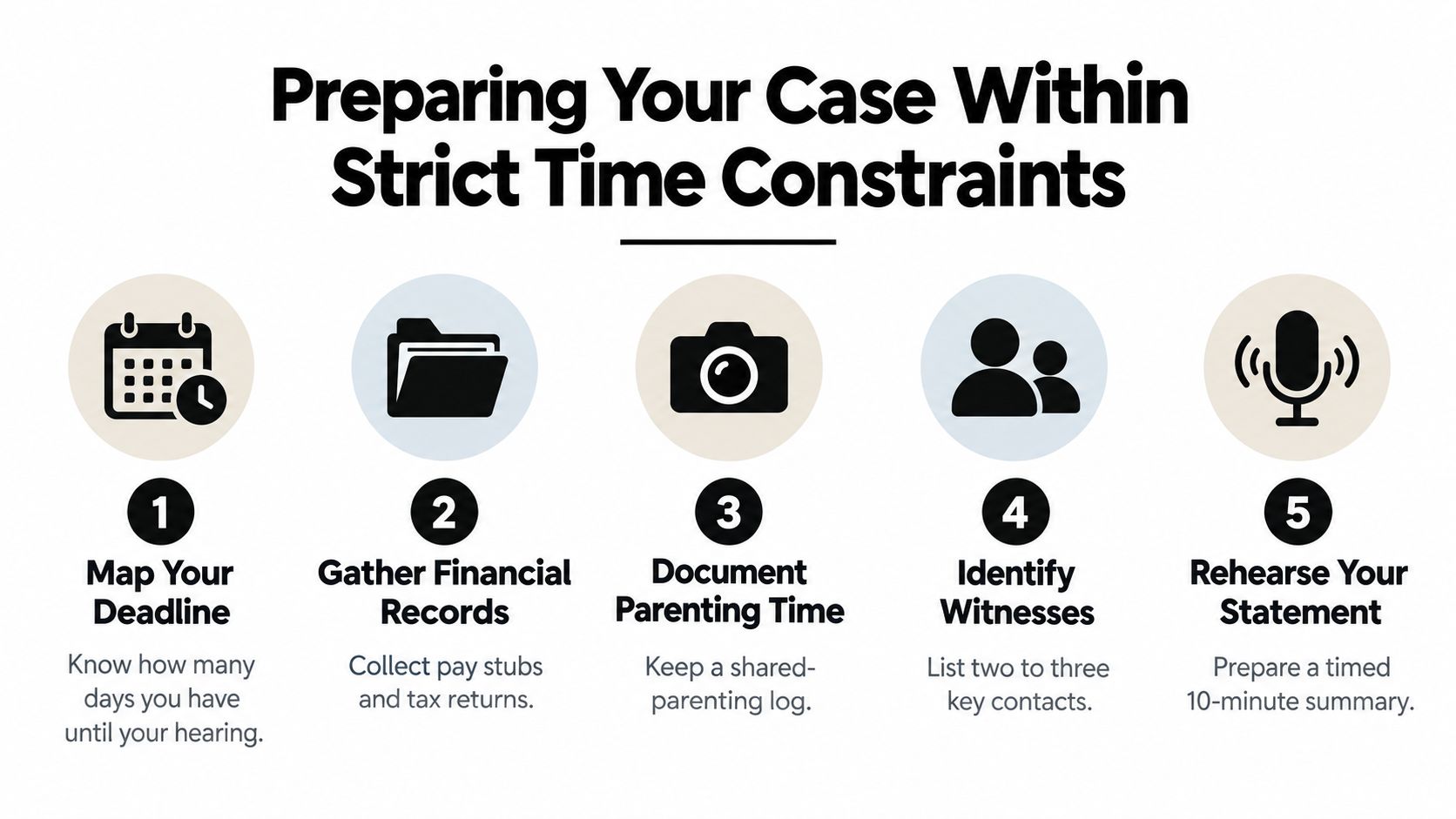
Once you know the assigned setting, prepare backward from the clock. Your objective isn't to tell the judge every detail of your family history. It's to prove the facts connected to the temporary orders you're asking the court to enter.
Build a short, usable evidence file
Start with the requested orders. Write down the parenting schedule, decision-making terms, support request, property provision, or other relief you want. Then connect each requested term to the evidence that supports it.
When child support or spousal support is at issue, Harris County requires the parties to complete and exchange Financial Information Statements, copies of income-tax returns for the preceding two years, and the two most recent payroll stubs before the hearing begins. The requirement appears in the Harris County District Clerk's family-court rules.
Organize your materials so you can find a document immediately. A practical file may include:
- Financial records: Put the Financial Information Statement, tax returns, and payroll stubs together.
- Parenting records: Arrange calendars, messages, school information, and records by issue rather than by emotion.
- Safety evidence: Separate records that address a specific safety concern from ordinary parenting disagreements.
- Proposed orders: Bring a clear written version of the terms you want the judge to sign.
Rehearse the presentation
Give each witness a defined purpose. If two witnesses will repeat the same fact, decide whether both are necessary. A witness who cannot connect testimony to a requested temporary order may consume time without strengthening the case.
Practice a concise opening and a concise final request. Use plain language, identify the disputed facts, and explain the order that would address them. Don't spend your first portion of the hearing describing every disagreement with the other parent.
A short hearing rewards prioritization, not volume.
Your preparation should also account for the possibility that the court may deny additional time. If the evidence is extensive, ask counsel about a written motion showing good cause before the hearing rather than assuming the judge will extend the setting on the day of court.
Finally, separate facts you can prove from conclusions you want the judge to draw. A payroll stub is a record. A detailed parenting log may support a possession argument. A general statement that the other parent is “unreasonable” usually needs specific facts before it helps the court decide temporary relief.
Your Complete Action Plan for Temporary Orders Success
Start when the notice arrives, not when you walk into the courthouse.
- Read the setting: Identify the hearing type, assigned court, date, time, and listed relief.
- Check notice and service: For an ordinary temporary-relief hearing, confirm the applicable three-day notice rule. For enforcement involving child support, possession and access, or a temporary order, check the personal-service deadline under Texas Family Code Section 157.062.
- Review filing requirements: Determine whether the assigned court requires an affidavit with the request for temporary orders. The 257th Court expressly identifies that requirement for requests for temporary orders or additional temporary orders.
- Confirm the courtroom limit: Ask whether your setting is total or per side, whether parent-child issues are contested, and whether the judge has issued case-specific instructions.
- Complete financial disclosures: If support is at issue, finish and exchange the Financial Information Statement, the preceding two years of tax returns, and the two most recent payroll stubs before the hearing begins.
- Prepare the presentation: Select your essential witnesses, organize exhibits, draft your requested orders, and rehearse within the time allowed.
- Plan the written order: After the ruling, track the deadline for reducing temporary orders to writing and forwarding the proposed order to the court.
Don't assume an emergency TRO and a noticed temporary-orders hearing are interchangeable. Emergency relief may involve accelerated procedures, while the contested hearing still requires a defined setting and disciplined presentation.
If you're in Humble, Atascocita, Kingwood, or Northeast Houston and the time limit, notice, affidavit, or financial disclosures are unclear, get advice before the hearing date. The Law Office of Bryan Fagan can review the assigned court's procedures, help organize the evidence, and prepare a focused request for temporary relief.
The Law Office of Bryan Fagan offers family-law guidance for divorce, custody, support, and temporary-orders disputes, including practical preparation for Harris County courtroom time limits. Schedule a free consultation by visiting Law Office of Bryan Fagan to discuss your hearing and get a clear plan before you appear.