Skip to content
A late-night knock can turn a Humble family's ordinary evening into a crisis. A parent in Atascocita may open the door to a CPS investigator and a law-enforcement officer, hear that the child is being taken, and suddenly face questions about medication, supervision, substance use, injuries, or people living in the home. The parent may not know where the child is going, when court will happen, or what to say without making the situation worse.
The Harris County 313th Juvenile Court CPS removal hearing moves quickly. Your words, documents, relatives, and decisions during the first hours can affect whether the child returns home, stays with family, or remains in state custody while the case continues. If CPS has contacted your Humble, Kingwood, or Northeast Houston family, treat the matter as an emergency legal problem and get advice before signing anything.
When CPS Shows Up and Takes Your Child
At 11 p.m., a parent in Kingwood may be standing in a doorway, trying to understand why a caseworker wants to see the child. The investigator may say CPS believes the child faces immediate danger. The parent is tired, frightened, and focused on keeping the family together. A rushed explanation, an angry statement, or an agreement made without understanding the consequences can later appear in the case record.
Texas CPS rules generally restrict removal without a court order unless exigent circumstances exist. The agency must address immediate danger to the child's physical health or safety, reasonable efforts to secure safety, and whether any reasonable alternative could protect the child without removal. The DFPS explanation of the emergency-removal process is available in its CPS policy on emergency removal and court review.
What to do at the door
Stay calm, keep the conversation respectful, and don't physically interfere with the investigator. Ask clear questions:
- Ask for the basis: What immediate danger does CPS allege?
- Request the paperwork: Ask to see the affidavit and any emergency order.
- Clarify approval: Ask whether a CPS supervisor reviewed or approved the removal.
- Protect your signature: Don't sign a voluntary safety plan, release, or placement agreement before a lawyer reviews it.
- Record the details: Write down names, badge information, times, statements, and where the child is taken.
You can ask questions without volunteering a long narrative. The investigator's notes may later be compared with testimony and documents presented in the 313th Juvenile Court. Statements made at the home, during transportation, or during a later phone call can become part of the State's explanation for removal.
Practical rule: Be cooperative about safety, but don't guess, exaggerate, or sign a legal document just because you're under pressure.
If CPS asks to interview your child at the Harris County Children's Assessment Center and CPS interview location, ask your lawyer what participation is appropriate and how to protect the child's interests. The first day isn't the time to argue every allegation at the front door. It is the time to preserve your credibility, obtain the documents, locate counsel, and prepare for the court's review.
What a CPS Removal Hearing Actually Is
A CPS removal hearing is the first formal court test of the State's decision to keep a child outside the home. It isn't the final trial deciding whether a parent permanently loses custody. The judge is deciding whether the emergency situation and the evidence support temporary protection while the broader lawsuit proceeds.
Texas law separates the emergency removal from the temporary custody process. Under Chapter 262 of the Texas Family Code, the initial review generally occurs on or before the first business day after a child is taken into possession without a court order. That first review is typically ex parte, meaning the court can review the emergency request without a full adversarial presentation from every party.
If the child isn't returned, a full adversary hearing must follow within 14 days. DFPS describes this court sequence in its policy governing the first court hearing after removal. Texas Family Code Sections 262.201 and 262.203 are commonly associated with the temporary custody and adversary stages.

The papers and people matter
DFPS files a suit affecting the parent-child relationship, often with a petition and supporting affidavit. The affidavit explains the allegations and the facts the agency says justify removal. A return of service shows whether the legal papers were delivered to the parent or another party. The court clerk processes filings and maintains the court record, but the clerk doesn't decide whether removal was justified.
At the hearing, DFPS presents its evidence, the parent has the right to respond through counsel, and the judge decides whether the State met the applicable standard. The 313th Juvenile Court is part of Harris County's specialized juvenile court system, and its listed court contact is (832) 927-8450, with coordinator Natalie Yates, according to the Harris County juvenile court information.
The hearing may include questions about the affidavit, testimony from a caseworker, photographs, records, and proposed placements. It isn't the same as a final trial on the entire CPS case. A parent who loses the removal hearing still has important opportunities to challenge evidence, complete services, seek placement changes, and pursue reunification.
The Legal Standard the State Has to Meet
The State can't keep a child away from a parent merely because a family is struggling, a home is imperfect, or an investigator dislikes a parenting decision. The removal request must connect specific facts to a legally recognized safety concern.
For emergency removal, the petition and supporting affidavit must allege immediate danger to the child's physical health or safety, that remaining in the home would be contrary to the child's welfare, and that reasonable efforts were made to avoid removal. If the court isn't satisfied at the initial hearing, Texas law favors returning the child unless continuing danger is shown. The Texas Children's Commission explains these requirements in its bench book discussion of emergency removal review.
What the allegations can look like
Parents may see allegations involving neglectful supervision, physical abuse, unsafe conditions, domestic violence, or a drug-exposed infant. The label itself doesn't prove the case. The judge must connect the alleged conduct to the statutory safety standard and decide whether the evidence supports continued temporary custody.
The initial review and the adversary hearing don't serve exactly the same function. The early stage asks whether probable cause and emergency facts justify temporary protection. At the full adversary hearing, DFPS must satisfy the heightened clear and convincing evidence standard for continued conservatorship. Your lawyer should challenge both the facts and the connection between those facts and the requested order.
Common evidence can include:
- The removal affidavit: The written account supporting the emergency action.
- Caseworker testimony: What the investigator observed, who provided information, and what alternatives were considered.
- Photographs and video: Images of injuries, living conditions, medications, or household hazards.
- Medical and police records: Records that may support or contradict the allegations.
- Parent evidence: Witnesses, treatment records, safety improvements, and proof of an appropriate relative placement.
| Hearing Stage | Statutory Authority | Burden of Proof | Key State Evidence |
|---|---|---|---|
| Emergency possession and initial review | Chapter 262 and emergency-removal provisions | Emergency facts and probable cause supporting temporary protection | Affidavit, investigator observations, safety information |
| Temporary custody hearing | Texas Family Code Section 262.201 | Evidence supporting continued temporary custody | Caseworker testimony, records, photographs, proposed safety plan |
| Adversary hearing | Texas Family Code Section 262.203 | Clear and convincing evidence for continued conservatorship | Affidavit, admissible records, witness testimony, placement evidence |
| Later merits and permanency proceedings | Suit affecting the parent-child relationship and Chapter 263 | Standards applicable to the particular order requested | Service compliance, visitation, safety progress, permanency evidence |
The strongest defense usually isn't a speech about being a good parent. It is a focused response to each required element, supported by admissible evidence and a workable safety plan.
Inside the 313th Juvenile Courtroom
The 313th Juvenile Court is Judge Natalia Cokinos Oakes’ court at the Harris County Juvenile Justice Center. The court system confirms that the 313th handles CPS dockets and shares juvenile matters with the 314th and 315th courts. Check current courtroom instructions and scheduling information before traveling, because courtroom logistics can change.
Expect security screening and a busy courthouse environment. Parents may wait while other CPS cases are called, and several attorneys, caseworkers, relatives, and court-appointed professionals may be involved in the morning calendar. The court coordinator manages scheduling, while the judge controls the hearing and decides what evidence and arguments matter.
Who sits at counsel table
The participants may include:
- DFPS counsel, representing the Department.
- The parent and the parent's attorney, presenting the response to removal.
- The child's attorney ad litem, appointed to represent the child's legal interests.
- A CASA volunteer, if the court has appointed one through the child-advocacy system.
- A relative or other intervenor, if that person seeks placement or a legal role.
The exact lineup depends on the case. A caseworker may testify about the investigation, the alleged danger, the child's condition, and alternatives considered before removal. The parent's attorney can cross-examine the witness, object to improper evidence, present documents, and propose a safe placement or monitored return.
Parents often fear that the courtroom will feel hostile. It is formal, but the judge is focused on the child's safety, the legal allegations, and what order can protect the child while preserving family relationships. Read the practical overview of what happens at a family court hearing in Harris County before attending.
A family under severe stress may also need help outside the courtroom. Resources such as Katy counseling for families in crisis can support parents and teenagers dealing with fear, anger, or destabilizing family conflict. Counseling doesn't replace legal representation, but emotional support can help a parent communicate more steadily and follow through with court requirements.
The judge may announce findings and orders on the record. Listen carefully, ask your lawyer to explain anything unclear, and leave with the next hearing date, visitation rules, service requirements, and placement conditions written down.
Your First 72 Hours as a Parent
The first three days require disciplined action, not frantic calls to everyone you know. Treat the removal like an urgent legal file. Preserve information before messages disappear, and make every communication with CPS brief, accurate, and respectful.
Day one
Ask for the complete removal affidavit, the emergency order, the petition, and the location and condition of the child's placement. Request the date and time of the initial review and the adversary hearing. If CPS offers a voluntary safety plan or parental child safety placement, don't sign blindly. Have counsel review the language, duration, restrictions, transportation obligations, and consequences of noncompliance.
Call a Humble or Houston family-defense attorney immediately. If private counsel isn't possible, contact legal-aid and court-appointed representation resources and ask how to apply. Confirm scheduling information with the 313th coordinator, Natalie Yates, through the court's listed contact.
Day two
Preserve texts, emails, photographs, medical records, school communications, doorbell-camera footage, and voicemail messages. Don't delete messages that make you uncomfortable. Save copies in a secure folder and keep the original files with their dates and identifying information.
Identify a relative or trusted adult who may provide a safe kinship placement. That person should be prepared for DFPS screening and should understand that cooperation, a safe home, and reliable communication matter. A placement request is stronger when the proposed caregiver is ready, not merely named during a courtroom argument.

Day three
Start a daily journal. Record calls, visits, missed contacts, requests made to CPS, documents delivered, and every service completed. Don't editorialize or insult the caseworker. Write dates, times, names, facts, and the effect on the child.
The discipline is similar to organizing a personal injury case timeline, although a CPS case has different legal issues and deadlines. Your attorney needs a reliable chronology to compare with the affidavit and prepare questions for the hearing.
Use the parent action plan below as a starting point.
Write it down: A parent who can show what happened, what was requested, and what was completed gives counsel facts to use instead of relying on memory during a frightening week.
Possible Outcomes the Judge Can Order
The adversary hearing doesn't produce only two results, return or permanent loss. The judge can choose an order that addresses safety while preserving family contact. The practical question is which facts support each option and what responsibilities follow afterward.
A parent should arrive with more than a denial. Bring a credible alternative that answers the alleged danger. If the State claims a child cannot safely remain with one adult, identify another caregiver, supervision arrangement, treatment step, or home change that addresses that specific concern.
| Outcome | Typical Facts | Effect on Parents |
|---|---|---|
| Return home | The evidence doesn't establish continuing danger, or the alleged risk can be controlled safely in the home | The parent may resume care, subject to court conditions, services, or monitoring |
| Monitored return | The home can become safe with supervision, restrictions, or another adult present | The parent must follow detailed conditions and cooperate with monitoring |
| Kinship placement | A relative or trusted adult has a safe home and can meet the child's needs | The parent may receive visitation while working toward reunification |
| DFPS temporary managing conservatorship | The State proves that continued removal is necessary to protect the child | DFPS controls placement and services while the parent works on the case plan |
| Parent or kinship conservatorship | The evidence supports a safe parent or relative placement under court supervision | The conservator assumes defined care responsibilities and the parent follows the court's visitation and service orders |
The order should identify who has possession, where the child will live, how visits occur, and what services or restrictions apply. A parent should ask counsel to explain every finding on the record, especially findings about danger, reasonable efforts, and the reason a less restrictive option was rejected.
If DFPS becomes the child's temporary managing conservator, the downstream case matters. DFPS states that the court must hold a status hearing within 60 days after the adversary hearing and a first permanency hearing within 180 days under the circumstances described in its policy on post-adversary hearings and permanency review. Those hearings are not automatic opportunities to start over. Service completion, visitation, drug testing where ordered, counseling, housing, and safe-contact records can shape the next ruling.
A temporary order may also be modified as circumstances change. Ask your attorney whether the ruling can be challenged, modified at a status hearing, or addressed through a request for expanded visitation or a monitored return.
How to Prepare Your Case Before the Hearing
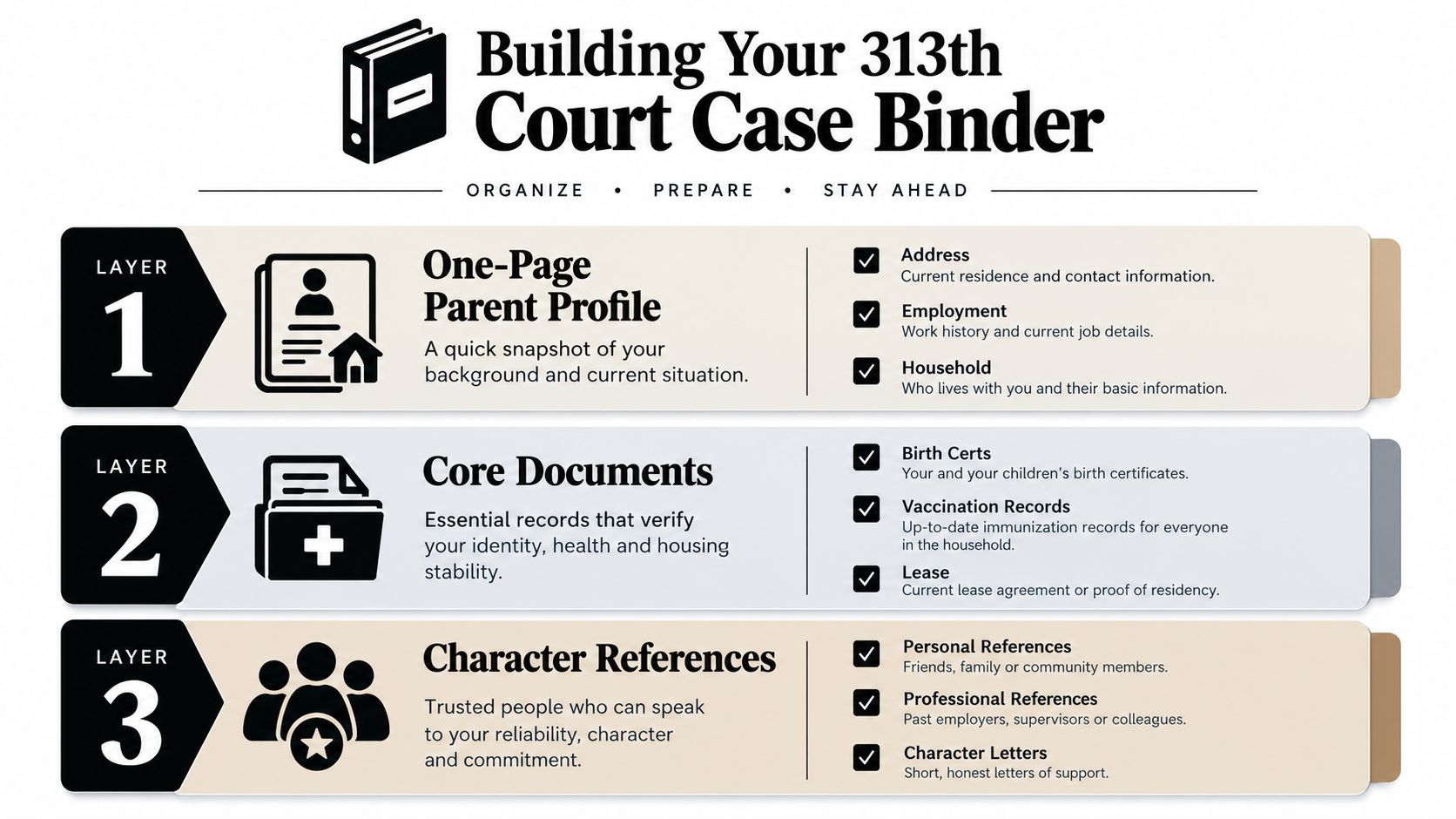
Build a binder that lets your lawyer and the judge understand the case quickly. Organize it around the allegations, the child's needs, the proposed safety solution, and the work you've completed since removal. A disorganized stack of papers makes it harder to see progress.
Start with a one-page parent profile
Put your current address, employment, household members, contact information, and prior CPS history on one page. Explain who lives in the home, who can supervise the child, and what has changed since the removal. If you live in Humble, Atascocita, Kingwood, or Northeast Houston, include practical information about transportation, school, medical care, and available family support.
Add the records that answer safety questions
Gather birth certificates, immunization records, school reports, medical records, lease or mortgage proof, pay stubs, and drug-test results if available. Include screenshots of communications with the caseworker, but preserve complete conversations rather than selecting only favorable lines.
Ask two or three people who know the family and can speak to the home environment whether they are willing to serve as witnesses. A relative, pediatrician, counselor, pastor, or neighbor may address supervision, routines, treatment, or the proposed placement. Your attorney should prepare each witness to answer specific questions, not to deliver a general character speech.
Prepare questions and proof of progress
Ask the caseworker, through counsel when appropriate:
- What exact allegations appeared in the original report?
- When was the removal affidavit prepared and filed?
- What facts does DFPS say show immediate danger?
- What safety plan or alternative to removal was offered?
- What specific action would support a monitored return?
Create a dated record for every service-plan task. Keep parenting-class certificates, counseling-intake records, drug-screening results, repair receipts, photographs of completed home changes, and visit notes. Use the Harris County custody evidence guide to organize proof that responds to the issues in dispute.
Don't promise changes you haven't made. Show the judge what you completed, what remains, and how the plan protects the child.
Getting Local Help in Humble and Harris County
A CPS case can involve the 313th Juvenile Court, DFPS, the child's attorney, a CASA volunteer, relatives, and service providers. Start by confirming the court's current information through the listed 313th contact, (832) 927-8450, and ask for coordinator Natalie Yates when you need scheduling information. Put every court date, service deadline, visit, and attorney appointment on one calendar.
Humble parents should seek counsel quickly rather than waiting for the adversary hearing to arrive. A lawyer can review the affidavit, challenge unsupported allegations, request a kinship placement, address visitation, and negotiate a monitored return when the facts support one. The Humble CPS defense service is one local option for parents who need advice about an investigation or removal.
For free or reduced-cost assistance, ask Lone Star Legal Aid, Houston Volunteer Lawyers, or an applicable court-appointed representation program about eligibility. You can also ask the court about CASA involvement for the child and contact Child Advocates of Harris County for information about child advocacy services. Availability and eligibility can change, so confirm current intake procedures directly.
Don't use emergency numbers as substitutes for legal advice. The DFPS Abuse Hotline is 1-800-252-5400, and 988 connects callers to the 24-hour Harris County Crisis Line. If someone is in immediate physical danger, call emergency services.
Schedule a same-week consultation if possible. A Humble attorney can help you understand the allegations, protect your communication with CPS, organize evidence, identify a safe relative, and prepare for the next appearance. Early action gives your lawyer more time to address placement and safety instead of reacting to a fully developed record.
The Law Office of Bryan Fagan offers free consultations and practical representation for Humble-area families facing CPS investigations, removal hearings, and related custody issues. Visit Law Office of Bryan Fagan to request a consultation and discuss the steps you should take before your Harris County hearing.