Skip to content
You're sitting at the kitchen table in Humble with a custody or divorce packet open on your laptop, trying to determine which page comes first. Your spouse may already be talking about court, your children may be asking questions, and the legal vocabulary makes a difficult family situation feel even more overwhelming. Many neighbors in Atascocita, Kingwood, and East Houston start in exactly this position.
The Harris County law library self-represented family forms process can give you a practical starting point, but finding a packet is only one part of handling a family-law case. You also need to identify the right type of case, complete the required intake documents, file usable documents with the District Clerk, and recognize when a form-based approach is no longer sufficient for your family's needs.
Finding Your Way to the Harris County Law Library
The Harris County Robert W. Hainsworth Law Library is downtown, not in Humble or Northeast Houston. Its physical address is 1019 Congress Street, 1st Floor, Houston, Texas 77002, according to the library's Pro Se Litigant Handbook and forms information. For a resident driving from Humble, Atascocita, Kingwood, or East Houston, that means planning for downtown traffic, parking, and enough time to locate the correct building before you need to use a computer, speak with a reference librarian, or prepare documents.
The library describes its forms collection as a self-help service for people representing themselves. It also explains that its Texas Law Help combined packets were assembled to support public-facing institutions, including county law libraries, public libraries, clerk's offices, and community centers that assist people who need printed forms. That makes the library more than a place to download a document. It's part of a broader public access system for people who need reliable legal information without immediately hiring counsel. You can review the library's family-law forms and Texas Law Help packet information before making the trip.
Start with the digital entry point
Before leaving home, write down the legal problem in plain language. “I need custody papers” may describe a new suit affecting the parent-child relationship, a request to modify an existing order, or an enforcement issue. Those situations can require different forms and different procedural decisions.
Save the packet and instructions in a clearly labeled folder. If you're working from a phone, consider visiting a library or using a computer so you can download the actual document files rather than relying on screenshots. Keep a separate notes page for questions the forms don't answer. The law library can help you locate reference materials and forms, but staff assistance isn't the same as legal advice, strategy, or representation.
The library states that it provides free access to reference librarians, legal books, sample documents, legal forms, public computers, and free notary services at its downtown Houston location. It also offers English- and Spanish-language support materials. Those services can be particularly useful when you need to read a form carefully, print a packet, or understand how a legal term is used in a court document.
Know what the library can and can't do
A reference librarian can help you find a form or resource. The librarian generally won't decide which litigation strategy protects your children, tell you what result a judge will reach, or prepare arguments for your hearing. That distinction matters because a completed packet can still be legally incomplete or poorly suited to the facts.
If you need a local orientation to the courthouse area, the Harris County Family Law Center location information can help you understand where family-law proceedings and related offices are situated. For people creating organized working files from digital documents, a resource such as LiveDocument for legal professionals may also help with document handling, but no software can determine the correct legal remedy for you.
A Humble resident seeking custody and conservatorship representation for Humble families can review Child Custody Lawyer in Humble, TX before deciding whether self-help is appropriate. The important first decision is not merely whether a form is free. It's whether the form matches the dispute you're facing.
Understanding Available Family Law Form Packets
The right packet depends on the legal relationship, the existing court orders, and what you want the court to decide. TexasLawHelp's family, divorce, and children guide is written specifically for people representing themselves. Its toolkit includes forms and instructions for seeking custody, visitation, child support, and medical support orders, making it a useful starting point for families who need to understand the basic filing pathway before visiting the clerk's office.
A divorce packet generally addresses the dissolution of a marriage. A suit affecting the parent-child relationship, often called a SAPCR, addresses issues involving children, such as conservatorship, possession and access, and support. These issues may arise inside a divorce, but they can also arise when the parents aren't married. Choosing a divorce packet when your central problem is a parent-child order can send you in the wrong direction from the beginning.
Match the packet to the court problem
Use the wording of your situation as a sorting tool:
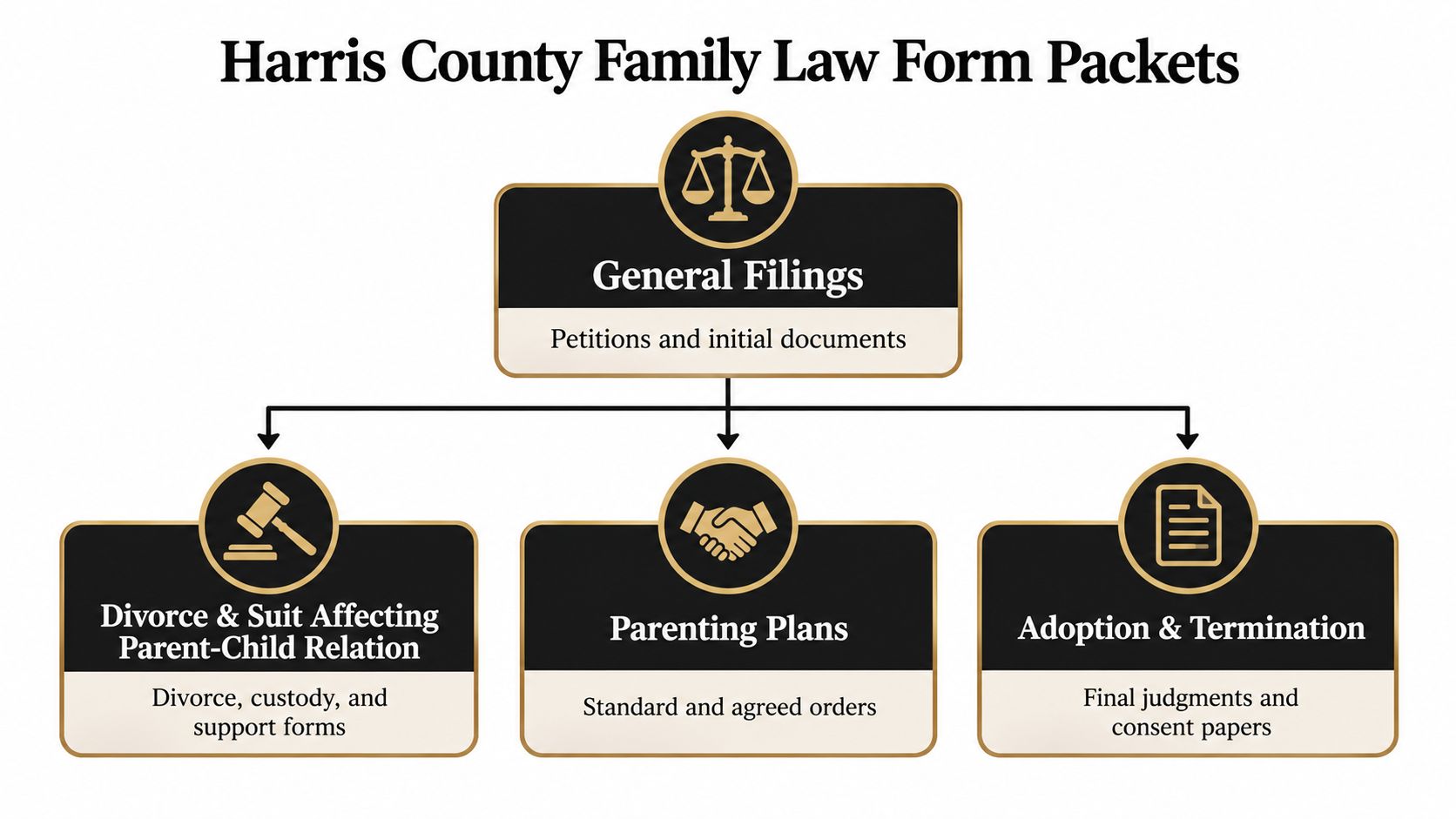
- Divorce without children: Look for materials focused on ending the marriage and addressing property or other relief that applies to your circumstances.
- Divorce involving children: Expect the case to include both marital issues and child-related orders. Read the instructions for parenting, support, and possession carefully.
- Custody or support without a divorce: Look for SAPCR materials rather than assuming a divorce form applies.
- Agreed parenting arrangements: An agreement still needs to be put into a form the court can review and approve. Agreement between parents doesn't eliminate the need for accurate court documents.
- Adoption or termination matters: Treat these as distinct proceedings. Don't assume a general custody packet addresses the required findings, consents, or final documents.
That last category deserves caution. A diagram may help you see how broad family-law materials are organized, but it isn't proof that every possible packet fits your facts or that a form can be filed without additional requirements. A person dealing with termination, adoption, emergency relief, or an existing order should identify the exact proceeding before completing documents.
Read the instructions as part of the form
Self-help litigants often download the petition and skip the instruction pages. That approach saves time at the beginning and creates confusion later. Instructions may explain who files, who must be notified, which attachments are required, and what happens after filing. They can also identify terms that seem interchangeable but have different legal effects.
Texas county-specific materials caution that some counties use local rules affecting form use. That warning is important for Harris County residents. A packet found online may be generally designed for Texas but still require local verification before submission. Check the current Harris County District Clerk and domestic-relations guidance rather than relying on an old copy saved by a friend.
Practical rule: Treat every packet as a starting framework, not a guarantee that the clerk will accept every page exactly as downloaded.
Do not mix pages from unrelated packets merely because the wording seems similar. If you have an existing custody order, a modification or enforcement path may be more appropriate than starting from an original petition. If the other parent agrees with your proposed arrangement, that agreement may simplify the dispute, but it doesn't excuse missing information or incorrect filing steps.
A short educational video can make unfamiliar court terminology easier to recognize before you begin reading the packet.
Completing the Required Intake Documents Correctly
Harris County's District Clerk and Domestic Relations Office identify specific intake materials for self-represented litigants in SAPCR matters. Those materials include Information on Suit Affecting the Family Relationships, Record of Support, and Income Withholding for Support. The office also states that self-represented litigants must file their own forms and pay any applicable fees.
The first document gives the court and related offices identifying information about the family-law case. Complete names, addresses, identifying details, and information about the children should be consistent throughout the packet. If a name is spelled one way in the petition and another way in the intake document, that inconsistency can create avoidable questions later.
The Record of Support should reflect the support history relevant to the case. Don't guess because a number feels close. Gather records before filling it out, including payment information, prior orders, and any correspondence that helps establish what was paid or ordered. If you're unsure whether a payment belongs in a particular category, mark the question for legal review instead of placing it in a field that may not fit.
Income Withholding for Support requires the information needed to direct support payments through the appropriate process. Report income accurately and consistently with the rest of the filing. A person who works for an employer may have regular wage information, while a person with self-employment, contract, or irregular income may need to gather more records before completing the form. Don't use a convenient estimate when the form calls for information you can verify.
Build a document set that can survive review
The safest working method is to create one master folder containing the petition, intake documents, instructions, proposed orders, supporting records, and copies of anything you submit. Use the same spelling, dates, addresses, and child information across the entire set. Before filing, read the documents as if you were a clerk seeing the case for the first time.
Electronic filing creates another point of failure. Harris County's District Clerk and Domestic Relations Office warns self-represented litigants to avoid sending photographs instead of document files. A phone photo may be blurry, rotated, incomplete, or impossible for the receiving system to process correctly. If you're completing a PDF, this guide to completing PDF forms can help with the mechanics of entering information, but it can't tell you what a legally correct answer should be.
The Humble guide to filing for custody in Texas can provide additional local orientation. Still, read the current Harris County instructions alongside any general guide because local procedures can change how you submit and follow up on documents.
Understand service before you file
Filing starts the case. It doesn't automatically notify the other party in the legally required way. Service is the formal process of notifying the respondent that a lawsuit has been filed. The proper method depends on the circumstances and the relief requested, so don't assume that texting a copy, emailing a petition, or handing over papers at home completes service.
If the respondent signs an appropriate waiver or files a legally sufficient response, that may affect the next procedural step. If the respondent can't be located, refuses to cooperate, or presents a safety concern, the situation may require a different approach. Keep proof of whatever occurred and don't represent that service happened when you only sent an informal copy.
The District Clerk and Domestic Relations Office materials also note that some forms use DocuSign and that non-in-person matters require a Prove-Up Affidavit. Read the current office instructions carefully so you know whether your case requires that affidavit and how it must be completed. A notary can verify a signature when required, but notarization doesn't correct an incomplete or legally unsuitable document.
Filing Strategies and Fee Considerations
Filing day should be treated as a quality-control exercise, not a race to upload the first version of a petition. Confirm that you have the correct case type, the required intake documents, readable document files, and copies for your records. The District Clerk and Domestic Relations Office states that self-represented litigants are responsible for filing their own forms and paying applicable fees.
Payment and fee questions deserve attention before submission. The amount and accepted methods can depend on the filing office and current procedure, so check the Harris County District Clerk's instructions before traveling or attempting an electronic filing. If paying a fee would create a serious financial barrier, ask the clerk what current process is available for requesting a waiver or deferral and what proof must accompany that request. Don't assume that a request is approved merely because you're under financial pressure.
Harris County Filing Essentials Checklist
| Document / Requirement | Purpose |
|---|---|
| Correct petition or originating pleading | Identifies the type of family-law case and the relief requested |
| Information on Suit Affecting the Family Relationships | Provides required case and family information for a SAPCR filing |
| Record of Support | Gives the court-related offices support-payment information relevant to the case |
| Income Withholding for Support | Supplies information used for support-withholding processing |
| Required attachments and proposed orders | Gives the court the materials needed to review and process the requested relief |
| Proper document files | Prevents submission problems caused by photographs or unreadable uploads |
| Filing fee or fee request | Addresses the financial requirement connected with filing |
| Service or waiver documentation | Shows that the respondent received legally sufficient notice or completed an appropriate waiver |
| Prove-Up Affidavit for a non-in-person matter | Satisfies the requirement identified in the District Clerk and Domestic Relations Office materials |
Check the file before pressing submit
Open every PDF after saving it. Make sure pages aren't blank, signatures appear where required, and attachments are included in the correct order. A photograph of a signed page may not be accepted as a proper document file, and an upload that looks complete on your phone may be missing pages when opened elsewhere.
Keep the filing confirmation, stamped copies, payment receipt, and every message from the clerk. If the clerk rejects a filing, read the reason carefully and correct the specific problem. Do not upload the same packet again without making changes.
For a non-in-person matter, pay particular attention to the Prove-Up Affidavit requirement identified by the District Clerk and Domestic Relations Office. The affidavit isn't a substitute for the petition or other required documents. It's part of the process for the type of matter described in the office's instructions.
Before filing: A complete packet is not merely a stack of forms. It's a consistent record in which the case type, requested orders, supporting information, signatures, and filing method all fit together.
When to Seek Professional Legal Help in Humble
The law library is valuable when you need access to forms, books, computers, and general legal information. It becomes less sufficient when the central question is not “Where is the form?” but “What should I ask the court to do, and what could happen if I ask incorrectly?”
Self-representation may be manageable when the case is straightforward, the parties agree on the material terms, the forms clearly match the situation, and neither side is hiding information. It becomes more hazardous when the family has significant property, business interests, retirement accounts, debts, a history of family violence, relocation concerns, or a major disagreement about the children.
Compare the resource with the risk
| Self-help resource | Professional representation |
|---|---|
| Helps locate forms and reference materials | Helps determine which legal path fits the facts |
| Provides access to public computers, books, and sample documents | Develops a filing and hearing strategy |
| Can support careful preparation by a self-represented litigant | Identifies missing claims, defenses, and requested orders |
| Doesn't act as your lawyer or make decisions for you | Can communicate legal positions and advocate for your interests |
| May work for a limited, agreed matter | Often becomes important when the other side contests custody, property, or support |
A reference librarian can explain where to find a form. A lawyer can evaluate whether the form asks for the relief you need, whether your proposed order creates an unintended problem, and whether your evidence supports the position you plan to present. Those are different functions, and confusing them is one of the most common mistakes made by anxious self-represented litigants.
You should strongly consider a consultation if the other parent has hired counsel, disputes possession or conservatorship, threatens to move with the child, or has made allegations that could affect the case. A consultation may also be appropriate when you're trying to divide a home, business, investment account, or substantial debt. Texas community-property rules can make property division more complicated than a basic form suggests.
The Humble divorce lawyer guidance can help you think through whether your circumstances are suitable for self-representation. You can also review real family law marketing outcomes as an example of how legal practices may evaluate their outreach, but marketing information isn't a substitute for an individualized assessment of your case.

Get help before an avoidable mistake becomes permanent
A lawyer doesn't need to take over every task for a consultation to be useful. You may ask for help reviewing a completed packet, identifying missing documents, preparing for service, understanding a proposed order, or deciding whether an agreement protects your children and property. That limited review can be more productive when you bring your organized folder, existing orders, financial records, and a written list of questions.
Residents of Humble, Atascocita, Kingwood, and Northeast Houston also need to consider practical safety issues. If you're dealing with threats, stalking, intimidation, or pressure to sign an agreement immediately, don't treat the matter as a routine paperwork exercise. Tell the lawyer what has happened and preserve relevant messages, court papers, and records.
The Law Office of Bryan Fagan serves local families in family law, divorce, child custody, child support, criminal defense, estate planning, wills, trusts, and probate. If you've started with Harris County self-help forms and want a professional review, schedule a free consultation with Law Office of Bryan Fagan to discuss your documents, filing concerns, and next steps. Bring the packet you're working on so the conversation can focus on the specific issues affecting your family.