
Harris County's probate fee schedule lists a $360 heirship filing fee and a $750 attorney ad litem deposit, with the Harris County Clerk's probate fee schedule stating those charges in the same sentence. The court sets the final ad litem fee, typically around $700 for a standard appointment, using the Harris County fee standard as the local benchmark.
For a family handling a loved one's estate in Humble, the upfront deposit is security, not the final ad litem fee. Your budget also needs room for notice, records, your own attorney's work, and any investigation needed to establish the family history.
Harris County Heirship Costs at a Glance
A family opening an heirship case in Harris County faces $1,110 in stated upfront charges before any other expense: a $360 heirship filing fee plus a $750 attorney ad litem deposit on the Harris County Clerk's probate fee schedule. The same filing fee applies to heirship combined with administration. Those two line items only start the case, though. Neither one is the final cost of the ad litem's work.
There's also a local wrinkle worth checking before you pay. A Harris County security-deposit order sets a $700 deposit beginning October 1, 2024, due no later than one week after filing. Because county materials show different amounts, confirm the order governing your particular court and filing date.
Harris County heirship charges at a glance
| Charge | Amount | Who typically pays | Notes |
|---|---|---|---|
| Heirship filing fee | $360 | Applicant at filing | County schedule; the same charge applies to heirship combined with administration |
| Attorney ad litem deposit | $750 per county schedule; $700 under the October 1, 2024 order | Applicant, no later than one week after filing under that order | Security for compensation, not the final approved fee |
| Court-approved ad litem fee, standard appointment | About $700 flat, the county benchmark for appointments after October 1, 2022 | Estate or a party, as ordered | Court determines reasonable compensation |
| Typical ad litem award range | Varies with the scope of the investigation; straightforward files sit at the low end | Estate or a party | Set case by case, so treat any figure as an estimate rather than a quote |
| Minimum stated county charges | $1,110 using the scheduled deposit | Applicant | Excludes other legal and case expenses |
| Publication, service, certified copies, appraisal | Obtain case-specific quotes; amount unknown before scope is established | Applicant or estate | Confirm required work with the clerk and service providers |
The deposit-versus-fee distinction drives most budgeting mistakes in these cases. The deposit is security: money held to guarantee the appointed attorney gets paid. The final fee is whatever the court approves as reasonable compensation after the work is done. What you hand over at filing and what the ad litem ultimately earns are related, but they aren't the same number, and the gap between them depends on how much investigation the file requires.
Your own probate attorney's fee is another budget item, separate from both. That lawyer represents your interests in preparing and presenting the case, while the appointed lawyer serves a different role.
Budgeting rule: Ask for a breakdown showing filing charges, deposited funds, private attorney fees, and expenses separately.
A complete family record generally supports a more limited investigation. Missing relatives, disputed relationships, or additional hearings can require more work, but a clean file doesn't guarantee a particular award. Treat these charges as a starting budget, not a quote.
What an Attorney Ad Litem Does and When One Is Required
An attorney ad litem provides a place at the table for heirs the court cannot identify or locate. Say a grandmother dies in Atascocita, and her family knows of three children living nearby but also knows about another child from an earlier relationship whose address is missing. The absent child's interests still need protection before the court decides who inherits.
Under Texas Estates Code Section 202.009, the court must appoint an attorney ad litem to represent heirs whose names or locations are unknown. The ad litem doesn't represent the applicant or the estate generally. Family agreement therefore doesn't eliminate the need to protect unidentified or absent interests.
The role is protective and investigative.

In an heirship case, the appointed lawyer typically reviews the family history, asks about possible heirs, examines notice issues, and presents the results to the court. Although ad litem appointments also arise in other legal settings, this appointment concerns inheritance interests, not general child advocacy.
Why an agreed estate can still need investigation
For families in Humble, Atascocita, Kingwood, and Northeast Houston, the difficult questions often involve prior marriages, blended families, adoptions, estranged relatives, or someone who moved abroad. None of those circumstances necessarily means there's a dispute. They mean the family history needs careful documentation.
If you're navigating probate without a will in Texas, explain uncertain relationships early rather than assuming they won't affect the application.
Useful preparation includes:
- Vital records: Gather death certificates, marriage records, and birth records that establish relationships.
- Firsthand accounts: Identify relatives or other knowledgeable people who can explain marriages, children, and family connections.
- A documented family tree: Include names, relationships, relevant dates, and last known addresses, marking uncertainty clearly.
The compensation framework in Texas Estates Code Section 53.104 leaves payment under court control. Better records can narrow the work, but they don't buy an exemption from a required appointment.
The Probate Lawyer in Humble, TX practice covers probate administration and estate settlement in Harris County. When preparing for legal help, bring the unresolved questions along with the records. An accurate account, including gaps, is more useful than a polished family tree that leaves someone out.
Who Pays the Ad Litem and How the Court Sets the Fee
The applicant posts the deposit, but the judge allocates the final fee. Whoever advances the security at the start of the case may or may not be the person the court ultimately orders to bear the expense, because the signed payment order controls the outcome.
This court-controlled approach is long-established. The 1984 Texas Probate Code already authorized reasonable compensation set by the probate court and taxed as proceeding costs. Harris County's published fee standards provide a local benchmark of $700 flat for typical appointments made after October 1, 2022, rather than a universal statewide price.
The payment process follows the court's appointment and approval orders.
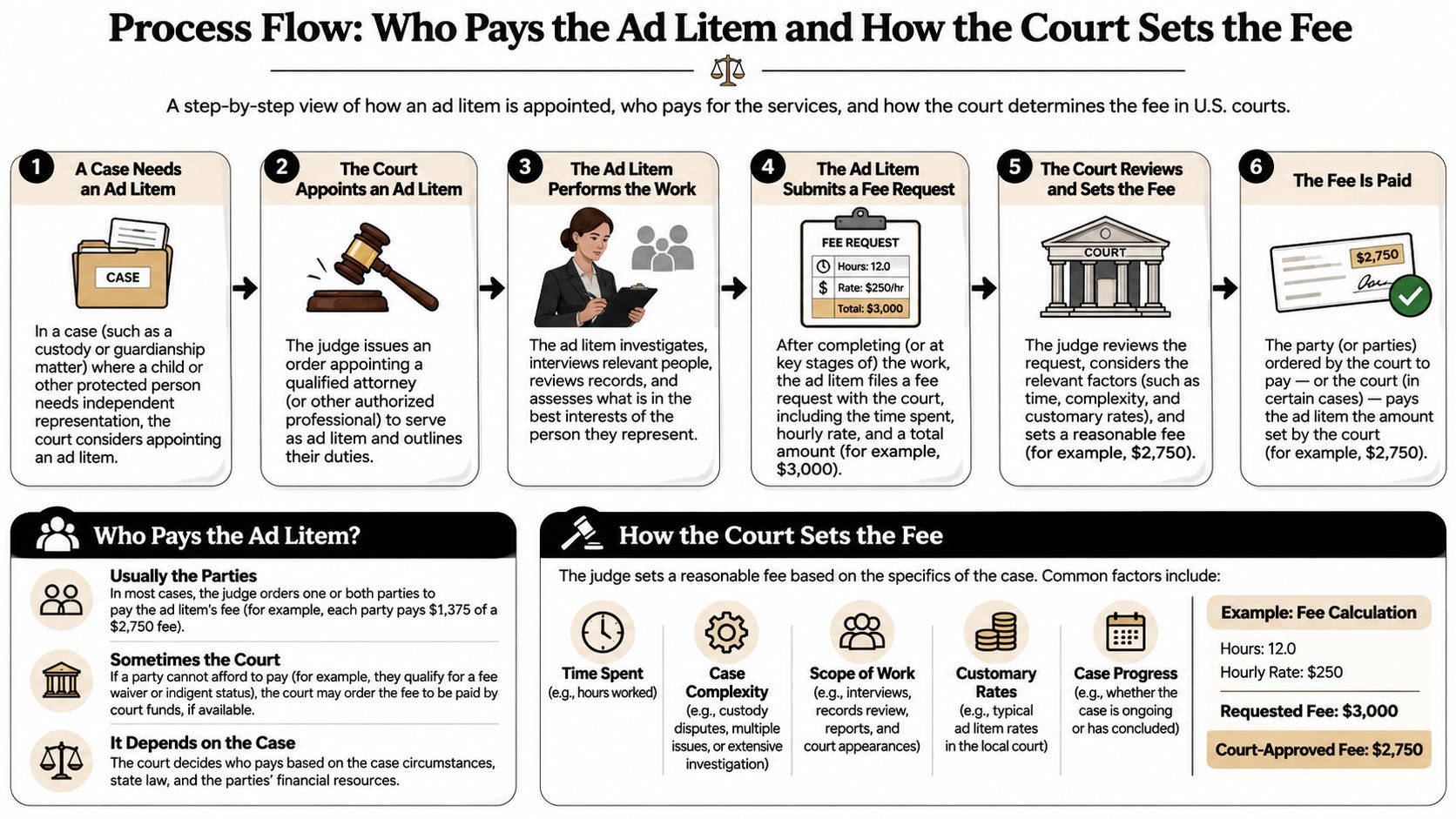
- The applicant files the heirship application. The applicant pays the filing charges and prepares to provide the required security.
- The applicant deposits security under the applicable order. The deposit is held for appointed counsel's costs under the Estates Code security provisions, rather than treated as a private retainer.
- The ad litem performs the assigned work. Investigation and review of notice proceed while the deposited funds remain available for court-directed payment.
- The ad litem requests compensation. The request should identify the work supporting the requested award; the applicant doesn't privately negotiate away the court's authority.
- The judge reviews and approves compensation. The resulting order determines the approved amount and who must pay it.
- Payment is made as directed. The deposit can fund the approved fee, and additional payment may be necessary if the award exceeds available security.
That last step is where families get caught off guard. A deposit covers the award only up to the amount held, so an approved fee above that figure leaves a balance someone must pay. The order names who.
Keep the payment order with your estate records
Retain the deposit receipt, appointment order, compensation request, and signed payment order together. Those documents help distinguish money you advanced from the expense the court ultimately allocates. If a reimbursement question comes up later among the heirs, the signed order answers it far better than anyone's memory of who wrote the first check.
For filing logistics, our guide to Harris County probate court for Humble families provides local context. Ask the clerk which deposit order applies, and ask your attorney to explain the final allocation before assuming you'll receive reimbursement.
For additional context on the heirship process, this video may help you prepare questions for your consultation.
Why the Final Bill Can Differ From the Deposit
The $750 security amount in the Harris County probate materials is money advanced toward the ad litem's compensation. It is not a fixed attorney fee, and it does not measure how much investigation the appointed lawyer will need to complete.
Consider a Kingwood estate where the family can name the likely heirs, but confirming a possible half-sibling requires records from several counties and follow-up with relatives who have not spoken in years. Even without open conflict, that investigation can take more work than reviewing a well-documented family history. The final approved fee reflects the work the court finds reasonable after the investigation is finished.
When the approved fee exceeds the deposit
| Scenario | Likely ad litem amount | What drives it | Who typically pays |
|---|---|---|---|
| Unusual or contested matter | A court-set amount that may exceed the amount typically awarded in a straightforward case | Missing heirs, disputed relationships, publication or other notice requirements, added hearings, and cross-county family records | The estate or a party, as ordered |
The gap between deposit and award usually comes down to proof. Time, complexity, missing addresses, notice problems, and additional hearings all increase the work counsel must document and support.
Before the compensation hearing, ask:
- Deposit treatment: Will unused security be returned, and how will the deposit be credited against the approved fee?
- Additional funding: What missing information, investigation, or court appearances would support a request for more money?
- Final responsibility: Will the estate pay, or might the court direct a party to bear the expense?
A larger deposit only provides more security for payment. It does not control the compensation the judge approves, so review the requested award and the treatment of any remaining funds as separate questions.
These questions matter even more in a low-cash estate. A house may have substantial value while providing no ready money for court expenses. If the ad litem seeks more than the deposit, ask for the written work or time records supporting the request. Those records should show what drove the amount and whether the additional work came from a problem the family could not have resolved earlier.
Practical Ways to Keep Heirship Costs Down
An Atascocita family brings a documented family tree to its first meeting with counsel, with dates, addresses, and relationships already verified against vital records. That preparation can eliminate a second round of requests to establish the same relationships, narrowing the investigation without sacrificing accuracy. Correcting an omitted relationship after filing, by contrast, can require more work than documenting it accurately at the beginning.
Use this checklist to organize the documents and questions you'll bring to counsel.
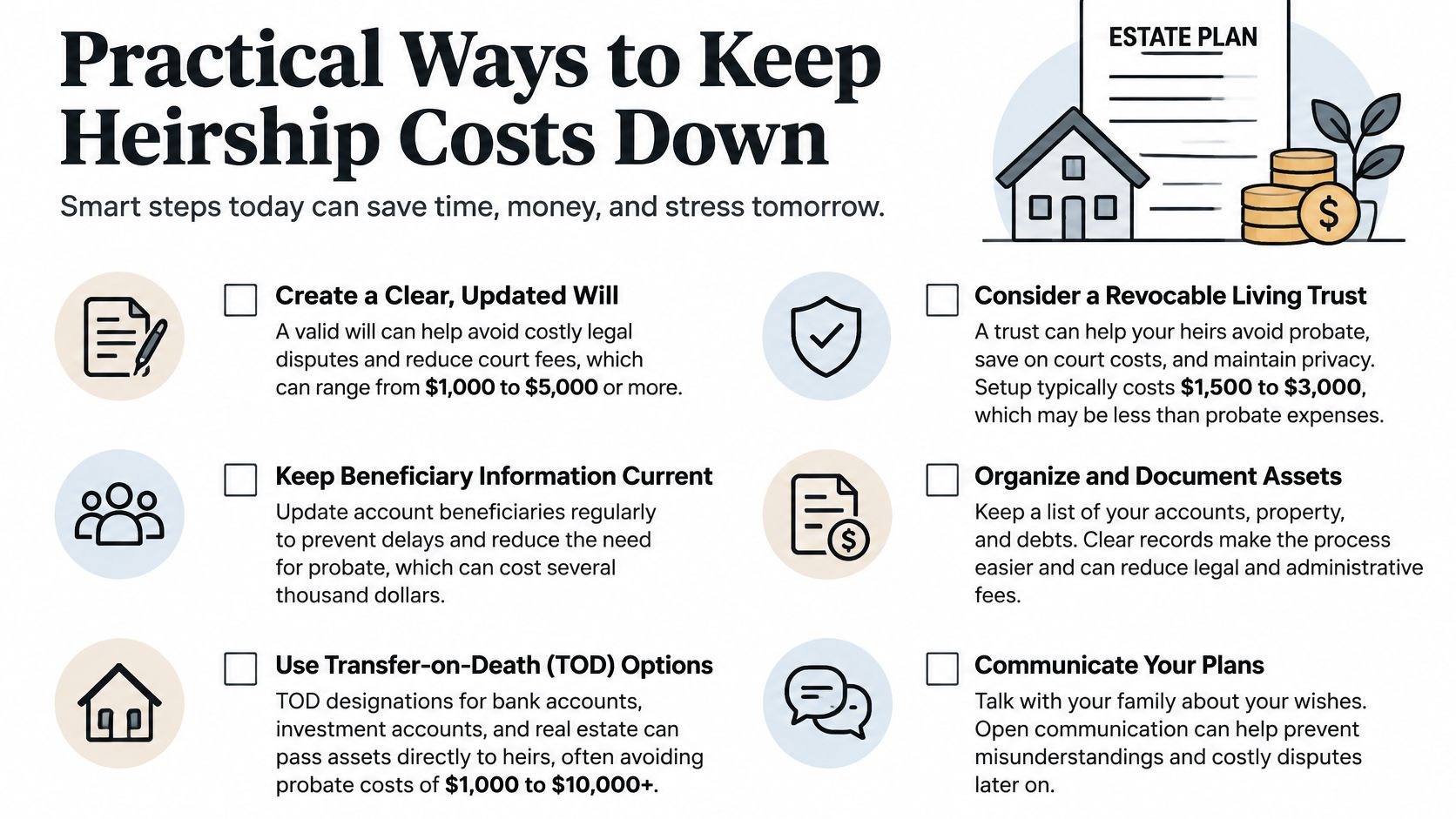
- Build a complete family tree. Record relationships, relevant dates, and last known addresses, including relatives who died before the decedent.
- Gather vital records. Collect the decedent's death certificate and the birth and marriage records needed to connect close relatives.
- Collect firsthand family information. Ask knowledgeable relatives to document what they know about children, prior marriages, and adoptions; let counsel determine the proper affidavit form.
- Confirm the current court requirements. Verify the filing charge and applicable deposit order with the probate clerk for your filing date.
- Request a written estimate of expected work. Ask the ad litem what information is missing and what could expand the investigation.
- Submit a consistent application. Review names, relationships, and addresses against the supporting documents before filing.
- Document known heir questions. Where legally appropriate, resolve factual uncertainty in writing without attempting to bargain away someone else's inheritance rights.
- Compare the two cost categories. Weigh the scope of your probate attorney's proposed work against the separate appointed-counsel expense before deciding what assistance you need.
Choose documents for the actual task
An heirship affidavit for a Humble estate may raise different questions from a judicial heirship proceeding. Don't assume a signed affidavit automatically replaces the court process your property or estate requires.
For relatives living elsewhere, Semper Terra's fee guide for out-of-state heirs offers context for discussing estate-settlement billing. Keep that discussion separate from the court-appointed ad litem's compensation.
Complete records shorten the investigation. Every accurate address you supply is one the ad litem doesn't have to locate, and every verified relationship is one less question requiring testimony or added document requests. I would treat the first few weeks after a death as the cheapest window for this work, because relatives are reachable, records are easy to gather, and memories are fresh. The same information gathered months later, after the application is already on file, tends to cost more in everyone's time.
Your Next Step
Before your next hearing or filing deadline, gather every document that shows how the ad litem was appointed and what payment the court has already authorized. The signed appointment order, any deposit requirement, and the written estimate of expected work each answer a different question. Together, they show what has been charged up front, what work the ad litem expects to perform, and what may still require court approval.
The county clerk's probate page is a useful starting resource for filing information, but the clerk cannot advise you about your family's rights or the estate's obligations. If the requested compensation seems excessive, identify the specific entries or tasks you question and ask for supporting records before the court rules. A focused objection gives the judge something concrete to review.
Bring questions, not just paperwork
At a consultation, bring the family tree, available vital records, any application already filed, court correspondence, and deposit receipts. Include a short list of missing relatives, uncertain relationships, and cash-flow concerns. If someone has already requested additional payment, bring that request too. These details help counsel evaluate whether the work matches the complexity of the file or whether the investigation has expanded beyond what the estate appears to require.
For a Harris County heirship proceeding, attorney ad litem cost is best evaluated alongside the family history, required notice, and available estate cash. Choosing help based only on the smallest initial payment can leave important work outside the quoted scope.
The Law Office of Bryan Fagan serves Humble, Atascocita, Kingwood, and Northeast Houston, and the firm explains Harris County court procedure in plain English so families can decide on the next practical step. During a free consultation, you receive a confidential review of your circumstances, honest feedback about your legal options, and clear direction on what to do next. Call (281) 817-1827 to schedule with the Humble office, even if your file is not yet complete.
Then work through this checklist:
- Confirm the governing court and deposit order. Ask the probate clerk which requirement applies to your filing date rather than relying solely on a fee quoted elsewhere.
- Collect the appointment documents. Request the ad litem's name, the signed appointment order, and the written estimate of expected work.
- Address fee concerns specifically. Identify the entries or tasks you question and request supporting records before the court rules.
- Decide what legal assistance you need. Have counsel assess whether you can appropriately handle any part yourself and what representation the application and administration require.