Skip to content

Filing for divorce in Texas isn’t just about paperwork; it's about navigating a legal system with its own set of rules right here in our community. For families in Humble, Atascocita, and Kingwood, the process starts by making sure you meet the state's residency rules and then filing a document called an Original Petition for Divorce. The good news? Texas is a no-fault state, which really simplifies things. You don't have to prove someone was "to blame" for the marriage ending. Once the petition is filed and your spouse is formally notified, a mandatory 60-day waiting period kicks in before anything can be finalized.
Your First Steps in the Texas Divorce Process
Thinking about divorce can feel overwhelming, like you're staring up at a huge mountain without a map. If you're here in Humble, Atascocita, or anywhere in Northeast Houston, we want you to know the path forward gets a lot clearer once you grasp a few key ideas in Texas family law. The journey doesn't have to start with conflict and courtrooms; it can start with knowledge and preparation.
Our goal at The Law Office of Bryan Fagan is to break this process down into real, manageable pieces. Let's walk through the foundational concepts every Humble resident needs to understand before taking that first official step.
Understanding No-Fault Divorce in Texas
One of the first things that brings a sense of relief to many of our clients is when they learn Texas is a "no-fault" divorce state. This is a big deal. It means you don't have to air private conflicts or prove your spouse did something specific like adultery or abandonment to get divorced.
Instead, the legal reason is simply that the marriage has become "insupportable." This is just a formal way of saying there’s been a breakdown in the relationship and there's no reasonable chance you'll get back together. This approach takes the blame game off the table, which can dramatically lower the temperature and emotional strain of the entire process for your family. While you can still file on fault grounds if you need to, the vast majority of divorces we see in Harris County are no-fault. It keeps everyone focused on resolution, not revenge.
Meeting the Residency Requirements
Before any Texas court will even look at your divorce petition, you have to prove you belong there. This is a strict, non-negotiable requirement that ensures your case is handled locally.
The rules are pretty simple:
- State Residency: At least one of you must have lived in Texas for the last six months.
- County Residency: That same person has to have lived in the specific county where you’re filing (for our local clients in Humble, this is almost always Harris County) for the last 90 days.
These rules make sure your case is handled by a local court that understands our community. If you're in Kingwood or Humble, you'll be heading to the Harris County Civil Courthouse. It’s a well-trodden path—in 2022 alone, 71,988 divorces were granted in Texas, and straightforward rules like these are part of what makes the process manageable.
To give you a clearer picture, here's a quick rundown of these essential concepts.
Key Texas Divorce Concepts at a Glance
This table summarizes the foundational terms and requirements you'll encounter when filing for divorce in Humble, Texas.
| Concept | What It Means for You | Local Consideration (Harris/Montgomery County) |
|---|---|---|
| No-Fault Divorce | You don't have to prove your spouse did something wrong. Citing an "insupportable" marriage is enough. | This is the standard approach used in nearly all local filings, which helps streamline the process. |
| State Residency | You or your spouse must have lived anywhere in Texas for at least 6 months before filing. | This is a mandatory prerequisite. The court will dismiss your case if you don't meet this. |
| County Residency | The person who lived in Texas for 6 months must also have lived in the filing county for the last 90 days. | For Humble residents, this means filing in Harris County. For those in The Woodlands, it's Montgomery. |
| 60-Day Waiting Period | A judge cannot finalize your divorce until at least 60 days have passed since you filed the petition. | This is a "cooling-off" period. It applies to every case, even fully agreed-upon divorces. |
Understanding these basics sets the stage for a smoother, more predictable process from the very beginning.
It's important to remember that divorce is a legal process that ends a marriage, which is distinct from simply living apart. For those unsure about the finality of divorce, it's helpful to understand the differences between legal separation vs. divorce in Texas, as separation is not formally recognized in the same way.
Making the decision to file for divorce is huge, and starting with a clear understanding of these initial requirements is the best thing you can do for yourself and your family.
Filing Your Divorce Petition in Harris County
Once you've confirmed you meet the residency rules and understand the grounds for divorce, it’s time to move from planning to action. For anyone in Humble or the surrounding Northeast Houston area, this means dealing with the Harris County court system. Don't let that intimidate you; it's a well-defined path, and knowing the steps ahead of time makes all the difference.
This is where your decision becomes a legal reality. The whole process kicks off with one crucial document: the Original Petition for Divorce. Think of it as the official starting gun for your case. This form lays out the basic facts for the court—who you are, who your spouse is, if you have children—and formally requests that a judge dissolve your marriage.
Getting and Preparing the Right Paperwork
Your main source for official court documents is the Harris County District Clerk's office. You can usually find the forms you need, including the Petition, on their website or by stopping by the courthouse.
While the state provides standard templates, filling them out correctly is non-negotiable. One small mistake or an incomplete section can get your entire filing rejected, sending you right back to square one. This is a common pitfall and a perfect example of where an experienced local attorney can save you a world of frustration, ensuring every detail aligns with Harris County's specific rules.
Here’s a quick look at how these initial steps flow together.
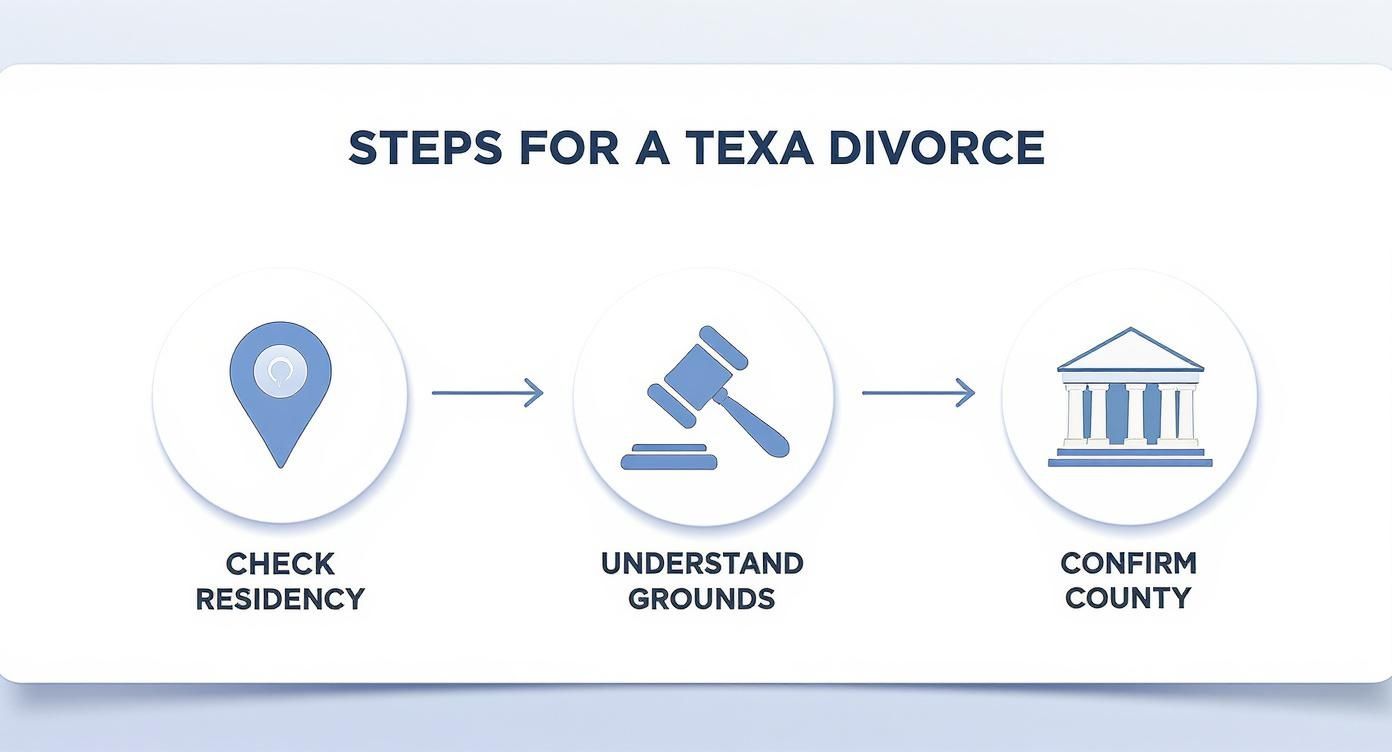
This visual just reinforces the fundamentals: before you ever file, you have to nail down your residency, grounds, and the right county. Getting this foundation right is everything.
The Formal Process of "Serving" Your Spouse
After your petition is stamped and filed with the Harris County District Clerk, Texas law is very clear: your spouse must be formally notified. This isn't optional, and you can't just text them a picture of the paperwork. This official notification is called "service of process," and it’s a legal requirement to ensure the other party knows they're involved in a lawsuit.
You have a few ways to get this done:
- Personal Service: This is the go-to method. A neutral third party—like a sheriff, constable, or a private process server—physically hands a copy of the petition and a court "citation" to your spouse.
- Waiver of Service: If things are amicable, your spouse can sign a Waiver of Service. By signing this form, they're telling the court they've received the petition and agree to skip the formal delivery process. This can save time, money, and stress.
- Substituted Service: What if you can't find your spouse? In that situation, your attorney can petition the judge for an alternative. This might mean leaving the papers with another adult at their home or even serving them via social media, but you have to get the court's permission first.
Getting service right is a critical checkpoint. Any missteps here can bring your case to a screeching halt.
Understanding the Fees and Timelines
Filing for divorce isn't free. In Harris County, expect the court filing fees to be around $300, though these figures can and do change. If you're struggling financially, you can ask the court to waive these costs by filing a Statement of Inability to Afford Payment of Court Costs.
Once your spouse has been served, the clock starts on a mandatory 60-day waiting period. A Texas judge legally cannot finalize your divorce until at least 60 days have passed from the filing date. It's often called a "cooling-off" period, built into the law to give couples a moment to pause before the marriage is officially over. This waiting period applies even in straightforward, no-fault cases where the reason cited is an 'insupportable marriage.' For more context on divorce trends, you can review some Texas divorce statistics.
Keep in mind, the 60-day period is the absolute minimum. If you have complicated property to divide or are working through custody arrangements, expect the process to take longer. But it gives you a baseline for your timeline.
Properly handling these administrative steps is essential. At The Law Office of Bryan Fagan, our Humble team has guided countless local families through every form, filing, and deadline. If you're ready to move forward, we are here to help.
Untangling Your Lives: Property Division and Child Custody

Once you’ve filed the initial paperwork, you get to the real heart of the matter: dividing up a shared life. For most families in Humble, Kingwood, and Atascocita, this boils down to two critical areas—your property and your children.
These aren't just legal hurdles to clear. The decisions made here will echo for years, shaping your financial stability and your family's future. Getting it right is about more than just checking boxes; it’s about building a solid foundation for the next chapter of your life. Let's break down how Texas courts handle these issues so you know what to expect.
What “Community Property” Really Means in Texas
You’re going to hear the term community property state a lot. What it means is surprisingly simple: almost everything you and your spouse acquired during the marriage belongs to both of you. It doesn’t matter whose paycheck bought the car or whose name is on the deed to the house.
Think of the community pot as including things like:
- The family home in Humble.
- Cars, boats, or other vehicles bought while married.
- Retirement funds like a 401(k) or pension that grew during the marriage.
- Bank accounts and investment portfolios.
The flip side of this is separate property. This is anything you owned before the wedding, or assets you received as a personal gift or inheritance during the marriage. The key here is proof. The burden is on you to prove an asset is separate, and that often requires a clear paper trail. Without it, the court will likely presume it's community property.
It's Not Always 50/50: The "Just and Right" Standard
Many people assume community property means a clean 50/50 split. That's a common misconception. Texas law mandates a “just and right” division, which is a far more flexible standard. A judge has the authority to divide the marital estate in a way they believe is fair under the circumstances, which might be 50/50, but it could just as easily be 60/40.
So, what sways a judge's opinion? They’ll look at the whole picture, including factors like:
- Each spouse’s ability to earn a living.
- Which parent the kids will live with primarily.
- Any fault in the breakup (like adultery or cruelty).
- The size and nature of each spouse's separate property.
This is precisely why a complete and honest financial inventory is non-negotiable. You need to account for every asset and every debt to argue effectively for a division that is truly fair for you and your family.
Creating Stability with Temporary Orders
That mandatory 60-day waiting period can feel like an eternity. Who pays the mortgage? Where will the kids sleep on Tuesday? Who gets to stay in the house? This is exactly what Temporary Orders are for. They are court-enforceable rules of the road that govern everyone’s behavior while the divorce is pending.
These orders can dictate crucial arrangements, including:
- Who has temporary use of the family home.
- A temporary custody and visitation schedule for the children.
- Temporary child support and, in some cases, spousal support.
- Injunctions to prevent one spouse from emptying bank accounts or selling off assets.
For families across Northeast Houston, temporary orders provide critical stability during a very unstable time. They protect your kids' routines and your financial well-being until you can reach a final agreement.
How Texas Handles Child Custody and Support
When kids are involved, the court’s vocabulary changes. What most of us call "custody" is known as conservatorship in a Texas courtroom.
The court has one primary directive that trumps everything else: making a decision that is in the "best interest of the child." This principle guides every ruling, focusing on the child's well-being, needs, and the parents' ability to create a safe, stable home.
Most often, Texas judges name parents as Joint Managing Conservators. This means you share the right to make major decisions about your child's education, healthcare, and religious upbringing. It doesn’t automatically mean a 50/50 time split. Usually, one parent is named the "primary" conservator, which gives them the right to decide where the child lives.
The other parent is given a visitation schedule, called a possession order. Texas provides a Standard Possession Order that is presumed to be in the child's best interest, but you and your ex are free to agree on a custom schedule. Child support is then calculated using a state formula based on the non-primary parent’s net income and how many children there are. If you need a deeper dive into these specifics, our guide on how to get sole custody in Texas explores these critical issues in more detail.
The decisions surrounding your property and children are the heaviest and most consequential parts of a divorce. At The Law Office of Bryan Fagan, our Humble-based team is here to help you understand your rights and advocate for a fair outcome. We invite you to schedule a free consultation to talk about your specific situation.
Finding the Right Path: Uncontested vs. Contested Divorce
When people in Humble think about divorce, the first image that often comes to mind is a tense courtroom battle. But that’s more Hollywood than Harris County. The truth is, most divorces don’t end in a dramatic, drawn-out public fight. You actually have a few different paths you can take, and knowing your options is the first step toward finding a more peaceful and less expensive resolution for your family.
Ultimately, the route you choose will come down to your family’s unique situation and, frankly, how well you and your spouse can communicate through this process. The main forks in the road lead to an uncontested divorce, a contested divorce, or a resolution found through mediation. Each comes with its own process, timeline, and emotional weight, so let's break them down.
The Smoothest Route: The Uncontested Divorce
An uncontested divorce is what most people hope for. It’s pretty straightforward: it just means you and your spouse have already agreed on everything. I mean every single detail needed to dissolve the marriage—from who gets the house and how the retirement accounts are split to the parenting schedule and child support.
When you can make this work, the benefits are huge:
- It’s Cheaper: With nothing to fight about, you’ll spend a fraction of the money on attorney’s fees and court costs.
- It’s Faster: These divorces move quickly. Many are finalized not long after the mandatory 60-day waiting period is over.
- It’s Private: You keep the intimate details of your family’s life out of a public courtroom.
- You’re in Control: You and your spouse get to decide your future, not a judge who doesn't know you.
For this path to work, both of you have to be willing to negotiate in good faith. If you can sit down together and map out a fair plan for your family, whether you’re in Kingwood or Atascocita, the uncontested route is the most direct way to move forward.
When You Can’t Agree: The Contested Divorce
A divorce becomes contested the moment you and your spouse can’t agree on one or more key issues. That disagreement is the trigger that forces the court system to step in and make the decisions for you. A case might be contested over something big, like who gets the family home, or something complex, like how to divide a family business. Even disagreements over the parenting schedule can turn a divorce into a contested one.
This is the path that involves litigation. It’s a much more formal process that includes a discovery phase, where both sides are required to exchange information, financial records, and other documents. It can also involve things like depositions, where attorneys question each party under oath. It’s an intimidating part of the process, which is why we created a guide on how to prepare for a deposition in your Texas case. The whole point is to get all the facts out on the table before a judge has to get involved.
Don’t let the word "contested" scare you into thinking a trial is inevitable. The reality is that more than 90% of all contested cases still end up settling before they ever see a final trial. The legal process is just designed to prepare you for that possibility.
Finding Common Ground Through Mediation
Because contested divorces can be so draining—emotionally and financially—courts in Harris County and throughout Texas heavily favor mediation. In fact, they often require you to try it. Mediation is a structured negotiation where you, your spouse, and your lawyers meet with a neutral third-party mediator.
The mediator's job isn't to pick a side or issue a ruling. They are specially trained to facilitate a productive conversation, help you find areas where you actually agree, and guide you both toward a solution you can live with. It’s a completely confidential process, which gives you a safe space to hash things out without the pressure of a courtroom. More often than not, mediation is the key that unlocks a settlement in even the most difficult cases, saving families all over Northeast Houston from the high cost of a trial.
Understanding these different avenues is your first step. At The Law Office of Bryan Fagan, our Humble attorneys are experienced in navigating all three. We invite you to schedule a free consultation to talk through your situation and figure out which approach makes the most sense for you and your family.
Common Mistakes to Avoid During a Texas Divorce

The path through a divorce is lined with potential pitfalls that can cost you time, money, and peace of mind. Based on years of helping families across Humble, Atascocita, and Kingwood, we've seen firsthand how a few common missteps can create serious long-term problems.
The good news? You can sidestep these issues with a bit of foresight. Making smart, strategic decisions from the start is about protecting yourself, your finances, and your children from unnecessary conflict.
Oversharing On Social Media
It's so tempting to vent your frustrations online, especially when emotions are running high. But when you're going through a divorce, you have to treat your social media accounts as potential evidence, not a private diary. Every single post, picture, or comment can be twisted and used against you in court.
Think about it. A picture of you out with friends could be framed as irresponsible parenting. A frustrated post about your ex could be used to paint you as uncooperative. The safest rule is simple: do not post anything about your divorce online. Keep your private life private until the process is completely over.
Hiding Assets Or Misrepresenting Finances
In a Texas divorce, honesty isn't just a good idea—it's the law. The court requires full financial disclosure from both spouses. Some people think they can be clever by hiding cash, transferring money to a friend's account, or undervaluing a business. This is a massive mistake.
Sooner or later, concealed assets are almost always found during the discovery process. When that happens, the consequences can be severe. A Harris County judge can punish the dishonest spouse by awarding a larger portion of the community property to the other party. In some cases, it can even lead to civil or criminal penalties. The risk just isn't worth it.
One of the most critical steps in any divorce is gathering a complete inventory of your financial life. This isn't just about what you own; it's about being prepared to prove it.
To help you get organized, we've put together a basic checklist of the documents you'll want to start collecting right away.
Document Checklist for Filing Your Divorce Petition
Gathering these documents early on will streamline the divorce process and ensure you are prepared for property division discussions.
| Document Category | Examples of Documents to Collect |
|---|---|
| Financial Records | Bank statements (checking, savings), credit card statements, pay stubs for both spouses |
| Property Information | Deeds to real estate, vehicle titles, mortgage statements, property tax records |
| Debt Information | Loan statements (car, personal, student), information on outstanding debts |
| Retirement & Investment | 401(k) statements, pension information, brokerage account statements |
| Personal Documents | Marriage certificate, birth certificates for children, Social Security cards |
Having these items on hand makes everything smoother and shows the court you're taking the process seriously.
Forgetting The Emotional Impact On Children
Divorce is an adult problem, but kids are often caught in the emotional crossfire. It's a huge mistake to use them as messengers, confidants, or pawns in your disputes. Speaking negatively about your co-parent in front of your children can cause lasting emotional harm and damage their relationship with both of you.
Texas courts take a very dim view of any parent who tries to alienate their child from the other. Your job as a parent is to provide stability and reassurance. Co-parenting classes, which are often required by local courts anyway, can give you valuable strategies for communicating effectively and keeping your kids out of the conflict.
Trying To Handle A Complex Case Alone
Sure, a simple, uncontested divorce with no kids and minimal assets might be manageable on your own. But trying a DIY approach for a more complex situation is incredibly risky. For instance, while most cases cite an 'insupportable marriage,' fault-based grounds like adultery are still a factor for about 60% of individuals. Knowing how these nuances play out locally is crucial. For more context, you can explore some Texas divorce and custody statistics that shed light on these trends.
If you have significant assets, a family business, retirement accounts, or disagreements over child custody, the stakes are simply too high to go it alone. An experienced Humble divorce attorney can protect your rights, fight for a fair property division, and advocate for your children's best interests.
Avoiding these common mistakes can make a world of difference. If you’re concerned about any of these issues, our team at The Law Office of Bryan Fagan is here to help. Schedule a free, confidential consultation at our Humble office to discuss your situation and learn how we can protect you and your family.
Common Questions About Divorce in Humble
When you're first considering divorce, a million questions can start swirling in your head. Below, we’ve tackled some of the most common ones we hear from our neighbors right here in Humble, Atascocita, and Kingwood. Our goal is to give you clear, straightforward answers without all the dense legal jargon.
Think of this as your starting point. It’s a quick-reference guide to help you get a handle on the big-picture issues, from how long it might take to what it could cost.
How Much Will a Divorce Cost Me in Texas?
This is almost always the first thing people ask, and the most honest answer is: it truly depends. There isn't a single price tag for a divorce in Texas. The final cost is a mix of court fees, attorney expenses, and other professional services that might be needed.
The single biggest factor that drives the cost up or down is conflict.
- An Uncontested Divorce: If you and your spouse are on the same page about everything—property, kids, support—you're in the best-case scenario, cost-wise. Your expenses will be on the lower end, mostly covering the legal help needed to draft and file the paperwork correctly.
- A Contested Divorce: The moment you disagree on key issues, the costs start to climb. This path requires a lot more of an attorney's time for back-and-forth negotiations, formal mediation, and potentially preparing for and attending court hearings.
Just to get the case started, the court filing fees in Harris County will run you about $300. But remember, that's just the entry fee. The more you have to fight over, the more you can expect to invest.
We Have a Prenup. Can We Still Get Divorced?
Absolutely. A prenuptial agreement doesn't stop you from getting a divorce. What it does is lay out a pre-determined roadmap for how your assets are supposed to be divided if the marriage ends. Here in Texas, a well-drafted prenup can make the property division part of your divorce much simpler by clearly defining what is separate property versus what is community property.
That said, a prenup isn't automatically ironclad. It can be challenged in court. For a judge to uphold it, the agreement must have been signed voluntarily by both of you, with a fair and reasonable disclosure of finances at the time. A court won't enforce a prenup if it's found to be "unconscionable" (grossly one-sided) or if it was signed under pressure or duress.
Can We Just Use the Same Lawyer to Save Money?
We understand the logic behind this question, especially when a couple wants to keep things amicable. But in Texas, the answer is a hard no. It's an ethical impossibility for one attorney to represent both spouses in a divorce. It creates a direct conflict of interest.
An attorney's core duty is to be a zealous advocate for their client's best interests. In a divorce, even a friendly one, the two spouses' interests are legally opposed. One lawyer can draft all the paperwork for an uncontested divorce, but they can only officially represent and give legal advice to one person. The other spouse is always strongly encouraged to have their own independent lawyer review everything before signing.
What if My Spouse Refuses to Sign the Divorce Papers?
Don't panic. This is a common fear, but Texas law has a process for exactly this scenario. If your spouse digs in their heels and refuses to sign anything, it can't stop you from moving forward with the divorce.
The first crucial step is to make sure they are officially "served" with the divorce petition. This is typically done by a constable or a private process server who physically delivers the documents to them. Once that happens, a legal clock starts ticking, and they have a specific deadline to file a formal response, called an Answer, with the court.
If your spouse is properly served and still refuses to file an Answer, you can proceed with a default divorce. This allows you to go to the judge and ask them to finalize the divorce based on the terms you laid out in your petition—all without your spouse's signature or participation.
The bottom line is that the system is designed so one person cannot trap the other in a marriage. While their cooperation makes everything faster and less expensive, their refusal to participate will not prevent you from getting a final divorce decree.
At The Law Office of Bryan Fagan, we know the questions and worries that keep our Humble neighbors up at night. If you're looking for clear answers and a confident path forward, we invite you to schedule a free, no-obligation consultation with our local attorneys. Let us help you figure out the best next steps for you and your family.