Skip to content

When you're a parent facing a child custody case, it's easy to feel overwhelmed. The path forward for your family can seem confusing, but taking that first step is everything. For parents right here in Humble, Texas, a knowledgeable humble child custody attorney can bring immediate clarity, cutting through the legal jargon and focusing on what truly matters: your child's well-being.
Your First Steps in a Humble Child Custody Case
If you live in Humble, Atascocita, or the surrounding Northeast Houston area, the sheer uncertainty of a child custody dispute can feel paralyzing. The most important thing to remember is that you are not alone in this. The first move is to connect with a local attorney who can translate the complex Texas court process into a clear, straightforward plan for your family.

Understanding Texas Conservatorship
Here in Texas, you'll quickly notice we don't really use the word "custody" in our legal documents. The official term is conservatorship, and it's simply the legal framework that defines a parent's rights and responsibilities. The easiest way for our clients in Humble to think of it is as a detailed playbook for how you and the other parent will raise your child after a separation.
This playbook has two main parts:
- Managing Conservatorship: This covers who gets to make the big decisions for your child. We're talking about crucial choices regarding their education, non-emergency healthcare, and any psychological care they might need.
- Possessory Conservatorship: This is what most people picture when they think of custody. It lays out the possession schedule—the specific days and times each parent will have the child. This is your visitation schedule.
No matter what, the court’s single most important mission is to protect the "best interest of the child." A thoughtfully drafted conservatorship order gives children the stability and routine they desperately need to thrive, both during and long after a family law case concludes.
Getting these first steps right is foundational. The way your conservatorship is set up will define your co-parenting relationship and your child’s day-to-day life for years to come. Here at The Law Office of Bryan Fagan, our Humble-based team has spent years guiding families across Northeast Houston, from Atascocita to Kingwood, through this very process with compassion and resolve.
We firmly believe that every family deserves a stable and secure future. To get started, schedule a free, confidential consultation at our Humble office. We can talk through your specific situation and show you how we can protect your parental rights and your child's best interests.
Understanding Texas Joint and Sole Conservatorship
When you first dive into a Texas child custody case, you'll quickly come across legal jargon that can feel pretty intimidating. The most important term to know is conservatorship—it's simply what Texas law calls custody. For any parent in Humble, Kingwood, or Atascocita, getting a handle on the two main types of conservatorship is the first crucial step in protecting your relationship with your child.
The truth is, the vast majority of Texas custody orders name both parents as Joint Managing Conservators (JMC). This is the default in our state because Texas law presumes that it's best for a child to have two actively involved parents. Think of it as a partnership for raising your child, where both parents share the rights and duties to make big decisions together.
Joint Managing Conservatorship Explained
Even when parents are named joint conservators, the arrangement needs a little more structure to work day-to-day. One parent is usually named the "primary" parent. This doesn't mean they are more important; it just means they have the exclusive right to decide where the child lives (usually within a set geographic area like Harris County) and they are the one who receives child support.
This structure provides a stable home base for the child while making sure both parents have a real say in their life. For example, a family in Atascocita could have a JMC order where Mom is primary. The child lives with her, but both parents must still agree on things like which school the child attends or if they need non-emergency surgery. The father will have his own possession schedule and an equal voice in those major decisions. We explore this in more detail in our guide comparing joint and sole custody arrangements.
When Sole Managing Conservatorship Is Used
On the other hand, there are less common situations where a judge will name one parent as the Sole Managing Conservator (SMC). In this scenario, one parent gets the exclusive authority to make all major decisions without needing the other parent's input. The other parent is then named the "Possessory Conservator," which gives them the right to visit the child but removes their decision-making power.
A judge will only grant a Sole Managing Conservatorship if there's compelling evidence that it’s in the child’s best interest. This is reserved for serious situations, such as a documented history of family violence, substance abuse, severe neglect, or one parent being completely absent from the child's life.
These arrangements are the foundation of family law and affect millions of families. In the U.S., there are approximately 13 million custodial parents who have the primary responsibility for their children. But it's also important to know that about 90% of all custody cases are settled through negotiation before they ever get to a trial. This highlights just how critical skilled legal guidance can be. These national statistics absolutely reflect what we see happening with families right here in Humble and Northeast Houston. You can learn more about these child custody statistics and their implications.
How Judges Decide Custody in Harris County
When you and your co-parent can’t agree on a custody arrangement, the final decision rests with a Harris County family court judge. For most parents in Humble, the thought of a stranger making such personal decisions about their child’s life is incredibly daunting. You might be wondering, what exactly does a judge look for?
The entire decision-making process boils down to one guiding principle: the “best interest of the child.” This isn’t just a vague idea; it's a specific legal standard. To ensure they make a fair and thorough decision, Texas judges rely on a set of guidelines called the Holcomb Factors. Think of it as a roadmap the judge follows to get a complete picture of your child’s world.
This all leads to the judge’s ultimate decision on what type of conservatorship is appropriate—usually a choice between giving both parents rights and duties (Joint) or assigning them primarily to one parent (Sole).
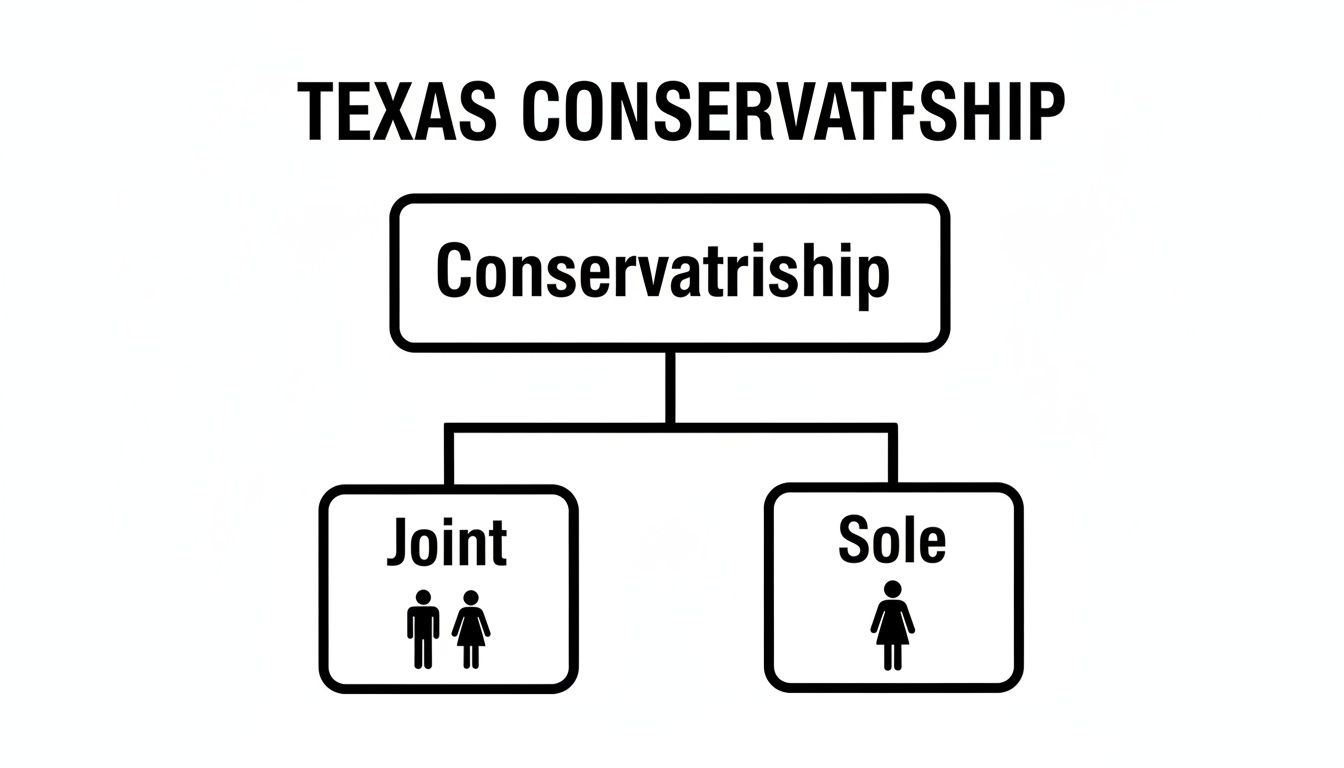
Ultimately, every piece of evidence and testimony presented is viewed through the lens of these factors to arrive at the right conservatorship order for your child.
The Holcomb Factors Explained
So, what are these factors a judge at the Harris County Civil Courthouse will be weighing? They are designed to cover every angle of a child's life and a parent's ability to provide for them.
The table below breaks down some of the most critical factors and what they mean for you as a parent in the Humble area.
Key Factors Harris County Judges Consider in Custody Cases
| Factor | What It Means for Humble Parents | Example |
|---|---|---|
| The Child’s Needs | A judge assesses your child's immediate and future emotional, physical, and educational needs. | Does your child have special needs that one parent is better equipped to handle? Is staying in their Humble ISD school crucial for their stability? |
| Parental Abilities | This looks at each parent’s capacity to be a good caregiver. It’s not about who makes more money, but who can provide a nurturing environment. | One parent may have a more flexible work schedule, allowing them to attend school functions and doctor’s appointments more easily. |
| Stability of the Home | The court prioritizes a safe, stable, and consistent home life. Frequent moves or a chaotic environment can be a major red flag. | A parent who has lived in the same Atascocita home for years and has a strong local support system might be seen as providing more stability. |
| The Child's Preference | If a child is 12 years or older, the judge will privately interview them to hear their wishes. It’s important, but not the only deciding factor. | A teenager may express a desire to live with the parent whose home is closer to their friends and after-school job in Kingwood. |
| Any Potential Danger | The judge will look for any past or present danger to the child's physical or emotional well-being, including abuse, neglect, or substance abuse. | Evidence of a parent’s history of family violence or a recent DWI arrest will weigh heavily against them in a custody determination. |
These factors aren't a simple checklist where one parent can "win" by scoring the most points. Instead, the judge weaves them together to see the whole story. Our job as your local Humble attorneys is to help you present your story in a way that clearly shows how you meet your child’s needs. We have extensive experience helping clients understand how to prove the best interest of your child with compelling and relevant evidence.
It's also worth noting that courts are increasingly open to shared parenting arrangements. While it's not the law in Texas yet, there's a growing recognition that children often do best when both parents are actively involved. In fact, 40% of U.S. states now have laws or resolutions that promote starting with a presumption of equal parenting time. As your Humble child custody attorney, we stay on top of these trends to best advise you on what to expect in a modern courtroom. You can read more about the latest child custody trends and what they mean for parents.
How a Humble Child Custody Attorney Protects You
Trying to navigate a child custody dispute on your own can feel incredibly isolating. You're dealing with the emotional weight of your family's future while trying to understand a complex legal system. This is where a dedicated Humble child custody attorney from The Law Office of Bryan Fagan comes in. We're here to be your guide and your defender, ensuring you never have to face this fight alone.

Our job is to take your commitment as a parent and present it in a way that a Harris County judge can clearly see and respect. We don't just fill out paperwork; we build a strong, clear story that safeguards your relationship with your child.
Building Your Case with Evidence
Every strong custody case is built on a foundation of solid evidence. We work right alongside you to meticulously gather and organize all the information needed to show the court that you are a stable, loving, and capable parent. This is a practical, step-by-step process of painting a true picture of your life.
This process involves several key steps:
- Documenting Communication: We'll help you manage and save text messages, emails, and conversations from co-parenting apps. This creates a record that demonstrates your willingness to cooperate and always put your child first.
- Gathering Witness Statements: Sometimes, the most powerful voice isn't your own. Testimony from teachers, neighbors, coaches, or family friends in the Humble area can offer an unbiased perspective on your parenting and your child’s well-being.
- Collecting Records: We'll help you pull together crucial documents like your child’s report cards, medical records, and school attendance logs. These simple records can speak volumes about your daily involvement and commitment.
This proof isn't about "winning" points. It's about providing the judge with a clear, undeniable picture of your dedication and the stability you provide for your child.
Drafting a Forward-Thinking Parenting Plan
A well-designed parenting plan is your single best tool for preventing future conflict. We don't rely on one-size-fits-all templates. Instead, we sit down with you to craft a detailed, custom Possession Order that is built to last and anticipates real-life challenges. We’ll help you think through all the details—holidays, summer vacations, extracurriculars, and birthdays—to create a clear and practical roadmap.
A parenting plan is more than just a calendar—it is a detailed agreement that provides the structure and predictability your child needs to feel secure. It sets clear expectations for both parents, which significantly reduces the potential for misunderstandings and disagreements down the road.
Advocating for You in Mediation and Court
Most child custody cases in Texas are actually resolved through mediation. We will thoroughly prepare you for this process, helping you clarify your goals and negotiate from a position of confidence and strength. Our aim is always to find a fair solution that protects your child's best interests without the cost and stress of a trial.
However, if the other side is unwilling to be reasonable, we are always prepared to fight for you in the courtroom. As your Humble child custody attorney, we will present the evidence we've gathered and argue passionately and persuasively on your behalf before a Harris County judge.
This is what it means to have The Law Office of Bryan Fagan in your corner. It’s about partnering with a local expert who is deeply invested in the future of your family, whether you're in Humble, Kingwood, or Atascocita. To learn more about how we can protect you, schedule a free, confidential consultation with our Humble office today.
When Custody Cases Get Complicated
Most Humble-area custody arrangements start with a clear, court-ordered plan. But life doesn’t always stick to the script. When a parent loses a job, wants to move away, or simply refuses to follow the rules, your original custody order might not work anymore. These are the moments when a standard case can become much more complex.
Families across Northeast Houston run into these kinds of challenges all the time. Sometimes, it’s about updating the agreement to reflect a new reality. Other times, it's about forcing the other parent to comply with the order that’s already in place.

It can be incredibly frustrating when a parent won’t follow the court's possession schedule. You need to know that you have powerful legal options to set things right.
Enforcing or Modifying Your Custody Order
Because life changes, Texas law provides two key tools for dealing with an outdated or ignored custody order: modifications and enforcements. Here is a practical, step-by-step breakdown.
Modifying a Custody Order: You can’t change a court order just because you want to. You have to prove two things to a judge: first, that there has been a "material and substantial change in circumstances," and second, that changing the order is in your child's best interest. This could be triggered by a parent's remarriage, a major job change, or a plan to relocate outside the approved geographic area.
Enforcing a Custody Order: What if the other parent repeatedly denies your court-ordered time with your child? You can file an enforcement action. A Harris County judge has the authority to force them to comply and can even grant you make-up visitation time or impose other penalties on the non-compliant parent.
When one parent ignores the possession schedule, it does more than just frustrate you—it robs your child of stability. Taking firm legal action isn't about getting even; it's about restoring the predictable routine that your child needs and deserves.
For day-to-day scheduling, a good co-parenting schedule app can be a lifesaver, cutting down on conflict and keeping everyone on the same page. But when things escalate and you believe your child is in immediate danger, you may need to take urgent action. We explain your options in our guide on how to file for emergency custody.
International Custody Disputes
With the diverse, global community we have here in areas like Humble and Kingwood, international custody issues are a very real possibility. These cases are incredibly sensitive and operate under a different set of rules.
In 2023, the Bureau of Consular Affairs reported handling 721 international parental child abduction cases that involved 982 children. These disputes are often governed by international treaties, most notably the Hague Convention, which establishes a legal process for returning a child who has been wrongfully removed to another country.
Navigating an international custody battle requires deep knowledge of both Texas family law and international treaties. It's a specialized field where having an experienced Humble attorney on your side is absolutely essential to protect your parental rights.
Your Next Step: A Conversation at Our Humble Office
Facing a child custody case can feel like you're navigating a maze in the dark. It’s overwhelming, the stakes are incredibly high, and it's easy to feel like you're all alone. But you don't have to find your way through this by yourself. The first step toward clarity and confidence is simply talking to someone who knows the path forward.
That's where we come in. At The Law Office of Bryan Fagan, we're not just attorneys; we're part of the community. We live and work here, serving families across Humble, Kingwood, and Atascocita. Our deep familiarity with the Harris County court system isn't just a professional advantage—it's how we build practical, effective strategies for our neighbors.
Your family's future is everything. Think of a free consultation as a confidential, no-pressure way to turn on the lights, see the path ahead, and start making a plan with an experienced guide.
We want to personally invite you to our Humble office for a free, no-obligation consultation. This is your time. It’s a dedicated opportunity to ask your questions, get honest answers, and understand what your options truly are. Let a dedicated humble child custody attorney help you take that first, crucial step toward protecting what matters most.
Common Questions We Hear About Child Custody in Humble
Going through a child custody case brings up a flood of questions. It's a confusing and emotional process, and having clear, straightforward answers can make all the difference. As attorneys working with families in Humble every day, we hear the same concerns over and over. Let's walk through some of the most common ones.
Is a 50/50 Schedule a Guarantee in Texas?
A lot of parents come in assuming a 50/50 possession schedule is now the standard. While they are getting more common, they are definitely not automatic. A Harris County judge will only order a 50/50 split if they're convinced it’s what's genuinely best for the child.
To decide, the judge looks at the real-world logistics:
- Where does everyone live? A 50/50 plan works best when parents live close to each other, keeping the child in the same school zone, like Humble ISD or Aldine ISD, and near their friends and activities.
- Can you get along? This is huge. If parents can't communicate and cooperate without constant arguments, a judge will be hesitant to force a schedule that requires that much interaction.
- How old is your child? A judge will weigh the child's age, maturity, and specific needs when considering if this kind of schedule is a good fit.
If a 50/50 schedule just isn't practical, the judge will almost certainly default to a Standard Possession Order. This is still the most common arrangement in Texas for a reason. We can talk through your situation and help you understand if a 50/50 split is a realistic goal for your family.
What Should I Expect a Child Custody Case to Cost?
This is the million-dollar question, and honestly, there's no single price tag. The single biggest factor driving the cost is how much conflict there is between you and the other parent. If you can agree on the major issues and settle things in mediation, your case will be far less expensive.
On the other hand, a case that drags on with intense disputes, requires a lot of investigation (discovery), and ends up in a courtroom trial will, frankly, become expensive. In the Humble area, attorney's fees typically fall in the $250 to $400 per hour range, and most lawyers will ask for an initial retainer to get started. We believe in being completely upfront about costs and will lay out a realistic financial picture for you during our first meeting.
What Happens If My Ex Wants to Move Away With Our Child?
This is a fear for many parents. Most custody orders in Texas include what’s called a geographic restriction. This clause specifically limits where the primary parent can live with the child—usually to Harris County and the counties directly touching it. If that parent wants to move outside the approved area, they have to get the other parent’s agreement or the court's permission first.
The entire point of a geographic restriction is to protect the child’s relationship with both parents. A judge isn't going to let one parent move away without a very good reason, and moving without permission is a serious violation of a court order.
Whether you're the parent who needs to relocate or the one trying to stop a move, you have to act fast. An experienced attorney is crucial for navigating the modification process correctly.
How Long Will This Whole Process Take?
Like the cost, the timeline for a custody case hinges almost entirely on cooperation. If you and the other parent can find common ground, a final agreed-upon order can sometimes be signed by a judge in just a few months.
However, if your case is contested, you’re looking at a much longer road. A case that involves mediation, hearings for temporary orders, and ultimately a final trial can easily take a year, sometimes longer, to work its way through the busy Harris County court system.
At The Law Office of Bryan Fagan, we know these questions are just the tip of the iceberg. Every family's story is unique, and you deserve answers that fit your specific circumstances. We invite you to schedule a free, no-pressure consultation with one of our compassionate Humble child custody attorneys. Let's talk about your concerns and start building a strategy to protect what matters most. Visit us at https://humbletxlawyers.com to get started.