Skip to content
When child support payments stop coming, the financial pressure on your family can feel overwhelming. If you live in Humble, Kingwood, or Atascocita, you're not alone in this struggle. The good news is that Texas law gives you a powerful way to collect the money your child is owed. Yes, you can sue for unpaid child support by filing a legal action called a Petition for Enforcement.
Your Guide to Enforcing Child Support in Humble
This guide is designed to walk you through filing a child support enforcement action—the legal term for "suing" for back payments. As local attorneys who care about our community, our goal is to cut through the confusion of the Harris County court system and show you how, with the right strategy, you can get your child's financial future back on track. Think of this as your roadmap for turning that piece of paper—your court order—into the actual support your family needs to thrive.
The first thing to understand is that a child support order isn't a suggestion; it's a legally binding command from a judge. When the other parent fails to pay, they are directly violating that court order. For many parents I've worked with across Northeast Houston, simply knowing this fact gives them the confidence they need to take the next step.
The Scope of the Problem
The challenge of collecting unpaid child support is something families face everywhere. But having a formal court order is what gives you the power to act. Nationwide data reveals that over 57% of parents with legal agreements received at least some payments, a rate far higher than for those relying on informal promises. This statistic really underscores why having that official order—and knowing how to enforce it—is so critical. You can read more about these child support statistics and their impact on families like yours.
The reality is, a child support order is only as good as your ability to enforce it. Taking legal action isn't about starting a fight; it's about standing up for your child's legal right to financial stability.
This flowchart breaks down the enforcement journey, showing the path from the moment you realize a payment was missed to actually securing those funds for your child.
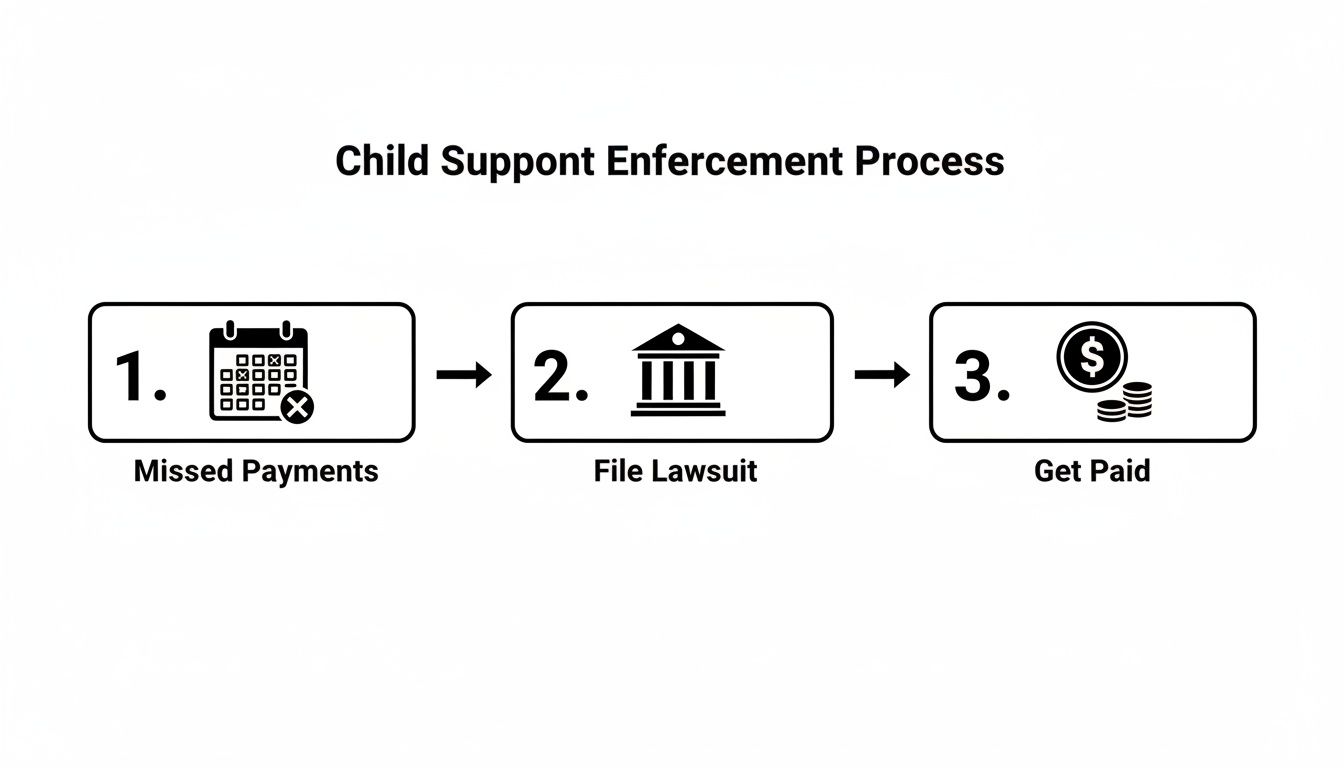
As you can see, the process moves through three clear phases: identifying the violation of the court order, filing a formal lawsuit to address it, and finally reaching a resolution where payment is collected.
What Does It Mean to "Sue for Child Support"?
When we talk about "suing for child support," we're really talking about filing a specific lawsuit called a Petition for Enforcement. This legal document formally asks a Harris County judge to intervene and compel the non-paying parent to follow the existing order.
It’s an official request for the court to use its authority to help you collect:
- Arrearages: This is the legal term for the total sum of all missed payments.
- Interest: Texas law allows you to collect 6% annual interest on the unpaid balance, which can add up significantly.
- Attorney's Fees: The judge can—and often does—order the non-compliant parent to reimburse you for the legal costs you incurred to bring the lawsuit.
At The Law Office of Bryan Fagan, we see firsthand the stress this situation causes for families in Atascocita, Kingwood, and Humble. Our job is to lift that burden by providing a clear, strategic path forward. If you're dealing with unpaid child support, don't let the debt pile up. Contact our Humble office for a free consultation to go over your options and learn how we can help enforce your order.
Building Your Case with Evidence of Non-Payment
When you decide it’s time to sue for unpaid child support, you’re doing more than just telling a judge your side of the story. You’re building a legal case that needs to be proven with solid, undeniable facts. Before you even think about stepping into a Harris County courtroom, your most critical job is to gather and organize your evidence.
I've seen it time and again: a judge in Humble or Northeast Houston isn't moved by frustration alone. They operate on documentation. The better your records, the stronger your position will be when it's time to file an enforcement action.
Step 1: Create Your Payment Ledger
Your absolute most important piece of evidence is a detailed payment ledger. Think of it as the official financial record of your child support. It's a simple, yet powerful, tool that tracks every payment that was supposed to be made and every dollar that was—or wasn't—received.
You can easily set this up in a spreadsheet or even a dedicated notebook. The key isn't the format; it's the meticulous detail. For every single payment period, you must log:
- Payment Due Date: The exact date the payment was required under your court order.
- Amount Due: The specific dollar amount you were supposed to receive.
- Date Payment Received: The actual date the money showed up.
- Amount Received: The exact amount paid, especially if it was a partial payment.
- Running Total Owed: A clear calculation of the total arrearages (the unpaid balance) as it grows.
Handing a clean, organized ledger to a judge instantly shows you're prepared and credible. It makes it incredibly difficult for the other parent to argue with the numbers or dispute the facts of their non-payment.
A well-kept payment ledger turns a messy "he said, she said" argument into a simple math problem. It strips away all the emotion and ambiguity, giving the court a clear, factual path to a judgment in your favor.
Step 2: Gather Supporting Documents
Your payment ledger is the foundation, but you need other documents to build a rock-solid case around it. The more layers of proof you have, the better. Start collecting these items the moment you realize payments are becoming a problem.
Bank statements, for instance, are invaluable. Go through them and highlight every deposit that was for child support. Just as importantly, the absence of a deposit during a month when a payment was missed provides a powerful, third-party confirmation that supports your ledger. Getting a handle on legal documents is crucial; for example, understanding a transcript of deposition, which contains sworn testimony, can give you insight into the types of evidence that hold up in court.
You also need to save every single bit of communication with the other parent regarding child support. This isn't the time to delete old messages. Be sure to keep:
- Text messages where payments are discussed, promised, or where they give an excuse for a late payment.
- Emails that detail payment plans or acknowledge they've fallen behind.
- Voicemails or call logs related to unpaid support.
This kind of communication is often a goldmine of evidence. It can directly show that the other parent knew they had an obligation and knew they weren't meeting it, which can make a huge difference in front of a judge.
Of course, accurately tracking missed payments is also vital for knowing exactly what's owed. You can check out our guide on how to calculate child support in Texas to get a clearer picture of the total amounts involved in your case.
This level of detailed prep work might feel overwhelming, but it is truly the best investment you can make in the success of your enforcement case. The attorneys at The Law Office of Bryan Fagan are here to walk you through this process, helping you organize your evidence so it's compelling and court-ready. We invite you to schedule a free consultation at our Humble office to discuss how we can help you build the strongest case possible.
Step 3: Kick Off the Lawsuit to Enforce Your Child Support Order
With your evidence organized and ready, it's time to take the next crucial step: formally starting the legal process. This is the moment you officially "sue" for child support by filing a specific document with the court. In Texas, we call this the Petition for Enforcement of Child Support Order.
Filing this petition is a big deal. It’s your official request asking a Harris County judge to intervene and force the other parent to follow the court's order. For many parents I’ve worked with in Humble and Kingwood, this is the most intimidating part. But once you understand what's involved, it becomes a much clearer, more manageable process.

What Must Be in the Enforcement Petition?
Your Petition for Enforcement isn't just a simple form you fill out. It's a detailed legal document that has to spell out your case perfectly. I've seen cases get delayed for months or even thrown out because of a simple mistake or a missing piece of information. The petition has to be crystal clear, telling the judge exactly what order was violated, how it was violated, and what you want the court to do about it.
To be legally sufficient, the petition must include:
- The specific part of the order that was ignored. You’ll need to identify the exact date of your child support order and quote the language that requires the other parent to pay.
- A play-by-play of every violation. This is where your payment ledger becomes the star of the show. You will list every single date a payment was missed or came up short, along with the amount still owed for that specific pay period.
- The total amount of arrearages. This is the bottom-line number—the grand total of all missed and partial payments you are owed.
- What you're asking the court to do (your "relief"). This typically includes asking for a judgment for the back support, interest on that unpaid amount, court costs, your attorney's fees, and, in many cases, asking the judge to hold the other parent in contempt of court.
Think of the petition as the roadmap for the judge. It needs to give them everything they need to see the history of non-payment and make a ruling that benefits your child.
The Nuts and Bolts of Filing and "Serving" the Lawsuit
Once the petition is written, it has to be officially filed with the Harris County District Clerk. This is what formally opens your case and gets it a cause number. At this point, you become the "Petitioner" and the non-paying parent is now the "Respondent."
But here's a critical point: just filing the paperwork isn't enough. The other parent has to be given formal, legal notice that you have sued them. This is a constitutional right known as service of process, and you can't just text them or mail them a copy yourself.
Proper service almost always involves one of these methods:
- Hiring a private process server or using a sheriff or constable to hand-deliver a copy of the filed petition and a formal court summons (called a "citation") directly to the other parent.
- The server then files a "Return of Service" with the court. This is a sworn affidavit confirming the exact date, time, and place where the other parent was served.
This step is absolutely non-negotiable. Without a proper Return of Service on file, a judge in Harris County has no legal authority to move forward with your case or issue any orders against the other parent. From my experience helping families in Atascocita and Northeast Houston, this is often where things get tricky, especially if an ex is actively trying to avoid being found.
Getting the petition drafted and properly served is the foundation of your entire case. One mistake here can put everything in jeopardy, which is why having an experienced guide is so valuable.
The legal rules for filing an enforcement action are strict and unforgiving. A small mistake on the petition or an error in how the papers are served can set you back by months, adding even more financial stress to your family. This is precisely why so many parents in the Humble area decide to work with an attorney from the very start.
At The Law Office of Bryan Fagan, we handle these foundational steps with the careful attention they demand. We make sure your petition is legally solid, filed correctly, and that service is handled by the book, setting your case on the right track from day one. Don't let paperwork and procedure get in the way of the financial support your child deserves. Schedule a free, confidential consultation with our Humble team today and let us take this burden off your plate.
Powerful Enforcement Tools a Texas Court Can Use
So, you've gone to court and the judge has confirmed what you already knew: you’re owed back child support. That's a huge step, but the big question is, now what? How do you actually get the money your child is legally entitled to?
This is where a judge’s ruling turns into real action. For families here in Humble, Kingwood, and Atascocita, a Harris County court has a serious arsenal of tools designed to make a non-paying parent comply. You’re not just asking for a piece of paper that says you’re owed money; you’re asking the court to enforce it.

Wage Garnishment: The Automatic Solution
This is the go-to enforcement tool for a reason. A wage withholding order, or garnishment, is a direct command from the court to the other parent's employer. It’s incredibly effective.
The order requires the employer to take the child support payments right out of the parent's paycheck—before they ever see that money. It completely removes the other parent from the payment process. You don't have to chase them for a check or wonder if a deposit will hit your account. The funds go from the employer to the Texas Child Support Disbursement Unit, and then directly to you. It's consistent and takes the stress out of the equation.
Contempt of Court: The Ultimate Consequence
What happens when a parent has the money but simply refuses to pay? In that case, a judge can hold them in contempt of court. This isn't a slap on the wrist; it’s a serious finding that the parent has deliberately ignored a judge’s order.
The penalties are designed to get their attention, fast. A judge has the power to:
- Impose significant fines.
- Order jail time—up to six months for each violation.
- Place the parent on community supervision (probation), where they have to make every payment on time to stay out of jail.
Holding a parent in contempt is the court’s way of saying, "Your obligation to your child is not optional." Often, the simple threat of jail is all it takes to finally get those overdue payments flowing.
Placing Liens on Property and Assets
Think of a child support lien as a legal "hold" on the other parent's property. It’s a claim that attaches to their assets, ensuring that the child support debt gets paid before they can profit from selling anything.
A lien can be placed on all sorts of valuable property, including:
- Real estate, like their house or any land they own.
- Vehicles such as cars, trucks, boats, or RVs.
- Bank accounts and other investments.
- Personal injury settlements or inheritance money.
A lien essentially freezes the asset's value until your child is paid. If the other parent tries to sell their house or cash out an investment, your child support debt must be settled first.
License Suspension: A Major Inconvenience
To really turn up the pressure, a Texas court can order the suspension of critical licenses. This tactic creates major problems in a person's daily life and career, making it nearly impossible to keep ignoring the support they owe.
A judge can order the suspension of:
- Driver’s licenses, which makes it illegal to drive.
- Professional licenses for jobs like doctors, lawyers, plumbers, or real estate agents.
- Recreational licenses, like permits for hunting and fishing.
Suddenly being unable to drive to work or even practice their profession is often the wake-up call a non-paying parent needs to make things right.
And don't think a parent can just move out of the country to avoid paying. The U.S. Office of Child Support Enforcement’s Central Authority Payment (CAP) service has successfully processed over $10 million in international child support payments. When you sue for child support, federal programs ensure that financial obligations can be met even across borders.
These are powerful tools, but knowing which ones to use and when requires a strategic plan. To get a deeper look at the process, we recommend reading our in-depth guide on enforcing child support in Texas.
At The Law Office of Bryan Fagan, we have years of experience helping parents in Northeast Houston use every available tool to get the money their children need. If you're ready to take the next step, contact our Humble office for a free consultation. We'll talk through your unique situation and figure out the best path forward.
Step 4: Navigating Your Enforcement Hearing in Harris County
Walking into the courtroom is where everything comes to a head. For many Humble families, this is the most stressful part of the process, but being prepared is the best way to calm those nerves. Knowing what to expect inside a Harris County family court takes the fear of the unknown out of the equation, letting you focus on what matters: advocating for your child.
Remember, the judge has a packed docket and has probably seen dozens of cases just like yours that very week. Their goal is to get to the facts, and quickly. A clear, organized presentation will always be more powerful than an emotional one.
Making Your Case to the Judge
You’ve already put in the work gathering your evidence; now it’s time to use it. When the judge calls your case, this is your opportunity to clearly show them the proof you’ve collected. That payment ledger you spent time creating? It’s about to become the star of the show.
The key is to keep it simple. Your job is to paint a clear, fact-based picture for the judge. You or your attorney will:
- Present your payment ledger and explain exactly what it tracks.
- Clearly state the total amount of arrearages—the total sum of missed payments you've calculated.
- Point out your most crucial pieces of backup evidence, whether it's bank statements showing the missing deposits or text messages where the other parent admits they haven't paid.
Think of it as telling a straightforward story: "Your Honor, the court ordered child support of X amount on this date. As this ledger shows, the other parent has failed to make payments on these specific dates, and the total amount owed to my child today is Z dollars."
What the Judge Will Want to Know
Harris County judges are busy, so expect their questions to be direct and to the point. They’re trying to cut through the noise and get to the heart of the matter. Be ready to answer questions like:
- "Is this the payment ledger you prepared?"
- "Did you give credit for every single payment that was made?"
- "What is the exact total you are claiming is owed as of today?"
- "Is this a true and correct copy of the court order that established this child support obligation?"
Answer every question honestly and directly. If you don’t know an answer, it is far better to say, "I'm not sure, Your Honor," than to guess and risk your credibility.
Here's a piece of advice I give every Humble and Kingwood parent before court: Judges value preparation. They are looking for the parent who can lay out the facts clearly and concisely, not the one who is the most emotional.
Responding to Common Defenses
The other parent will get their turn to speak, so it’s smart to anticipate what they might say. One of the most common arguments we hear in Northeast Houston courtrooms is a claim of "inability to pay." The other parent might say they were laid off, had a medical emergency, or just didn't have the money.
Here’s the critical part: an inability to pay is not a legal excuse for violating a court order. While a judge might consider their financial hardship when deciding on a punishment (like whether to order jail time), it absolutely does not wipe away the debt. The child support is still owed, period.
If the other parent's financial situation truly changed, their legal responsibility was to go back to court and file a motion to modify the child support order. Simply deciding to stop paying on their own isn't an option.
Walking through these common hearing scenarios helps take the anxiety out of the process. When you know what’s coming, you can focus on the facts and state your case with confidence. At The Law Office of Bryan Fagan, we prepare our clients for every single step. Schedule a free consultation with our Humble team to talk about how we can stand with you in court and fight for the support your child is owed.
Why a Humble Family Law Attorney Is Your Strongest Ally

While it’s true that Texas law lets you file an enforcement action by yourself, the legal system is a genuine maze of complex rules and rigid deadlines. When you decide to sue for child support, the stakes are enormous—not just for you, but for your child’s financial security. This is precisely why bringing in an experienced local attorney is one of the smartest moves you can make.
A dedicated Humble family law attorney from The Law Office of Bryan Fagan does far more than just fill out forms. We become your guide and your champion, making sure every step is handled correctly and powerfully. We live and breathe the specific local rules of the Harris County courts and know exactly what judges in our community expect to see in a child support enforcement case.
More Than Just Legal Paperwork
I’ve seen it happen too many times: filing the wrong motion, missing a deadline by a single day, or failing to properly serve the other parent can get your case thrown out before it even gets started. That means months of wasted time and mounting frustration. An attorney simply eliminates that risk.
We handle the details so you don’t have to. We’ll draft the Petition for Enforcement with precision, organize your evidence into a compelling story for the judge, and manage the formal service of process to ensure it's done right the first time.
Think of us as your strategic partner. We’re already thinking two steps ahead, anticipating the excuses the other parent might use and building strong counterarguments. We also handle all the phone calls and negotiations, shielding you from the stress of dealing with a non-compliant ex.
When you hire our firm, you aren't just getting a lawyer. You are getting a team that is personally invested in your family's stability. Our job is to wrangle the legal complexities so you can focus on what's most important—caring for your child.
For families in nearby Atascocita and Kingwood, having a local attorney who is a familiar face in the Harris County court system is a real advantage. We know the procedures, the court staff, and the personalities of the judges, which lets us navigate your case with an insider’s perspective. That’s a level of local knowledge you just can’t get from a downtown Houston firm that only occasionally comes out to our community’s courts.
Your Advocate in and Out of the Courtroom
Our support doesn't stop once the papers are filed. We are your voice in the courtroom, presenting your case with the confidence and clarity that only comes from years of experience. We know how to cross-examine the other parent, dismantle weak arguments, and respectfully command the court’s attention.
Here’s what that support actually looks like:
- Building a Game Plan: We don't just file a standard petition. We create a full strategy based on your unique situation, identifying which enforcement remedies are most likely to get you paid.
- Telling a Clear Story with Evidence: We turn your payment records, bank statements, and text messages into a clear, persuasive narrative that leaves no room for doubt.
- Powerful Courtroom Representation: We do the talking for you at the hearing, clearly articulating the facts and making the legal arguments needed to secure a judgment in your favor.
- Making Sure You Get Paid: If the other parent still doesn't comply after the hearing, we immediately take the next steps to enforce the judge's new orders, whether that means pushing through a wage garnishment or holding them in contempt of court.
Choosing the right legal partner is a major decision. To help you feel confident, we've put together a guide on how to choose a family law attorney that fits your family's specific needs.
The emotional and financial weight of unpaid child support is heavy. You don’t have to carry it by yourself. The attorneys at The Law Office of Bryan Fagan are deeply committed to serving our neighbors right here in the Humble community. We are ready to stand with you, protect your child's rights, and fight to secure the future they deserve.
We invite you to schedule a free, no-obligation consultation at our Humble office. Let's sit down together, go over your case, and show you exactly how we can help.
Common Questions About Suing for Child Support
When you're trying to enforce a child support order, it's natural to have a lot of questions. For parents across Humble and Northeast Houston, getting straight answers is the first step toward regaining some control. Let's tackle some of the most common concerns we hear from parents in your exact situation.
How Long Does This Actually Take?
This is usually the first question on everyone's mind. The honest answer is: it depends. A straightforward case, where the other parent is easy to find and doesn't fight the process, might wrap up in a few months.
But things can get complicated. If the other parent is dodging service in Atascocita or has moved and is difficult to locate, or if they decide to contest the lawsuit, the timeline can stretch out. The single best thing you can do to speed up the process is to make sure your initial filing is done perfectly—no mistakes, no missing information. That alone can save you from frustrating and preventable delays down the road.
Can I Get Interest on All the Missed Payments?
Yes, you absolutely can, and you should. The Texas Family Code is very clear on this. Any judgment for child support arrearages automatically includes interest on the unpaid amount.
As of 2026, that interest is set at six percent per year, calculated as simple interest. We make it a point to ensure our clients' final judgments include not just every penny of the principal they are owed, but also all the accumulated interest they are legally entitled to receive.
What if the Other Parent Lives in Another State?
This is a very common situation, so don't let it discourage you. A federal law called the Uniform Interstate Family Support Act (UIFSA) was created specifically for this purpose. It establishes a clear, cooperative system for states to recognize and enforce each other's child support orders.
A family law attorney who has handled these interstate cases before can manage the UIFSA process, ensuring your Texas order is enforced with the same authority, whether the other parent is in Louisiana or California.
Don't let distance become an excuse. Your child's right to support doesn't stop at the Texas state line. The law provides powerful tools to hold a parent accountable, no matter where in the U.S. they live.
Can I Make the Other Parent Pay for My Lawyer?
In many enforcement cases, yes. If the court finds that the other parent ignored their court-ordered duty to pay child support, the judge has the authority to order them to cover your reasonable attorney's fees and court costs.
This provision exists for a good reason: you shouldn't have to be financially penalized for having to hire an attorney just to collect the support your child was already supposed to receive.
The legal path to enforcing a child support order can feel overwhelming, but you don't have to figure it out on your own. At The Law Office of Bryan Fagan, our team is here to offer the local experience and dedicated support you need. We are deeply committed to helping our neighbors in Humble, Kingwood, and Atascocita get the financial stability their children deserve.
Schedule a free, confidential consultation with our Humble office to go over the specifics of your situation and see how we can help. Contact us now.