Skip to content
You’re parked at the exchange spot in Humble. The time in your order has come and gone. Your child’s other parent isn’t answering calls, or worse, they’ve answered and said they’re not bringing the child.
That moment feels bigger than the clock. You’re worried about your child, angry about being ignored, and unsure what to do next. Many parents in Humble, Atascocita, Kingwood, and across Northeast Houston ask the same question in that exact moment. Can police enforce custody order Texas Humble?
The short answer is sometimes, but not always in the way people expect. Police can play a role, especially when a valid order is clear and the situation is happening in real time. But in many cases, family court is where real enforcement happens.
A Stressful Moment at the Exchange Point
You might be sitting outside a park in Humble or in a grocery store parking lot in Atascocita, checking your phone every few minutes. Your order says the exchange is at 6:00 p.m. It’s now well past that. You’ve sent a calm text. You’ve called. Nothing.

In another version of the same scene, the other parent does show up, but then refuses to release the child. Sometimes they say the child doesn’t want to go. Sometimes they claim there was a misunderstanding. Sometimes they drive away. For a parent who followed the order and arrived on time, it can feel like the system has stopped working.
That panic often leads to one immediate thought: should I call the police?
The answer depends on what your court order says, how clear it is, and whether there’s an immediate safety issue. It also depends on what responding officers can realistically do on the scene. If you’re dealing with a child who hasn’t been returned, this guide on what to do if the other parent won’t return your child in Texas can help you start taking the right steps.
The first goal is to protect the child and create a clear record of what happened.
Parents in Kingwood and Northeast Houston often feel pressure to solve the dispute in the parking lot. That usually makes things worse. A denied exchange is upsetting, but your next steps matter. Calm documentation, a smart police call when appropriate, and fast legal action often do more than a heated confrontation ever will.
The True Role of Police in Custody Disputes
Police in Humble are not family court judges. That’s the most important place to start. When an officer responds to a custody dispute, the officer’s first job is usually to keep everyone safe, lower the temperature, and figure out whether there is a valid court order that clearly applies to that moment.

What officers look for on the scene
Texas orders include language that matters. In Texas, every final conservatorship order must include this notice:
“NOTICE TO ANY PEACE OFFICER OF THE STATE OF TEXAS: YOU MAY USE REASONABLE EFFORTS TO ENFORCE THE TERMS OF CHILD CUSTODY SPECIFIED IN THIS ORDER,” as described by Texas Law Help’s discussion of law enforcement, child safety, and visitation disagreements.
That notice gives officers authority to use reasonable efforts to enforce clear custody terms. In practice, that usually means an officer may review the order, confirm the exchange terms, and direct a parent to comply if the order clearly says who has possession, when, and where.
If your order says Parent A gets possession at a certain time and place, and both parents are there, an officer may tell the withholding parent to release the child. That’s real authority. But it has limits.
What police can do and what they usually won’t do
Officers can often:
- Review the order: They’ll look for signed, specific language about possession or exchange.
- Keep the peace: Their presence may stop the situation from escalating in front of the child.
- Direct compliance: If the order is clear, they may instruct a parent to follow it.
- Create a report: Even if they don’t transfer the child, a report can help later in court.
Officers usually won’t:
- Interpret a vague order: If the language is confusing, they may treat the issue as civil.
- Rewrite parenting terms on the spot: They cannot change what the judge ordered.
- Act as long-term enforcers: Their involvement is often temporary and limited to the immediate incident.
That’s why parents asking can police enforce custody order Texas Humble often get a frustrating answer. The law allows some intervention, but the practical reality in Humble, Atascocita, and Kingwood is that officers often focus on de-escalation first.
For many families, it helps to understand the Texas access and visitation hotline information before the next dispute happens.
When refusal can become a crime
If a parent refuses to comply after an officer gives a lawful direction based on a clear order, the situation can become more serious. Under the same Texas Law Help summary, refusal can lead to Interference with Child Custody under Texas Penal Code § 25.03. That offense is a state jail felony, punishable by 180 days to 2 years in state jail and fines up to $10,000. Additional charges such as Interference with Public Duties may also apply if someone obstructs law enforcement.
Here’s a short overview that helps explain how these custody disputes can play out:
The on the ground reality in Humble
A Humble police officer responding to a denied exchange is likely to ask a few practical questions first. Is the child safe? Is anyone threatening violence? Is there a signed order? Does the order clearly say this parent should have the child right now?
Practical rule: Call police when there is an immediate exchange problem, a clear order, and a need for an official response. Call a lawyer quickly if the issue is repeated, strategic, or likely to continue.
Even when police are called, family court remains the main place where custody orders are enforced. As noted in the Texas Law Help resource above, police are a first-response tool, not the primary long-term enforcer. That distinction matters for parents throughout Northeast Houston because it tells you when a patrol response may help and when you need to move straight toward court.
Civil Contempt vs Criminal Interference Explained
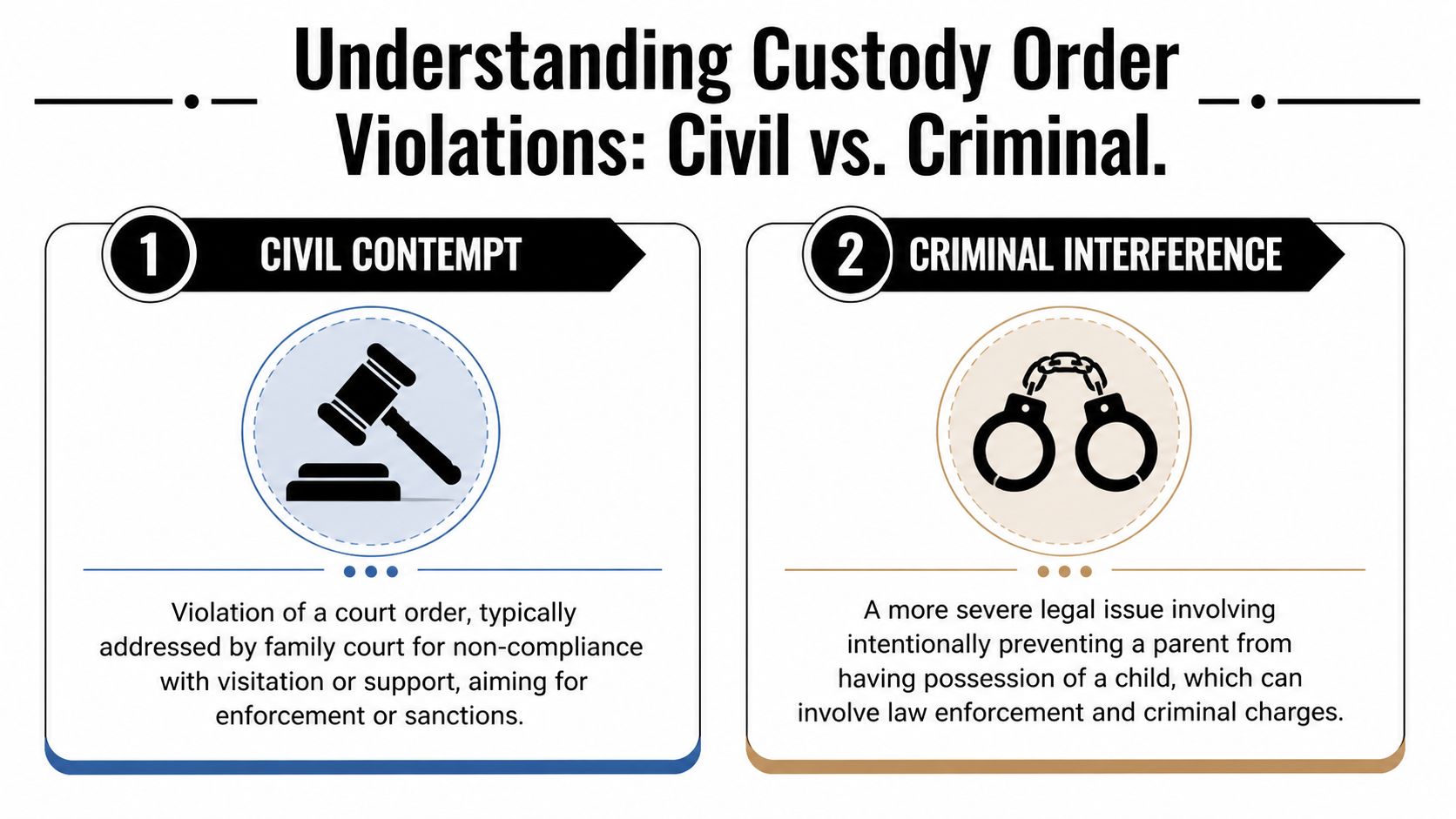
A custody violation can lead down two very different legal paths. One path stays in family court. The other can move into the criminal system. Parents often blend these together, but they are not the same thing.
The easiest way to think about it is this. Civil or criminal contempt is the court responding to disobedience of its order. Criminal interference with child custody is the State of Texas treating certain conduct as a crime.
Two systems with different purposes
Family court asks, “Did this parent violate the court’s order, and what needs to happen now?rdquo;
A criminal case asks, “Did this conduct meet the legal definition of a crime, and should the state punish it?rdquo;
That difference changes everything, including who brings the case, what proof matters most, and what penalties are on the table.
| Issue | Civil or criminal contempt in family court | Criminal interference case |
|---|---|---|
| Main purpose | Enforce the judge’s order | Punish conduct defined as criminal |
| Who starts it | Usually the other parent through enforcement filings | Law enforcement and prosecutors |
| Main focus | Missed exchanges, denied access, noncompliance | Conduct meeting criminal elements |
| Common result | Court orders, fines, jail for contempt, makeup time | Criminal charges, possible conviction, criminal record |
Civil contempt and criminal contempt in family court
Texas uses a tiered structure. According to this discussion of Texas enforcement remedies and contempt architecture, civil contempt is coercive. The court can confine a violating party to county jail and impose fines that continue until the person complies with the underlying order.
Criminal contempt in family court is punitive. It can include up to six months of incarceration per act of contempt and fines up to $500 per violation, according to that same source. Each violation can count separately.
That means one denied weekend is not necessarily treated as one vague complaint. It can be one distinct violation. A pattern of missed exchanges can stack consequences quickly if the violations are well documented.
Detailed records change a custody case. Dates, times, locations, screenshots, and witness names give the judge something concrete to enforce.
The same source explains that courts may also order makeup visitation, custody modification, wage garnishment, or property liens depending on the facts and the relief requested.
Criminal interference is different
Criminal interference with child custody is more serious and narrower. It does not apply to every messy exchange or every misunderstanding. It applies when the facts fit the criminal statute.
That’s why some parents are surprised when police don’t arrest the other parent on the spot. A denied exchange may justify a police report and later court enforcement, but not every denial automatically becomes a criminal case.
Why documentation matters so much
The enforcement process depends on specifics. The familylawyerkaty.com source stresses that the motion for enforcement requires precise documentation because the remedy requested connects directly to the evidence presented.
For Humble parents, that means you should preserve:
- Texts and emails: Keep the full thread, not just selected screenshots.
- Exchange details: Note date, time, place, and who was present.
- Call logs and voicemails: They help show your effort to follow the order.
- Photos or location proof: If safe and lawful, preserve evidence that you were at the pickup point.
- Witness information: Neutral third parties can matter.
That same source gives a theoretical example of 12 monthly visitation denials creating cumulative exposure of six years of potential incarceration and $6,000 in criminal contempt fines, plus possible civil contempt confinement. Whether a judge imposes those remedies is case-specific, but the example shows why repeated violations should never be brushed off as “just coparenting drama.”
When The Court Must Intervene The Enforcement Process
A missed exchange in Humble can feel like an emergency. In court, though, the judge has to slow that moment down and look at it piece by piece. The question becomes simple: What did the order require, what happened, and what proof shows the difference?
If police at the scene could not fix the problem, the next legal tool is usually a Motion for Enforcement filed in Harris County. That asks the family court to enforce the order that already exists. It does not start a brand-new custody case. It asks the judge to address a specific violation.
For many parents, this is the point where frustration has to turn into a clean paper trail. A judge cannot act on a general statement like, “she never follows the order.” A judge needs dates, times, language from the order, and evidence tied to each violation.
What a motion for enforcement must show
Texas courts look closely at whether the order is clear and unambiguous. That matters more than many parents expect.
A custody order works a lot like a set of directions on a prescription bottle. If the instructions clearly say when, where, and how something is supposed to happen, enforcement is more straightforward. If the wording is fuzzy, the court may have trouble punishing the other parent for violating it.
That is why a lawyer will usually start with the order itself before talking strategy. The court often needs to see that the order clearly states:
- Who had the right to possession
- The exact date and time of the exchange
- The location for pickup or drop-off
- Any conditions tied to the exchange
- Which parent failed to comply, and on what date
You will also want the supporting proof gathered in one place:
- The signed court order
- A timeline of each violation
- Texts, emails, and call records
- Police reports or incident numbers, if they exist
- Photos, receipts, or location records that support your timeline
- Witness names and contact information
If you are dealing with repeated denials, this guide on penalties for violation of a custody order in Texas explains the kinds of consequences a judge may consider.
What usually happens after filing
Once the motion is filed, the other parent must be served, and the court sets the matter for hearing. The exact timing depends on the court’s docket, the type of relief requested, and whether the facts call for faster action. In Harris County, speed can vary from courtroom to courtroom, so local practice matters.
That local reality is important for Humble families. On paper, the law gives you enforcement remedies. On the ground, you still have to get in front of a judge, present a precise case, and ask for a remedy the court can legally grant.
At the hearing, the judge usually focuses on a few practical questions:
- Was there a valid court order in place?
- Was the order specific enough to enforce?
- Did the violation happen as alleged?
- Can the parent who filed prove each violation clearly?
- What remedy fits the violation?
A parent with exact dates, saved messages, and a copy of the order usually stands in a stronger position than a parent who only describes a pattern in general terms.
What a Harris County judge can do
Family court has tools that police officers at the exchange point do not. That is the big difference.
Depending on the facts, the judge may order:
| Remedy | What it can do |
|---|---|
| Make-up parenting time | Gives back missed possession periods |
| Attorney’s fees and court costs | Shifts some financial consequences to the violating parent |
| Contempt remedies | Punishes willful violations if the legal requirements are met |
| Orders to clarify or tighten exchange terms | Reduces future arguments about time, place, or procedure |
| Other enforcement relief allowed by Texas law | Addresses repeated noncompliance in a more direct way |
For families in Humble, Kingwood, Atascocita, and Northeast Houston, this is often the turning point. An officer may document what happened and keep the peace in a parking lot. A judge can issue orders with lasting consequences.
One more point causes confusion. Parents sometimes assume any Harris County family court will handle the matter the same way. In practice, local procedure, scheduling, and the wording of your current order all affect how the case moves. That is one reason it helps to speak with a lawyer quickly after a violation, especially if the order is old, vague, or has already been ignored more than once.
A court order does not enforce itself. The parent asking for relief has to bring the judge a clear timeline, a clear order, and clear proof.
Your Step-by-Step Guide After a Custody Violation in Humble
When an exchange goes wrong, your first few decisions shape what happens next. A calm response creates better evidence and usually protects your child better than a confrontation.
Step 1 assess immediate safety
If the child is in immediate danger, call 911. Safety comes first.
If there’s no immediate threat, shift your focus from argument to documentation. Don’t try to physically take the child. Don’t start a shouting match in a parking lot in Humble, Atascocita, or Kingwood. Those moments can spiral fast and can hurt your position later.
Step 2 secure the evidence
Start a written timeline right away while the details are fresh. Use your phone’s notes app, an email to yourself, or a dedicated folder.
Record things like:
- Exact time you arrived
- Exact location of the exchange
- What the order required
- What the other parent said or didn’t say
- Whether the child was present
- Who witnessed the event
Save texts, voicemails, emails, and call logs. If you sent a message saying, “I’m here at the exchange location,” preserve it. If a grandparent, neighbor, or friend saw what happened, write down the person’s name and contact information.
Step 3 decide who to call first
Many parents become stuck at this point. The right first call depends on the facts.
Decision Guide Police or Lawyer
| Situation | Best First Call: Police | Best First Call: Lawyer |
|---|---|---|
| Child appears to be in immediate danger | Yes | Yes, after safety is addressed |
| You’re at the exchange point and the other parent refuses to comply with a clear order | Yes | Also likely helpful soon after |
| The order language is vague or disputed | No | Yes |
| This is a repeated pattern of denied visitation | Sometimes for documentation | Yes |
| The other parent already left with the child and there is no immediate emergency | Sometimes, depending on facts | Yes |
| You need makeup time, fees, or contempt remedies | No | Yes |
Step 4 if you call police, keep your request focused
When talking to dispatch or an officer, stay calm and be specific. Explain that you have a signed Texas custody order, that you are at the exchange location, and that the other parent is refusing to comply. Have a copy of the order ready on paper or on your phone.
Don’t give a long history of the relationship unless the officer asks. Start with the present event. The clearer your explanation, the easier it is for the officer to assess whether the order is specific enough for on-the-scene action.
A helpful script sounds like this:
I have a signed custody order. It states I have possession at this date, time, and location. I’m here now, and the other parent is refusing to comply. I’d like an officer to document the violation and review the order.
Step 5 ask for a report or documented response
Even when officers don’t transfer the child, a formal record helps. Ask respectfully whether a report, incident number, or documented civil standby is available.
That record can support a later enforcement filing because it shows you were present and attempted to follow the order. It also helps rebut later claims that you never showed up.
Step 6 avoid common mistakes
Parents under stress often make choices that create new problems.
Avoid these:
- Don’t self-help: Don’t take the child by force.
- Don’t coach the child: Avoid putting the child in the middle or asking them to choose.
- Don’t send angry threats: Those messages often appear in court later.
- Don’t rely on memory alone: Write everything down.
Step 7 prepare for court quickly
If the violation is part of a pattern, court action is usually the next move. Organize your records by date. Keep all communication in one folder. Build a simple timeline.
You may also want to contact a family law attorney who handles Harris County enforcement matters. One local option is the Law Office of Bryan Fagan, which handles motions to enforce and related family court filings for parents in Humble and surrounding areas.
Step 8 think beyond the missed exchange
A denied visit is not always just one denied visit. Repeated violations can support requests for makeup time, contempt findings, fees, or changes to the custody arrangement depending on the facts.
Parents in Northeast Houston often call only after months of frustration. Earlier action usually gives the court a cleaner picture and gives you a better chance to stop the pattern before it becomes normal.
How Our Humble Law Office Protects Your Parental Rights
A custody order only helps if someone enforces it. When the other parent keeps ignoring the schedule, the problem usually won’t fix itself. You need a plan that matches what Harris County courts require.

What legal help looks like in practice
A good enforcement case starts with sorting the facts. Which possession periods were denied? What does the signed order say? Was police involved? Do the messages help or hurt? Those questions matter before anything is filed.
From there, legal counsel can help with:
- Reviewing the order for enforceable language
- Building a violation timeline
- Preparing the motion with exact dates and facts
- Assembling exhibits such as texts, logs, and reports
- Presenting the case in Harris County court
Parents in Humble, Atascocita, Kingwood, and Northeast Houston often need more than a one-time answer. They need a strategy. In some cases, the right goal is makeup time. In others, it’s fees, contempt remedies, or a broader change that protects future exchanges.
Why local court knowledge matters
Custody enforcement is technical. Small details can determine whether a judge sees a strong, enforceable claim or a vague complaint.
A local attorney can help you avoid mistakes like relying on general accusations, filing before your evidence is organized, or asking for relief the court can’t grant on your facts. That local perspective matters when your case is moving through Harris County and the outcome affects your child’s routine, school schedule, and sense of stability.
The strongest custody enforcement cases are usually the ones built carefully, not the ones argued the loudest.
If you’re dealing with repeated denials or a recent exchange problem, schedule a free consultation with our Humble office. We can help you evaluate what happened, what evidence you need, and what next step makes the most sense for your family.
Frequently Asked Questions About Custody Enforcement
Can Humble police force the other parent to hand over my child
Sometimes officers can direct compliance if the order is clear and the exchange is happening in real time. But officers are usually cautious. If the language is vague or the facts are disputed, they may document the incident and tell you to go to family court.
Should I call police every time the other parent is late
Not always. A short delay and a complete refusal are different. If the issue is minor and isolated, document it first. If the other parent clearly denies your possession time, leaves with the child, or creates a volatile scene, a police call may be appropriate.
What if my child says they don’t want to go
A child’s reluctance does not automatically cancel the court order. Parents still have to follow the order unless a judge changes it. If there are real safety concerns, treat those seriously and get legal help quickly. But don’t assume “the child didn’t want to” is a legal defense to a denied exchange.
Can I get makeup time if the other parent kept my child from me
Yes, that’s often one of the most practical remedies family court can order. If the denial is documented well, a judge may award additional parenting time to compensate for what you missed.
What if there was no police report
You can still pursue enforcement. Police reports help, but they aren’t required in every case. Texts, emails, witness statements, calendar records, and your detailed timeline may still support a strong motion.
Can one missed visit justify court action
It can, depending on the facts and the wording of the order. That said, repeated violations often create a clearer enforcement picture. Even if you decide not to file after one incident, document it carefully in case it happens again.
What if my order is confusing
That’s a common problem. Courts enforce clear orders more easily than vague ones. If the language is hard to apply, you may need legal advice not only about enforcement but also about whether the order should be clarified or modified.
Should I keep communicating with the other parent after a violation
Yes, but keep it brief, calm, and written if possible. Avoid insults, threats, or long emotional messages. Simple communication such as confirming that you appeared at the exchange location and asking when the child will be released is usually more helpful than an argument.
Does a custody violation affect future custody decisions
It can. A repeated pattern of refusing possession or access may influence how a judge views each parent’s willingness to support the child’s relationship with the other parent. In the right case, that can become relevant to modification as well as enforcement.
When should I speak to a lawyer
If there’s an immediate danger issue, call emergency services first. For repeated denials, a withheld child, an unclear order, or a pattern that’s getting worse, talk to a lawyer as soon as possible. Early legal advice often prevents months of avoidable conflict.
If you’re facing a denied exchange, a withheld child, or repeated custody order violations in Humble, Atascocita, Kingwood, or Northeast Houston, Law Office of Bryan Fagan is available to help. A free consultation can help you understand whether police involvement makes sense, whether a Motion for Enforcement is the better path, and how to protect your parental rights with a clear plan under Texas law.