Your judgment says you report monthly. You go, you sign in, you drive to work. Three weeks later your officer tells you the check-in never counted, because your case runs through the online system between the first and the tenth, or because a special condition added a weekly date you never saw.
That gap, between what a person believes the schedule is and what the file requires, is where most supervision trouble starts in Harris County. Not defiance. A missed detail in a set of instructions nobody read out loud.
The short version I give neighbors in Humble, Atascocita, Kingwood and Northeast Houston is this. The general county guidance is a starting point. Your signed order and your assigned officer's directions decide your case, and Harris County community supervision reporting requirements are a document problem before they're ever a court problem.
Which Reporting Method Applies to You
Your reporting method and timing come from the signed order in your file and from the officer assigned to you, not from a single county-wide rule. That answer often disappoints people because nobody can give you a schedule without reading your paperwork.
Find your row in the table below, then read the paragraph under it that matches.
| Reporting Method | Who It Usually Applies To | Key Rule | Common Risk |
|---|---|---|---|
| In-person check-in | Cases where the order or the officer requires it | Appointment required; on domestic-relations cases a child cannot attend the meeting | Arriving without an appointment or bringing a child |
| Monthly reporting | The default under general county guidance | Report right after the hearing, then at least monthly; the court or officer can change the schedule | Assuming a monthly habit equals compliance |
| Mail or online check-in | Only when the officer specifically authorizes it | Submit through the designated check-in system between the 1st and 10th of the month (domestic-relations cases) | Missing the window can revoke mail privileges and force in-person reporting |
| Web reporting | Clients who qualify and are approved | Treated as a privilege, not a right; approval can be pulled for noncompliance | Believing approval is permanent |
| Weekly reporting with job-search proof | Unemployed parents who are behind on child support (domestic-relations cases) | Weekly reporting plus evidence of job-search help through Workforce Solutions or the Texas Workforce Commission | Missing a weekly report or the job-search documentation |
The Harris County Domestic Relations Office orientation materials spell out two rules that catch people at the door. In-person reporting requires an appointment, and a parent who arrives with a child will not be permitted to meet with the officer and must return without the child. Mail reporting, when it's specifically authorized, is completed through the county's designated online check-in system between the 1st and 10th day of the month, and missing that window can cost the parent mail-in privileges and put them back in line for in-person reporting.
Those details matter here. A shift at a warehouse on Rankin Road, a school pickup in Atascocita, a bus transfer from Kingwood: all of it has to fit around a method the county chose, not the one that's convenient. Deferred adjudication adds its own layer, since the conditions set at the plea still govern how and when you report, and our guide to what deferred adjudication means in Texas explains how that works.
Who controls when the instructions conflict
The assigned officer's instructions control if they differ from general county guidance. If your order says one thing and your officer says another, you follow the officer and get it in writing. Confirm the schedule before you assume, which is what the next section walks through.
How to Confirm Your Exact Reporting Schedule
The most common mistake is smaller than a missed report. It's trusting the word monthly. A person hears monthly, reports like clockwork, and still ends up in front of a judge because the method was wrong, a special weekly condition went unmet, or a new address was never reported.
The Community Supervision and Corrections Department FAQ puts people on notice to report immediately after the relevant hearing and at least monthly after that, while saying the court or the supervising officer can change the schedule. Domestic-relations materials say the same thing from a different angle: the method and timing depend on the court order and the officer's instructions, and they can run in person, by mail, by web, or by remote video.
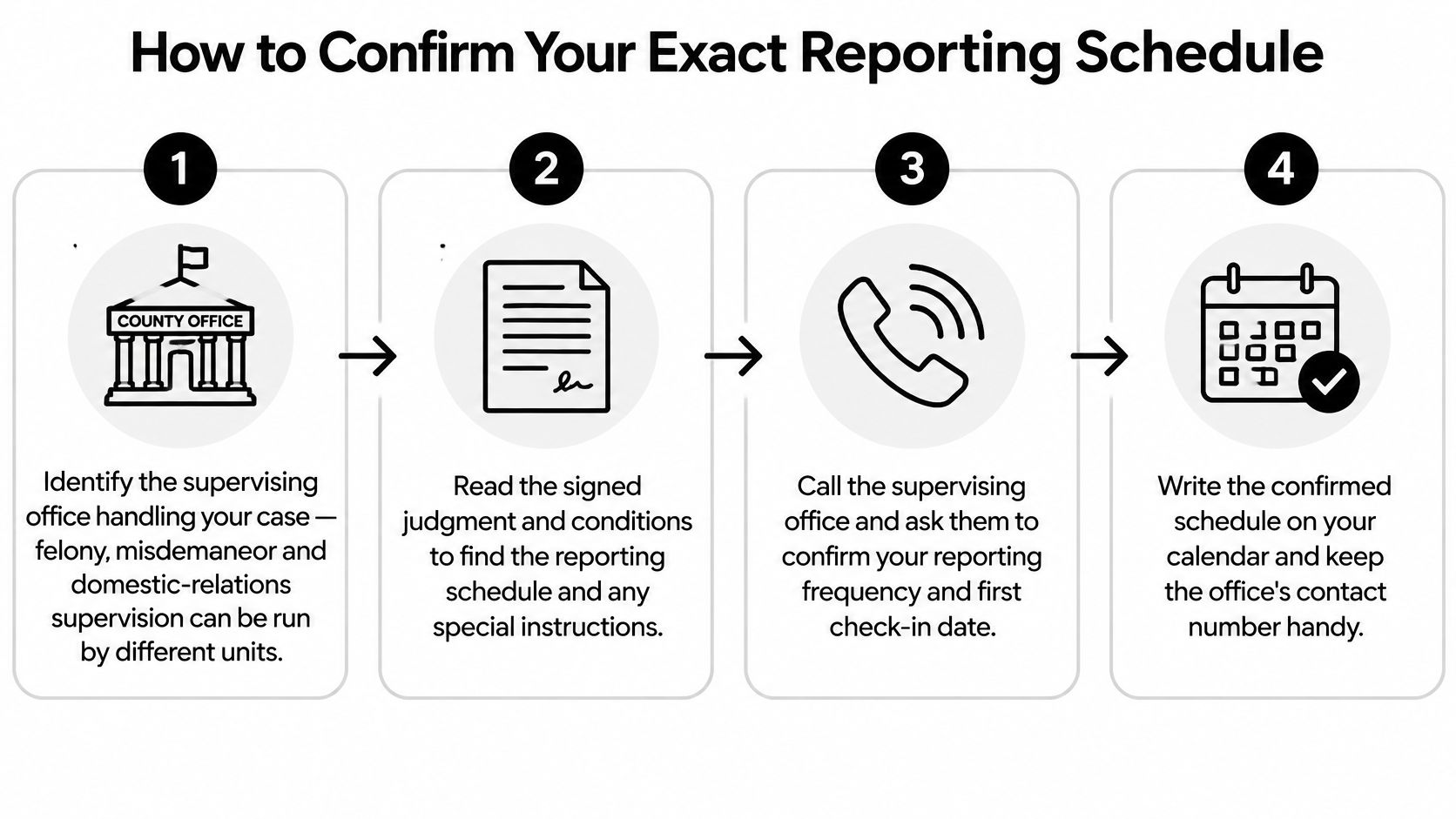
Four steps that settle it in one afternoon
- Identify the supervising office. Felony community supervision, misdemeanor probation, and domestic-relations supervision can be handled by different units with different phone numbers and different front desks. A friendly answer from the wrong office changes nothing in your file.
- Read the signed judgment and the conditions of supervision. Reporting frequency, fees, drug testing, travel limits and employment reporting should all appear there. Highlight every line with a date or a dollar figure attached to it.
- Call your assigned officer with three questions. Which reporting method applies to me? How often do I report, and on what day? When is my next date due?
- Ask for the answers in writing. An email, a portal message, or a letter. A voicemail and a hallway assurance won't protect you six months from now.
Your officer-specific directions are the ones that count, and a missed or incorrect reporting format can have consequences even when you reported every month. That's the false reassurance built into the word monthly. Frequency alone is not compliance.
Practical rule: write the date, the method, the officer's name, and the deadline in your calendar the same day you get off the phone. Then recheck after any change, whether that's a new job, a new address, a new car, a new phone number, a modification order, or a new officer.
A confirmed schedule on paper looks unremarkable. It has a method, a frequency, a day, a name, and a date. It fits on an index card. If yours doesn't fit on an index card, you don't have a confirmed schedule yet, and it's worth one more call before the next deadline arrives.
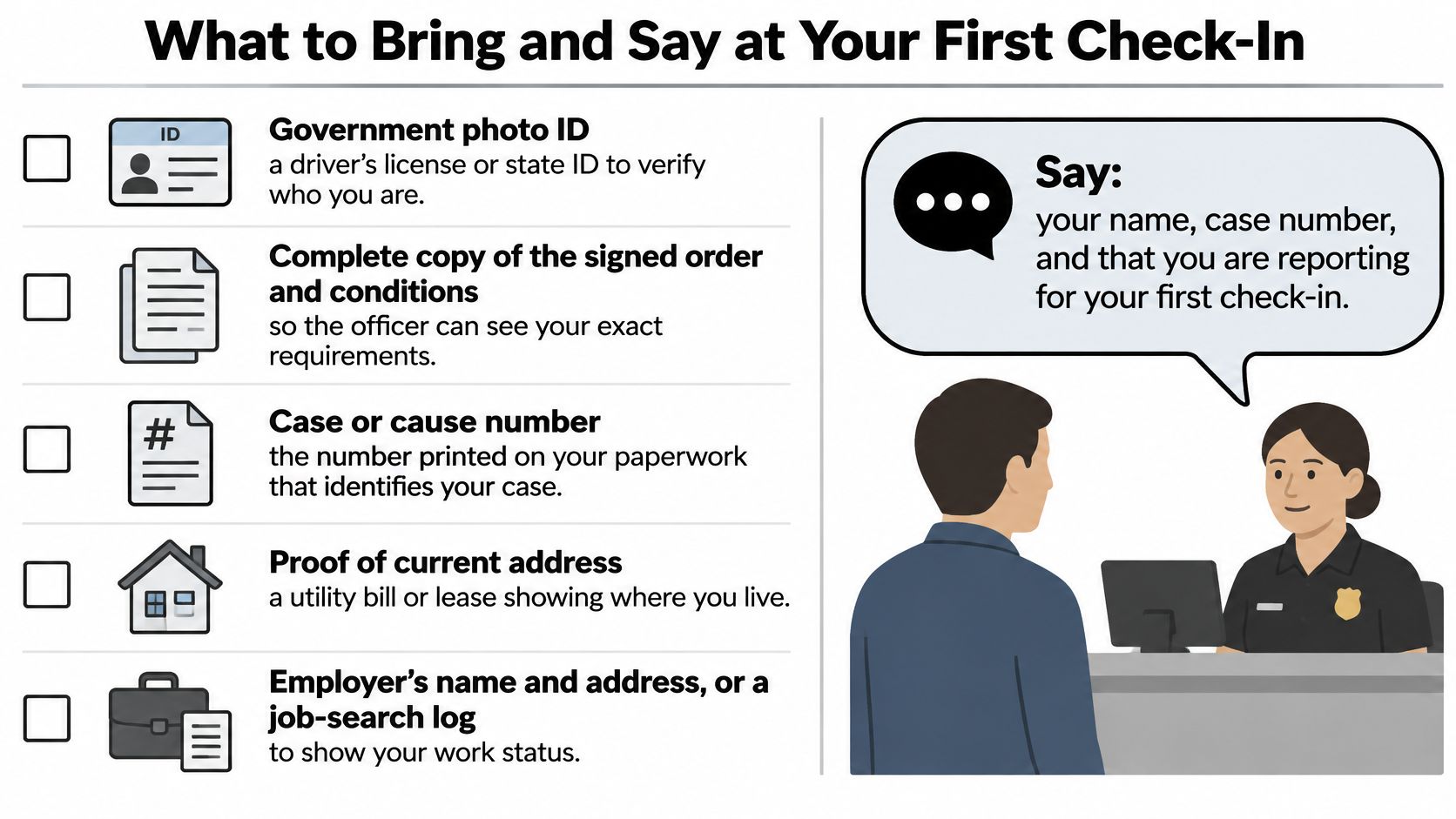
What to Bring and Say at Your First Check-In
Walk in prepared and the visit takes minutes. Walk in guessing and it turns into a second appointment, or worse, a note in your file you spend a year explaining.
What to bring
- Government photo ID. A driver's license or state ID, current and not expired.
- A complete copy of the signed order and conditions. Every page, including addenda. The officer should be able to read your exact requirements off your own paperwork.
- Your case or cause number. It's printed on your documents. Put it on a sticky note so you aren't scrolling through a phone in the lobby.
- Proof of your current address. A lease, a utility bill, or mail with your name and address on it.
- Work information. Your employer's name, address and phone, or a dated job-search log if you're between jobs.
- Payment records. Bring bank statements, Zelle or Cash App screenshots, canceled checks, money order receipts, wage withholding records, and the OAG payment history if one exists.
- Testing and treatment paperwork. Completion certificates, testing results, sign-in sheets.
- Copies, not originals. Keep the originals at home in a folder.
What to say at the window
Keep it short and factual. Rehearse it once in the truck if that helps.
"My name is ___ and my cause number is ___. I'm here for my scheduled check-in. Can you confirm which reporting method applies to me, how often I report, and when my next date is due? I'd like that in writing if possible."
Then stop talking. Don't discuss the offense, an alleged violation, or a dispute with staff without your lawyer present, and don't volunteer theories about what the order means. Bring copies rather than originals in case someone keeps a page, arrive early enough that parking doesn't make you late, and write down the name of the person who helped you and the time you were seen.
Reporting Changes When Money or Work Gets Tight
The monthly date on your card can feel like the whole obligation. It isn't, once money or work changes. In domestic-relations cases, parents under community supervision generally report monthly, but an unemployed parent who is delinquent on child support may have to report weekly and show evidence of job-search assistance through Workforce Solutions or the Texas Workforce Commission. Monthly reporting creates false reassurance. The method you use, the timing the officer sets, the written instructions, and the proof you can produce are what decide compliance.

The Harris County Domestic Relations Office monthly monitoring guidance identifies a $25 monthly monitoring fee. That fee is not assessed for a full-service child-support case handled by the Office of the Attorney General. Ask whether the exemption covers your case before you budget for it. The signed order and your assigned officer control the answer.
If you cannot pay, ask before the due date
New employers must be reported, and withholding orders may be issued once you're working again. Compliance with child support, costs, fees, classes, referrals, and officer instructions also decides whether web reporting stays available. Miss those pieces and the online option can come off the table.
Inability to pay does not automatically become a violation. The outcome depends on what your order requires and on how your officer documents the situation. I would put a written request for a hardship review or a payment plan in before the due date, while the payment is still open. An explanation offered afterward has to catch up to a miss that is already on the record.
Keep a dated job-search log, separation letters with dates, and receipts for partial payments so a weekly report has something attached to it. For an enforcement hearing, build a timeline of the support payments before the hearing, one line per payment with date and amount, so the record answers the question before the judge asks it. If pretrial supervision conditions are part of your case too, our page on Harris County pretrial services supervision conditions covers how those conditions stack on top of a reporting schedule.
Missed Reports, Violations and When to Call an Attorney
The mistake that costs people the most usually isn't the missed report itself. It's waiting to find out whether anyone noticed.
A missed report is not the emergency. A missed report nobody documented is.
Handle it the same day. Call the supervising office, ask to reschedule, and save proof of the attempt: the call log, the voicemail, the name of the person you spoke with, the confirmation email.
| Problem | First Step | Record to Keep |
|---|---|---|
| Missed scheduled check-in | Call the supervising office the same day and ask to reschedule | Date, time, call log, voicemail, or staff names |
| Used an unauthorized reporting method | Confirm the authorized method in writing and report the right way next time | The officer's written instruction and the dates you used the wrong method |
| Lost a job or changed address | Notify the officer as the order requires and ask about the reporting deadline | Employer letter, separation date, proof of new address |
| Cannot pay fees or child support | Ask in writing for a payment plan or hardship review before the due date | Income records, job-search log, payment history |
| Received a violation notice | Stop discussing the facts and contact an attorney before responding | Copy of the notice and all related correspondence |
An alleged violation can lead to a motion to revoke and a hearing before the judge. In serious cases the sentence that was suspended can be imposed. Even a minor lapse can bring stricter reporting conditions, added fees, or a curfew. The stakes are why the record matters more than the explanation.
If you're trying to understand how a probation violation gets proven and what a hearing looks like, the Ticket Shield DUI probation guidance walks through the consequences in plain terms, and it's a useful read before you decide how to respond to a notice.
When to call an attorney first
- A violation notice or a motion to revoke has been filed.
- A warrant has been issued, or a deputy has already come by.
- Your officer is alleging a new offense.
- You need a condition changed, such as travel, employment, or reporting location.
- Payments have fallen short more than once, even if nobody has complained yet.
An attorney can line your chronology up against the signed order and the docket entries, spot the gaps, and speak for you if a hearing gets set. Our probation violation lawyer in Humble page explains how that review works in Harris County courts. Calm, early documentation usually does more for a case than a good explanation offered late.
Schedule a Free Consultation Before Your Next Check-In
A short conversation can separate three very different situations: routine supervision that just needs a clean calendar, a hardship case that needs a written request filed before the next due date, and a case moving toward a hearing that needs attention this week.
During the free consultation with the Law Office of Bryan Fagan, you get a confidential review of your case details, honest feedback about your legal options and possible outcomes, guidance on the Texas criminal law that fits your situation, and clear direction on what to do next. No scripts, no pressure.
Families across Humble, Atascocita, Kingwood and Northeast Houston come to us for criminal defense, family law and estate planning, and criminal questions can be reviewed through the firm's criminal defense practice page on humbletxlawyers.com. If a violation notice, a missed payment, or a change in work or housing has landed on you, schedule a free consultation before your next check-in. Call the Humble office at (281) 817-1827, or schedule online or stop by the Humble location.
You don't have to sort this out alone, and one calm conversation before your next date can make the path a lot clearer.
If your paperwork and your officer's instructions don't match, or a missed date is already sitting in your file, the Law Office of Bryan Fagan can read the signed order with you, map your reporting history against it, and tell you plainly what to fix first. The firm offers a free consultation at its Humble office for residents of Humble, Atascocita, Kingwood and Northeast Houston. Visit Law Office of Bryan Fagan to schedule yours before the next check-in date arrives.