
You file a motion, find an open date in the District Clerk's system, and tell your family the hearing is set. Then no confirmation arrives, and you're left wondering whether to take time off work or arrange childcare. That mix-up is easy to make: choosing a date online starts a request. It doesn't, by itself, confirm a hearing.
For families in Humble, Atascocita, Kingwood, and Northeast Houston, knowing what happens between filing and court day can prevent avoidable delays. The 245th District Court handles family matters, but the clerk's confirmation, proper service, and a careful check of the docket all matter. The Harris County Family Courts guide for Humble residents offers broader background on how these cases proceed.
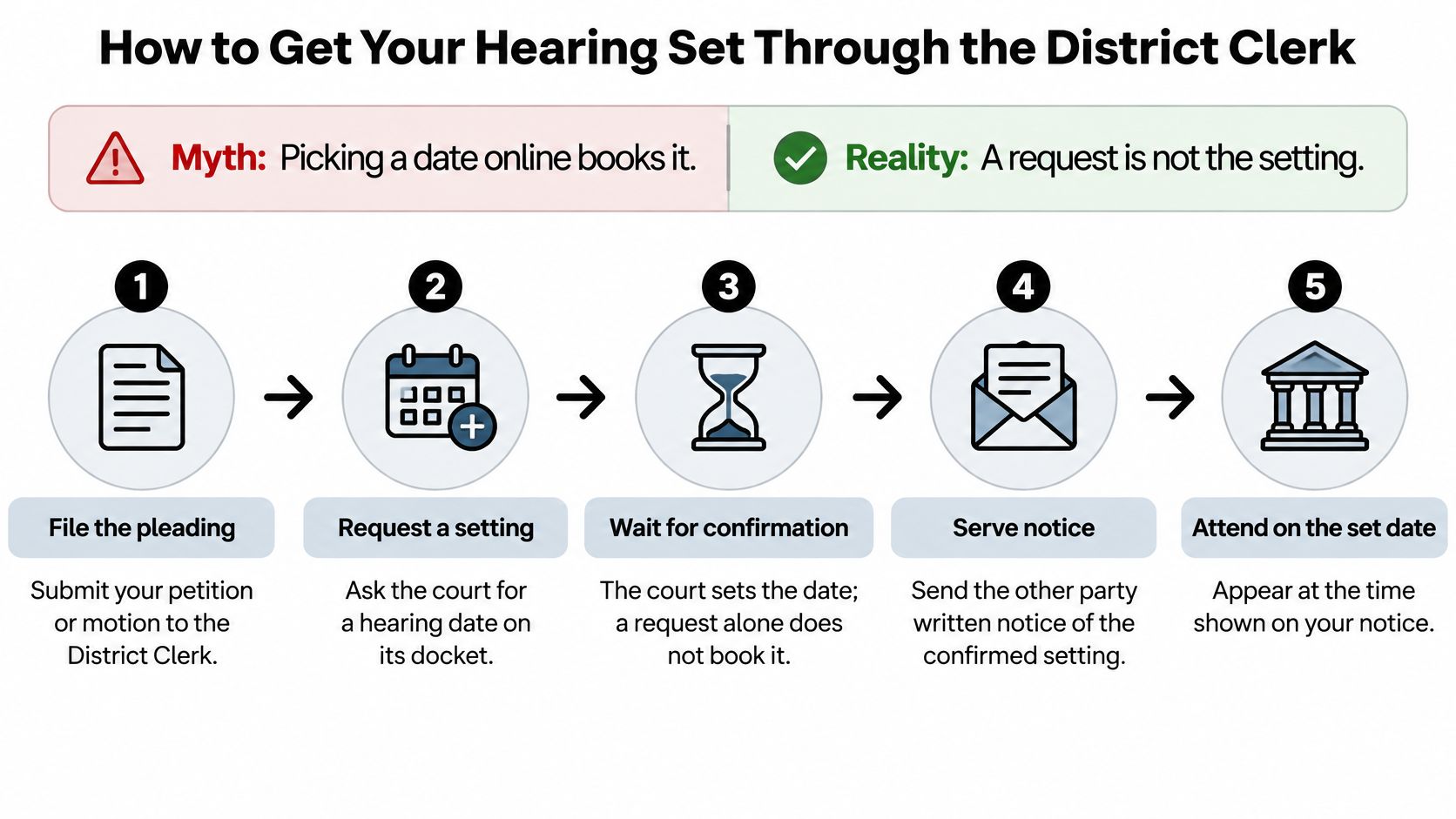
How to Get Your Hearing Set Through the District Clerk
A date that appears available online may look like a booking, but it's only a proposed setting until the clerk reviews and confirms the request. Don't make plans based on the date you selected alone.
For an e-filed petition or motion, the 245th Court's policies and procedures.pdf) describe the scheduling process. Follow it in order:
- File the pleading. Submit the petition or motion through an authorized electronic filing service provider. You'll need the filing to appear in your account before you can request a setting.
- Sign in with the matching email. Use the same email address associated with the e-filing. A different account may not show the filing you need.
- Open My Filings. On the District Clerk's website, go to Online Services, then My Filings.
- Find the motion. Look under Recent or use Search to locate the filed document.
- Select the gavel icon. This opens the hearing request workflow for that filing.
- Enter the hearing information. Provide the requested details and choose an available date.
- Submit the request. Submission asks the clerk to review a proposed setting. It doesn't confirm the hearing.
The system generates a proposed notice of hearing for clerk review. The clerk records the hearing time, then returns a file-stamped notice electronically so you can serve the other parties.
Confirm before you calendar
A tentative online selection isn't reliably calendared until clerk review and confirmation. Keep the returned, file-stamped notice. Check that it shows the right cause number and motion, serve every required party, and monitor the docket sheet for rulings or further instructions.
If you need to look up older docket activity, set a date range beginning with the filing date. Without a date range, the District Clerk's search may start with current or future results. For more practical guidance on getting a date, see the Harris County hearing-date coordinator guide.
Filing and Service Rules for Each Family Document
Before filing, check the current 245th Court policies. The court's official page says its 2024 policies and procedures were updated effective February 1, 2024, so don't rely on an old copy when planning service or preparing proposed orders. You can review the update on the Harris County District Courts' 245th Court page.
| Document | Who must receive it | Timing and method | Common delay |
|---|---|---|---|
| Original petition | Other spouse or parent | Serve by citation. The answer deadline is set by Texas Rule of Civil Procedure 99. | Proof of service missing from the file |
| Motion to modify or enforce | All parties or counsel of record | Serve through e-service under Rule 21a, with a notice of hearing attached. | Wrong cause number on the motion |
| Notice of hearing | All parties or counsel | The clerk-stamped copy is returned after the setting is confirmed. | Served before clerk confirmation |
| Proposed temporary orders | Opposing party or counsel | Exchange before the hearing in the court's format. | Order not in the court's required format |
| Certificate of service | Filed with each pleading or motion | State how and when each party was served. | Missing or vague certificate |
The two delays that are easiest to prevent are a missing certificate of service and a notice carrying the wrong cause number. Review the case number on every document before filing or sending it. Notice periods for contested settings can differ, so confirm the required period with the court rather than assuming that a date shown online gives everyone enough notice.
Harris County families in Atascocita, Kingwood, and Northeast Houston often need the same basic paperwork. A written checklist can catch missing pieces before they mean another trip downtown. If you're checking how to calculate a deadline, MatterAlert's court deadline guide can help you organize dates, but confirm the applicable period with the court or your lawyer. For filing details, see the firm's guide to e-filing requirements for a Harris County family case.
Preparing Exhibits and Evidence for the Bench
An unlabeled document can be hard for a judge to follow, even if it seems important to you. The court needs to know what each item is, and a witness may need to explain how it relates to the dispute.
Start with a clear label for every exhibit, such as “Petitioner's Exhibit 1.” Prepare three sets: one for the judge, one for the other side, and one for the witness. Keep the labels and numbering consistent across all copies.
Then make an exhibit list. For each item, note its number, a short description, its date, and the witness who can identify it. A bank statement, tax return, or school record may help explain a family issue, but you still need a witness who can tell the court what the record is and why it matters.
Preserve the original records
Texts, emails, and screenshots need a witness who can explain what they show and how they were captured. Keep the original device or account record when possible. A screenshot without context may leave questions about who sent the message, when it was sent, or whether it's complete.
Before filing exhibits, check Texas Rule of Civil Procedure 21c for sensitive information that must be redacted. That includes full Social Security numbers, full account numbers, and full birth dates. Remove protected details before attaching a document to a court filing.
Practical rule: If you can't name the witness who'll identify an exhibit, it isn't ready.
What Happens at Docket Call and Your Hearing
On court day, give yourself time to get through security and find the posted docket. Arrive at least 30 minutes early, and bring a government photo ID and your case paperwork.

Docket call is when the court works through its list of cases. Your matter may be resolved, reset, or assigned a time to be heard. The judge may ask whether you and the other party agree on anything. Listen closely, even if your case isn't called right away.
When the court calls your case, state your name, your role in the case, and the cause number. Be ready to say whether you're prepared to proceed. If you're representing yourself, sit at the table, speak when addressed, and call the judge “Your Honor.”
Know what kind of hearing you have
An agreed matter may be short if both sides have worked out the terms and prepared an order. A contested hearing can take longer because each side may need to present witnesses and exhibits. If the dispute involves custody, understanding what evidence the court can consider is important; this guide to evidence rules in custody hearings gives a general overview.
Follow the courthouse rules for phones and recording. Dress neatly and conservatively. Don't assume that a ruling will always be announced in the room. The court may post a ruling or further instruction to the docket sheet later, so check it after the hearing.
If you need help preparing for a divorce setting, Divorce Lawyer in Humble, TX describes divorce representation for clients in Humble and Harris County. Whatever path you take, write down the judge's instructions and confirm them against a written order before you act.
Continuances and Emergency Hearings Explained
A witness who cannot attend can put a contested hearing at risk. To ask for a continuance on that basis, explain what the witness is expected to say, why that testimony matters, and why the witness cannot appear or provide the information another way. Give the judge supporting details, such as the reason for the absence and the steps taken to secure the witness. A general statement that a witness is unavailable does not explain why the hearing should be moved.
A continuance is a request to move a hearing to a later date. If both sides agree, they can submit an agreed motion or order. If they disagree, the judge decides the motion based on the reason and supporting information. An agreement between the parties does not itself grant a continuance.
| Situation | How it is usually handled | Typical timing | What to bring |
|---|---|---|---|
| Agreed reset by both sides | Submit an agreed motion or order to the clerk and court. | Before docket call; court approval is still needed. | Signed agreed order |
| Contested continuance | The judge decides a motion for continuance. | As soon as the reason arises. | Stated reason and supporting proof |
| Emergency temporary orders | File a sworn motion and affidavit asking for expedited handling. | The court sets the timing; confirm it on the docket sheet. | Sworn affidavit and proof of urgency |
| Family violence risk | Seek an emergency protective order from a magistrate, separately from the regular docket. | It may be possible the same day. | Facts, dates, and any police report |
| Immediate child safety concern | Contact an attorney right away and file an emergency motion. | As fast as possible. | Written timeline and supporting documents |
For example, suppose a witness who can address a disputed issue tells you they cannot attend the hearing. Explain the specific testimony they would provide, why it matters to the issue before the court, and the reason they cannot appear. Include available supporting proof and explain whether another way of presenting that information is practical. The judge can then weigh the request against the other side's position and the scheduled hearing.
Family violence concerns may call for an emergency protective order from a magistrate rather than waiting for a regular family docket setting. For details about local temporary-order procedures, review the guide to Harris County temporary-orders hearing time limits and local rules.
If a child may be in danger, call an attorney the same day. The timing of an emergency filing can matter as much as the documents you prepare.
Your Timeline and Checklist Before Court Day
Count back from the confirmed setting and check the notice period and current court rules before arranging time off, childcare, or witness attendance. Use the weeks before court to catch scheduling problems and finish the tasks that need lead time.
| Timing | Task | Why it matters |
|---|---|---|
| One to two weeks before | Exchange exhibit lists and proposed orders. | Gives the other side time to raise objections. |
| One week before | Check the docket sheet and confirm each witness. | Helps catch a moved or cancelled setting early. |
| Day before | Review your schedule, witness availability, and docket status. | Helps you spot a change before traveling to court. |
| Court day | Arrive early and check the posted docket. | Confirms your case is on the list. |
| After the ruling | Check the docket sheet for the signed order and calendar its deadlines. | The written order controls what happens next. |
The week before, confirm that each witness can attend and that the docket still shows your setting. If either has changed, address it before court day rather than discovering the problem at the courthouse. Keep the day-before check focused on timing and attendance; your filing and exhibit preparation should already be in order.
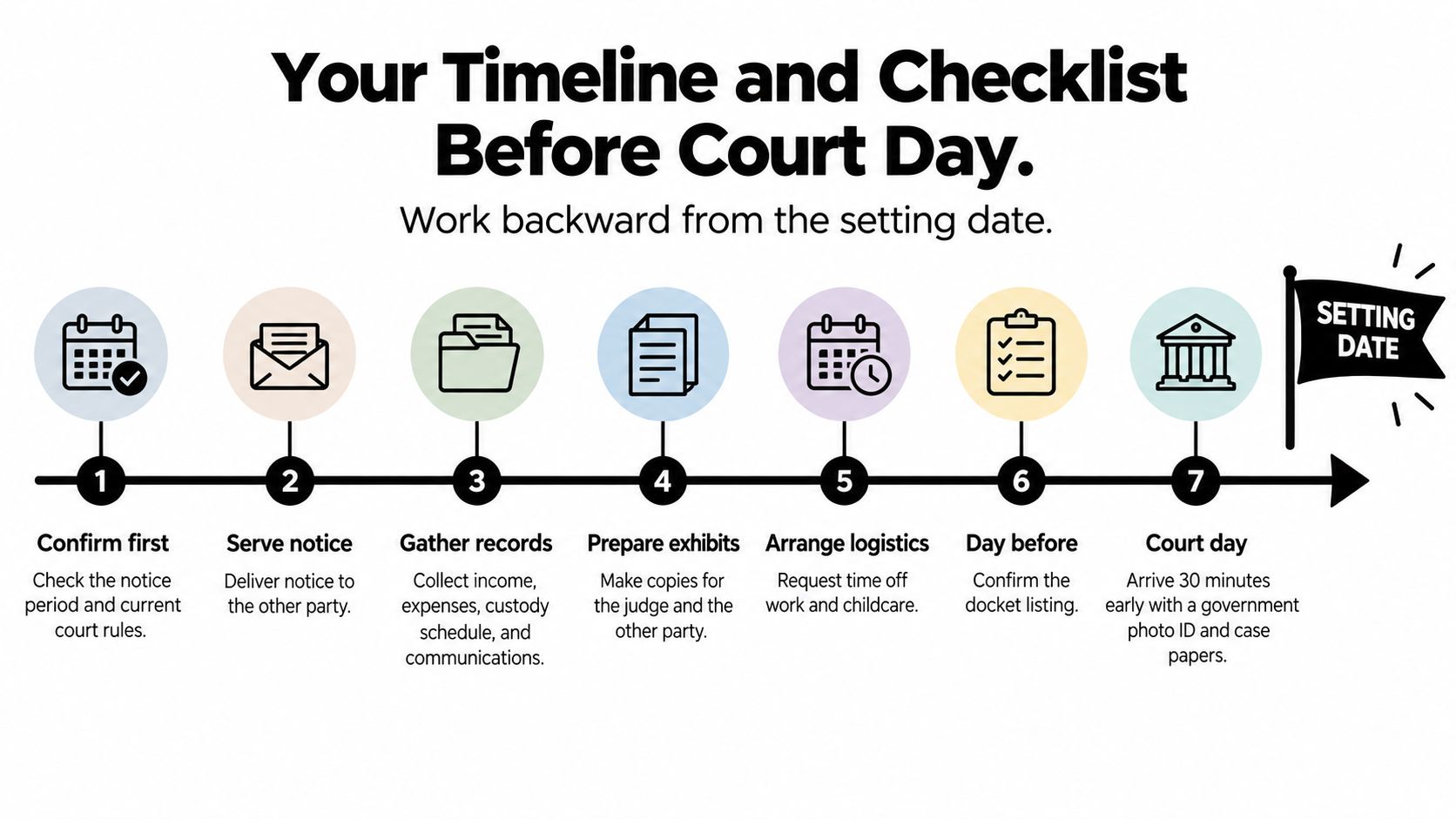
After the ruling, look for the written order on the docket and calendar every deadline it sets. If the other side does not follow the order, use the signed terms to identify what must be enforced. The steps depend on the order and the problem: for e-filing requirements in a Harris County family case, see the Harris County family case e-filing requirements.
Deciding Whether You Need an Attorney Before Your Setting
An agreed hearing with a clear proposed order may be manageable without a lawyer if you understand the court's instructions and prepare carefully. A contested custody dispute, protective-order matter, significant property issue, or hearing involving complicated evidence calls for more care. A lawyer can help you decide what to present, when to present it, and how to respond to the other side's arguments.
Get advice before the hearing if opposing counsel files a motion you have not seen, your proposed date conflicts with another court appearance, or a docket instruction is unclear. Seek help, too, if your notice does not match your filed motion or the other party has not followed an earlier order.
Clarify any notice, deadline, or court instruction you do not understand before the hearing.
An attorney's review may catch a missed deadline or an exhibit that lacks a witness who can identify it. That can matter when the court must decide whether the evidence can be considered. The Law Office of Bryan Fagan offers family-law guidance for Harris County residents preparing for a 245th Court setting. Bring your stamped notices and timeline, and visit the Law Office of Bryan Fagan to schedule a free consultation at the Humble office.