You filed the divorce petition last week, or the debt suit, or the papers asking to change custody. The other parent still lives somewhere between Humble, Kingwood, and Atascocita, and nothing moves until those papers are handed over. That handoff is what people mean by Harris County Sheriff Civil Process Division service, and the cheap-looking fee is not the whole bill. A wrong address or a thin return makes you pay for the same paper twice.
What Civil Process Handles in Harris County
Say you live off FM 1960 and the petition is already on file. The court will not treat the other spouse, the other parent, or the person who owes the debt as notified just because you filed. Someone still has to process, serve, and, when the order calls for it, execute the paper.

Civil process covers subpoenas, summonses, citations, writs, and notices on people and on businesses. Harris County's FY2025 budget materials count 469,332 civil-process requests in a year and set a 60% target for documents successfully delivered. That 60% figure is a county performance target, not a success rate for your case.
Who touches the paper
The issuing court and the District Clerk produce the citation and collect filing and issuance charges. A sheriff's deputy or a constable's deputy serves, or tries to serve. A certified private process server may serve only when the rules, or a written court order, allow that person to do it.
Residents of Humble, Atascocita, Kingwood, and Northeast Houston hit this step in family cases, ordinary civil lawsuits, property fights, and post-judgment work. Enforcement of Court Orders in Humble is the later stage, when a divorce decree or custody order is already on the books and a provision still is not being followed. Many of those later papers are issued through the Harris County civil courthouse at 201 Caroline.
Before you look at a fee, name the document and the court that issued it. That pair picks the row.
Service Fees by Document Type in Harris County
The document type sets the published service charge. Read your row first, then add the rest of the filing package.
| Document type | 2025 fee | Typical use |
|---|---|---|
| Standard citation | $85 | New lawsuit or divorce petition |
| Child-custody warrant | $155 | Custody order enforcement |
| Attachment | $155 | Securing property to back a claim |
| Civil capias | $155 | Court order for arrest after failing to obey an order |
| Writ of execution | $185 | Collecting a money judgment |
| Writ of execution and order of sale | $185 | Selling property to satisfy a judgment |
| Garnishment | $125 | Collecting from wages or bank accounts |
| Forcible-eviction proceeding | $85 | Eviction filings |
| Deposition subpoena | $85 | Requiring a witness to testify |
| Precept or other process or order | $85 | Other court-directed papers |
| Out-of-state affidavit of service | $30 | Proof of service completed outside Texas |
The Harris County District Clerk's civil court information lists those 2025 charges, including $85 for a standard citation, $155 for a child-custody warrant, an attachment, or a civil capias, $185 for a writ of execution or a writ of execution and order of sale, $125 for garnishment, and $30 for an out-of-state affidavit of service. There is no single flat charge.
Why the service line is not the whole bill
The District Clerk calculates filing fees, process-issuance fees, and process-serving fees as separate pieces. What you pay to start or move a case can run past the sheriff or constable line alone.
A parent in Kingwood who needs one standard citation served pays the $85 service fee plus those separate filing and issuance charges. The published service fee does not rise because the house is farther from downtown Humble.
If a constable deputy is needed past two hours, Harris County's 2025 constable fee schedule adds $75 per hour per deputy. Ask the clerk for the current sheet before you pay. Schedules get revised.
Match the paper to a row, then budget the full package. In a Humble divorce, a house, retirement account, or business interest is often the main dispute, and a Property Division Lawyer in Humble works on how community property and more complicated assets get divided. Service of the citation is only the front door to that case.
Practical rule: If the caption says "citation" but the body is a writ, you are on the wrong fee row.
Choosing the Service Method
Filing the petition does not prove the other person was served. The method has to be one the rules allow for that case.
| Method | Who performs it | Best fit | Watch for |
|---|---|---|---|
| Sheriff or constable service | Sheriff's or constable's deputy | Standard in-person delivery to a verified address | Fee by document type; success depends on address accuracy |
| Certified process server | Authorized private process server | Flexible hours or a tight schedule | Must be authorized by rule or court order; the server bills a private fee outside the county schedule |
| Certified mail, restricted delivery | Sender by certified mail | When the rule's requirements are met and the defendant must sign | Signature must be the defendant's; a household member's signature may not qualify |
| Substituted or alternative service | Server acting under court order | After diligent attempts fail | Requires court authorization before the attempt |
| Electronic submission | Office portal or email, if accepted | When the office offers it for your request | Get written confirmation the office accepts that method before you rely on it |
The Texas Rules of Civil Procedure generally allow a sheriff or constable, a certified process server, or another person authorized by court order to serve citation. In justice-court matters, service normally means handing the citation, the petition, and the attachments to the defendant in person. Registered or certified mail with restricted delivery is another listed method when that rule's requirements are met. The same gap shows up in Harris County family, debt, and eviction cases. The file stamp is not service.
Judgment calls the table cannot make
- Pick in-person service when the address is recent and you have checked it, not when it is only the address on an old tax bill.
- Skip restricted mail when a roommate or a new partner might sign. The signature has to be the defendant's.
- Do not assume a portal or email counts until that office says it accepts your kind of request.
- Do not treat the cheaper route as the safer one if your case type does not authorize it. A rejected attempt costs another fee and another week.
For divorce papers in this part of the county, many families start with constable service in Precinct 4. Before you choose any of these routes, it helps to use a practical guide to verifying subjects before service so the name, the workplace, and the street address belong to the right person.
Can the defendant be reached at a verified address? If the answer is no, plan diligent attempts and, if those fail, substituted service under a court order.
How to Submit a Service Request Step by Step
A mismatch at the counter is the delay you can prevent. The civil counter will not guess which citation you meant.

Confirm the case identifiers. Match the cause number, the court name, and the clerk's issuance stamp on the citation. A swapped digit stalls intake because the office cannot tie the paper to the file.
Check every attachment. The petition, the exhibits, and any order the citation mentions have to travel with it. Omitted pages are a common reason a later judge treats service as defective. Parents who want the path through the family courts can read Harris County Family Courts: A Humble Resident's Guide for how those cases move in the courts that serve Humble.
Write down the best address and a backup. Use a home address you have confirmed, plus a workplace if you know one, a physical description, and a vehicle if you have seen it. A wrong address is not a single failed attempt. It can mean a second fee, a second trip, and another week, which is how the lowest advertised service price turns into the most expensive route. "He used to live off Will Clayton" is not a service address.
Choose the server from the method that fits. A sheriff's or constable's office handles standard in-person service. A certified process server is proper only where the rules or a court order allow it. If the choice is unclear, ask the clerk which route your case type permits before you pay anyone.
Pay the fee that matches the document and keep the receipt. Use the document-type row, pay it with the filing package, and do not round the amount from memory.
Confirm where and how this office takes the request. Some requests go to a civil counter in person. Others go by mail with payment and a cover sheet. Use a portal or email only after that office confirms it accepts your request that way. Check the Harris County District Clerk's civil filing locations page for the counter address and hours before you drive.
Write the submission date on your calendar and set a reminder for the issuance limit, so an unserved citation does not sit until it expires.
Check status and ask whether a return has been filed. "We have it" is not the same as "the return is in the file."
A quick check at the counter
- The citation in your hand matches the packet you are handing over.
- The server's name and contact line are filled in, not blank.
- Your receipt shows the fee for the document type you submitted.
- You have the clerk's date-stamped copy or receipt.
- You know the date you will check for a return.
Service Timelines, Proof of Service and Deadlines
A citation carries two clocks, and they do not start on the same day. The first is the issuance limit: under the Texas Rules of Civil Procedure on returns and issuance, a citation that has not been served within 90 days after issuance generally must be returned unserved. Ask the clerk for reissuance, or ask the court for relief, before that date. The second clock starts when the defendant is served, because the answer deadline runs from service. Families who miss the first clock often pay twice, once for the original service fee and again for a new citation. That repeat charge is the cost problem hiding inside a timeline.
| Control | Rule or timing | What to do |
|---|---|---|
| Issuance limit | Counted from the date the citation is issued | Request reissuance or court relief before the limit runs |
| Justice-court diligent effort | Within five business days after filing in certain proceedings | Log every attempt from the first visit |
| Return of service | File promptly after execution | Include date and time received, cause number, documents and person served |
| Pre-trial rule timing | Weekends and legal holidays may be excluded under some short rules | Count backward using the court calendar |
| Expedited service (justice court) | $85 surcharge on the 2025 schedule | Pay for priority; it does not guarantee an attempt by a set date |
| Answer deadline | Counted from the date of service | Calculate both dates from the docket |
In certain justice-court proceedings, Justice court procedure materials call for a sheriff or constable to make a diligent effort within five business days after filing. Everywhere else, the general rule remains prompt execution and a prompt return. Because the answer clock starts at service, it can fall well after the issuance limit has passed. A return can still fail if it does not show what was delivered, when, where, and to whom.
What the return must show
The return should record the date and time the papers were received, the cause number, the case name, the issuing court, the documents served, and the identity of the person or entity served. Each attempt needs its own line: date, time, location, a physical description, access limits such as a gated entry, and anything an occupant said. A bare "unable to serve" note is thin.
File the return promptly after execution. Texas law does not set one universal number of hours for that filing. When a short pre-hearing rule applies, weekends and legal holidays may be excluded, and some proceedings require the return at least one day before trial.
The Harris County District Clerk FAQ points people to fees and online case tools, but it does not publish one turnaround time for every civil paper. An $85 expedited-service surcharge on the 2025 justice-court schedule can buy priority. It does not promise an attempt by a named date, and it does not promise that the person will be home. The lowest fee on that schedule can become the most expensive line in the case when a thin address or an incomplete return forces a second payment.
Ask the clerk which status the paper is in: issued, assigned, attempted, served, or returned not served. Issued means the clerk has created the citation but no one has tried to deliver it. Assigned means the court has directed it to a server. Attempted means someone tried and logged the result. Served means delivery happened. Returned not served means the paper came back without delivery, so the next step is usually reissuance or a better address. Compare the return against the docket before anyone relies on it, including before a default. The service clock is only one part of the case file. What happens in the weeks after a divorce case is opened is a separate track, and what happens after a divorce is filed explains that sequence.
When Service Fails and How to Respond
Two returns arrive in the same week. One says "not found." The other says "refused." Same court, same kind of case, two different issues, and the next step is not the same for either. Treat "refused" like "not found" and you will pay a second fee to knock on a door that already answered. That is how the lowest advertised fee becomes the expensive option.
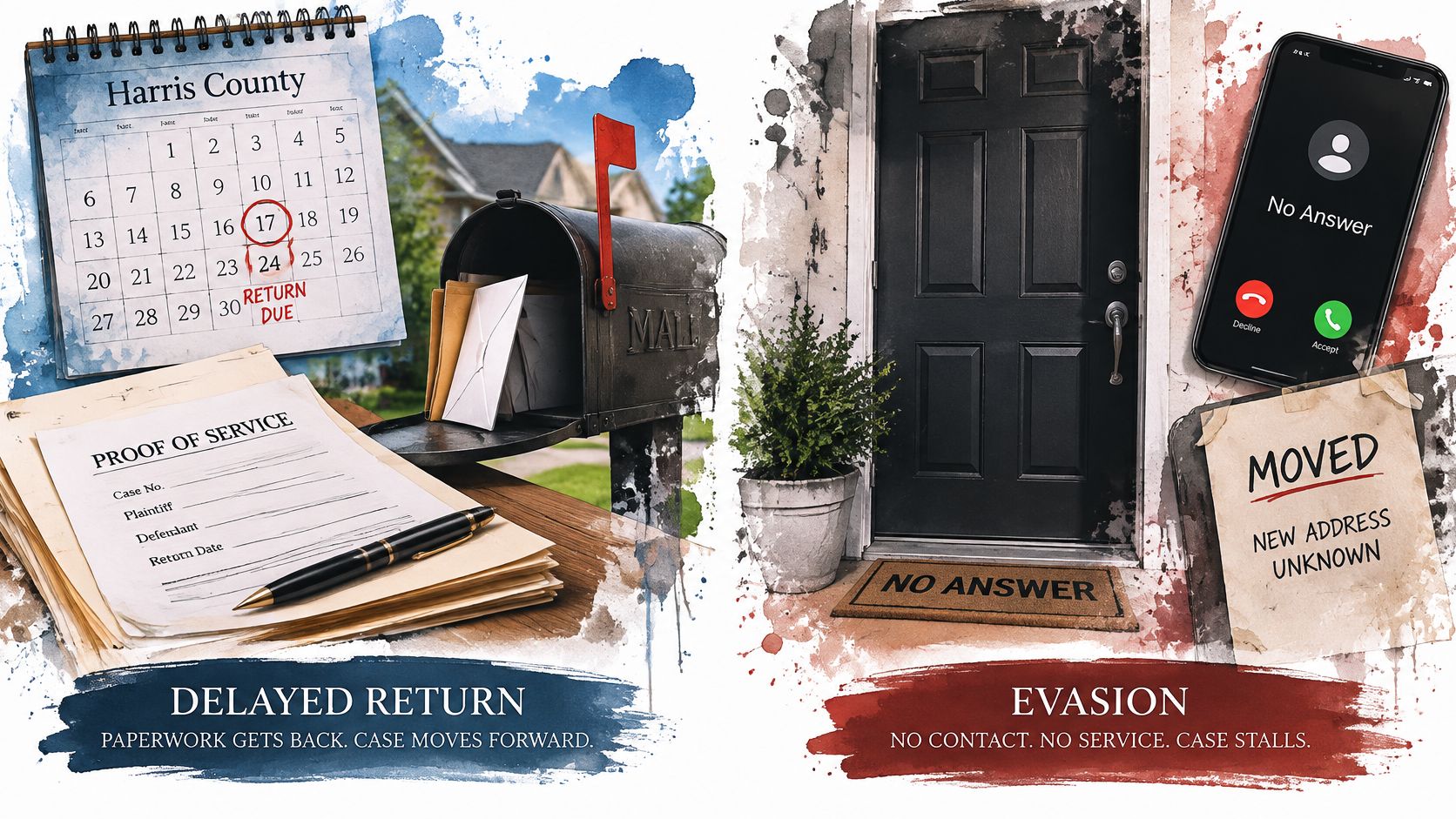
The wording on the return tells you which problem you have. "Refused" means someone at the address knew about the attempt. "Not found" means the address or the timing was wrong, and no amount of patience fixes a bad address.
Part of the confusion is that four different offices can carry the same paper. The District Clerk issues the citation and holds the file. A constable precinct or the Sheriff's civil process division makes the physical attempt. Certified mail travels through the postal service. A private server is hired by you or your lawyer. Four desks, four sets of intake rules, and a packet sent to the wrong one comes back unserved for reasons that have nothing to do with the other person.
Delay looks different from avoidance. A return that sits untyped for a week is paperwork catching up. Repeated no-answers at a verified address, a move nobody announced, a household that will not come to the door: that pattern points toward a request for another method.
A response order that holds up
- Read the return for the specific reason. "Not found," "moved," and "refused" point to different next steps.
- Re-check the address through public records and through a workplace or family contact you can name.
- Change the day and the time. One Tuesday morning does not show that nobody lives there.
- Log each attempt in the detail the return is supposed to carry.
- Ask for reissuance before the issuance deadline if the paper is still out.
- Ask the court for substituted or alternative service when the log shows real avoidance, and do it only with the authorization the rule requires.
- If an existing order is being ignored after personal service, ask whether a follow-up such as a civil capias request fits.
A Humble parent whose ex moved somewhere in Northeast Houston and is found only at a job site is a common version of this. One failed knock does not persuade a judge. A log that shows different days, a workplace, and a description does.
Keep the receipts, the attempt notes, and every returned copy. You will need them if you ask for a different method.
Book a Free Humble Consultation Before You File
Handle the request yourself when the document is simple, the address is verified and recent, the fee matches the current sheet, and neither the issuance clock nor the answer clock is close. A clean request on a good address is usually the cheapest path.
Get help when attempts have failed more than once, the other person appears to be avoiding service, a deadline is close, or a custody or child-support order is what you are trying to enforce. Those are the files where a second bad attempt costs more than a conversation. Each repeat attempt adds another fee and another wait, and the lowest advertised fee can become the expensive option when a wrong address or incomplete return forces a second round.
What the visit covers
The free consultation gives you a confidential review of your case details, honest feedback about legal options and potential outcomes, guidance on Texas family, estate, or criminal law that fits your situation, and clear direction on what to do next. A short conversation can also show whether the matter is simple arrears, a contempt issue, an income withholding problem, or something that needs faster court action.
Bring the citation, the petition, any return, and the address you have been using. Those four items show whether the next step is a cleaner request or a court order for a different method.
The office is at 414 E Main St, Humble, TX 77338. Call (281) 817-1827 to set a time, or stop by the Humble location. The firm serves clients throughout Harris County and the Houston metropolitan area, including Humble, Atascocita, Kingwood, and Northeast Houston.
The Law Office of Bryan Fagan helps Humble families sort civil service, court deadlines, and the next step in a divorce, custody, or enforcement matter before a bad address or a thin return runs up the cost. If your papers are sitting unserved, or a return already came back not served, bring them in and the office will walk through the practical options with you. Schedule a free consultation with the Humble office through Law Office of Bryan Fagan.