Skip to content
Life changes. It's a simple fact. If you're a parent in Humble, Atascocita, or Kingwood, you know that the financial realities of today might look nothing like they did when your child support order was first created. When your circumstances shift, it's natural to wonder if your child support order can shift, too.
The good news is that Texas law anticipates these changes. A child support order isn't set in stone forever. At The Law Office of Bryan Fagan, we see it as a living document that can and should be updated to reflect your family's current situation. Let's walk through what it takes for families in our community to make that happen right here in the Humble area.
Is It Time to Change Your Child Support Order?

To get a Harris County judge to approve a modification, you can't just say that things are different. The Texas Family Code sets specific legal standards, or "grounds," that you have to meet. For Humble families, this almost always boils down to one of two situations.
Material and Substantial Change in Circumstances
This is the most common reason for a child support modification. It’s a bit of legal jargon, but what it really means is that something significant and likely permanent has changed for the child or one of the parents.
The court needs to see more than a minor, temporary hiccup. What counts as material and substantial? In our experience helping families in Humble and across Northeast Houston, it often includes things like:
- A parent losing their job or having a significant, involuntary decrease in income.
- The paying parent's income going up substantially.
- A change in the custody or possession schedule, meaning the child is spending more time with one parent than before.
- A change in the child's needs, such as a new medical diagnosis that requires expensive care.
- A parent becoming responsible for another child.
This is where the specifics of your situation are crucial. The court will want to see proof that the change is real and affects your ability to pay or the child’s need for support.
The Three-Year Review Rule
What if nothing dramatic has happened, but it's just been a while? Texas law has a provision for that, too. You can ask for a review and potential modification if two conditions are met:
- It has been at least three years since your child support order was signed or last modified.
- Under the current Texas child support guidelines, the monthly payment would change by either 20% or $100.
Think of this as a built-in check-up. It's a practical way for parents in Humble, Kingwood, and Atascocita to make sure their support amount keeps up with inflation, cost-of-living increases, or even just standard career progression over time. You don't have to prove a major life event—just that the numbers now calculate to a different amount based on the passage of time and income changes.
To make it clearer, here’s a quick breakdown of the two primary grounds for seeking a modification in Texas.
Quick Guide to Child Support Modification Grounds in Texas
This table gives Humble parents a simple reference for the two main legal reasons to change a child support order.
| Reason for Modification | What It Means for Humble Families | Real-World Example |
|---|---|---|
| Material and Substantial Change | Something significant has happened to one of the parents or the child since the last order was made. | A parent working in the oil and gas industry in Humble gets laid off and is forced to take a much lower-paying job in a different field. |
| Three-Year Review Rule | It's been over 3 years, and the calculated support amount would now differ by 20% or $100. | A parent received regular raises over three years, and their income is now high enough that the guideline support amount has increased by $125/month. |
Understanding which path applies to you is the first critical step in the process.
Key Takeaway for Humble Parents: You don't have to be stuck with an outdated child support order. Whether you've had a significant life change or it's simply been three years, Texas law provides clear pathways to ensure the amount is fair and reflects your current reality.
Knowing these rules is one thing; navigating the Harris County court system to put them into action is another. At The Law Office of Bryan Fagan, we’re committed to helping local families understand their rights and pursue modifications that protect their children's best interests and their own financial stability.
If you believe your situation fits one of these scenarios, don't wait. An outdated order can cause unnecessary financial strain or, conversely, leave your child without the support they're entitled to. We are here to offer clear, compassionate guidance tailored to the Humble community. Schedule a free consultation with our Humble office today to talk about your case and find out how we can help.
What Qualifies as a Material and Substantial Change?
When you need to change your child support order in Humble, a Harris County judge will be looking for a legally sound reason to do so. You can't just decide you want to pay a different amount. Texas law is very clear on this, and it all boils down to proving a “material and substantial change in circumstances.”
That’s a formal legal phrase, but for families in our community, it means something significant and probably permanent has changed for you, the other parent, or your child since the judge signed the last order. This isn't about small ups and downs; it's about major life shifts that genuinely impact finances.
Real-World Scenarios We See in Harris County
So, what does a "material and substantial" change actually look like for a family in Atascocita or Kingwood? It has to be more than a temporary dip in overtime pay or a minor disagreement.
From our experience helping local families through this process, here are some common situations that typically clear that bar:
- Involuntary Job Loss or a Big Pay Cut: This is a common one. A parent gets laid off from their job and has to take a new position that pays significantly less. The key word here is involuntary—a judge won't look kindly on someone quitting a high-paying job just to try and lower their child support obligation.
- A Major Jump in Income: On the flip side, if the paying parent gets a huge promotion, a new high-paying job, or a significant inheritance, that can also be grounds for a modification.
- The Child’s Needs Have Changed: This often involves a new medical diagnosis that comes with expensive treatments, ongoing therapy, or special equipment that insurance doesn't fully cover.
- Custody Arrangements Have Flipped: If the child starts living primarily with the parent who was originally paying support (the obligor), that’s a fundamental change that almost always requires modifying the support order.
Even changes in a child’s living situation outside of the parents' homes, like establishing temporary guardianship with a relative, could qualify. The goal is always to show the court how these new circumstances have completely changed the financial reality from when the original order was made.
The bottom line is this: for a Harris County judge to consider a change "material and substantial," it needs to be an unexpected event that has a real, measurable impact on either a parent's ability to pay or the child's financial needs.
The Three-Year Review and the 20% or $100 Rule
But what if there wasn't one big, dramatic event? What if things have just… changed over the years? Texas law has a second path for these exact situations.
You might be able to modify your child support in Humble if you can meet two specific conditions:
- It has been three years or more since your current child support order was created or last changed.
- The monthly support amount would change by at least 20% or $100 if you recalculated it today using current incomes and the Texas child support guidelines.
This is an incredibly practical rule. It acknowledges that life doesn't stay the same. Incomes change, the cost of living in Northeast Houston goes up, and a support amount from three or four years ago might not make sense anymore.
This isn't just a Texas thing. States across the country have similar rules to keep the courts from getting bogged down with minor requests while ensuring support orders remain fair. A report from the American Academy of Matrimonial Lawyers on the many facets of child support modification shows how these standards function nationwide. In Texas, the 20% or $100 threshold ensures that any change is meaningful.
The three-year review is a powerful tool. It gives you a way to keep the child support order in step with your family’s current financial picture without having to prove a single, major life crisis. Understanding whether you have a "material and substantial change" or qualify under this rule is the very first step.
The Step-by-Step Process to Modify Child Support in Humble
So, you've realized your child support order needs an update. But how do you actually get it done? The idea of heading into the Harris County court system can feel overwhelming, especially when you're already dealing with a major life change.
We see families from Humble, Atascocita, and Kingwood walk through this process every day. When you break it down into clear steps, it's far less intimidating. Here is our practical, step-by-step advice for getting your child support order updated.
Step 1: Build Your Case with Strong Evidence
Before you even think about filing paperwork, you need to gather your proof. A judge won’t modify an order based on your word alone; they need to see clear, documented evidence of that “material and substantial change” we talked about.
Think of it this way: you have to paint a picture for the court that shows exactly what changed and by how much. For Humble families, this proof often includes:
- Income Changes: This is the big one. If you lost your job, you'll need the termination letter. If your hours were cut, grab your last several pay stubs to show the difference. For those whose income went up, you'll need pay stubs, bonus statements, or commission reports that prove it.
- New Child-Related Expenses: Is the modification about a child’s new needs? Collect everything. We're talking medical records, bills from specialists, pharmacy receipts for new prescriptions, and invoices for ongoing therapies.
- The Full Financial Picture: Don't forget bank statements and your most recent tax returns. A simple, honest monthly budget showing your income versus your expenses can be incredibly powerful in court.
Getting all this organized upfront is a game-changer. It’s the foundation of your entire request and makes every other step run more smoothly.
Step 2: Make It Official by Filing the Petition
The legal journey officially starts when you file a "Petition to Modify the Parent-Child Relationship." This is the document that formally asks the court to change your existing child support order. For most folks in the Humble area, this will be filed with the Harris County family court that handled your last order.
This petition lays out the who, what, and why of your case. It tells the court who the parents and children are and clearly states the reasons you’re asking for a change.
A Crucial Warning: A simple handshake deal with the other parent is not enough. We've seen it happen time and again: parents agree on a new amount, but because it's not in a court order, it isn't legally enforceable. If the other parent has a change of heart, you could be on the hook for the full original amount, plus interest. Only a new, signed court order can legally protect you.
The flowchart below shows the common triggers we see that kickstart this whole process for local families.
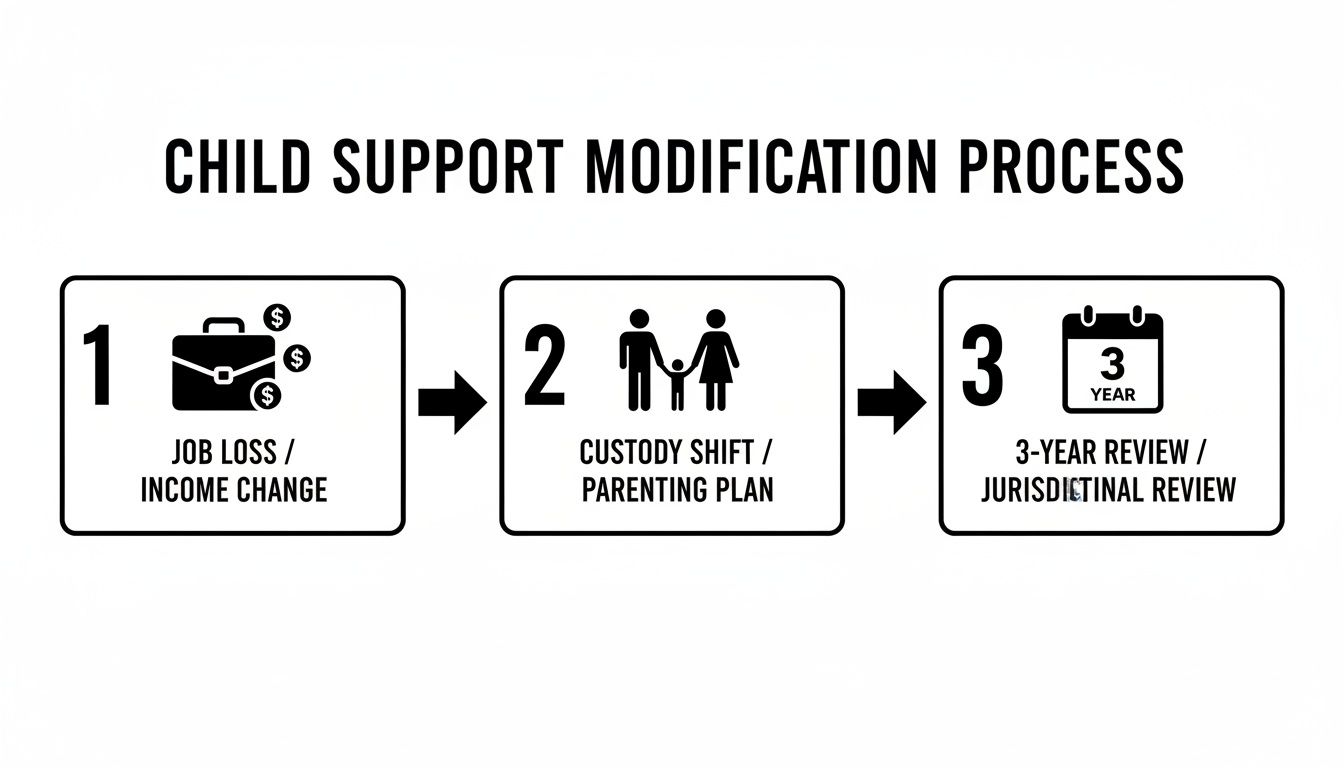
Whether it's a sudden event or just the passage of time, several valid reasons can open the door to a modification.
Step 3: Notify the Other Parent (The Right Way)
Once the petition is filed, you have to give the other parent official notice that you’ve started a lawsuit. This step is called "service of process," and you can't just text them a picture of the paperwork or hand it to them at school pickup. This is a formal legal requirement.
In Texas, service has to be done by a neutral third party, like a constable, sheriff's deputy, or a private process server. They will personally deliver a copy of the lawsuit to the other parent. This ensures the court has proof that they were properly notified.
From the day they are served, the other parent has a set deadline to file a formal response with the court, known as an "Answer." This is their chance to officially state whether they agree with or plan to fight your request.
Step 4: Explore Settlement Through Mediation
Here’s something that surprises a lot of parents: most child support modification cases never go to a final trial. Harris County judges strongly encourage—and often require—parents to try to work things out first through mediation.
Mediation is a confidential, structured negotiation session. You, the other parent, and your lawyers will sit down with a neutral mediator whose only job is to help you find a compromise. It's a lower-stress setting to hash out the numbers and try to reach an agreement that works for your family.
If you succeed, your attorneys draft a new "Agreed Order" reflecting your terms. The judge signs it, and it becomes your new, legally binding child support amount. If you can't find common ground, the next step is a hearing with the judge. Having a guide through this complex system is invaluable, and our team of experienced Harris County family law attorneys can provide the support and advocacy you need, whether you're at the mediation table or in the courtroom.
How New Child Support Payments Are Calculated
If you're thinking about asking to modify child support in Humble, the big question on your mind is probably, "What will the new payment actually be?" Getting a clear picture of how a Harris County court crunches the numbers is the best way to set realistic expectations for your financial future.
It's not some secret formula, but a process laid out directly in the Texas Family Code. A judge will start with a basic percentage, but what truly shapes the final number are the specific details of your income.
Starting with the Texas Guideline Percentages
The whole calculation kicks off with a standard set of percentages. This is the starting line for every single child support case in Texas, whether you're in Humble, Atascocita, or Kingwood.
Here’s the basic guideline breakdown:
- 1 Child: 20% of net monthly resources
- 2 Children: 25% of net monthly resources
- 3 Children: 30% of net monthly resources
- 4 Children: 35% of net monthly resources
- 5+ Children: 40% of net monthly resources
These numbers provide a consistent framework across the state. But that percentage is only half the story. The real question is, "a percentage of what?" The final support amount depends entirely on what the court defines as "net resources."
Defining Net Monthly Resources
This is where things get more granular. Net monthly resources isn't just what you see on your paycheck. The Texas Family Code casts a very wide net, including nearly every dollar that comes in the door.
What's Included in Income:
- Wages, salary, overtime pay, and tips
- Bonuses and commissions
- Income from self-employment
- Rental income
- Retirement benefits and pensions
- Social Security and disability payments
- Dividends, interest, and capital gains
To get from this total gross income to the "net" figure, the court subtracts a few specific things. This typically includes what you pay in federal income taxes, Social Security taxes, any mandatory union dues, and—crucially—the cost of the child's health and dental insurance premiums.
We see firsthand how broader economic shifts affect Humble families. For example, major policy changes over the years have often led to a greater need for modifications. After welfare reforms, the number of families receiving government assistance dropped, but the demand for updated child support orders grew. In 2018, while 57% of 12.9 million custodial parents with support orders got at least some money, the overall receipt of payments had actually fallen 30% since 1996. This really drives home how vital it is to keep your order current with your life's circumstances.
A Humble Scenario: How Income Changes Affect Support
Let's look at a quick example of how this plays out for a local parent.
Imagine a father living in Humble is paying support for one child. His original divorce decree set his child support based on a net monthly income of $4,000. Using the state guideline, his payment was calculated at $800 per month (20% of $4,000).
Three years go by. He earns a promotion at work, and his net monthly resources climb to $5,500. The child's mother files a petition to modify the support order.
The new guideline amount would be $1,100 per month (20% of $5,500). That $300 increase easily clears the $100 or 20% threshold needed for a modification after three years. A Harris County judge would almost certainly approve this change, aligning the father's obligation with his new financial reality.
This is the fundamental math at the heart of the modification process. Understanding these calculations is the first step toward a fair and proper child support order. If you're unsure about what counts as income or how these guidelines apply to your unique situation, our team is ready to help. Contact The Law Office of Bryan Fagan for a free, no-obligation consultation at our Humble office.
Common Missteps to Avoid in Your Modification Case
Trying to modify a child support order is a high-stakes process. Your financial health and your child’s stability are both on the line, so it’s easy to feel the pressure. From our experience helping families across Humble, Atascocita, and Kingwood, we've seen a few common, yet preventable, mistakes that can unfortunately sink an otherwise solid case.
Knowing what these pitfalls are ahead of time is half the battle. By staying proactive and making sure every move you make is legally sound, you can protect your rights and move forward with much more confidence.
The Danger of Informal Agreements
One of the biggest—and most tempting—mistakes is relying on a verbal or "handshake" agreement to change child support. It seems so much easier to just talk it over with your ex and agree on a new payment amount. But here's the hard truth: in Texas, those informal deals are completely unenforceable.
A judge’s signature on a new order is the only thing that legally matters. If you start paying less based on a conversation and the other parent changes their mind, a court will hold you accountable for the full amount in your original order, plus interest. This is how parents end up with thousands of dollars in back pay, or arrears.
We cannot stress this enough: Until a judge signs a new order, your original child support obligation remains in full effect. Always, always get your agreement in writing and file it with the court.
You might be surprised how common these informal arrangements are. Of the 12.9 million custodial parents in 2018, about 12% of those with agreements were relying on non-legal, informal ones. This is a risky gamble, and these stats show why formalizing any change is so important. The Law Office of Bryan Fagan helps parents in Humble do just that.
Waiting Too Long to Take Action
Just as dangerous as a handshake deal is the temptation to do nothing at all. When a major life change hits—like losing your job—it’s completely normal to feel overwhelmed. But putting off filing your modification petition is a mistake that can cost you dearly.
In Texas, a court can only modify child support retroactively back to the date the other parent was officially served with the lawsuit. Every month you wait to file is another month you're on the hook for the old, higher payment amount.
- Real-World Example: Imagine you were laid off in January but didn't file to modify child support in Humble until May. Even with proof of your job loss, the court cannot legally reduce your payments for January, February, March, or April. The reduction can only start from the date of service in May, leaving you with four months of arrears you could have avoided.
Not Gathering Enough Evidence
You can't just walk into a courtroom and tell a judge your life has changed. You have to prove it with clear, documented evidence. Failing to gather the right paperwork is one of the fastest ways to get your modification request denied.
Before you even think about filing, get your ducks in a row. This means collecting hard proof.
- Proof of Income Change: This could be a termination letter, pay stubs showing fewer hours, or a new job offer with a lower salary.
- Proof of New Expenses: Do you have new medical bills for your child? Invoices for therapy or receipts for specialized equipment? Get them together.
- A Complete Financial Picture: Be prepared with recent tax returns, bank statements, and a detailed monthly budget showing where your money is going.
Organizing this paperwork isn't just busywork. It's the foundation of your entire case. It’s what will convince a Harris County judge that your request is justified. Taking the time to build a strong, evidence-backed case from the start dramatically boosts your odds of success.
Answering Your Top Questions About Child Support Modifications
When you're thinking about changing a child support order here in Humble, it's completely normal for your head to be swimming with questions. The legal process can feel like a maze, and you just want straight answers. We've heard these questions time and again from parents just like you in our community, so let's clear up the most common ones.
How Long Does a Child Support Modification Take in Harris County?
This is usually the very first thing parents want to know. The timeline can vary, but you should generally plan for it to take several months. The biggest factor is whether you and the other parent agree on the change.
If you’re both on the same page, you can sign what’s called an Agreed Order. Once that’s filed, a judge can often sign off on it within a few weeks. But if you can't agree, and the case becomes contested, you're looking at a longer road. You'll have to wait for a hearing date on the court's busy schedule, which can easily stretch the process out for several months.
Can I Just Stop Paying Child Support if I’m Not Getting to See My Kids?
We cannot stress this enough: no. In the eyes of Texas law, child support and visitation (legally called "possession and access") are two completely separate issues. We know how incredibly frustrating and painful it is to be denied time with your child. But stopping your support payments is not the answer and will only land you in a world of legal trouble.
If you stop paying, you could face serious consequences:
- Wage Garnishment: The state can force your employer to take the payments directly out of your paycheck.
- Property Liens: A legal claim can be placed on your house, car, or bank accounts.
- License Suspension: Your driver’s license, professional licenses, and even your hunting and fishing licenses can be suspended.
- Jail Time: In serious cases of non-payment, you can be held in contempt of court and face time in jail.
The right way to handle denied visitation is to file a separate enforcement action with the court. Don't take matters into your own hands by withholding child support.
What Happens if My Ex and I Agree on a New Child Support Amount?
Getting the other parent to agree is a fantastic step forward. It can save everyone time, money, and heartache. We see parents from Atascocita to Kingwood work out new terms all the time. But—and this is a big but—a simple handshake deal or a text message agreement is not legally enforceable.
To make it official, your agreement must be put into a formal document called an Agreed Order to Modify the Parent-Child Relationship. Both of you must sign it, and then it must be submitted to the court for a judge to approve and sign. Until a judge signs that new order, your old child support obligation is still in full effect.
Key Insight: Even a signed, notarized agreement between the two of you isn't enough. Only a new court order signed by a judge can legally change your child support payments. This is a critical step to protect yourself from future claims of unpaid support, often called retroactive child support.
Do I Really Need a Lawyer to Modify Child Support in Humble?
You are legally allowed to represent yourself (the court calls this "pro se"). However, trying to handle a child support modification in Humble on your own can be a real headache. The legal standards, the specific forms required by Harris County, and the local court rules are tricky to manage if you haven't done it before.
Hiring a local family law attorney who cares about our community means you have an expert on your side to make sure:
- Your petition is filed correctly with all the necessary details.
- You don't miss any critical legal deadlines.
- Your financial evidence is organized and presented clearly to the judge.
- Your rights are defended, especially if things get contentious with the other parent.
Think of an attorney as your guide and your advocate. They can help you sidestep costly errors and give you the best possible shot at a fair outcome for you and your children.
Trying to change a child support order can be a stressful journey, but you shouldn't have to walk it alone. The dedicated team at The Law Office of Bryan Fagan is here to offer the clear advice and strong representation that Humble, Atascocita, and Kingwood families need. We know the local courts and are focused on protecting your family's future. Schedule a free consultation with our Humble office today to talk about your situation and find out how we can help.