Skip to content

You may be sitting in your house in Humble, long after everyone else has gone to bed, staring at the ceiling and wondering one question that feels bigger than everything else: can my ex take my house in divorce texas?
That fear is common. It hits hard in places like Atascocita, Kingwood, and Northeast Houston because a house usually isn't just an asset on paper. It's the place where your kids sleep, where the bills land, where birthdays happened, and where your whole routine still lives.
The good news is that Texas law doesn't treat this as a simple grab-the-house contest. Your ex can't just point at the home and automatically get it. At the same time, the answer usually isn't a clean yes or no. It depends on how the house is classified, who can afford it, what happened during the marriage, and what the court decides is fair.
What helps most is turning panic into a checklist. Once you understand the rules, the process starts to feel less mysterious and more manageable.
That Middle-of-the-Night Worry What Happens to My House
A lot of people come in with the same story. The argument happened, the word "divorce" finally got said out loud, and now every ordinary thing in the house feels shaky. Who sleeps in the bedroom. Who pays the mortgage next month. Whether one spouse can change the locks. Whether filing first means winning the house.
For many families in Humble and nearby communities, the house is the center of the divorce worry because it touches everything else. Kids' school routines. Commute times. Whether you can stay near family. Whether you're going to have to move before you're ready.
The fear usually sounds like this
Sometimes the question isn't really about long-term ownership at all. It's more immediate.
- Can I be forced out right away
- If my name isn't on the deed, am I out of luck
- If the house was mine before marriage, is it still mine
- If we both paid for it, does that change everything
- Will a Harris County judge make us sell it
Those are smart questions. They tell me you're already focusing on the facts that matter.
The house issue usually has two separate tracks. One is who can stay there during the case. The other is who gets it, or its value, when the divorce is final.
That distinction matters because people often blend those questions together. They hear "property division" and assume it answers whether they have to leave this week. It usually doesn't.
Fear gets worse when the rules sound more complicated than they are
Texas divorce law has a lot of moving parts, but the core ideas are understandable. You don't need to become a lawyer overnight. You need to know what facts matter, what paperwork matters, and what steps help you protect your side of the story.
If you're in Humble, Kingwood, or Atascocita, the practical first move is usually to stop guessing and start gathering. Pull the deed. Find the closing papers. Print recent mortgage statements. Make a list of major repairs and who paid for them.
That won't solve everything in one night. It will give you something better than panic. It will give you a starting point.
Texas Property Law The Two Buckets That Matter
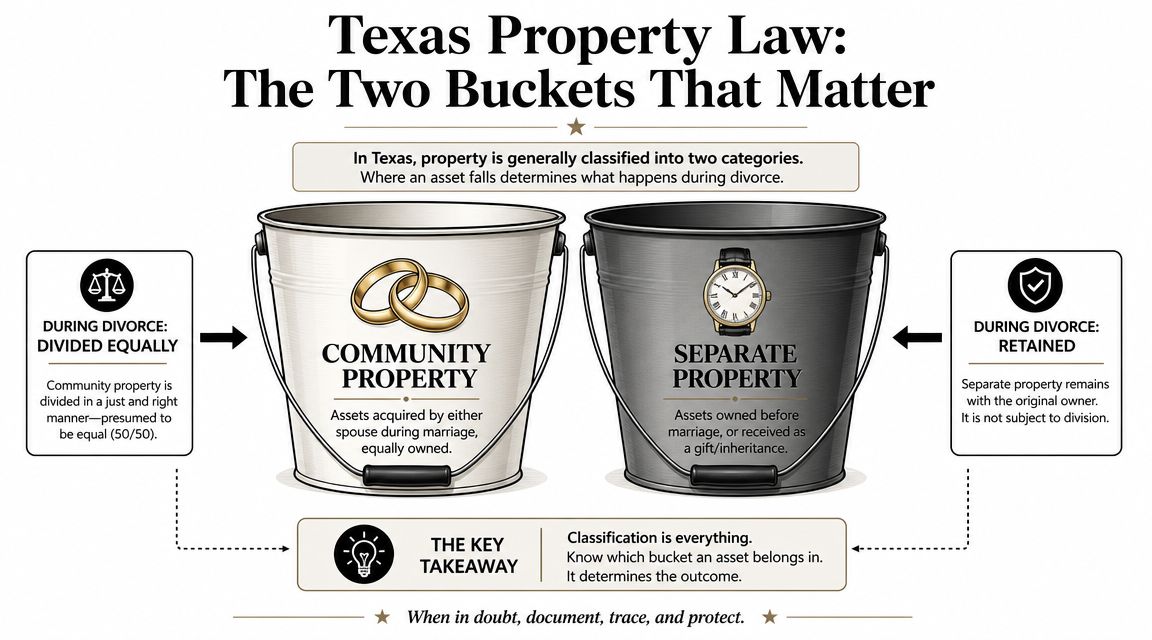
For most house disputes in a Texas divorce, the first job is simple. Put the home in the right bucket.
One bucket is community property. The other is separate property. If you sort that out early, a lot of the confusion starts to settle down.
Bucket one is community property
Community property is generally property acquired during the marriage. In plain English, if the house was bought while you were married, a Harris County court will usually start by treating it as part of the marital estate.
That can include a home when:
- It was purchased during the marriage
- Income earned during the marriage paid the down payment or mortgage
- Only one spouse is on the deed, but marital money was used to buy the house
The deed alone does not settle the question. That surprises many people in Humble. They assume, "My name is on it, so it's mine." Texas courts look deeper than the title page. They also look at when the property was acquired and what funds were used.
Bucket two is separate property
Separate property usually means property that belonged to one spouse alone under Texas law. A house may fit here if:
- You bought it before the marriage
- You inherited it
- It was given to you alone as a gift
Here is the part many people miss. Separate property is not something you win by telling a clear story. You prove it with documents.
A judge is far more persuaded by a deed, closing disclosure, probate record, bank statement, or gift letter than by "we always considered it mine."
Practical rule: If you believe the house is separate property, start gathering the paper trail now.
The buckets can mix, even if the house started in one
This part feels unfair until you see how it works.
A home can begin as separate property and still create a community claim later. For example, if marital earnings were used to reduce the mortgage principal, pay for major improvements, or cover certain carrying costs, the community estate may have a reimbursement argument. The house does not automatically jump from one bucket to the other, but the financial claims tied to it can get more complicated.
Joint accounts often make this harder to trace. If you want a plain-language explanation of why account structure matters, Senki's insights on married finances give a helpful overview.
How This Affects Your House in Humble
If you live in Humble, Kingwood, or Atascocita, the practical question is not who feels more attached to the house. The practical question is what records show about ownership, purchase date, and payment history.
Start with these:
- Deed
- Closing papers
- Mortgage statements
- Home equity loan statements
- Bank records showing who paid what
- Receipts or contracts for major repairs or remodels
- Any inheritance or gift records tied to the property
That file will help your lawyer evaluate which bucket the house belongs in and whether there are reimbursement claims that could affect a Harris County court's view of a fair result. If you want a clearer foundation on the rules, this explanation of community property in Texas is a helpful place to start.
One more point matters here. Even when a house falls into the community-property bucket, that does not guarantee a 50-50 split. Harris County courts use a just and right standard, which means the judge looks at the actual facts, the finances, and what outcome is fair under the circumstances.
How a Harris County Judge Decides Who Gets the House
Once the house is in play, a Harris County judge doesn't flip a coin and doesn't automatically split everything down the middle. The legal standard is just and right, which means the court looks at the actual situation in front of it.

Affordability matters more than people expect
A court can award the house to one spouse, but that doesn't mean it should if keeping it isn't realistic.
As described in this discussion of Texas divorce home division, courts often focus on reimbursement, equity, and affordability. If one spouse wants to keep the residence, the practical issue is whether that person can handle the mortgage, taxes, insurance, and maintenance. If not, a sale and division of proceeds is often the cleaner outcome.
That tends to surprise people. They come in focused on fairness in an emotional sense. Judges also have to think about whether the proposed result can work after the divorce papers are signed.
Equity is usually part of the conversation
When a spouse wants to keep the home, the discussion often turns to equity. In practice, Texas divorce guides commonly describe the process as:
- Appraise the home
- Subtract the mortgage balance
- Calculate the equity
- Compensate the other spouse for their share if one spouse keeps it
That compensation can happen in different ways. Sometimes it's a refinance and buyout. Sometimes other property offsets the value.
If you're trying to understand home-value tools before talking numbers, it can help to discover AVMs for real estate investors. An automated valuation model isn't the same thing as a final legal valuation, but it can help you understand how people begin estimating property value.
Judges look at the lived reality of the family
A Harris County court may consider facts such as:
- Children's stability: If children are involved, staying in the same home near school and familiar routines may matter.
- Income and credit: A spouse who wants the home usually needs a workable path to carry it.
- Other assets and debts: The home doesn't get decided in isolation.
- The history of the property: If community money reduced debt or paid for improvements on an otherwise separate home, reimbursement issues can shape the result.
A house can be emotionally priceless and still be financially unworkable for one person after divorce.
That doesn't mean the court ignores attachment. It means attachment alone usually isn't enough.
Reimbursement can change what feels obvious
Let's say one spouse owned the house before marriage. At first glance, that may sound simple. But if community income later paid the mortgage, taxes, or major renovations, reimbursement claims can arise under Texas divorce practice, and that can influence the overall property division.
So when people ask who gets the house, a better local question is often this: What facts would a Harris County judge see on paper, and what arrangement can be carried out?
That's why strong preparation matters. The court is not just sorting ownership labels. It's sorting a family balance sheet with a roof attached to it.
What Happens Immediately Temporary Orders and Exclusive Use
For many people in Northeast Houston, the urgent question isn't who gets the house at the end. It's who stays there while the divorce is pending.

One spouse usually can't just throw the other out
In Texas, a spouse generally can't kick the other out unilaterally. As explained in this overview of removing a spouse from the home in Texas, the practical issue is often occupancy, safety, and short-term control, not final ownership. A protective order can remove a spouse if family violence is shown, and courts can also issue temporary orders during the divorce to decide who stays in the home.
That means there are different legal tools for different problems.
The short-term tools do different jobs
Here is the plain-language version:
Temporary orders
These can set rules while the divorce is pending. They may address who lives in the house, who pays which bills, and how day-to-day life works until final orders are entered.Exclusive use of the home
This is often requested through temporary orders. One spouse asks the court to grant exclusive use and possession of the residence during the case.Protective orders
These are tied to safety concerns, especially allegations of family violence. A protective order can affect who is allowed to be in the home.Temporary injunctions or restraints
These can restrict certain conduct, such as disturbing the peace or interfering with property, while the case moves forward.
If you need a simple explanation of one related tool, this page on temporary restraining orders in Texas helps clarify part of that picture.
The first month of a divorce often turns on who has legal authority to occupy the house, not who will own it in the final decree.
What you can do right now
If the living situation has become tense, don't rely on hallway negotiations and text-message threats. Start documenting and organizing.
A useful first-action list looks like this:
Save key records
Keep mortgage statements, utility bills, the deed, lease documents if any, and proof of current address.Write down the living situation
Note who is in the home, whether children are there, who has keys, and whether there have been incidents that raise safety concerns.Protect important items
Gather medications, identification, financial records, and essential belongings in one secure place.Avoid self-help lockouts
Changing locks or cutting off access without legal authority can create more conflict.Talk to a lawyer quickly if safety is an issue
If family violence is involved, the right response may be very different from a routine temporary-orders request.
For families in Humble, Atascocita, and Kingwood, local court practice matters because timing matters. Filing the right request early can stabilize the home situation while the larger property issues get sorted out.
Your Three Main Options for the Family Home
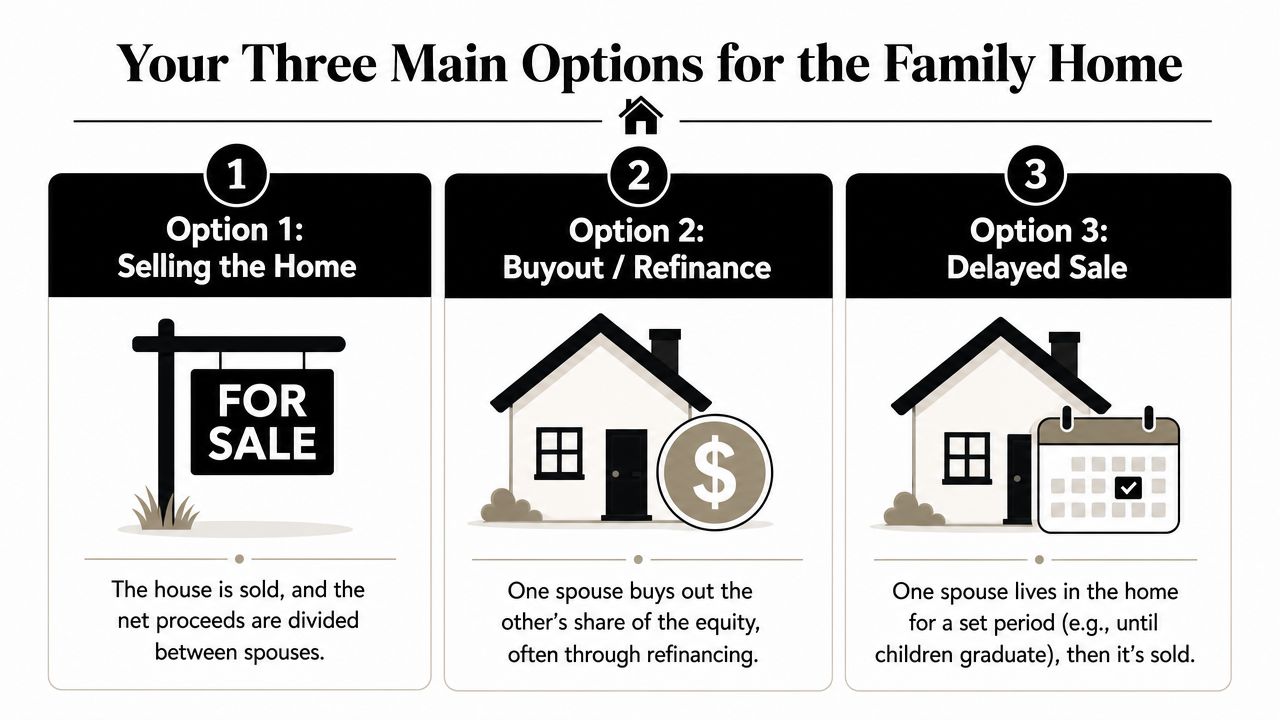
Most divorce cases involving a house move toward one of a handful of practical outcomes. Once you strip away the fear, the decision usually comes down to what arrangement is legally supportable and financially workable.
Option one is a buyout
One spouse keeps the house and compensates the other for that person's share of the equity.
This is often the choice people hope for because it can preserve stability. If children are involved, it may allow them to remain in the same home and school pattern. But it only works if the spouse keeping the house can support the payment obligations and complete whatever refinance or transfer is needed.
Option two is a sale
The house is sold, the mortgage and selling costs are addressed, and the remaining proceeds are divided according to the divorce resolution.
This is often the cleanest path when neither spouse can comfortably keep the home alone, or when both want a clean break. If you're exploring what a straightforward transaction can look like during a split, this overview of a fast, fair divorce home sale gives a practical outside perspective on the sale option.
A short video can also help you think through common divorce-home issues before making a final decision.
Option three is an offset with other property
Sometimes one spouse keeps the house, but instead of a cash buyout right away, the larger property division balances things with other assets or debts.
That can mean one person keeps more of a retirement account, savings, or another asset while the other keeps the residence. In some cases, parties also agree to a delayed sale structure, especially when trying to preserve short-term stability.
If you're weighing whether staying in the home is realistic, this page on how to keep a house in divorce gives a practical Texas-focused look at the considerations involved.
Comparing the options side by side
| Option | How It Works | Pros | Cons | Best For |
|---|---|---|---|---|
| Buyout | One spouse keeps the house and compensates the other for their equity share | Stability, continuity, avoids a forced move | May require refinance, cash flow, and ongoing upkeep | A spouse with the income and credit to carry the home |
| Sale | The house is listed, sold, and net proceeds are divided | Clean break, converts home value into usable funds | Requires moving and coordinating sale logistics | Couples who want closure or can't afford the home alone |
| Offset | One spouse keeps the house while the rest of the property division balances value elsewhere | Flexible, can reduce immediate cash pressure | Other assets may have to be traded away | Couples with enough other property to structure a balanced deal |
A quick example helps
Say a couple in Kingwood owns a home with meaningful equity. One spouse wants to stay because the children are settled. If that spouse can qualify to carry the home and the overall estate allows an offset, keeping the house may make sense.
Now change one fact. The monthly cost is too high for one income and there aren't enough other assets to balance the value. In that version, a sale may be the healthier answer, even if it isn't the emotional first choice.
The best option is usually the one you can still live with six months after the divorce, not just the one that feels comforting on the day you discuss it.
How to Protect Your Home and Prove Your Claim
A house case is often won or lost on paperwork.
In Texas, the question is usually not whose name is on the deed. The question is how the home should be classified and whether you can prove that story with records. A spouse who says the house is separate property has to do more than say, "I bought it." The court will want a clean paper trail that shows when the property was acquired, where the money came from, and what happened to the house during the marriage.
That idea confuses many people in Humble because title, mortgage responsibility, and ownership do not always match. A deed shows title. Mortgage statements show debt. Neither one, by itself, settles the property-division question in a Harris County divorce.
What "proving your claim" usually means
The job is to trace the house from the starting point to today. A judge looks for a story that holds together from one document to the next.
For a home, that often includes:
- The date the property was acquired
- The source of the down payment
- How mortgage payments were made during the marriage
- Whether the loan was refinanced
- Whether community money paid for repairs, upgrades, or principal reduction
A simple way to picture it is a bucket system with a receipt trail. If the house started in the separate-property bucket, you need records that show it stayed there, or at least show which parts stayed separate and which parts may create a reimbursement claim. If money from both buckets got mixed together, the paper trail matters even more.
What to gather right now
Do not wait for your spouse to produce these records later. Get copies while you still have easy access.
Start with:
- Deed and closing documents
- The original sales contract or settlement statement
- Mortgage statements from the beginning of the loan to the present, if available
- Refinance paperwork
- Bank records showing the down payment source
- Gift or inheritance records tied to the purchase or major improvements
- Invoices, contracts, and receipts for renovations
- Property tax statements
- Homeowners insurance records
- Any home equity loan or cash-out refinance documents
If you live in Harris County, also make a note of practical facts that may matter soon, such as who is living in the home, who has access to the online mortgage account, and whether any automatic payments are set to come from a joint account.
A practical way to organize everything
Create one timeline and one folder.
On the timeline, list the purchase date, marriage date, refinance dates, major repairs, insurance claims, and any large payments toward principal. In the folder, save the documents that match each event. That method helps your lawyer spot missing proof quickly and helps you explain the house clearly if temporary orders or settlement talks happen early.
If you are worried about immediate control of records, download account statements now, change passwords on your personal email and cloud storage, and save copies somewhere your spouse cannot edit or delete. Keep the process lawful. Do not guess passwords or access accounts that are not yours.
Common trouble spots
Refinancing often creates confusion. So do inherited funds that were deposited into a joint account before being used on the house. Another common problem is a spouse who knows the home was bought before marriage but has no bank records left to show where the money came from.
That does not always end the claim. It does mean your lawyer may need to rebuild the timeline from closing papers, archived bank requests, tax returns, and other financial records.
If you want local help reviewing those documents and sorting out a house claim in a Texas divorce, one option is the Law Office of Bryan Fagan in Humble, which handles family-law matters including divorce and property issues.
Take Control of Your Future A Humble Attorney Can Help
At this point, the question usually shifts. It starts as, "Can my ex take my house?" Then it becomes, "What do I do tomorrow morning?"
That is the right question.
A divorce case involving a home rarely turns on one dramatic moment. It is usually decided by a series of smaller choices made early and made carefully. In Harris County, that may mean asking for temporary orders before the situation at home gets worse, pulling mortgage and bank records before anything disappears, and getting clear about whether keeping the house is financially realistic after the divorce is final.
A Humble family-law attorney can help you turn that stress into a plan. The work often starts with practical tasks:
- identifying which house documents still need to be collected
- spotting weak points in a separate-property or reimbursement claim
- deciding whether to request temporary exclusive use of the home
- comparing a buyout, co-ownership for a short period, or a sale
- preparing your case around what a judge will view as just and right, not just what feels fair in the moment
That last point matters. Harris County courts do not use a one-size-fits-all formula for dividing a marital estate. A judge looks at the full picture, much like laying out all the pieces on a kitchen table before deciding what goes where. The house is one piece. Debt, income, children, reimbursement issues, and each spouse's future stability matter too. Good legal advice helps you see your house issue in that larger frame before you make a costly decision.
Sometimes the best next step is to fight to keep the home. Sometimes it is to negotiate time to refinance. Sometimes the smartest move is to sell, protect your share, and avoid falling behind on payments while the case is pending. Clear advice helps you choose based on facts, not panic.
If you want help sorting through those facts, the Law Office of Bryan Fagan in Humble handles divorce and property-division matters and can review your situation with you.