You're back home in Humble with a citation on the kitchen table, or you've just received a call that someone you love was arrested. You're trying to arrange work, transportation, and childcare while figuring out which court to call. The paperwork may tell you where to appear without explaining what will happen when you get there.
The Harris County Criminal Courts at Law misdemeanor process becomes easier to manage when you separate immediate release questions from preparation for the first court setting. During the first seventy-two hours, focus on locating the person, understanding any release conditions, preserving paperwork, and getting legal guidance. You don't have to solve the entire case tonight, but you do need to know the next required step.
Misdemeanor Stages in Harris County at a Glance
A citation from an encounter in Humble may look like a bill to pay. First, check the alleged charge and the court named on the paperwork. Paying or overlooking it without understanding the instructions can leave you unsure about the next required appearance.
Harris County's criminal-court information identifies the County Criminal Courts at Law as courts handling Class A and Class B misdemeanors, along with appeals from justice and municipal courts. A case filed directly in county court may follow a different route from a municipal citation that reaches county court through an appeal.
The Route From Arrest to Resolution
A case does not always pass through every stage. For example, a citation may lead to a court setting without jail booking, while a dismissed case does not proceed to sentencing.
Harris County misdemeanor stages and locations
| Stage | What Happens | Where It Happens |
|---|---|---|
| Arrest or citation | An officer arrests and books the person, or issues a citation | Scene, police station, or booking facility |
| Probable-cause review | A magistrate reviews the legal basis for the arrest | Joint Processing Center, by teleconference |
| Bond decision | A judge addresses bond and release conditions | Joint Processing Center or the court handling bond |
| Cite-and-release docket | An eligible person completes required processing after receiving a citation | Designated cite-and-release location |
| Arraignment setting | The court addresses the charge, plea, representation, and case status | Assigned County Criminal Court at Law |
| Discovery and pretrial motions | Counsel obtains evidence and raises legal challenges | Assigned court, with evidence reviewed outside court |
| Plea negotiation or trial | The parties negotiate, pursue an available program, or present the case for a decision | Assigned County Criminal Court at Law |
| Sentencing | After a conviction, the court imposes an authorized punishment | Assigned County Criminal Court at Law |
| Appeal or expunction | A person challenges an outcome or seeks eligible record relief | Reviewing court or court authorized to grant record relief |
Probable cause is a legally sufficient basis to believe an offense occurred and the person committed it. It is a threshold for continuing the case, not a finding of guilt. A bond decision addresses release while the case is pending.
Start with identification: Write down the charging court, court number, cause number, and next required appearance. These details help you distinguish the court handling the case from the place where an arrest or booking occurred.
For families in Atascocita, Kingwood, and Northeast Houston, the arrest location may not identify the courtroom. Use the actual notice or court record to confirm where the case is assigned.
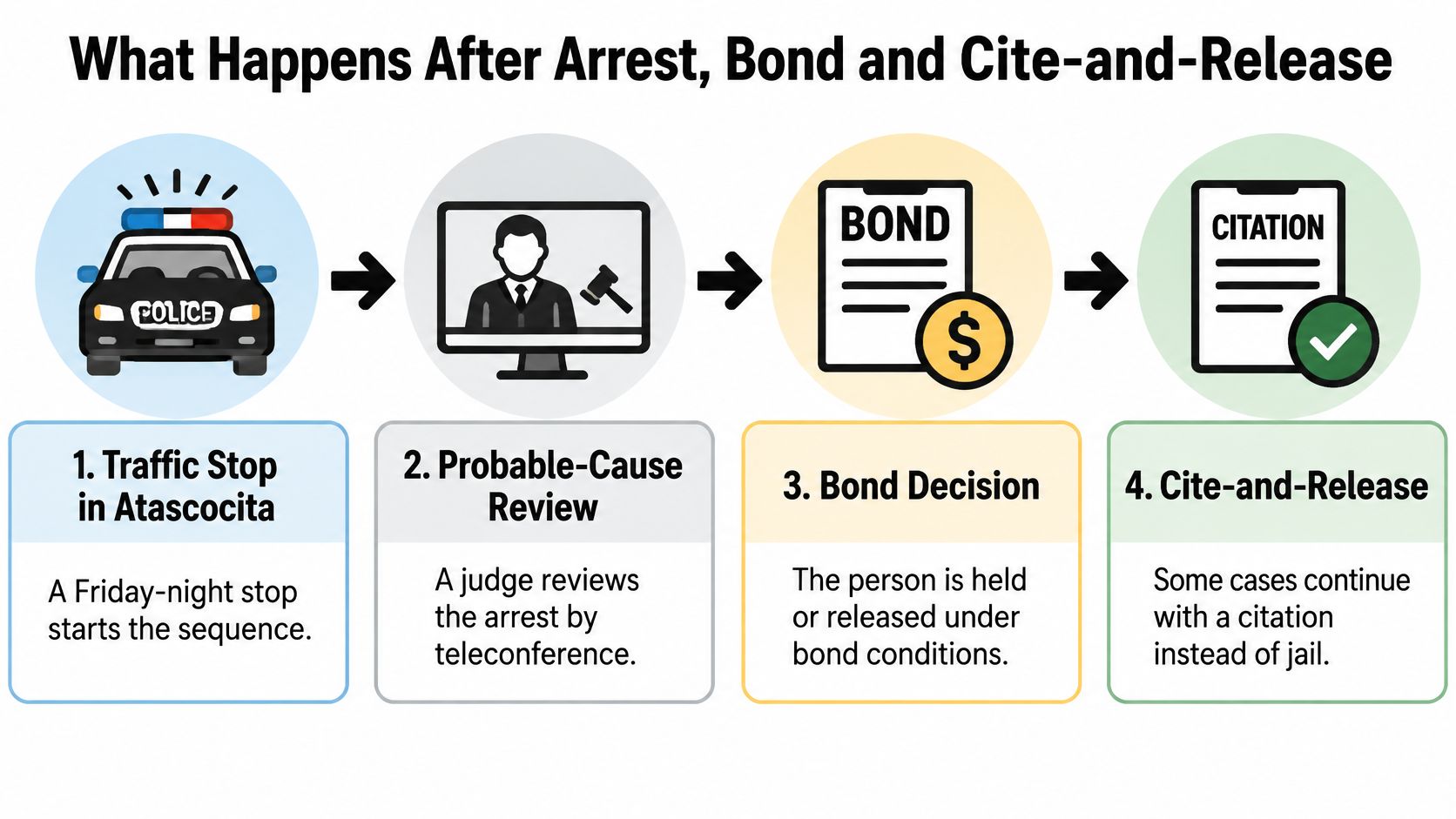
What Happens After Arrest, Bond and Cite-and-Release
You're stopped in Atascocita on a Friday night, and the officer arrests you. Your family's immediate question is whether you can come home. The answer requires separating booking, judicial review, the release decision, and the processing needed to carry out that decision.
This visual distinguishes the main early events. Cite-and-release is an alternative route for eligible cases, not a step every arrested person completes after bond.
What Your Family Should Expect
- Arrest or citation. Keep the paperwork identifying the agency, alleged offense, and instructions. A citation still requires attention even when the officer doesn't take you to jail.
- Probable-cause review. A magistrate, meaning a judge authorized to handle early criminal proceedings, reviews the basis for the arrest. Your family shouldn't assume that ordinary courthouse business hours control this process.
- Bond or release decision. The court considers the applicable release arrangement and conditions. A personal bond generally relies on a promise to appear rather than an upfront cash payment, but it still creates enforceable obligations.
- Conditions and paperwork. Obtain the written orders and read them before returning to normal routines. Ask counsel to clarify anything you don't understand.
- Court scheduling. Confirm the next appearance through the court's instructions. Don't treat release paperwork as proof that no further appearance is required.
The Harris County District Clerk's criminal-court page states that probable-cause hearings operate by teleconference twenty-four hours a day, seven days a week, with public viewing on the second floor of the Joint Processing Center at 700 North San Jacinto. The same page lists the cite-and-release docket for Wednesdays at 1:00 p.m. at 49 San Jacinto, First Floor, Houston.
Read the Conditions Before Making Plans
A no-contact condition can affect calls, texts, social media messages, and communication through relatives. Travel restrictions may affect your job, while other orders can address firearms or access to particular locations. The wording of your order matters, and another person's permission doesn't replace a court-approved change.
Release is not dismissal. You can be home with your family and still have an active prosecution, appearance requirements, and restrictions to follow.
Our explanation of what happens at a bond hearing can help you prepare questions about release. Keep booking documents together, arrange transportation, and confirm whether you must appear personally or remotely. Don't assume that a public viewing option is your authorized method of appearance, because misunderstanding a remote proceeding can create additional legal problems.
Arraignment, Discovery and Pretrial Motions Explained
The arraignment setting is an early checkpoint, not an invitation to explain the entire incident to the judge. Counsel should use it to confirm what the State has charged, whether representation is in place, and what must happen before the next setting.
Under the Harris County Criminal Courts at Law rules, filed cases receive random assignments, and Monday-through-Thursday filings generally receive an arraignment setting on the same day the following week, while Friday-through-Sunday filings generally receive a setting the following Friday. The rules also require an executed capias, a court-issued arrest process, before arraignment scheduling in non-arrest cases, and they state that arraignment scheduling doesn't change statutory indigency or appointed-counsel deadlines.
The checklist below separates the court setting from the preparation happening around it.
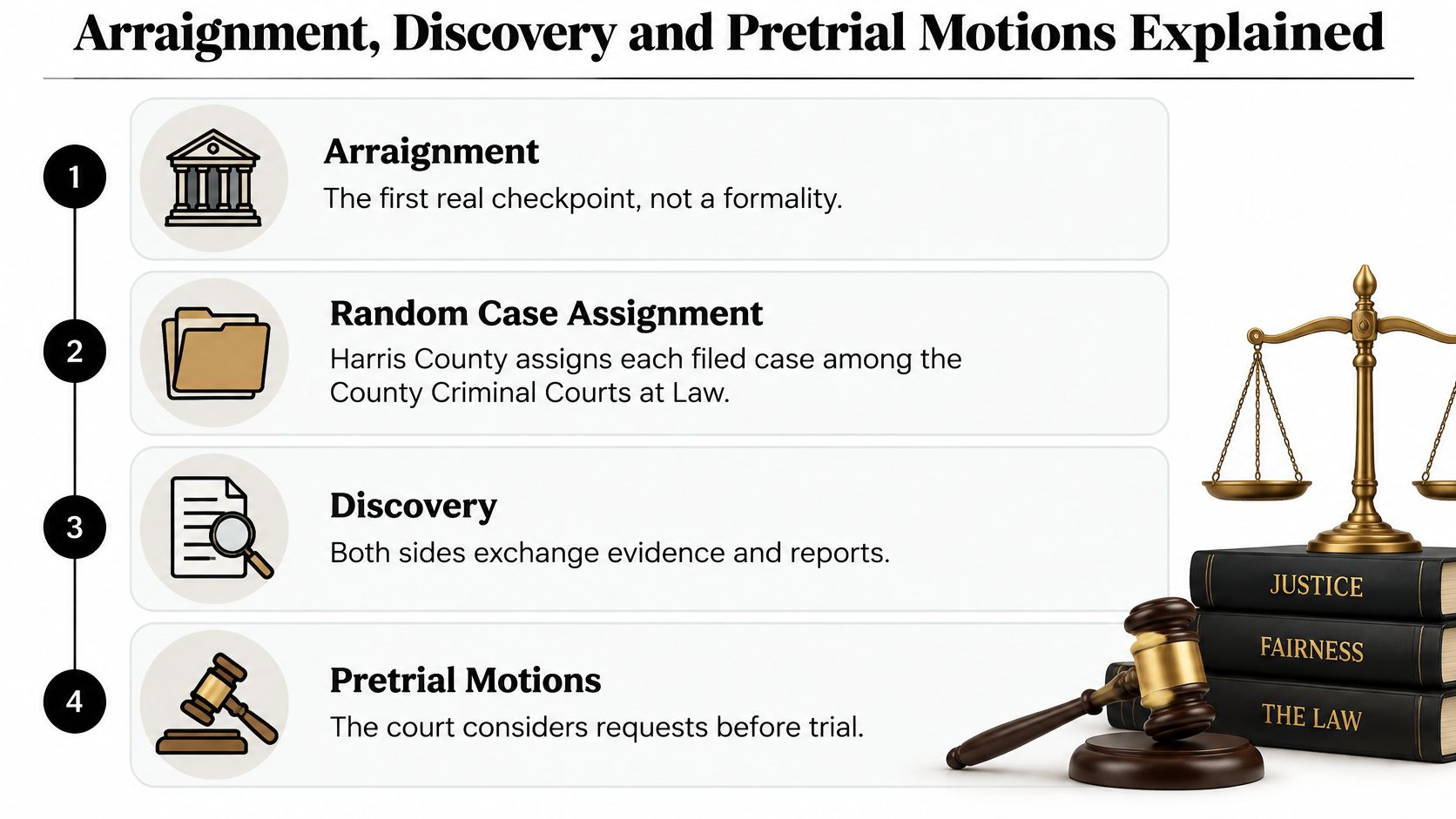
Prepare for the First Setting
- Verify the charging document and offense class. The written accusation, not an informal description, identifies what your lawyer must evaluate.
- Confirm bond and release conditions. Bring every order so counsel can identify restrictions or request clarification.
- Keep the notice of settings. Preserve the actual notice rather than relying on a calendar entry without courtroom details.
- Ask about discovery status. Your attorney needs to know what evidence has arrived and what remains missing.
- Address counsel and indigency paperwork. If you can't afford representation, request appointed counsel promptly and complete the financial information requested.
- Identify possible motions. Tell counsel about the stop, search, questioning, and available witnesses so potential challenges can be investigated.
Our guide to what happens at an arraignment hearing explains the purpose of that appearance. Don't wait until you're standing in court to raise a problem obtaining counsel.
Understand Evidence Review and Motions
Discovery is the legal process for obtaining relevant evidence, which may include police reports, recordings, photographs, and laboratory results. Your lawyer checks what the prosecution provides, requests missing material, and compares it with your account. Give counsel original messages and recordings without editing them.
A pretrial motion asks the judge to decide an issue before trial. A motion to suppress, for example, asks the court to exclude evidence because of a claimed legal violation involving a stop, search, or statement. Filing the motion doesn't mean the judge has granted it.
For a plain-language explanation of motion hearings, the courtroom preparation insights from CasePulse offer useful background. Preparation involves more than writing arguments: counsel must organize exhibits, prepare testimony, and anticipate the opposing position.
This video provides another way to approach preparation for a court appearance.
Our criminal defense team analyzes each case's details and develops a defense strategy. That work connects the accusation, available evidence, possible legal challenges, and your priorities.
Penalties by Class and the Court That Hears It
| Class | Maximum Jail | Maximum Fine | Usual Court |
|---|---|---|---|
| Class A misdemeanor | Up to one year | Up to $4,000 | County Criminal Court at Law |
| Class B misdemeanor | Up to 180 days | Up to $2,000 | County Criminal Court at Law |
| Class C misdemeanor | None, fine only | Up to $500 | Justice or municipal court, unless appealed |
These maximum punishment ranges appear in the Texas plea-admonishment materials available through the Harris County District Clerk. For jail-eligible misdemeanors, the authorized punishment can include jail, a fine, or both.
Check the Charge, Not Its Nickname
Calling an allegation a minor misdemeanor doesn't identify the actual exposure. Read the offense and classification printed on the complaint or citation, then have counsel check whether the allegations support that classification. Our explanation of a Class A misdemeanor in Texas provides additional context for that category.
Maximum punishment isn't the same as a prediction. Counsel should evaluate the evidence, history, available alternatives, court costs, and consequences for employment or professional licensing before assessing an offer.
Confirm Which Court Has the Case
The county's criminal-court jurisdiction information distinguishes original misdemeanor cases from lower-court appeals. Appeals from justice and municipal courts generally involve a trial de novo, meaning a new trial, while appeals from municipal courts of record generally involve review of the written record.
A related felony belongs in district court, but its existence doesn't automatically move every separate misdemeanor there. Ask counsel to identify each cause number and the court responsible for it.
The Harris County District Clerk's criminal-record information warns that its search doesn't include justice-court or other municipalities' Class C misdemeanor records. A missing search result therefore isn't proof that a citation disappeared.
- Record the forum. Identify the charging court and court number.
- Separate the files. Keep distinct cause numbers and notices together.
- Identify the route. Confirm whether the case is an original prosecution or an appeal.
If allegations also prompt a child-protection investigation, that is a separate concern. A CPS Defense Attorney in Humble provides defense against CPS investigations for Humble families.
Finally, a prosecutor's punishment recommendation isn't binding on the judge under the plea-admonishment materials. Understand the proposed agreement and the court's role before entering a plea.
Choosing Between a Plea, Diversion and Trial
A proposed outcome can sound straightforward until you ask what it means for your record and what happens if you miss a condition. The main paths differ in how the case ends, what the court requires, and what risks remain.
| Path | When It Often Fits | Main Trade-off |
|---|---|---|
| Dismissal or diversion program | The evidence supports dismissal, or an eligible person receives an approved program offer | A dismissal ends the case; diversion requires completing its conditions before dismissal |
| Deferred disposition or probation | An authorized supervision option matches the charge and goals | The legal effect depends on the specific option, and violating conditions can lead to further punishment or a conviction |
| Negotiated plea with agreed sentence | Counsel has reviewed the evidence and the offer serves the client's priorities | A conviction-based plea creates a record, and the court must address the proposed recommendation |
| Trial before judge or jury | The person contests guilt or the State's proof | Trial requires more preparation and time, and authorized punishment remains possible after conviction |
Criminal defense cases can be resolved through negotiation or trial. The choice should reflect the evidence, available legal arguments, prior record, and consequences that matter to you and your family. A plea offer can reduce uncertainty, while trial asks the State to prove the allegation.
Understand What Each Outcome Means
Dismissal ends the case. Diversion usually requires eligibility and agreement to program conditions before dismissal. A first-time charge does not guarantee a diversion offer.
Probation generally involves a conviction, while deferred adjudication can postpone a finding of guilt under authorized conditions. Fine-only deferred disposition is another process. Ask counsel to identify the exact outcome and explain what the final court paperwork will say, including what happens if you cannot complete a condition.
Questions to Answer Before Deciding
- What is the exact charge and class? Confirm that the offer addresses the filed allegation and any related cases.
- What is the statutory maximum, and what outcome is realistic for my circumstances? Ask counsel to explain the legal ceiling and how the evidence and your circumstances may affect the result.
- What evidence or motions could change the case? A recording, missing laboratory result, or unresolved legal challenge may affect the strength of the case and the value of an offer.
- What could a conviction cost beyond the sentence? Discuss fines, fees, work opportunities, licenses, and other consequences relevant to you.
Some dismissed cases may qualify for expunction, which removes eligible records, or nondisclosure, which restricts public access to eligible records. Neither happens automatically. Ask counsel how the specific dismissal, case history, and timing affect eligibility before assuming a record can be cleared.
How Long Each Stage Takes and Why Cases Stall
The first 72 hours after an arrest can feel like a blur. During that time, families may be trying to understand release instructions, locate paperwork, and work out when the first court setting is. Missing or overlooking one notice can create avoidable confusion later.
There is no single schedule for every misdemeanor case. The time between settings depends on the court's calendar, whether the person is in custody, how quickly evidence becomes available, and what preparation the case needs. A reset means the court has moved a setting; by itself, it does not show that the case has been abandoned or that dismissal is near.
| Part of the process | Typical timing | What can affect it |
|---|---|---|
| Initial court review and release arrangements | Early in the case | Custody status and processing |
| First court setting | After the case is filed, according to the notice | Filing and court scheduling |
| Evidence review and pretrial preparation | Several weeks to several months | Missing records, recordings, laboratory work, motions, or witness availability |
| Negotiation or trial setting | After enough preparation for the next decision | Evidence review and the court's calendar |
The timeline visual shows the general sequence. Use your written notices to confirm your own appearance date.
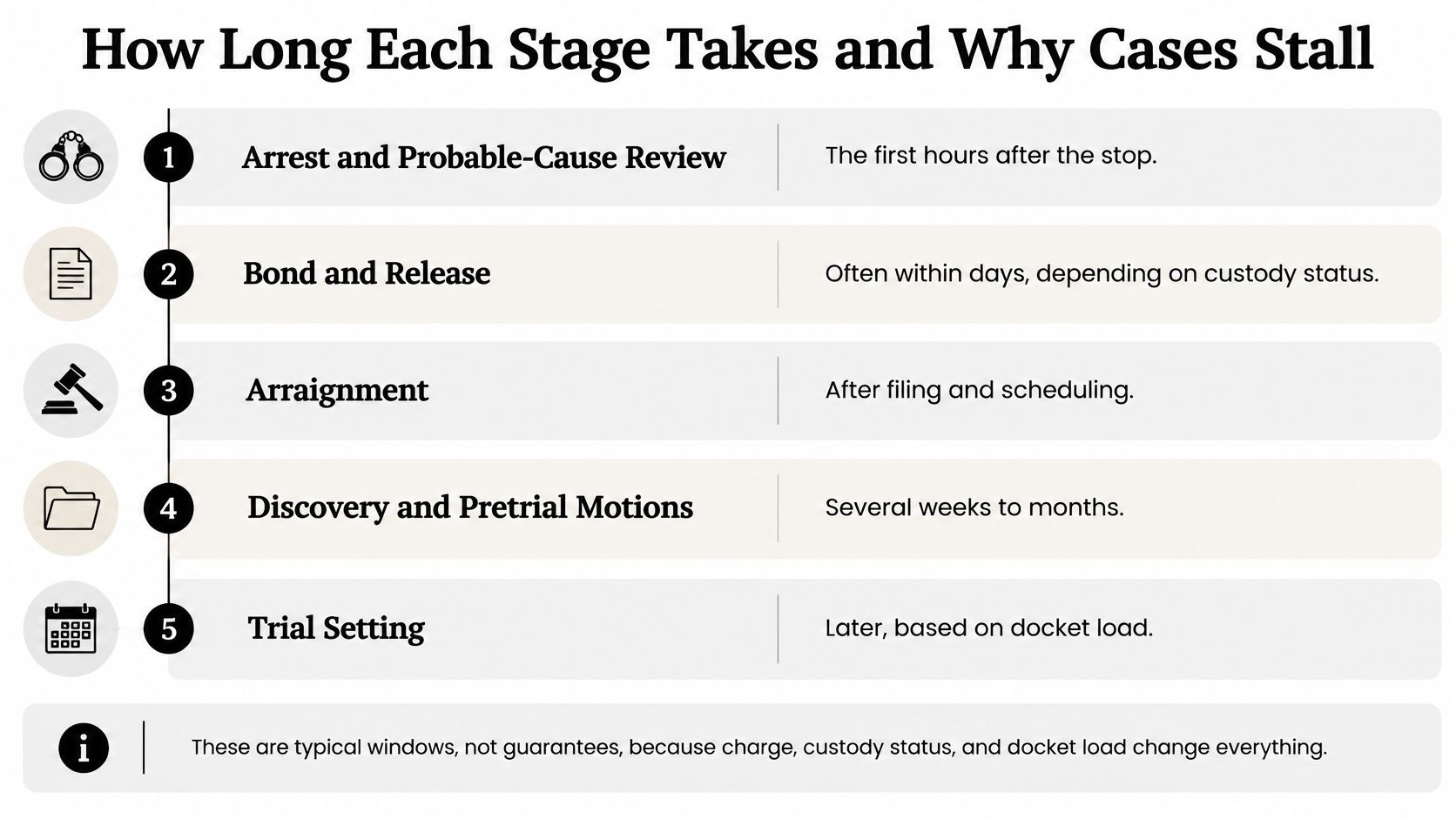
Why a Case May Stall
A delay often means someone is still waiting for information or a court opening. For example, a recording may not have been produced, laboratory work may be pending, or a motion may need a ruling. A crowded docket can also push a setting back.
The first week is a good time to prevent avoidable setbacks:
- Gather the paperwork you already have. Keep release instructions, court notices, and any documents related to the charge together.
- Confirm the next setting in writing. If a notice and an online listing appear to conflict, ask which date applies rather than guessing.
- Respond promptly to counsel. Send requested documents and answer scheduling questions as soon as practical.
- Keep contact details current. Tell your lawyer about changes and follow the court's procedure for updating your address or telephone number.
- Ask what is still outstanding. Find out what evidence or decision is pending, who must provide it, and what step can happen next.
Preparation can take time for a reason. Reviewing a recording, interviewing a witness, or resolving an evidence issue may matter more than reaching the next court date quickly.
Book a Free Consultation Before Your First Court Date
You don't need a complete file or a polished explanation before seeking help. You need the paperwork you have, a clear account of your immediate concerns, and a willingness to identify what still needs confirmation. Scheduling a consultation before the first setting gives you an opportunity to address those issues before appearing.
At the Law Office of Bryan Fagan, our criminal defense team reviews the charge, bond conditions, available evidence, and case details to develop a defense strategy. We explain the practical choices without promising a dismissal or a particular sentence.
What the Consultation Covers
During the free consultation, you receive a confidential review of your case details, honest feedback about legal options and potential outcomes, and clear direction on what to do next. We provide guidance on Texas criminal law relevant to your situation and can address related family-law or estate-planning concerns when they affect your questions.
For example, a parent may need to understand how a release restriction affects family arrangements, while a professional may be most concerned about a license. Tell us what you're worried about rather than assuming it falls outside the conversation.
Our office is at 414 E Main St, Humble, TX 77338. We serve Humble, Atascocita, Kingwood, Northeast Houston, and Harris County, helping local individuals and families understand their next practical step.
Bring the Paperwork You Have
- Citation or booking paperwork. Include documents identifying the arresting agency and alleged offense.
- Charging document and cause number. Bring the complaint or other accusation if you've received it.
- Bond and release conditions. Include separate orders and every page of the instructions.
- Court-date notices. Keep written notices, electronic messages, and any updated settings.
- Written questions. List concerns about penalties, work, family contact, transportation, and representation.
A short call early in the process can help protect your case from the start. Call (281) 817-1827 to schedule your free consultation, and bring the documents available rather than delaying while you search for a perfect file.
The Law Office of Bryan Fagan offers a confidential review of your misdemeanor case, practical guidance about Harris County court procedures, and help identifying your next steps. Visit Law Office of Bryan Fagan to learn more and schedule a free consultation with our Humble office before your first court date.