Say your neighbor in Humble got a divorce cause number years ago and now needs the final decree for a refinance. Or your son's case in Atascocita ended with an order you never picked up. The natural move is to fire off one email asking the county for the whole file. That's the most common way a Harris County open records request for a court file stalls before it starts.
A court file is not a single countywide inbox. It sits with the clerk who keeps that case type, and the request has to go to that custodian. Once you know which office holds the file, the rest is a checklist: find the cause number, search the free index, order only the pages you need, and expect some pages to be lawfully missing. This guide walks through each piece the way an attorney at the clerk's counter would explain it.
Which Harris County Office Keeps Your Court File
A parent in Kingwood holds a custody cause number and assumes the County Clerk can pull the whole family file. A neighbor in Humble facing a misdemeanor writes to a general “records” address. Both hit the same counter problem: the request went to the wrong custodian.
Harris County court files follow the clerk who keeps that case type. The Harris County records management directory identifies separate custodians for county civil records, district-court civil, criminal, and family records, and Justice of the Peace civil and criminal records across all 16 justice courts. A court-file request works more like asking the right courthouse desk for a specific drawer than sending one countywide email and hoping someone searches every shelf.
The routing table below answers the first question every requester should ask: which office has my file?
| Office | Typical files | Start here | Must include |
|---|---|---|---|
| Harris County District Clerk | Many district and county civil, family, felony, and county criminal court files | Free case search after login by cause number or party name | Cause number, court, parties, document type, date range, copy format |
| Harris County County Clerk | County civil and probate files | Clerk index using file number or film code | File number or film code, or expect a $5 search fee |
| Justice of the Peace courts | Civil and criminal files from the 16 justice courts across eight precincts | The JP court that heard the case, not a countywide desk | Precinct, case number, party names, document type |
| Wrong or unknown court | Any file you cannot match to a clerk | Customer service or the online case index before you write | Do not mail a blanket request for every record about a person |
That split matters because a public-information request has to describe existing information in enough detail for the office to identify and locate it. Texas public-information guidance requires the request to be in writing. Useful identifiers for a court file are the case number, court or precinct, party names, document type, and relevant date range.
Why a free search comes before any copy order
Residents in Humble, Atascocita, Kingwood, and Northeast Houston should search the District Clerk index before submitting anything. Public case information is free to view after a login, and the clerk will not accept a public-information request for material already available on its website. A docket lookup is not the same as an order for images, so mixing up those two steps can lead to an unnecessary fee or a rejected request.
The county's online-services directory points to a “Case Information and Court Record Search” service for Harris County District Courts and County Criminal Courts at Law. Treat that search like the aisle marker in a store: it tells you whether you are in the right building and which case identifier belongs on your request. If you only need to know what happened in a case, the free index may be enough. If you need a signed order for a bank or an employer, that is a copy order.
Civil files are generally public unless they are sealed, loaded with sensitive data, or confidential. When a file is confidential by law, access is limited to the attorney and the parties to that specific case. A public-information request cannot override that limit.
Practical rule: Search the free index first, write down the cause number and court, then send a written request to the one clerk who keeps that file. Never email the county as a whole.
If the order you need has a hard deadline and you are assembling certified copies for an active case, fast legal print delivery for deadlines can help turn selected pages into a delivery set while the clerk's estimate is still pending.
Copy Fees Deposits and Response Times
A copy order works like buying printed pages at a counter. The price depends on what you ask for, how you want it, and whether the clerk must search for it. A narrow request usually creates a smaller bill. A broad one can trigger written cost estimates and deposits before the clerk starts producing the file. The Harris County District Clerk's copy purchase page gives the schedule that controls both district and county clerk orders.
| Item | Amount or clock | What triggers it |
|---|---|---|
| Electronic copies | $1 for 1–10 pages, then $0.10 per page | District Clerk and County Clerk image orders |
| Paper copies | $1 per page | County Clerk paper copies |
| Certification and seal | $5 per document | Each document you ask to have certified |
| Search without a file identifier | $5 | No cause number, file number, or film code |
| Historical search | Additional $5 | Older records beyond a routine lookup |
| Written cost estimate | Required when charges exceed $40 | Sent before the office produces the copies |
| Reply to that estimate | 10 days | No reply can be treated as a withdrawal |
| Deposit, prepayment, or bond | When estimated cost exceeds $100 | Office may require payment before production |
| Diligent search window | At least 10 business days | County records guidance; not a guaranteed delivery date |
| Notice if not ready in 10 working days | Written date and time when records will be available | Inspection or production cannot happen inside that window |
The District Clerk warns that estimated charges may exceed $100. That matters most when someone requests an entire multi-year file without separating the pleadings, orders, and exhibits. A deposit can arrive before any page is produced. Asking for a specific case number and selected documents gives the clerk a much smaller target and gives you a clearer bill.
How the estimate rules change your order
Think of the $40 estimate as a warning light on the dashboard. It does not end the request, but it means the clerk must put the expected cost in writing before producing copies. You then have 10 days to answer. Silence can be treated as a withdrawal, so an unanswered estimate can stop the request even when you still need the record.
The $100 threshold has a different practical effect. At that level, the office may require a deposit, prepayment, or bond before it moves forward. A careful list saves money at that point. A signed order, a petition, and a few named exhibits are easier to price than “everything in the file.” If the other side claims cash payments, groceries, or school costs replaced support, the records you request should show what was agreed and what was not. A private attorney can help prepare the evidence and frame the request around the facts that matter most in the parent's home.
Timing works the same way. Harris County records guidance describes “promptly” as acting as soon as circumstances allow without unreasonable delay. One county records division asks requesters to allow at least 10 business days for a diligent search and response. If production cannot happen within 10 working days, the public information officer should send written notice with a reasonable date and time. No countywide turnaround promise exists, so confirm the date with the custodian who keeps the file and keep every written estimate.
Cost control: Review the written estimate before you authorize anything. Approve only the documents named in your request, and confirm whether certification is needed for each document. A whole-file request can become expensive quickly, even when you only need one order for a bank, employer, or hearing.
Court reporter records follow a different path from clerk copy orders, and their costs can depend on the transcript or recording requested. For a closer look at that separate process, see our guide on a Harris County court reporter record request and cost.
How to Request the Court File Step by Step
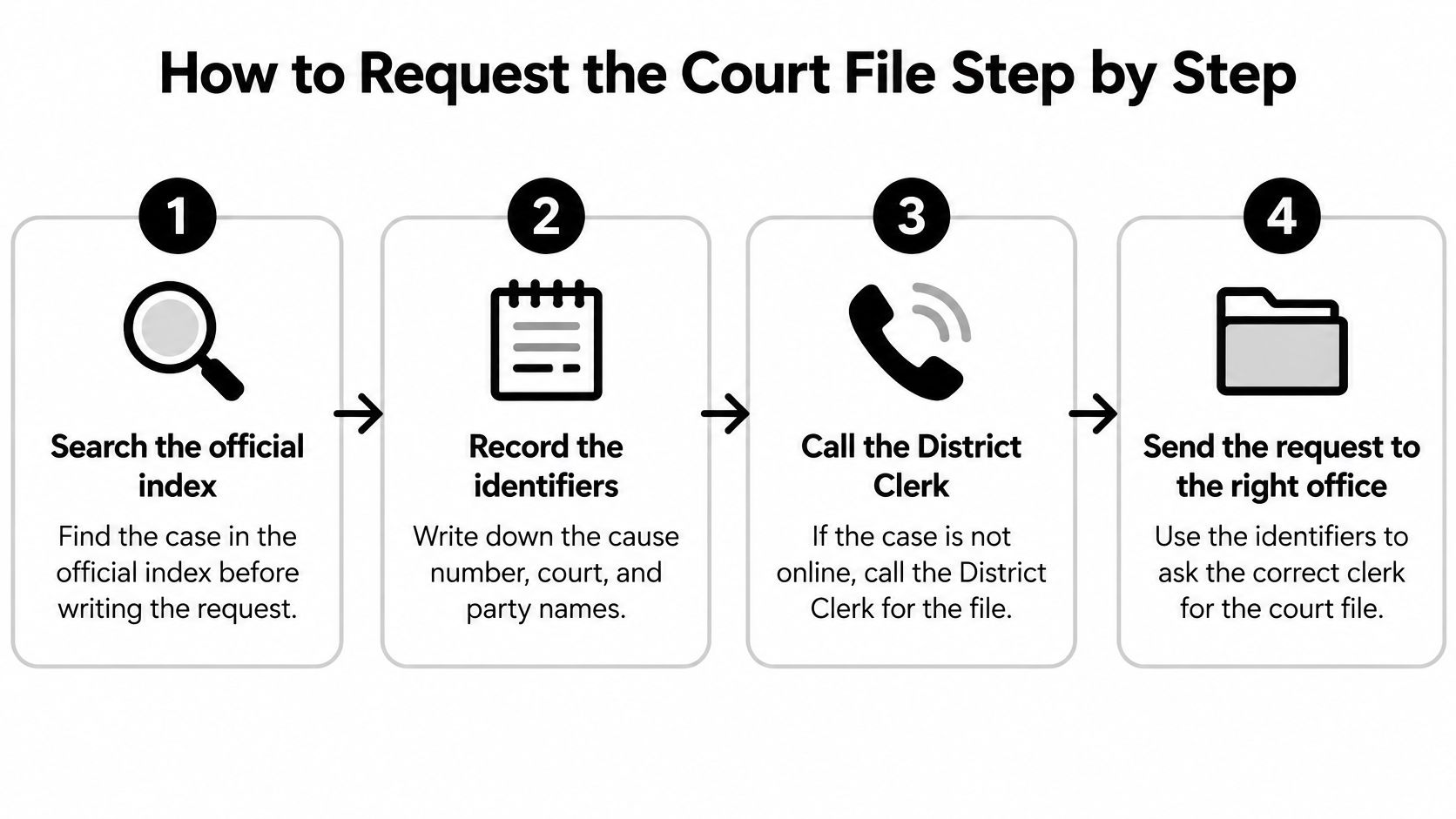
A court file request works best when you treat it like asking a clerk for a specific folder, not the whole courthouse cabinet. The District Clerk's open records request page explains that records should generally be searched through the clerk's online services before submitting a Texas Public Information Act request. Public court records do not require a PIA request for review, and a PIA request cannot be used for information already on the website.
The six-step sequence
1. Search the official index. Find the case by cause number or party name and write down the court, parties, and date range. If the case is not online, call District Clerk customer service instead of guessing. Residents of Humble, Atascocita, Kingwood, and Northeast Houston can use the clerk's case-search system, and customer service helps locate records not available online.
2. Decide what you need. Choose a docket printout, document images, certified copies, or a historical file, and list only those items. A petition and latest order are not the same as every exhibit in the file. A narrow request works like giving the clerk a labeled folder instead of asking them to empty the file room.
3. Write the request in plain, complete terms. Identify yourself and describe the records as specifically as possible, then add the cause number, court or precinct, party names, document types such as petition, order, or exhibit, the date range, and whether you want electronic or paper copies. Clear wording reduces back-and-forth about what you meant.
4. Ask about gaps in one sentence. Request that the clerk identify any page withheld or unavailable rather than sending an undefined “entire file.” This keeps a lawful redaction from looking like a processing error and helps you understand whether you received a complete public packet.
5. Send it the right way. For a District Clerk file, mail it to the public-information address or submit it electronically. Telephone requests do not qualify as public-information requests.
6. Keep proof. Save the delivery receipt and any cost estimate. If the order moves to production, monitor the estimate rules from the prior section.
Here's a short sample a self-represented reader can adapt:
Sample request: I am requesting non-certified electronic copies of the petition and the latest signed final order in cause number [cause number], [court], parties [Party A] and [Party B], with a date range of [start date] to [end date]. Please provide a written cost estimate before any charge.
Criminal lookups may require additional identifying information, including a date of birth. If a family case search looks unfamiliar, use a Harris County District Clerk family case lookup guide to understand what the index fields mean before ordering copies. For child support enforcement, the signed court order is the first item to gather because it shows the support amount, due date, medical support terms, and any prior arrears findings. The Law Office of Bryan Fagan reviews enforcement options, explains Harris County court procedure in plain English, and helps clients decide on the next practical step.
The office can be called at (281) 817-1827, and consultations can be scheduled by calling that number. A short consultation can show whether a case is simple arrears, a contempt case, an income withholding problem, or a situation needing faster court action.
Sealed Juvenile and Sensitive Records You May Not Receive
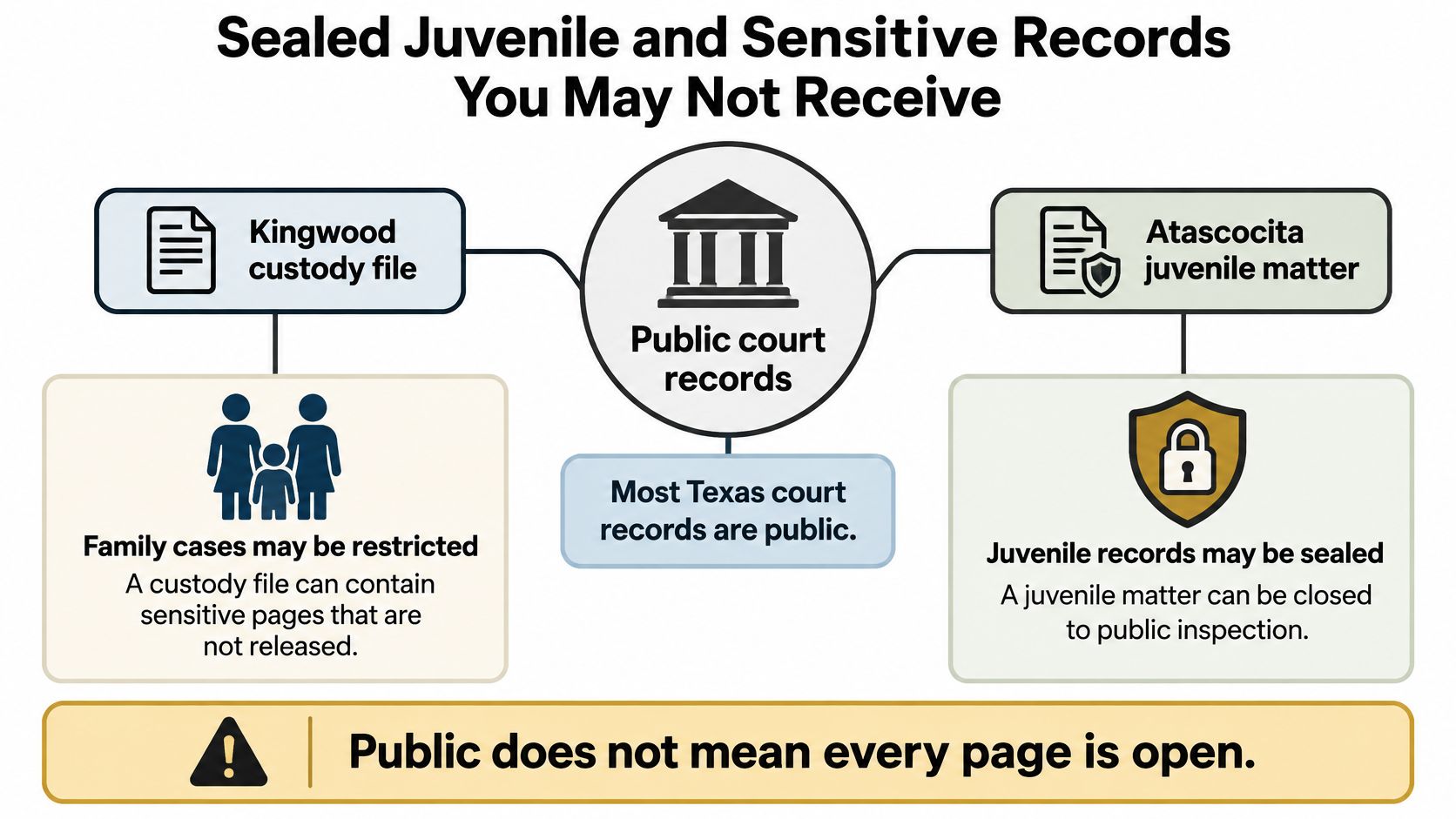
A Kingwood parent asks for a custody file and gets back a packet with missing pages. An Atascocita grandparent asks for a juvenile matter and receives nothing but a letter citing a restriction. Neither clerk lost the pages. The State Law Library's Texas court records guide explains that most court records are public, but family cases and cases involving minors may be sealed or limited to parties, and documents may be redacted or confidential under specific laws.
What a lawful incomplete file looks like
Texas practice expects sensitive data to be protected, including Social Security and government identification numbers, financial account information, birth dates, home addresses, and names of minors in qualifying filings. Rule 21c requires redaction of sensitive data while an unredacted version may remain with the court. A thinner packet can therefore be a lawful redaction, not a lost page.
Records confidential by law may be accessed only by the attorney and the litigants who are parties to that specific case. Knowing the cause number does not open those pages. Adoption files, juvenile records, and some protective-order material follow tighter rules than an ordinary civil docket. Texas Rule 12, which covers non-adjudicative judicial records rather than the case file itself, also allows withholding of confidential information and records whose release creates specified safety or privacy risks.
When the file is restricted
Ask the clerk whether the limit covers the whole file or only certain pages, and get the legal basis in writing. If the goal is to open a sealed civil record, that is a court procedure such as Rule 76a, not a second copy request. Dumping a minor's identifiers into a broad request does not release the file and can spread the exact information the law is trying to protect.
A custody or juvenile restriction is a good moment to keep discussions in a protected channel. Resources like Ciphar's lawyer-client confidentiality guide explain what stays private and why the channel matters before you send case numbers and party names anywhere.
Reality check: “Public” means the general docket is open. It does not mean every page is released. If the clerk cites a legal restriction, the next move is a motion or party access, not a louder open-records letter.
For Harris County readers weighing whether to fix an old record rather than fight for a sealed one, our expunction vs. nondisclosure comparison lays out the difference in plain terms.
Fixes When the Request Stalls or Is Denied
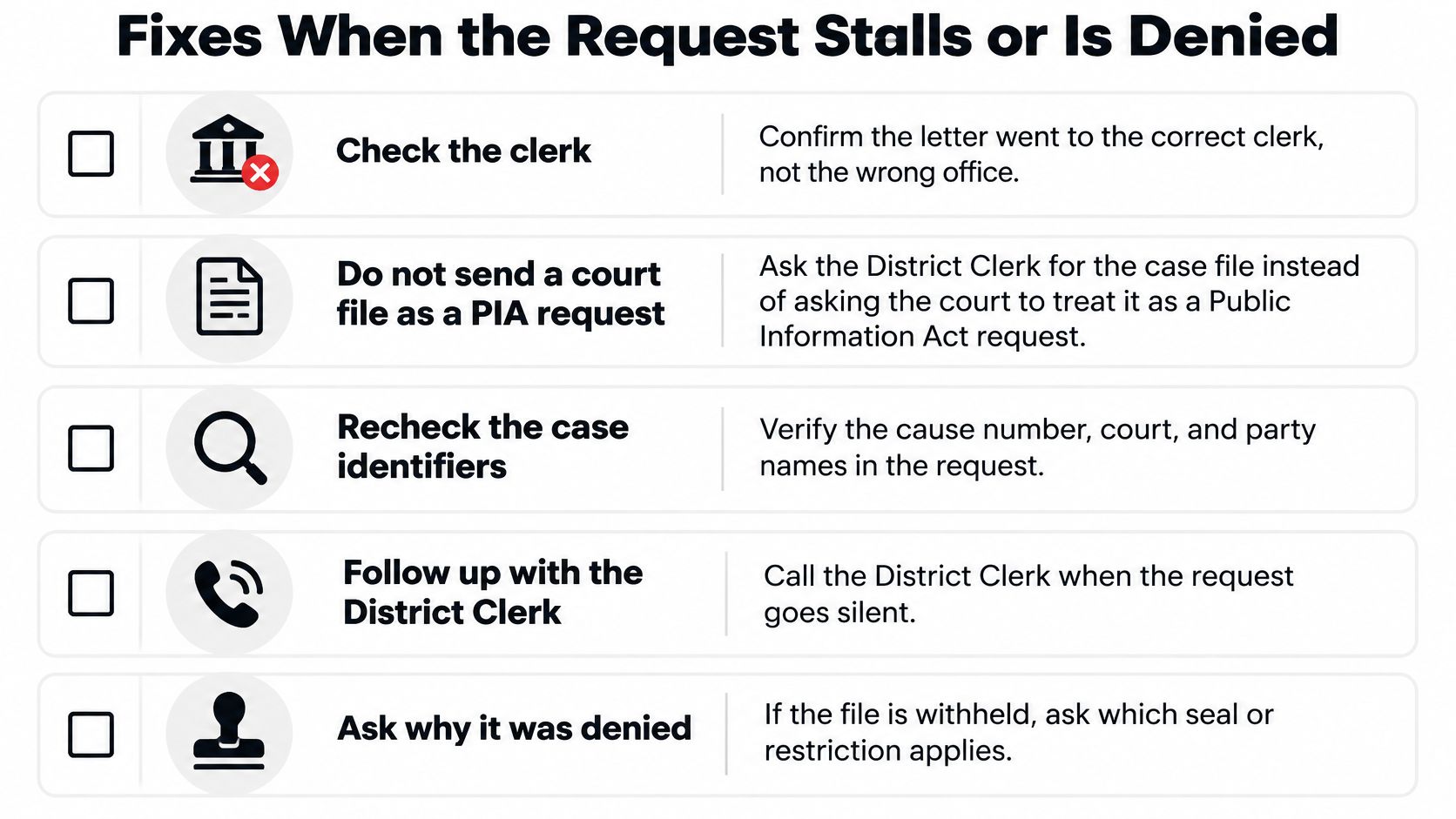
The miss that causes most silence is not a lost form. The letter went to the wrong clerk, or it asked a court to treat a case file as a Public Information Act request even though the District Clerk already posts public case information online. Harris County records division guidance confirms that “promptly” means as soon as possible under the circumstances and without unreasonable delay, not an immediate response.
Seven fixes in order
Match the clerk first. Confirm the cause number belongs to the District Clerk, the County Clerk, or the specific justice precinct that heard the case, then resubmit only to that custodian.
Wait out the diligent-search window. If nothing arrives after the search period, send proof of delivery and ask for the written date and time required when production cannot happen within 10 working days.
Reorder named images. If the packet is only a docket, request the specific images such as the petition and the latest order rather than a general “file.”
Ask about missing pages. For pages that are absent, ask which pages were withheld, the legal basis, and whether the limit applies to the whole file or only sensitive lines.
Separate an ordinary county record from a court access denial. A non-case county record the office wants to withhold generally requires a Texas Attorney General decision, and the requester may respond using the deadline on the denial letter.
Leave the sealed file with the court. A sealed, juvenile, adoption, or party-only court file is not opened by the Attorney General path. Access stays with the clerk and the court, and non-case judicial records use a written Rule 12 request.
Keep every denial and receipt. For a Humble, Atascocita, Kingwood, or Northeast Houston divorce, custody, probate, or criminal file, ask whether the next move is a narrower request, party access, or a motion.
The estimate thresholds also stall cases. If charges exceed $40, the office sends a written estimate and you have 10 days to respond. If the estimate exceeds $100, the office may require a deposit before production. A missed estimate email can read as an automatic withdrawal, so check the spam folder and the mailbox before assuming the clerk ignored you.
Triage rule: A silent request is usually a routing problem. A denied request with a legal citation is usually an access problem. Fix the first by re-sending to the right clerk, and fix the second by asking which seal or restriction applies.
Schedule a Free Consultation About Your Court File
Handle the request yourself when the case is public, the cause number is in hand, and you only need a non-certified order or petition for your own records. Call a lawyer when the clerk says the pages are sealed, confidential, or limited to parties in a divorce, custody, protective-order, juvenile, adoption, probate, or criminal case. Call also when a hearing is close and the estimate or delay will leave you without the order, or when you are being asked to pay a large deposit for an entire file you may not be allowed to see.
The Law Office of Bryan Fagan serves families across Harris County from 414 E Main St, Humble, TX 77338, and you can reach us at (281) 817-1827. During a free consultation, you get a confidential review of your case details, honest feedback about legal options and potential outcomes, guidance on the Texas family, estate, or criminal law in front of you, and clear direction on what to do next. The same conversation helps Humble, Atascocita, Kingwood, and Northeast Houston clients who need a court file because of custody, criminal charges, or an estate.
A missing page is often a routing or confidentiality problem, not a personal failure. The clerk's rules exist to protect the file, and your next step is to understand which rule applies. Before a deadline in the case passes, schedule the free consultation by phone or online and bring whatever the clerk already sent you.
If you need a Harris County court file for a family, criminal, or estate matter and the clerk's answer leaves you stuck, the Law Office of Bryan Fagan can review the route with you in plain language. Our Humble office helps you identify the right custodian, order only the pages you can access, and decide whether a restriction calls for a motion instead of another request. Visit Law Office of Bryan Fagan to schedule your free consultation before the next deadline in your case.