 Skip to content
A lot of families in Humble don't start thinking about a power of attorney until something has already gone wrong. A parent ends up in the hospital. A spouse can't sign bank paperwork. A small business owner in Atascocita suddenly can't manage payroll or vendor payments. In those moments, people often assume a close family member can act on their behalf. Texas law usually doesn't work that way.
A power of attorney gives someone you trust legal authority to act for you. If it's drafted and signed correctly, it can make a hard season more manageable. If it's vague, incomplete, or not properly executed, banks, title companies, and healthcare providers may refuse to honor it. That's why learning how to create Power of Attorney the right way matters for families across Humble, Kingwood, and Northeast Houston.
Planning for the Unexpected in Humble Texas
A few weeks ago, I spoke with a family dealing with a situation that's common here in Northeast Houston. Their mother had always handled her own bills, insurance paperwork, and doctor appointments. Then her health changed quickly. Her adult children wanted to help, but they ran into one problem after another because nobody had formal authority to act for her.
That kind of stress is avoidable.
A power of attorney, often called a POA, is a legal document that lets you choose someone to act on your behalf. Depending on the document, that person may be able to handle financial matters, healthcare decisions, or a very specific task. Used well, it isn't about giving up control. It's about deciding in advance who steps in if life gets complicated.
Why this matters for local families
For many people in Humble, this isn't abstract estate planning. It's practical household protection. You may be caring for aging parents in Kingwood, helping a spouse after surgery in Atascocita, or trying to keep business and family responsibilities moving at the same time.
A valid POA can help with things like:
- Paying routine bills when you're out of town or unable to manage them yourself
- Talking with banks or title companies when a transaction needs an authorized signature
- Coordinating healthcare decisions if a medical crisis leaves you unable to speak for yourself
- Managing urgent paperwork so your family isn't scrambling during an already emotional time
If you'd like a fuller overview of how these documents work before you decide which one you need, our plain-language guide on what a power of attorney is in Texas is a helpful starting point.
The good news is that this process isn't as improvised as many people assume. The process for creating a power of attorney is now governed by a widely recognized statutory framework, the Uniform Power of Attorney Act, which has been adopted by most states since 2006, and that standardization has simplified drafting and reduced errors according to MetLife's overview of getting power of attorney.
A power of attorney is one of the clearest ways to protect your family before they need to make decisions under pressure.
If you're also thinking about broader planning issues tied to incapacity and end-of-life choices, this Texas end-of-life POA guide gives useful context in plain English.
Choosing the Right Type of Texas Power of Attorney
The hardest part for many people isn't signing the form. It's choosing the right kind of authority.
Some POAs are broad. Some are narrow. Some handle money. Others deal with healthcare. If you choose the wrong tool, the document may be perfectly valid and still not solve the problem you have.
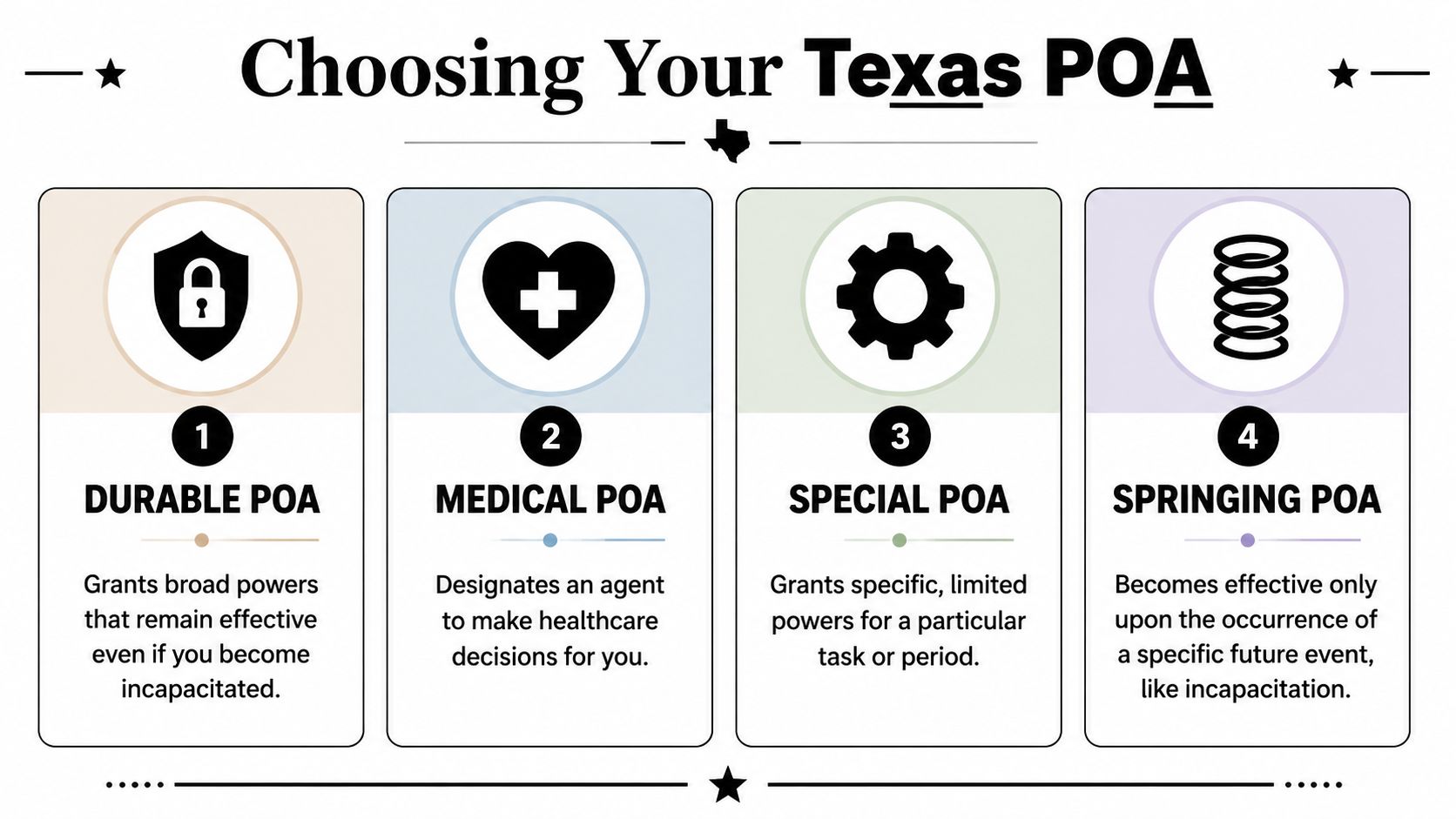
Four common POA types
Think of these like different keys. One key opens the whole house. Another opens only the garage. Another works only if a specific event happens.
| Texas Power of Attorney Types at a Glance | ||
|---|---|---|
| POA Type | Primary Use | When It's Active |
| Durable POA | Financial and property matters | Usually as stated in the document, and it can remain effective if you become incapacitated |
| Medical POA | Healthcare decisions | When you can't make or communicate healthcare decisions yourself |
| General POA | Broad authority for legal or financial matters | Typically while you still have capacity, depending on the document |
| Special POA | One specific act or limited task | Only for the task or time period named in the document |
| Springing POA | Authority triggered by a future event | Only after the stated triggering condition occurs |
How to match the document to your situation
A Durable Power of Attorney is often the workhorse document for estate planning. If you want someone to help manage accounts, pay bills, deal with property matters, or handle financial transactions even if you later become incapacitated, this is often the form families need.
A Medical Power of Attorney is different. This document names the person who can make healthcare decisions if you're unable to communicate. For a closer look at that specific document, see our guide to medical power of attorney in Texas.
A Special Power of Attorney works well when the task is narrow. If you're deployed, traveling, recovering from a procedure, or need someone to sign a single property document, this may be enough. It can be as limited as authorizing someone to close a sale, manage one account, or handle one short-term issue.
A Springing Power of Attorney doesn't become effective right away. It activates only when the event listed in the document occurs, such as incapacity. Some people like that extra control. Others prefer an immediately effective durable POA because springing language can create proof problems when an institution asks whether the triggering event has happened.
Local example: A Kingwood parent leaving town for an extended period may want a limited POA for one real estate closing. A retired couple in Humble planning for long-term health concerns may need separate durable and medical POAs.
Families dealing with other legal issues often find that planning documents overlap with broader household decisions. For example, when parents are also handling support obligations, a Child Support Attorney in Humble works on establishing, modifying, and enforcing child support in Harris County, which is a different legal process from creating a POA but often arises during the same period of family transition.
Selecting Your Agent A Critical Decision
The document matters. The person matters more.
You can have a perfectly drafted power of attorney and still create problems if you choose the wrong agent. In my experience, the safest choice isn't always the oldest child, the closest relative, or the person who insists they should be in charge. The best agent is the person who will handle responsibility carefully, stay calm under pressure, and follow your instructions.

What a strong agent looks like
One family in Northeast Houston chose a son who lived nearby, but he hated paperwork, ignored deadlines, and avoided hard conversations. Another family chose a daughter who lived farther away but kept organized records, responded quickly, and wasn't afraid to ask questions at the bank or hospital. Distance mattered less than reliability.
A good agent usually has several traits:
- Trustworthiness first because this person may have access to sensitive information and significant authority
- Practical judgment so they can make decisions without creating confusion or conflict
- Willingness to serve because an unwilling agent often delays action when timing matters
- Communication skills since banks, healthcare providers, and family members may all need updates
- Respect for boundaries so the agent follows your instructions instead of doing what feels easiest
Have the conversation before you sign
Don't surprise someone with this role after the document is finished. Ask them first. Tell them what the job may involve. Be clear about what authority you're giving and what limits you want.
It's also wise to name an alternate agent. People move, get sick, become overwhelmed, or turn out not to be the right fit.
If you're weighing personalities, family dynamics, and long-term planning together, many people also benefit from talking through those choices with counsel. Our article on how to choose an estate planning attorney can help you think through that process.
A short explanation can also help families start this conversation at home:
Choose the person who will protect your interests when you're not there to explain yourself.
Red flags people ignore
Sometimes the wrong choice is obvious only in hindsight. Be cautious if the person you're considering has a history of financial instability, family conflict, poor follow-through, or pressure tactics. A power of attorney can be a helpful tool. It can also be misused if the wrong person holds it.
For many Humble and Atascocita families, the right answer is the person who is steady, organized, and willing to act carefully, even if that person isn't the loudest voice in the room.
Drafting the Document Powers and Limitations
A Power of Attorney works best when it reads like a clear set of instructions, not a blanket permission slip. Here in Humble, I often see families download a generic form, check a few boxes, and assume that means every bank, title company, or medical office will accept it. In real life, vague wording is where problems start.
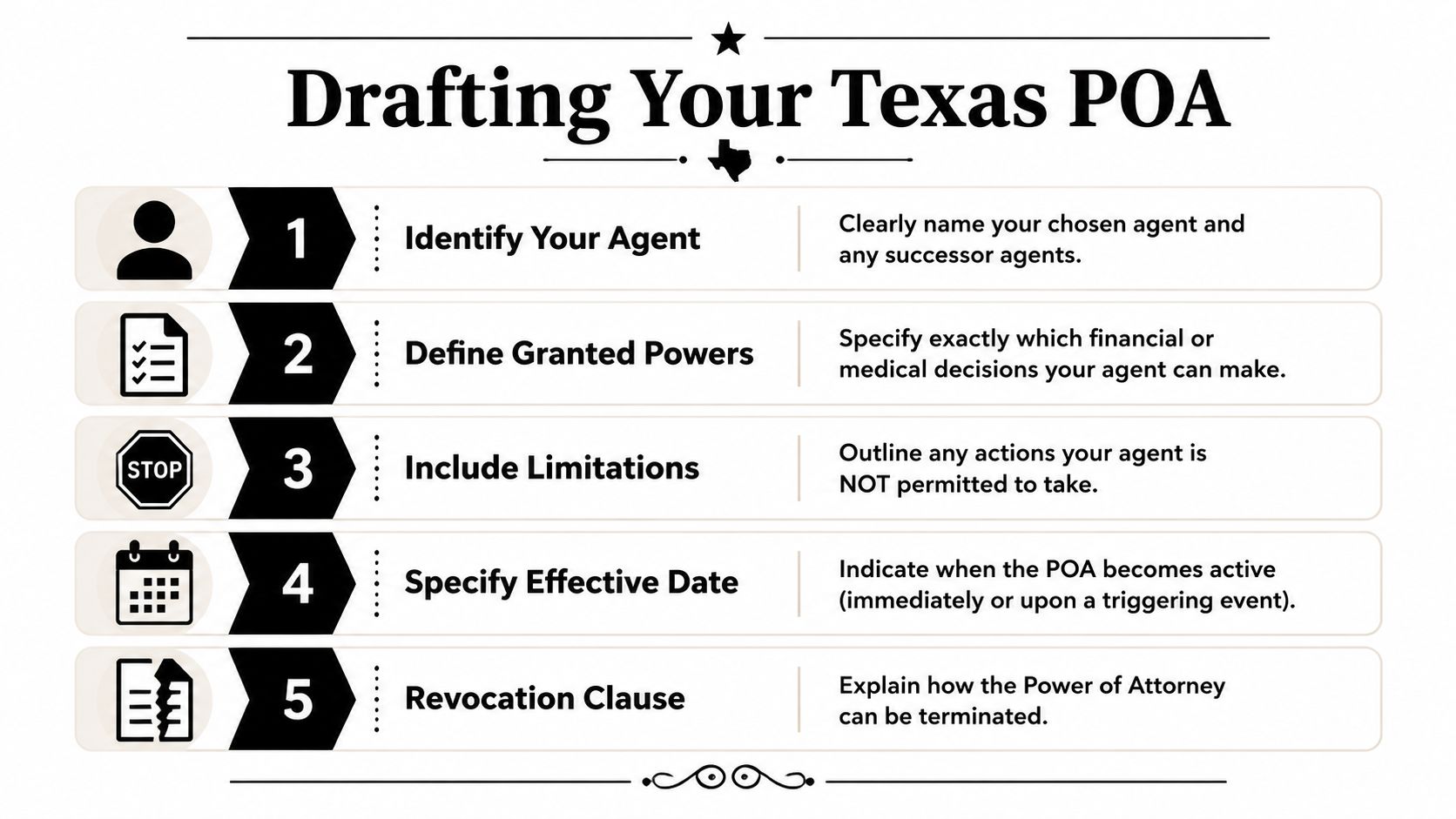
Put your instructions in plain, specific terms
The goal is simple. If your agent needs to act for you, the document should tell a third party exactly what that person can do.
A good draft usually answers five questions:
- Who is receiving the authority? Use full legal names for your primary agent and any backup agent.
- What can that person do? List the powers in specific categories, such as banking, real estate, taxes, insurance, or business operations.
- What is off limits? Spell out restrictions clearly.
- When does the authority start? Your document should state whether the authority begins right away or only after a stated event allowed under Texas law.
- How should later changes be handled? Clear revocation language helps reduce confusion if you sign a newer document later.
Specific wording matters because institutions often look for exact authority. If your agent needs to sign closing papers for a house in Harris County, manage a retirement account, or speak with a lender, the document should say that plainly.
Broad language often creates narrow results
Many people believe broader language gives better protection. It often does the opposite.
Banks and other institutions tend to be cautious. If a document says your agent may handle "all financial matters," the person reviewing it may still hesitate over a wire transfer, a deed, or access to an online account. A better draft names the task. That gives the institution less room to question whether your agent has authority.
A Power of Attorney works a lot like a well-labeled set of house keys. If each key is marked, the person helping you knows which door it opens. If everything is tossed into one unlabeled ring, confusion slows everything down.
Match the powers to your real life in Humble and Northeast Houston
Local context is important. A national template may mention banking and property in general terms, but it may not fit the way your family handles money, property, or work.
For example, your document may need to cover:
- Personal banking, including checking, savings, and credit union accounts
- Real estate matters, including signing documents for a sale, refinance, lease, or repair contract
- Tax matters, including speaking with your CPA or signing tax-related paperwork
- Insurance claims, especially after storm or flood damage that affects homes in the Humble area
- Retirement and investment accounts, if you want your agent to communicate with those institutions
- Digital access, if bills, statements, and account records are handled online
If your family owns rental property, inherited land, or a home that may need to be refinanced, say so in a way that matches the task. If your finances are mostly online, your document should address that too.
Business owners usually need more than a standard form
Many Humble area residents own small businesses, work as independent contractors, or run side businesses that keep the household going. A generic personal finance form often misses those details.
If you own a business, consider whether your agent should be allowed to:
- Access business accounts for payroll, rent, or vendor payments
- Use accounting platforms that store your books and tax records
- Sign routine business documents that keep operations going
- Communicate with clients, vendors, or service providers
- Handle limited contracts without having authority to sell the business or take on major debt
Those distinctions protect you. You might want someone to keep the lights on, pay employees, and answer urgent emails, while still blocking that person from making big structural decisions.
Limits deserve as much attention as powers
A careful Power of Attorney does not just grant authority. It also draws boundaries.
You can limit your agent's ability to sell property, change beneficiary designations, make gifts, access certain accounts, or manage business interests beyond day-to-day needs. That can be especially important in blended families, second marriages, or situations where one child helps with finances but you do not want that child controlling every asset.
Clear limits can prevent family conflict later. They also make your wishes easier to follow.
Use a form as a starting point, not the final answer
Templates can help you organize your thoughts. They are rarely enough by themselves.
Texas residents in Humble, Atascocita, Kingwood, and nearby communities often need language that fits local property issues, local business needs, and the practical concerns that come up when a bank or title company reviews the document. A well-drafted POA should sound like it was written for your life, because it was.
Executing Your POA the Right Way in Texas
A power of attorney isn't effective because you downloaded a form and filled in blanks. It becomes useful only when Texas execution rules are followed.
That part is straightforward, but it isn't optional.
Texas rules you need to meet
Texas requires a valid power of attorney to meet certain core conditions. In Texas, a power of attorney must be in writing, name your agent, and be signed by you in front of a notary public, and you must be of sound mind and over 18 years old for the document to be valid, according to Texas Law Help's explanation of powers of attorney.
That means a verbal agreement won't work. An unsigned draft won't work. A signed but unnotarized financial POA won't meet the requirement described above.
A simple execution checklist
For readers in Humble, Atascocita, Kingwood, and surrounding parts of Harris County, these are the practical steps:
- Use the final version only. Don't sign a draft that still has blanks, notes, or uncertain language.
- Bring identification. The notary needs to verify who you are.
- Sign in front of the notary. Don't pre-sign it at home and expect the notary to fix that later.
- Make sure your agent is correctly named. Even small errors can cause confusion later.
- Store the original safely. A fireproof home safe or attorney file copy can help.
- Prepare copies for institutions that may need them. Banks, doctors, and title professionals often need a readable executed copy.
Important: If real estate is involved, the POA may also need to be filed with the county clerk where the property is located so the agent can act in a property transaction.
What this looks like locally
In Harris County, many people sign before a notary at a law office, bank, or shipping store that offers notary services. Before you go, check that the document is complete and that the signer has capacity to understand what they're signing. If an elderly parent is confused, heavily medicated, or unable to communicate understanding, that's a warning sign to pause and get legal advice.
This is one reason families often wait too long. They assume they can "get it done later," and then later arrives after a medical event. The best time to sign is while the person creating the POA is calm, clear, and able to make their own decision.
Using Revoking and Updating Your Power of Attorney
After the document is signed, your job isn't over. A power of attorney works best when it's treated as a living part of your planning, not a one-time task stuffed into a drawer.
Your agent should know where the original is kept and which institutions may need a copy. If the POA is meant to help with banking, the bank may want to review it before a crisis happens. If it's meant to help with healthcare, family members should know who holds decision-making authority.
When to review or revoke it
Life changes. Your POA should keep up.
Review the document after major events such as:
- A divorce or separation
- A move or major property change
- A change in health
- A change in trust with the named agent
- A shift in business responsibilities or assets
If you want to revoke a POA, do it clearly and communicate that revocation to anyone relying on the old document. That can include your agent, banks, healthcare providers, and any title or financial institution that received a copy.
A power of attorney should match your life as it exists now, not the life you had five years ago.
Keep the whole plan connected
Families in Northeast Houston often create a POA while also thinking about wills, trusts, probate concerns, or medical directives. Others come to estate planning during a divorce, child support issue, or even after a criminal charge has disrupted daily life. Those problems are different, but they all affect who can make decisions, who has access to records, and how a household stays stable.
When your documents are coordinated, your family has clearer instructions and fewer obstacles. That's the value of taking time to create a power of attorney carefully.
If you're in Humble, Atascocita, Kingwood, or Northeast Houston and want help creating a Texas power of attorney that fits your family, your property, and your real daily needs, schedule a free consultation with Law Office of Bryan Fagan. A local attorney can help you choose the right type of POA, avoid signing mistakes, and put a plan in place that protects the people who count on you.


