Humble ISD's county split may shape school attendance and property taxes, but it does not choose the courthouse for a custody dispute. The district map and the court map answer different questions.
For custody, start with where the child lives. Then check whether a court already has continuing exclusive jurisdiction over the case. If another state may be involved, the child's home state under Texas law also matters. These facts, not the campus address, guide which court can hear the case.
That distinction can ease school-related stress: an enrollment form may show where a child attends, while the legal question turns on residence and the history of court orders. A campus can sit within a district that crosses county lines, yet that does not make the school's county the automatic place to file.
Which County Hears the Case
Humble ISD's split is a tax and attendance fact before it is anything else. A single district, a single network of campuses, and a single bus route can touch two courthouses. What decides your filing is not the district's footprint but three things: where the child lives, whether a court already holds the case, and whether another state is in the picture.
Answer these rows in order and you'll know which courthouse to call.
| Question | What parents often assume | What actually controls |
|---|---|---|
| Original custody filing | The campus or ISD county | County where the child resides |
| Parents live in different counties and no conservator yet | The school address | County of the parent with actual care, control, and possession |
| An SAPCR or custody order already exists | File again in the new county | Court with continuing exclusive jurisdiction under Chapter 155 |
| Divorce is already pending | Open a separate school-county case | Venue fixed by the divorce proceeding |
| A parent or child has ties to another state | The Harris-Montgomery line | Home-state test, usually six months, under Family Code Section 152.201 |
| A child may be in immediate danger | Wait until the ISD county is certain | Emergency temporary relief based on risk, not the district map |
| Enrollment, attendance, or a transfer fight | School records decide custody | Evidence for best interest under Section 153.002, not jurisdiction |
Start with row one. An original suit affecting the parent-child relationship generally goes where the child resides, unless another court already has continuing, exclusive jurisdiction or a divorce case fixes venue elsewhere. When the parents live in different counties and no managing conservator, custodian, or guardian has been appointed, the child's residence generally follows the county of the parent with actual care, control, and possession. That is the Texas Family Code venue provisions doing the work, using residence facts and prior orders rather than a campus address.
The mailbox picture: the district draws the neighborhood, residence marks the mailbox, and a court with continuing exclusive jurisdiction keeps the key to that mailbox.
Venue and jurisdiction are two different questions
Venue asks which county. Jurisdiction asks whether a Texas court may act at all. A filing in the wrong county is a fixable mistake. A filing in a court with no authority over the child is a different problem, and it costs money and months.
When a parent or the child has ties to another state, the county line stops mattering. Texas Family Code Section 152.201 lets a Texas court make an initial custody determination when Texas is the child's home state on the filing date, or was the home state within the preceding six months while a parent or person acting as a parent remains in Texas. If that test fails, the statute lists four alternative bases, including that another state lacks jurisdiction or declines the case, that the child and at least one parent have a significant Texas connection beyond mere physical presence, and that substantial evidence about the child's care, protection, training, and relationships exists here. Those four alternatives are the exclusive route for an initial determination.
What a move inside the district does not do
Say a parent leaves a Kingwood apartment for a Montgomery County address that feeds the same Humble ISD campuses. The commute changes, the school-night math changes, and the venue facts may change. The six-month home-state clock does not restart, and Texas does not become a different case because the mailbox crossed a line inside one district.
Before you call anyone, take a pencil to the table above and mark the one row that matches the paperwork already in your file. If that row says Chapter 155 or pending divorce, your courthouse is likely chosen, and the task changes from choosing to confirming. A request to move a case is its own motion, and transferring a family case into Harris County from another county explains when that request is available.
How to Document Where the Child Lives
The venue rule only works if you can state the child's residence in dates and addresses instead of impressions. Gather these seven items before you choose a courthouse, because each one answers a question a judge or a clerk will eventually ask.
Here's the checklist to keep beside you while you work.
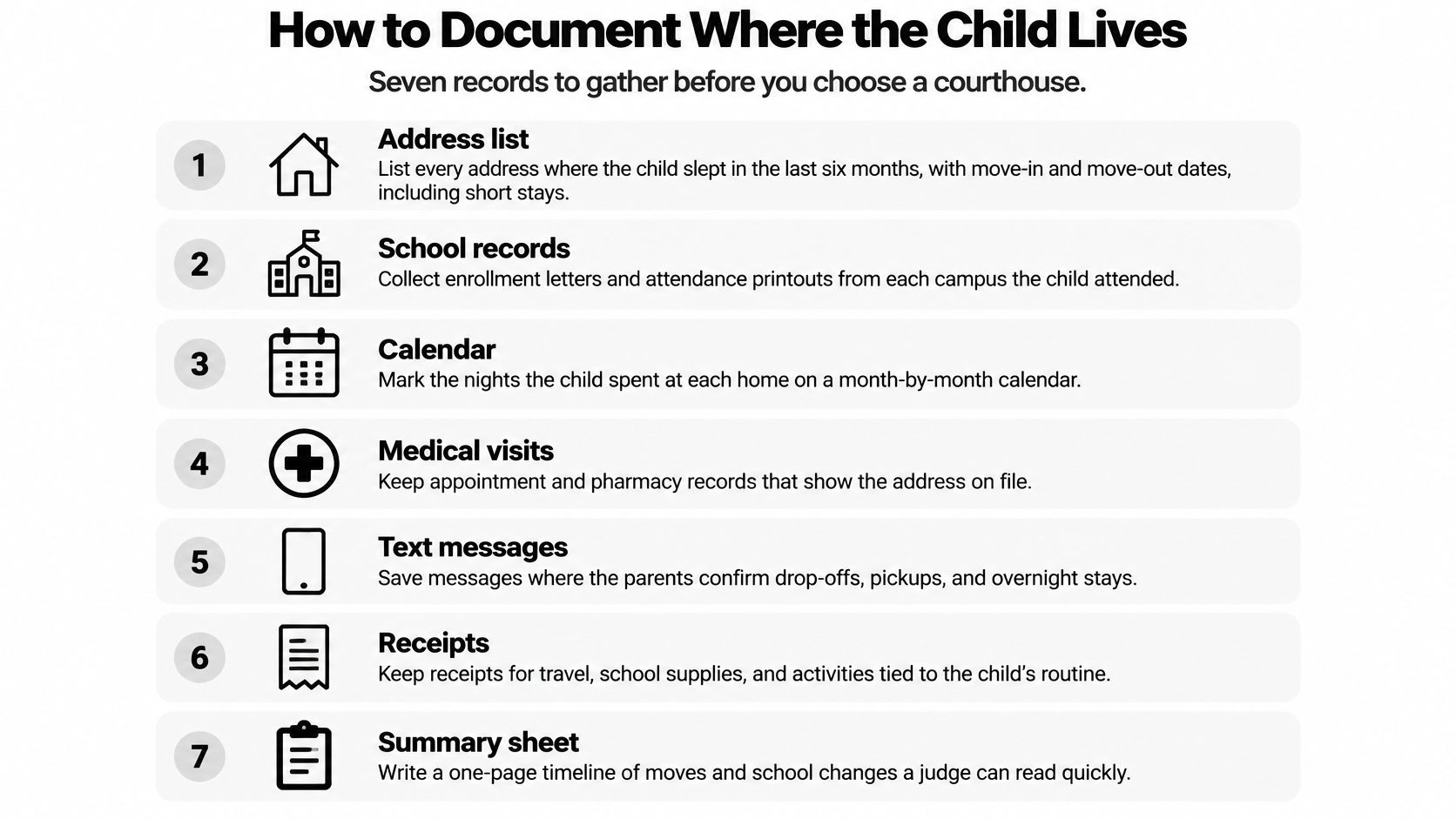
- List every address where the child slept in the last six months, with move-in and move-out dates, including short stays in Humble, Atascocita, Kingwood, and Montgomery County. Weekends at a grandparent's house count as a stay, not as residence, and leaving them out looks like concealment later.
- Mark which parent had actual care, control, and possession on school nights versus weekends. A schedule labeled 50-50 can hide a primary home, and school nights carry more weight than a calendar total.
- Pull the current SAPCR, the divorce decree, and any temporary orders, then circle the court, cause number, and county on each. Most wrong-county filings start with an order nobody reread.
- Collect lease, mortgage, utility, and voter or driver-license addresses for each parent, not just the enrollment form. A school form proves enrollment, and the Texas Children's Commission bench book guidance points to actual residence, so a utility account with a start date does more work than a campus name.
- Log medical, childcare, and extracurricular locations with dates. These show the child's connection to a community, which supports a best-interest argument, but they don't replace residence.
- Keep certified attendance records and parent-portal messages showing who enrolls the child, who attends conferences, and who handles daily transportation. Label them as school evidence, because that's what they are.
- Write a one-page timeline in date order, with school changes and moves on the same page. If an older Texas order appears anywhere in that timeline, call that court or a lawyer before filing in the other county.
Two edge cases worth naming
A child attends a Humble ISD campus on the Harris County side but spends school nights in Montgomery County. The campus belongs to Harris County geography. The school-night home may point the residence analysis at Montgomery County, and a parent who files on the campus address alone may end up in the wrong courthouse.
A parent lists a relative's Humble address to enroll the child. That solves an enrollment problem and creates an evidence problem. School records, mail, and the actual overnight pattern usually surface the difference, and a court asked to weigh credibility notices.
The timeline is what you hand to a lawyer. It isn't a substitute for reading the decree.
What School Records Prove About Best Interest
School evidence helps explain how a child's routine and needs are being met. Under Texas Family Code Section 153.002, the court's best-interest analysis guides decisions about conservatorship, possession, and access. A useful record connects a specific fact, such as missed school or reliable transportation, to the child's stability or well-being.
The district's size or tax base says little about an individual child. A custody judge can instead weigh school attendance, transportation arrangements, services the child receives, and patterns of missed school. These details may show continuity, involvement, or disruption, though no single school record decides the outcome.
Two exhibits, two very different impressions
A parent-portal history can show who enrolled the child, contacted the teacher about homework, and handled pickups. Paired with a record of punctual drop-offs, it can support a clear account of who has maintained the child's school routine.
A district boundary map answers a different question. It shows where Humble ISD extends, but it does not explain this child's daily experience or a parent's involvement.
Match each document to a point. Enrollment and attendance records can support continuity. Conference notes and portal messages can show past involvement. Special-education or 504 documents, together with missed-school patterns, can help explain the child's physical and emotional needs. Request certified campus records, and keep relevant messages about homework, pickups, and sick days.
Those records can also inform practical order terms. The parents may ask the court to identify the child's campus assignment, assign school-morning transportation, require notice of extracurricular commitments, and clarify each parent's access to school communications and records. A Child Custody Lawyer in Humble, TX can address the conservatorship request and help connect the evidence to the best-interest factors a court actually weighs.
When a Transfer or Move Breaks the Schedule
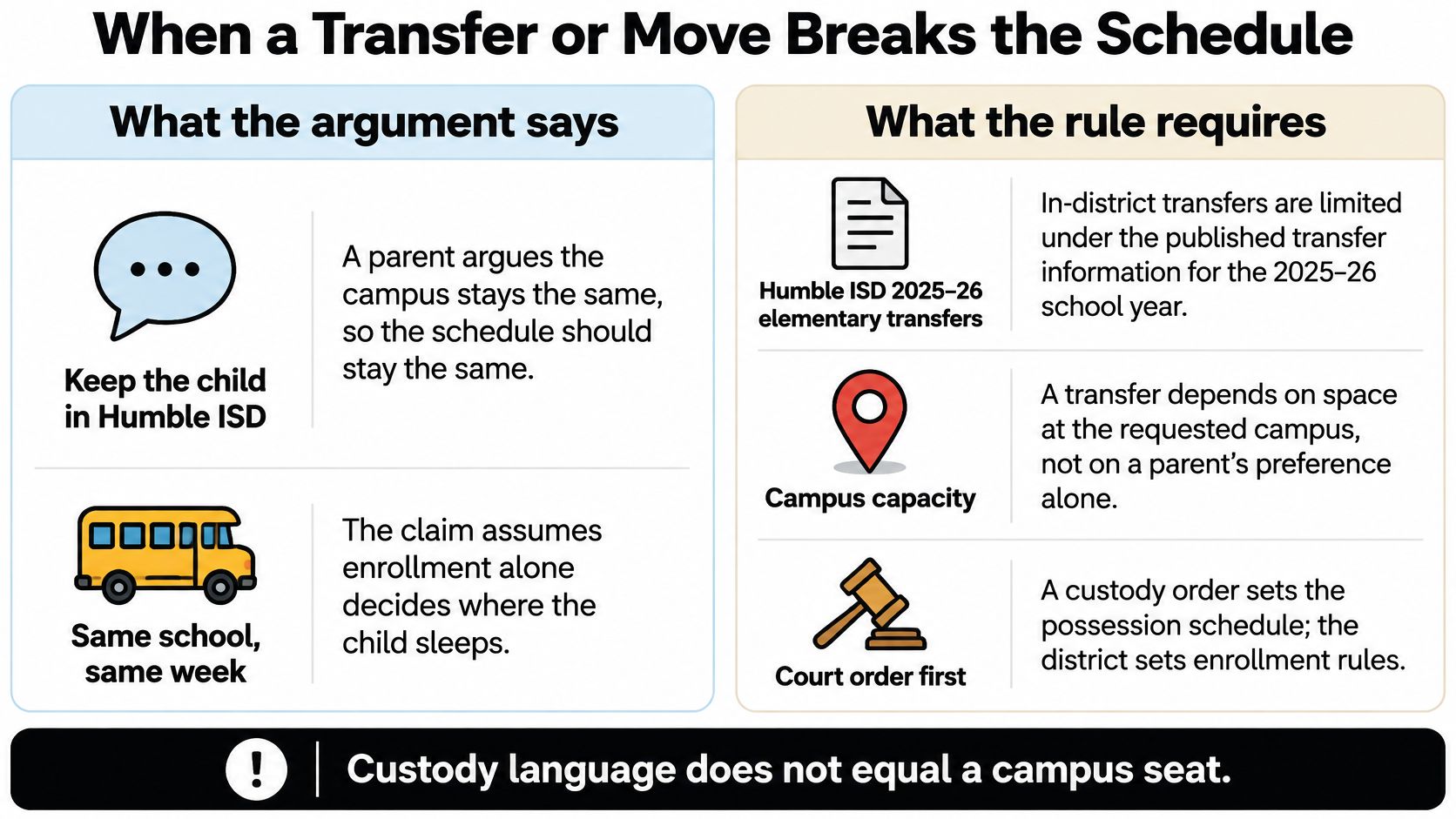
A campus transfer can change a child's school routine without changing the court order. Parents may have planned possession and transportation around one campus, only to learn that a transfer is unavailable or an application deadline has passed. The order and the district's enrollment rules address different parts of the problem.
Humble ISD's 2025-26 elementary transfer information explains which campuses accept in-district transfers, when applications must be submitted, and that only one transfer may be granted per school year. Those rules govern enrollment. The court order governs conservatorship, possession, transportation, and any geographic restriction.
Write terms the court can enforce when the campus changes
Plan for a campus change in the order, rather than relying on a campus name alone. Clear terms give both parents a workable next step if a transfer is denied or the child's assigned campus changes.
- A first choice and a backup: Name the preferred campus and the zoned campus to use if the transfer is denied.
- A named filer and a deadline: Specify which parent submits the transfer application and when.
- Morning transportation: Assign school-morning transport to a parent, rather than leaving it to “whoever has possession.”
- A travel cap: Set a mileage or time limit for the school commute, so the schedule can account for a future change in residence.
- Notice before an address change: Require written notice and explain whether the parents must return to court or attend mediation if the campus becomes unavailable.
The school district applies its enrollment rules, while the court sets terms for the child's best interests, possession, and geographic rights. Keeping those responsibilities clear helps parents direct enrollment questions to the district and schedule disputes to the court.
Once the order sets deadlines and pickup times, both households benefit from keeping a shared record of applications, drop-offs, and messages. Parents can compare co-parenting apps from Guiding Growth to find a way to organize those details. If a grandparent handles pickup or enrollment paperwork, Grandparents' Rights in Humble explains grandparents' custody and visitation rights in Harris County, which are separate from a parent's possession schedule.
A geographic restriction can help make a residence requirement clear and enforceable. Learn how geographic restrictions work in a Humble custody order, then consider whether both parents could still follow the order if the preferred campus became unavailable.
Emergency Orders When a Child Is at Risk
A district boundary is never the trigger for emergency relief. Risk is. Courts act on proof that a child may be removed from Texas, returned late or not at all, exposed to unsafe driving or substance use, or placed in a home where something has already gone wrong.
- Check for an existing order first. Write down its court, cause number, and county. An order already in place usually decides which court can act fastest.
- Document the specific risk with dates, incidents, messages, and witnesses. "He's unstable" gives a judge nothing. A dated text refusing to return the child, a pickup at 9:40 p.m. on a school night, a police report number, each of those gives a judge something to act on.
- Identify the court that can act now. If an order exists, that court holds continuing exclusive jurisdiction. If none exists, the court in the county where the child currently resides is the starting point.
- Ask for narrow terms that fit the danger. Limits on who may pick up the child, notice to the school office, a requirement that the child stay in the current home pending a hearing, or supervised exchanges.
- Don't wait for the county question to resolve. Call 911 for an active threat, and contact a family lawyer the same day for filings. Emergency paths still run through a court with authority, and a short call confirms which county that is before any paperwork goes out.
Practical rule: protect the child first, then sort the courthouse. Reversing that order costs hours nobody gets back.
A Split Week Between Kingwood and Montgomery County
The school district line can look more important than the county line. For a custody case, though, a Humble ISD campus does not choose the courthouse. Residence, an existing order, and the child's home-state history matter more.
Consider a composite family, not a client file. A third-grader attends a Humble ISD campus on the Kingwood and Northeast Houston side of the district. One parent rents an apartment in Harris County a few minutes from school. The other has moved a short distance into Montgomery County, still within the same district footprint. The child sleeps at the Harris County apartment on school nights and spends most weekends across the county line.

The Montgomery County parent wants to file there. The new lease feels local, the campus remains in Humble ISD, and the district map shows the same district on both sides of the county boundary. That makes the county question easy to misread: a school attendance map is not a court-jurisdiction map.
The 2020 School District Reference Map for Montgomery County identifies Humble ISD by district code 23910 beside New Caney and Splendora, with boundaries current as of January 1, 2020. The map explains why families may cross county lines while remaining within one school district. It also states that its boundaries are for statistical collection and do not determine legal jurisdiction, property ownership, or entitlement. School district lines help explain attendance and taxation; they do not settle which court can hear a custody case.
The assumption to check: nobody reread the order
Suppose a Harris County SAPCR was filed two years ago. If that court retains continuing exclusive jurisdiction, the existing order matters more than the other parent's new Montgomery County lease. Filing in another county without checking the order can create a second problem rather than resolve the dispute.
If there is no existing order, the child's residence becomes central. The school-night home is a practical fact to document, while attendance records can help explain the child's routine and inform a best-interest argument. Neither the campus nor the district name alone establishes venue. The child's residence and the six-month home-state test are separate parts of the jurisdiction question, so a weekend schedule across the county line should not be mistaken for an answer by itself.
Before choosing a courthouse, ask: does an existing order already identify the court with authority over this case?
Confirm the Court Before You File
Pause the filing until three items sit in one folder. Not four, not a shoebox: the six-month address timeline you built from the record routine, every prior SAPCR or divorce order with its cause number and county copied onto the front page, and school records labeled as evidence rather than venue.
If an order already names a court, call that court or a lawyer before opening a second case anywhere. Duplicate filings cost money, annoy judges, and can complicate an otherwise clean enforcement request. If no Texas order exists, file only after the residence county is identified, and never use a Humble ISD enrollment address as a shortcut to a courthouse.
Cross-county school weeks are common in Humble, Atascocita, Kingwood, and Northeast Houston, and they're manageable when the order is specific about campus, transportation, and notice. Harris County Family Courts: A Humble Resident's Guide walks through how family cases proceed in the Harris County courts that serve Humble, which helps when your timeline points toward Houston rather than Conroe.
Then come see us. Our office is at 414 E Main St, Humble, TX 77338, and the number is (281) 817-1827. In a free consultation you get a confidential review of your case details, honest feedback about your options and likely outcomes, guidance on the Texas family law issue in front of you, and a clear next step. Bring the folder. If a transfer window, a lease date, or a hearing is close, book the consultation before those dates harden the wrong facts.
Two maps decide different things in these cases, and the courthouse map is the one that moves your case forward. The Law Office of Bryan Fagan helps Humble families sort residence facts from school facts, read prior orders before a second filing, and build a possession schedule that survives a transfer denial or a move across the line. Start with a free consultation by visiting Law Office of Bryan Fagan, and bring your address timeline, your orders, and your school records so we can tell you which court should hear your case.