You bought it the right way. You paid the federal tax, waited for the approval, and put the paperwork in a folder. Maybe the folder sits in a filing cabinet, maybe in the safe next to the item itself.
Then life moves. Your son asks whether he can take it to the range. Your spouse asks what happens to it if you're in the hospital for a month. An adult daughter asks whether the whole collection has to go through a court when you're gone. Those three questions are where gun trusts live, and they have almost nothing to do with the downloadable trust kits sold with a checkout button.
Why Gun Trusts Matter to Humble Families in 2026
Two household scenes, both illustrative rather than drawn from a client file. A widow in Kingwood opens a safe and finds a suppressor registered to a trust her late husband set up years ago. Nobody in the family can say who the trustee is now, or whether the item can legally leave the house. A Humble owner wants his adult son to take a short-barreled rifle to a range in Atascocita without either of them committing a federal offense.
Three questions bring most Northeast Houston residents to a gun trust attorney in Humble, TX. Do I need a trust at all? What will it cost? Who nearby can draft it correctly? Each one gets an answer in the sections below.
One part of the usual sales pitch has faded. The old argument that a trust gets your application approved faster has lost most of its force now that federal processing has sped up. What remains is succession, lawful shared possession, and continuity when the owner is hospitalized or dies. This guide keeps those reasons and drops the marketing.
Families here are already doing this work. Many Humble, Atascocita, and Kingwood households are drafting wills and powers of attorney through Harris County estate planning, and a gun trust slots into that same plan. The city counted 16,795 residents in the 2020 Census, inside a Harris County population of 4,731,145, according to the 2020 Census figures for Humble. A small city inside a very large legal market.
A gun trust is a written set of instructions for who may hold and use a federally regulated firearm, and what happens to it when you cannot act.
Here's the road ahead: how a trust works, the federal rules that shape it, individual versus trust ownership, the Texas pieces, the drafting process, costs, and the questions neighbors ask first.
How a Gun Trust Works in Plain English
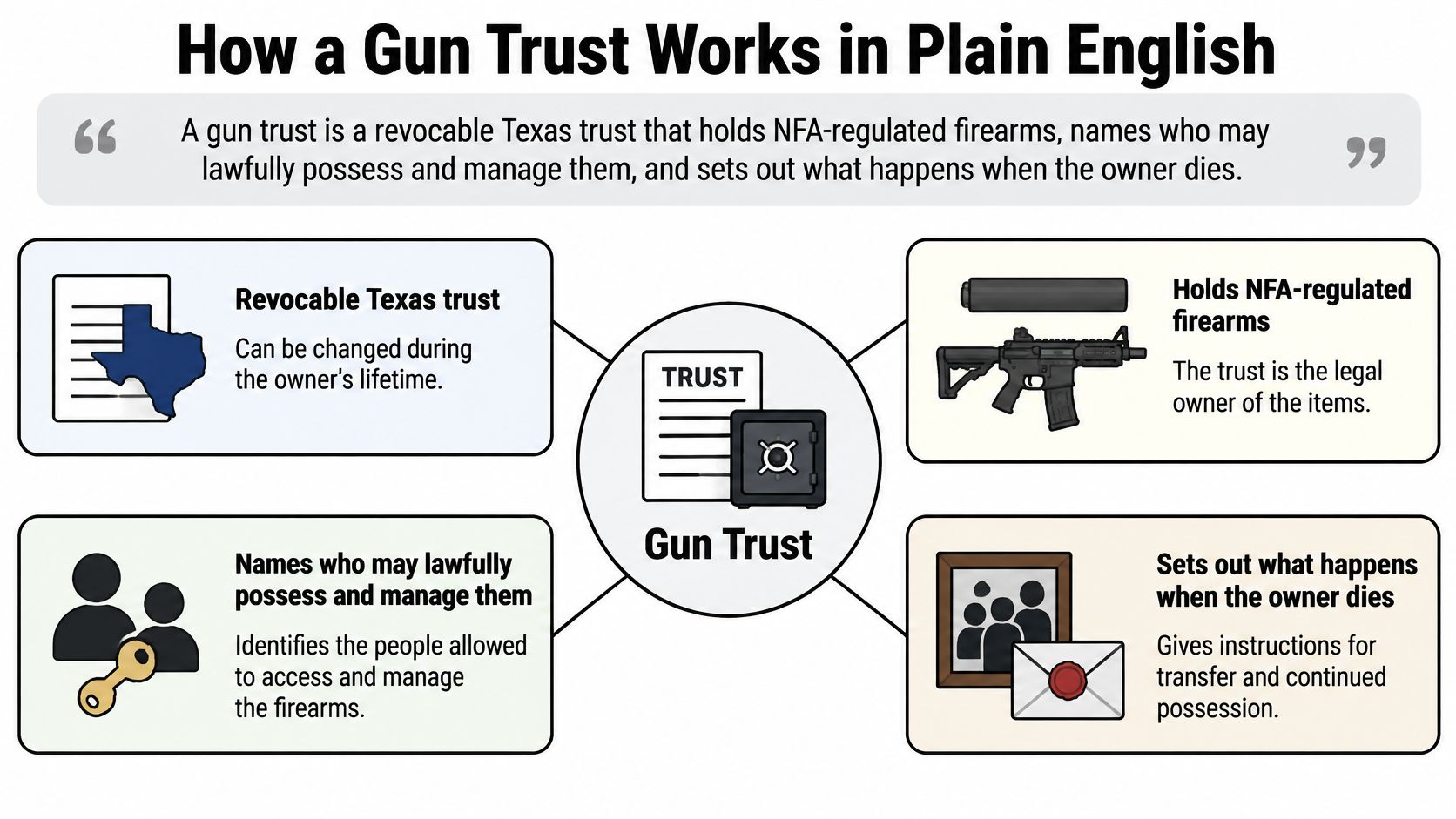
A gun trust is a revocable Texas trust that holds NFA-regulated firearms, names who may lawfully possess and manage them, and sets out what happens when the owner dies or cannot act. Everything else in this section unpacks that one sentence.
A gun safe with two additions is the easiest way to picture it. The safe holds the item. A written guest list taped to the door says who may open it. A rulebook inside says who takes over when you can't, and how the item eventually leaves the house. A gun trust supplies the guest list and the rulebook. The firearm inside stays exactly what it was, with the same federal rules attached to it.
If you're still deciding whether a revocable trust is the right container at all, our explanation of what a living trust is covers how a Texas revocable trust gets created, funded, and changed over time.
The Five Roles, One Sentence Each
- Grantor: the person who creates the trust and transfers the firearms into it.
- Trustee: the person who manages the trust property, keeps the records, and handles the federal filings.
- Successor trustee: the person who steps in when the trustee dies, resigns, or can't act, which is why the successor trustee duties after death are worth understanding before you name anyone.
- Beneficiary: the person who eventually receives the item or its value under the terms you wrote.
- Responsible person: any trustee or other person who can control or possess a trust NFA firearm, and who must clear federal screening.
Notice how those roles split the work. The grantor writes the rulebook, the trustee carries it out day to day, and the successor trustee picks it up when the first trustee can't. The beneficiary waits at the end of the line. One person can fill several roles at once, and in most family trusts the grantor starts out as the sole trustee, with a spouse or adult child named behind them.
What the Trust Holds and Where It Stops
Gun trusts in this practice are usually built around federally regulated items such as silencers, short-barreled rifles, and machine guns, along with the rest of the NFA categories. If an item falls outside that federal framework, an ordinary revocable trust or a simple will usually handles it, and the extra paperwork of an NFA trust adds little.
Now the boundary, stated as plainly as it can be. A trust organizes ownership and succession. It does not replace a background check for any responsible person, it does not let a prohibited person possess anything, and it does not erase the tax and registration steps. Whatever the rulebook says, federal law outranks it.
These rules are old rather than new. The National Firearms Act created the federal registration framework generations ago, and the Bureau of Alcohol, Tobacco, Firearms and Explosives maintains the National Firearms Registration and Transfer Record to this day. Processing volume has climbed sharply: the ATF's data and statistics pages show 563,127 firearms processed in fiscal year 2007 against 5,817,780 in fiscal year 2025, an increase of roughly 933%, with the yearly total rising from 1,112,041 in 2012 to 4,731,918 in 2024. Those totals measure federal processing activity rather than the number of trusts created or firearms owned in Humble.
The practical lesson is simple. A gun trust earns its keep through succession and lawful shared access, and the trust is only as sound as the federal paperwork filed under its name.
Federal NFA Rules That Shape Every Gun Trust
The forms follow the category of the item and the direction of the transaction. Here's the map before the details.
| NFA category | How it usually enters the trust |
|---|---|
| Machine gun | Form 4 tax-paid transfer to the trust |
| Short-barreled rifle | Form 4 transfer, or Form 1 to make one |
| Short-barreled shotgun | Form 4 transfer, or Form 1 to make one |
| Silencer | Form 4 transfer |
| Destructive device | Form 4 transfer, or Form 1 to make one |
| Any other weapon | Form 4 transfer |
Making Versus Transfer, the Distinction That Stops Filings
Form 1 is the application to make and register an NFA firearm, and the making tax must be paid before the firearm is made, as the ATF's Form 1 guidance explains. Form 4 covers a tax-paid transfer to an individual or to a legal entity such as a trust. Choose the wrong one and you either create a delay you can't fix by calling anyone, or you create an unlawful transfer. Neither outcome is worth saving a phone call.
The ATF's description of the National Firearms Act categories is the reference point here, because the trust's obligations differ materially depending on whether an item is an ordinary firearm or a regulated one.
Every Responsible Person Gets Screened
When a trust applies, each responsible person files ATF Form 5320.23 with identifying information such as legal name, position, residential address, date of birth, and citizenship. A photograph and fingerprints go with it. Being named trustee is not an honorary title. It hands someone legal control over a regulated item and pulls them into a federal screening process at the same time.
An attorney drafting for a Humble household therefore has to define who may possess the trust firearms, list current responsible persons accurately, and build a process for amendments when the roster changes.
Timing, Travel, and the Two Mistakes That Sink Filings
Federal regulations separate the transfer-tax application from the possession question, and they require the application for a trust or other legal entity to identify each responsible person. The federal NFA regulations also set out Form 5320.20 for certain interstate movements of machine guns, short-barreled rifles or shotguns, and destructive devices. Travel with a regulated item without checking that step first and a lawful trip turns into an exposure.
The two mistakes that most often derail a Humble family's filing: naming a trustee who cannot pass a background check, and amending the trust later without updating the federal paperwork to match. Both are avoidable at the drafting stage and expensive to unwind afterward.
Practical rule: verify each item's legal classification before you budget or file. The form and the tax both depend on it.
Choosing Between Individual Ownership and a Gun Trust
See the tradeoff in one place before reading any argument for either side.
| Question | Individual Form 4 | Gun trust |
|---|---|---|
| Approval speed in 2026 | About 4 days for an electronic Form 4 | About 5 days for an electronic Form 4 |
| Who may lawfully possess the item | Only the registered owner | Any trustee named as a responsible person |
| If the owner dies | An heir must complete a transfer before taking the item | Trustees keep lawful possession while the estate is sorted out |
| If the owner is hospitalized or incapacitated | No one else has authority | A successor trustee steps in under the trust terms |
| Probate exposure | Item is part of the estate | Item stays outside Harris County probate |
| Paperwork per added person | Not applicable | Form 5320.23, two fingerprint cards, a photo and a copy to the chief law-enforcement officer |
| Upfront cost | $200 tax plus dealer fees | $200 tax plus attorney drafting fee |
| Changing the plan later | Buy another item and file again | Amend the trust to add or remove trustees |
| Best fit for | One owner, no shared access, no succession worry | Spouses, adult children, co-owners and anyone planning for incapacity |
When Individual Ownership Is the Better Call
Choose an individual Form 4 when you're the only person who will ever handle the item, there is no one you intend to hand it to, and nothing needs to happen if you're hospitalized for a week or a month. A single owner with a single suppressor and no succession goal gets little from a trust except paperwork.
When a Trust Still Earns Its Fee
Choose a trust when a spouse or adult children need lawful access to the item, when you want a successor trustee to step in during incapacity, when you own or expect to own several regulated items, or when you want the collection kept out of probate. That last point matters more than people expect. Probate is public, and a trust keeps the inventory out of a court file.
The Tradeoff Nobody Mentions in the Sales Copy
Speed used to be the argument for a trust. It isn't anymore. The ATF's current processing times report that electronically filed Form 4 applications averaged 4 days for individuals and 5 days for trusts in October 2026, against roughly 247 days for individual Form 4s in 2023. A one-day difference doesn't justify an extra document on its own.
The honest version: faster approvals reduced the estate-planning gap between individual ownership and a trust. They didn't close it.
What the fast numbers do mean is that a long trustee list buys paperwork and privacy exposure rather than extra protection. Every trustee you add files another questionnaire, another set of prints, another photograph, another copy to the chief law-enforcement officer. Name the two or three people who need access, not everyone who might.
Four questions to answer before you call anyone:
- Who needs lawful access to the item besides you, today and in ten years?
- Who takes over if you're hospitalized for a month?
- Where should the item go after your death, and is that person able to pass a background check?
- Is this one item or part of a larger plan that also needs a will and powers of attorney?
If you're weighing a trust against a will for the rest of your property, our comparison of trusts versus wills explains which assets each document controls.
Texas and Harris County Rules That Affect Your Trust
Texas runs no separate state gun trust registration. There's no state agency to notify, no state stamp, no state database entry. What Texas does require is that the document be a valid Texas trust: clear terms, an identified trustee, identified trust property, and the signing and notarization formalities your drafting attorney follows.
What Texas Requires and What It Doesn't
The state-law side is about trusteeship, not registration. A trustee manages trust property for the beneficiaries and has to keep the trust's records straight. Think of the trustee less as an owner and more as a librarian: the items are theirs to manage, never theirs to treat as personal property, and every loan has to follow the written rules.
That distinction carries weight the day someone asks to borrow a suppressor for a weekend hunt. A trustee who hands a trust firearm to someone who cannot lawfully possess it has created a genuine problem for the family, no matter how good the intentions were at the time. The trust document itself is where those lending rules live, which is why possession and storage terms deserve real attention at the drafting stage rather than a copy of a template.
One habit worth building: photograph each item and record the serial number the day it enters the trust. In 2024, 55,795 firearms were recovered and traced in Texas, per the ATF's Texas trace data, and that same year 984 firearms were reported lost or stolen from federal firearms licensees in Texas, including 421 classified as losses, according to the ATF 2024 loss report. Records that exist on paper resolve questions that memory can't.
Where the Gun Trust Sits in the Wider Plan
A gun trust works best as one document inside a wider plan. The attorneys at our office work closely with clients to understand their goals and tailor a plan to their specific needs, and the trust's terms should line up with whatever else your family has already signed.
Then the local details show up. A trustee in Atascocita storing items at home answers a different set of practical questions than a Kingwood owner driving to another state, where federal movement rules follow the item across the line. A renter in Humble may have lease restrictions on storage, and a lease clause can shape where trust property physically sits. Adult children who live outside Harris County have to travel for paperwork and, in some cases, for the item itself, so naming them as trustees or successors means accounting for that distance in writing. If you're moving an item across state or county lines, it helps to compare state, county and city restrictions before you assume the rules at home follow you.
None of these details is exotic. They are ordinary life in this part of Texas, and the trust works when it anticipates them rather than discovering them.
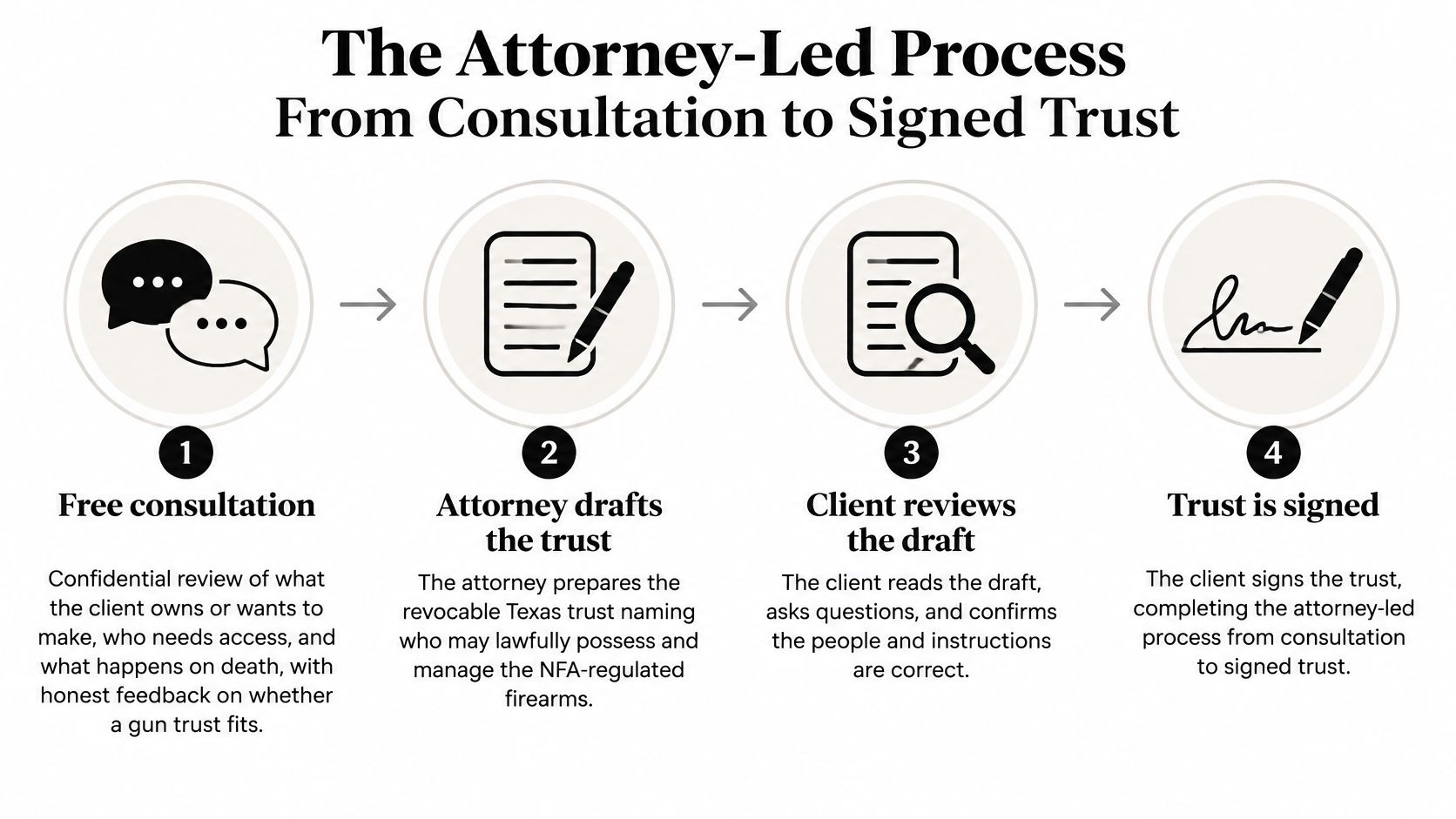
The Attorney-Led Process From Consultation to Signed Trust
A trust needs clear instructions for the people who will use it. The attorney-led process connects your ownership goals to lawful shared possession, succession, and the paperwork each requires. Approval speed alone is a weak reason to choose a trust.
The consultation starts with your situation and the legal options available.
1. Free consultation. Discuss what you own or intend to make, who needs access, and what should happen after your death. The firm provides a confidential review, honest feedback about options and potential outcomes, relevant legal guidance, and clear next steps. Ask whether a trust fits your needs before committing to drafting.
2. Intake and classification. Identify each item and determine whether the transaction involves making or transferring it. That determines the application. Use the ATF firearms forms library to review Form 1 for making and Form 4 for transfers. Settling classification first helps avoid filing the wrong paperwork.
3. Design decisions. Name trustees, identify responsible persons, choose successors, and establish possession and storage rules. Address beneficiaries, minor children, and future amendments. A trust works like an instruction manual: the people named in it need to understand both their authority and its limits. Broader access also brings paperwork responsibilities.
4. Drafting and review. The attorney drafts the trust and explains the names, powers, and succession provisions. Read it closely. Ask who may possess each item and what happens if a trustee dies or can no longer serve. Resolve unclear language before signing.
5. Signing and funding. Execute and notarize the trust, then coordinate assignments with any required federal approval. Signing the document does not itself authorize possession. Keep the signed original where your successor trustee can find it.
6. Federal submission. Assemble the applicable form, responsible-person questionnaires, fingerprints, photographs, chief law-enforcement copy, and any required tax. The applicant must wait for required approval before making or taking possession of an NFA firearm.
7. Recordkeeping and review. Keep the trust, approvals, and inventory together. Review trustee changes promptly, and revisit the documents after a move, marriage, death, or purchase so the written instructions remain useful.
Before hiring counsel, use our guide to choosing an estate planning attorney to prepare questions about drafting and review. Our Estate Planning Attorney in Humble practice handles wills, trusts, and probate matters, tailoring the work to each client's goals.
Schedule a consultation online, stop by the Humble location, or call (281) 817-1827.
What a Gun Trust Attorney in Humble Typically Costs
Two very different bills get confused in almost every conversation about cost. One is a government charge paid to ATF with your application. The other is an attorney fee, which depends on your facts and arrives as a written estimate after the free consultation.
| Line item | Cost | What drives it |
|---|---|---|
| Attorney drafting, one person with one or two NFA items | Quoted after consultation | Number of items and possession rules |
| Attorney drafting, married couple or several responsible persons | Quoted after consultation | Each added responsible person adds documents |
| Amendment to add or remove a trustee | Quoted after consultation | Whether federal filings must also be updated |
| Broader estate plan with will and powers of attorney | Quoted after consultation | Usually drafted in the same engagement |
| Making tax on Form 1 for most NFA firearms | $200 | Paid to ATF before the item is made |
| Transfer tax on machine gun or destructive device, Form 4 | $200 per item | Paid to ATF with the application |
| Transfer tax on silencer or short-barreled rifle, current Form 4 | $0 | Verify classification before budgeting |
| Transfer tax on any-other-weapon item | $5 | Set by 26 U.S.C. § 5845(e); verify current listing |
| Fingerprint cards and passport photo | Charged per person by the print and photo vendor | Two cards and one photo for each responsible person |
The government side is set by statute and by the ATF's current Form 4 instructions, which identify a $200 charge for a machine gun or destructive device and a $0 transfer tax for the other listed NFA categories, with the statute setting a $5 transfer tax for an item classified as an "any other weapon" under 26 U.S.C. § 5845(e). None of that money goes to a law office.
What Moves the Attorney's Number
Four things, mostly. How many responsible persons you name. How many regulated items the trust holds. Whether the trust stands alone or is drafted alongside a will and powers of attorney. And whether amendments are needed in the first year.
The per-person items are where budgets surprise people. Each responsible person needs two completed fingerprint cards and a photograph, plus a second copy of the questionnaire that goes to that person's chief law-enforcement officer, as the ATF's Rule 41F materials describe. Adding four adult children is a real cost decision, not a formality.
Why a Downloaded Template Costs More Later
A generic online trust usually skips three things: Texas signing formalities, a workable responsible-person procedure, and amendment language that matches how federal filings get updated. Repairing that document after a filing goes sideways tends to cost more than drafting it correctly the first time, and the repair happens under time pressure.
Questions worth asking any office, so quotes can be compared: how many responsible persons are included, is the ATF paperwork reviewed or just the trust, what does an amendment cost, and is a will or power of attorney included in the same engagement.
Common Questions Humble Owners Ask Before Calling
Is a gun trust legal in Texas, and does the state need to register it? Yes, it's legal, and no, there is no separate state registration. The trust still has to be a valid Texas trust, and every federal filing still applies to the items it holds.
Do I need a trust for one suppressor? Often not, if you're the only person who will ever use it and there's no one you intend to pass it to. The answer turns on your family, not your zip code. A single owner in a house full of trained adults faces a different question than a single owner who lives alone, because every other person with access to the safe is a potential unlawful-possession problem the trust is built to solve. That's why the consultation starts with two questions: who needs access, and what should happen on death.
Can I add a spouse or adult child later? Yes, by amendment. The new trustee completes the responsible-person questionnaire, prints, and photo before taking possession of anything. Do the paperwork first, then hand over the combination.
What happens to the items when I die? Trustees keep lawful possession while the estate is settled, and any eventual transfer to a beneficiary runs through a separate federal application. That's why the trust should name successors clearly and in order. A successor named third in line can step up if the first two can't serve, which matters more decades from now than it does the day you sign.
A local attorney matters here for a boring reason. Humble, Atascocita, and Kingwood families face identical federal forms, but the trust rarely stands alone. It usually sits inside a broader estate plan, and one office can coordinate the pieces so the trust, the will, and the rest of the plan don't contradict each other.
Bring a list of what you own or plan to buy. Include the model, the configuration, and who you'd want handling it if you couldn't.
The Law Office of Bryan Fagan helps Humble and Northeast Houston families build estate plans that hold together in real life, including the trust that carries a regulated firearm from one generation to the next. The attorneys take time to understand each client's situation before taking action, because every case is unique. If you're weighing a gun trust against individual ownership, the estate planning team will review what you own, who needs access, and what should happen on your death, then tell you plainly whether a trust earns its fee in your situation. Visit Law Office of Bryan Fagan to schedule your free consultation at the Humble office and get a clear answer before you file anything.