You've filed a motion because support payments stopped, the parenting schedule isn't working, or your family needs temporary arrangements during a divorce. You're checking your phone between work and school pickup, expecting a hearing date to appear. But the docket still doesn't show what you thought you requested.
That gap is where many self-represented parents get stuck. Filing a motion and obtaining a hearing setting are separate tasks. Understanding Harris County 507th District Court family docket procedures means knowing which calendar fits your request, how to obtain the setting, and what must be ready before the court can consider it.
For families in Humble, Atascocita, Kingwood, and Northeast Houston, getting those details right can help avoid an unnecessary trip, missed work, and another round of uncertainty.
Weekday Docket Map for the 507th Court
Say your former spouse stopped paying court-ordered support. You want enforcement, but you also need temporary arrangements addressing a separate custody issue. Those requests don't necessarily belong on the same docket: enforcement generally falls on Wednesday, while temporary orders fall on Tuesday or Thursday.
The 507th Court's published docket framework provides the weekday assignments and time windows below, including uncontested matters from 8:00 to 8:45 a.m., a 9:00 a.m. docket call, Friday discovery settings at 1:30 p.m., and temporary-orders hearings typically limited to one hour per party.
Weekday docket map for 507th Court family matters
| Day | Matters Typically Heard | Time Window | Notes |
|---|---|---|---|
| Every weekday | Uncontested matters | 8:00 to 8:45 a.m., then 9:00 a.m. docket call | Times can vary by court; confirm before you plan |
| Monday | Trials | Check the assigned trial setting | Final trials are handled outside the e-hearing system |
| Tuesday | Temporary orders and ancillary matters | Check the assigned hearing setting | Temporary-orders hearings are typically limited to one hour per party |
| Wednesday | Enforcement actions and CPS hearings | Check the assigned hearing setting | CPS hearings are handled outside the e-hearing system |
| Thursday | Temporary orders and ancillary matters | Check the assigned hearing setting | Confirm the setting in the docket before the day |
| Friday | Order entries and discovery disputes | 1:30 p.m. for discovery-dispute settings | Discovery disputes generally need a filed certificate of conference |
Match the request, not just the family problem
A docket category describes what you're asking the judge to do. An enforcement request asks the court to address alleged violations of an existing order. A temporary-orders request asks for arrangements while the case remains pending.
Neither category guarantees that the judge will hear every related disagreement that day. Your pleadings and setting need to identify the relief you're requesting.
Planning rule: Use the weekday map to identify the likely docket, not as permission to arrive without a confirmed setting.
An order-entry setting also isn't a substitute for finishing the paperwork. For uncontested final matters and order entries, required pleadings, proposed orders, and supporting forms must be filed; missing materials can prevent the matter from proceeding and may expose the case to dismissal.
Before arranging childcare or taking leave from work, confirm the current docket-call instructions with the assigned court. A calendar slot is useful only when your case is properly set and your filing package is ready.
Scheduling Your Motion and Knowing How It Is Heard
Start with the kind of proceeding and the way you filed. The joint court policies require most e-filed motions to be scheduled through the Harris County District Clerk's electronic hearing system, excluding CPS hearings and final trials, and place responsibility on parties to monitor the case docket sheet for rulings.
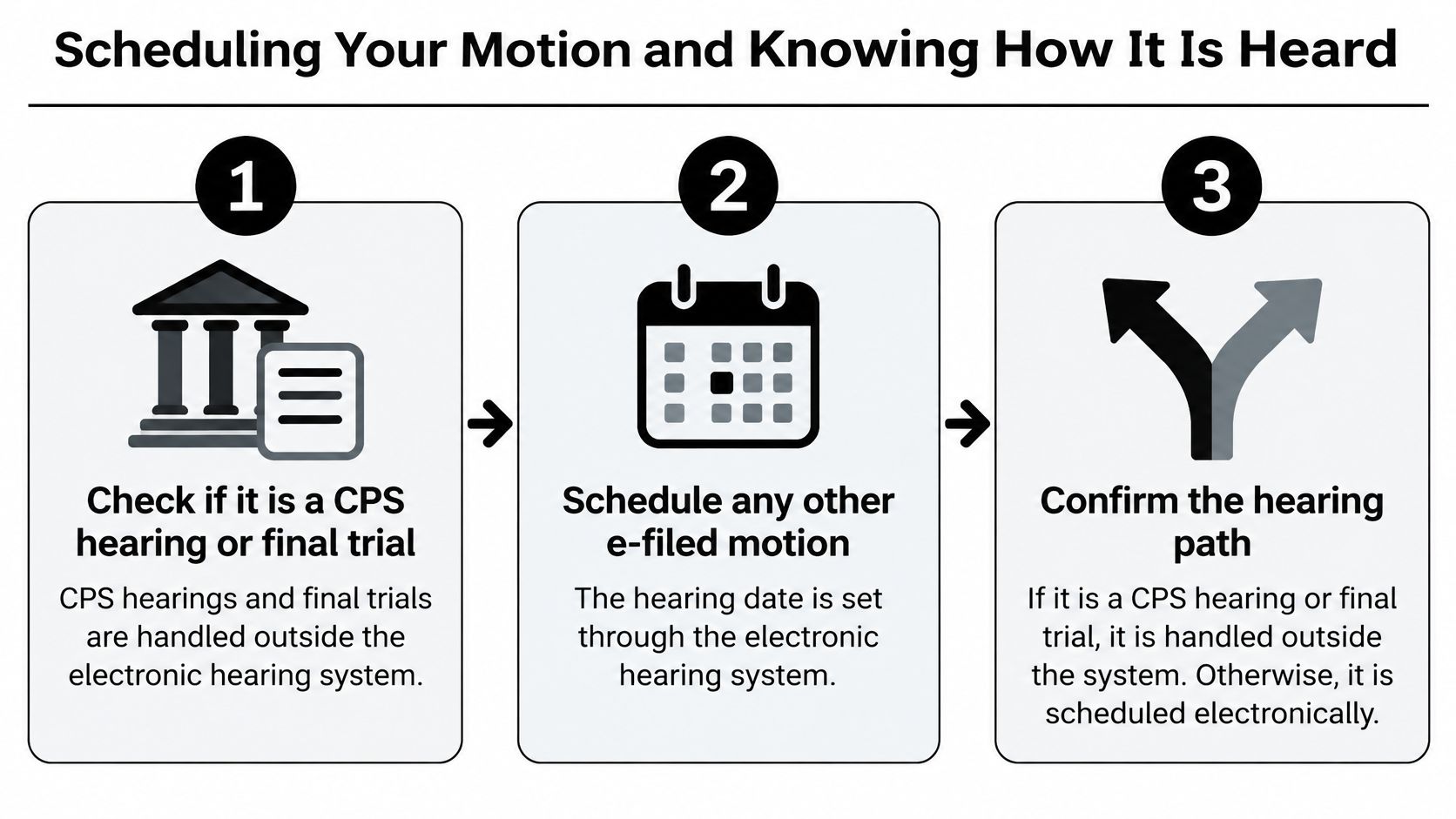
Follow the correct scheduling path
- Identify any exception. If your matter is a CPS hearing or final trial, confirm the setting process directly with the court rather than using the ordinary motion-scheduling route.
- Schedule other e-filed motions. Use the District Clerk's e-hearing system to obtain an available date for the appropriate motion category. Keep the setting confirmation with your filed motion.
- Contact the court clerk for a non-electronic filing. Self-represented parties filing outside the electronic system must obtain a setting through the court clerk.
- Read how the matter will be considered. An oral hearing allows argument before the court. A submission may be decided on the written materials without an oral hearing. Don't assume you can choose either route.
- Serve the correct notice. The 507th Court's local rules and joint procedures generally require submission notice at least 10 days before the setting, unless a statute or rule requires more time.
- Verify and monitor. Confirm the setting on the docket, then use the District Clerk's Case Search docket sheet to check subsequent case activity and rulings.
If you're unsure whom to contact, the firm's guide to working with the Harris County family court coordinator to obtain a hearing date can help you prepare a focused inquiry.
How 507th Court matters are heard and what they need
| Matter | How It Is Heard | Notice or Prerequisite |
|---|---|---|
| Motion set for submission | Decided without an oral hearing | Submission notice within the required advance-notice period; check for a longer applicable requirement |
| Discovery dispute | Oral argument, not submission | Filed certificate of conference |
| Dismissal for want of prosecution | Dedicated DWOP docket with an oral hearing | Review the dismissal notice and confirm attendance instructions |
| Temporary orders hearing | Time-limited presentation by each party | Affidavit and judicial approval for modification requests seeking temporary orders |
| CPS hearing or final trial | Handled outside the e-hearing system | Confirm the assigned court's scheduling instructions |
A dismissal for want of prosecution, often called a DWOP, concerns whether the case should remain pending because of a lack of progress. Don't treat a dismissal notice as routine correspondence.
For a submission, your written materials must explain the requested relief without depending on a speech you expect to give. For a discovery dispute, prepare to explain which information is missing and what efforts you made to resolve the disagreement.
Filed doesn't mean set, and a setting doesn't cure defective notice.
A missed notice deadline can cost you the date even when you obtained it through the correct scheduling system. Check service before treating the hearing as ready to proceed.
Filing Package Checklist Before Your Setting
A useful hearing folder contains more than copies of everything you've uploaded. It should let you quickly identify what was filed, what was served, what relief you're requesting, and which documents support it.

Build a usable hearing folder
- Filed pleadings. Keep the accepted version of your motion or petition. A saved draft isn't proof that the clerk accepted it.
- Proposed order. Make sure it accurately states the relief requested and uses the court's required format. The judge shouldn't have to reconstruct your request from scattered notes.
- Supporting forms. Check that required forms are complete and consistent with the proposed order, especially names and case information.
- Modification affidavit. If you're seeking temporary orders in a modification case, include the necessary affidavit and confirm that the required judicial approval has been obtained.
- Conference certificate. For a discovery dispute, verify that the certificate of conference was filed, not merely drafted.
- Organized exhibits. Prepare a numbered exhibit list and readable documents. Label the specific payment record, message, or calendar entry you intend to discuss.
- Disclosure and document exchange. Confirm what must be exchanged and whether you've completed it. Bringing documents to court isn't the same as providing them properly beforehand.
- Service records. Match the notice and proof of service to the actual setting and applicable notice requirement.
- Language-access arrangements. Raise interpreter needs before the hearing so the court can provide scheduling instructions.
Separate filing problems from legal problems
An electronic filing receipt can tell you that you submitted documents, but you should also check acceptance and the docket entry. The firm's explanation of Harris County eFileTexas requirements for a family case helps distinguish those administrative steps.
For law offices managing document-heavy cases, HireParalegals' virtual legal assistant services are an administrative support option for organizing records and tracking paperwork. That support doesn't replace an attorney's judgment about evidence, notice, or the relief a court can grant.
Keep this checklist with your docket printout and review it early enough to correct omissions. A tidy binder helps, but complete and properly filed documents matter more than presentation.
Courtroom Protocol, Mediation and Continuances
On hearing day, leave room for travel, parking, security, and finding the correct courtroom. For a parent coming from Humble or Kingwood, a last-minute school issue can quickly consume that margin.
Bring your case number, setting confirmation, docket printout, and hearing folder. Keep your phone quiet and follow the court's instructions about where to wait and how to check in.
Present the request clearly
Begin with what you want the judge to order, then connect each important fact to supporting evidence. A long account of the relationship can use up time without answering the question before the court.
Prepare a short outline identifying your requested relief, witnesses, and exhibits. For a temporary-orders hearing, prioritize the immediate issues rather than trying to present every dispute that might matter at final trial.
- Address the judge. Don't argue directly with the other parent across the courtroom.
- Answer the question asked. Give a direct answer before adding necessary context.
- Use documents deliberately. Know which exhibit supports each point instead of searching through screenshots while speaking.
Hearing-day recommendation: Practice explaining your request aloud in plain language. If you can't state what order you want, refine the request before court.
Confirm mediation and postponement requirements
Ask whether the court has referred your case to mediation or requires it before final trial. Get any deadlines and attendance instructions in writing rather than assuming another family's experience applies to yours.
The firm's explanation of mediation in family court can help you understand the process. Mediation offers an opportunity to negotiate, but preparation still matters: bring the information needed to evaluate proposed parenting, financial, or property terms.
If you need a continuance, confirm the court's procedure and submit the appropriate written request before the setting. Explain the reason and don't assume that agreement from the other side means the court has approved a postponement.
Ask court staff about courtroom logistics, exhibit formats, and proposed-order delivery. Staff can explain procedures, but they can't develop your legal argument. A calm manner and an organized folder won't decide the case, but they can help you communicate when you're already under stress.
Local Pitfalls for Humble and Northeast Houston Families
An old checklist can look reassuring because someone else used it successfully. That doesn't make it current: the Harris County District Clerk's family-court guidance identifies the unified Family Trial Division framework effective May 1, 2025, replacing rules that had remained substantially unchanged since 2003.
The revision also clarified disclosure and document-exchange requirements and incorporated a language-access plan. Current preparation should account for both your documents and your ability to participate meaningfully in the proceeding.
Replace assumptions with specific checks
Borrowing another court's calendar. The District Clerk warns that docket-call times differ by court. Ask the assigned court for current instructions instead of copying a friend's hearing routine or relying on an unofficial calendar.
Treating missing paperwork as a minor inconvenience. Missing pleadings, proposed orders, affidavits, or a conference certificate can prevent consideration; some omissions can expose a case to dismissal. For Atascocita parents coordinating work and school pickup, checking the package before traveling is far less disruptive than trying to fix it at the courthouse.
Relying on a supposed success rate. Don't use general county statistics to predict how this court will decide your motion. There isn't a reliable official court-specific hearing success rate, continuance rate, or disposition benchmark to use for that purpose.
Guessing at the judge's preferences. Confirm administrative requirements for exhibits, courtroom conduct, and proposed orders. An anecdote about what another judge accepted isn't a dependable instruction for your setting.
Know what requires legal judgment
Court staff can clarify where to send a document or how to confirm a setting. Whether your motion requests the right remedy, whether evidence is admissible, and whether a proposed order protects your interests are different questions.
A parent may have a serious concern but ask for relief that doesn't match the motion on file. Another may bring persuasive records without completing the required exchange. Those problems call for more than another docket search.
For Humble and Northeast Houston families, a common obstacle is the mismatch between what was filed and what the court needs to hear the matter. Focus on that match instead of trying to predict an outcome from someone else's case.
Confirm Your Setting and Schedule a Free Consultation
Before the coming week fills with work, school activities, and transportation plans, set aside time to verify the practical details of your case. You don't need to solve every issue at once, but you should know whether the next court event is ready to proceed.
Make the next contact count
- Check the docket sheet. Identify the actual setting, not just the entry showing your motion was filed.
- Confirm the hearing type. Know whether you're preparing for oral argument, submission, or another proceeding.
- Review notice and service. Verify the relevant dates and supporting records.
- Resolve uncertainty with the assigned court. Have your case number and a specific procedural question ready.
- Finish the filing package. Separate missing documents from questions that require legal advice.
If your issue is unpaid support or an existing parenting order that isn't being followed, describe the specific provision and alleged violation when seeking advice. Enforcement preparation works better with the signed order and an organized account of noncompliance than with a general description of conflict.
For broader orientation, distinguish enforcement from the overall path of a family case, including filing, service, temporary relief, discovery, settlement, and final resolution. Custody and conservatorship representation is available through the firm's Child Custody Lawyer in Humble, TX service.
Bring the information that helps someone assess your situation
Have the current order, recent filings, hearing notice, and your main questions available for a consultation. Law firms may use administrative support such as Virtual Legal Assistants' legal intake specialists to collect initial information; legal advice should come from the attorney reviewing your circumstances.
Families in Humble, Atascocita, Kingwood, and Northeast Houston can request a free consultation at our downtown Humble office. Whether you need family-law guidance or separate assistance with criminal defense or estate planning, explain the immediate concern and any pending court date so the conversation can focus on your next step.
The Law Office of Bryan Fagan offers family-law representation and free consultations at its downtown Humble office for families navigating custody, divorce, and related court procedures. Visit Law Office of Bryan Fagan to schedule a consultation and discuss your setting, filings, and questions before the hearing date.