You've got a notice in your hand, a hearing date circled on the calendar, and a lot of questions you didn't expect to ask. Maybe you're in Humble trying to arrange childcare for a Monday morning downtown, or in Atascocita wondering whether you need to take the whole day off work for a setting that might last twenty minutes. That's normal. Harris County 257th District Court family docket procedures feel confusing at first because the date on the notice is only the end of the timeline, not the start. Work backward from that date, and the pieces fall into place in a clear order.
Docket Days and Settings at a Glance
A Humble parent who assumes every family court date works the same way can prepare for the wrong kind of morning. A trial docket call is not an entry setting, and a contested hearing in a non-trial week doesn't run like a brief ancillary matter. Your first job is simple. Match your type of matter to the court's usual pattern, then trust the time printed on your actual notice over anyone's memory.
The Harris County District Clerk Family Courts page identifies the 257th as one of Harris County's family district courts governed by the Local Rules of the Family Trial Division, and the updated local rules became effective May 1, 2025, with stated goals of greater transparency, consistency, and accessibility for attorneys and self-represented litigants. That revision matters if you're holding old paperwork from a neighbor's case or a printout from years ago. I would check the current rule and your notice first, before you build childcare, travel, or time off around a date.
Matching Your Matter to the Right Row
Use this lookup to sanity check what you've been told, not to replace the notice itself.
| Matter | Usual setting | Notes |
|---|---|---|
| General trial docket | Twice each month, Monday at 9:00 a.m. | Trial-week setting; check the notice for the call |
| Non-trial docket weeks | Preferential trials and contested hearings, commonly 10:00 a.m., 11:00 a.m., or 1:30 p.m. | Exact time depends on the court's announcement |
| Temporary orders and ancillary matters | 9:00 a.m. docket | Affidavit required for temporary or additional temporary relief |
| Enforcement hearings | Usually Thursday at 9:00 a.m. | Per the court's published FAQ |
| CPS matters | Tuesday at 8:00 a.m. | Per the court's published FAQ |
| Entries | Friday at 9:00 a.m. | Per the court's published FAQ |
| Discovery disputes | Throughout the week | Confirm the specific setting in the notice |
Notice the practical difference those rows create. Someone driving in from Kingwood for an early CPS setting needs a different leave time than someone coming from Northeast Houston for an afternoon contested hearing. Parents also prepare differently. A trial week may require witnesses and a full exhibit set ready to go, while an entry setting usually centers on getting a proposed order signed and entered.
Practical rule: Read the notice for the matter type first and the date second. The type tells you how to prepare, and the date tells you when.
Why the Notice Wins Over Memory
Court announcements can shift a non-trial setting to a different start time within the same day. That's why two people in the same court on the same morning can legitimately have different report times. Don't rely on what another parent in the hallway was told last month. Confirm your own setting in writing, note whether you're in a trial week or a non-trial week, and plan your drive from Humble or Atascocita around that confirmed time.
How to Set a Hearing Through eHearing
Setting a hearing isn't one click. You file first, then you request a setting, then you wait for the clerk to confirm it. Families lose time when they treat step two as if it were the finish line. Follow the sequence in order and you will avoid the most common reset I see recommended against in practice, showing up prepared for a date the court never approved.
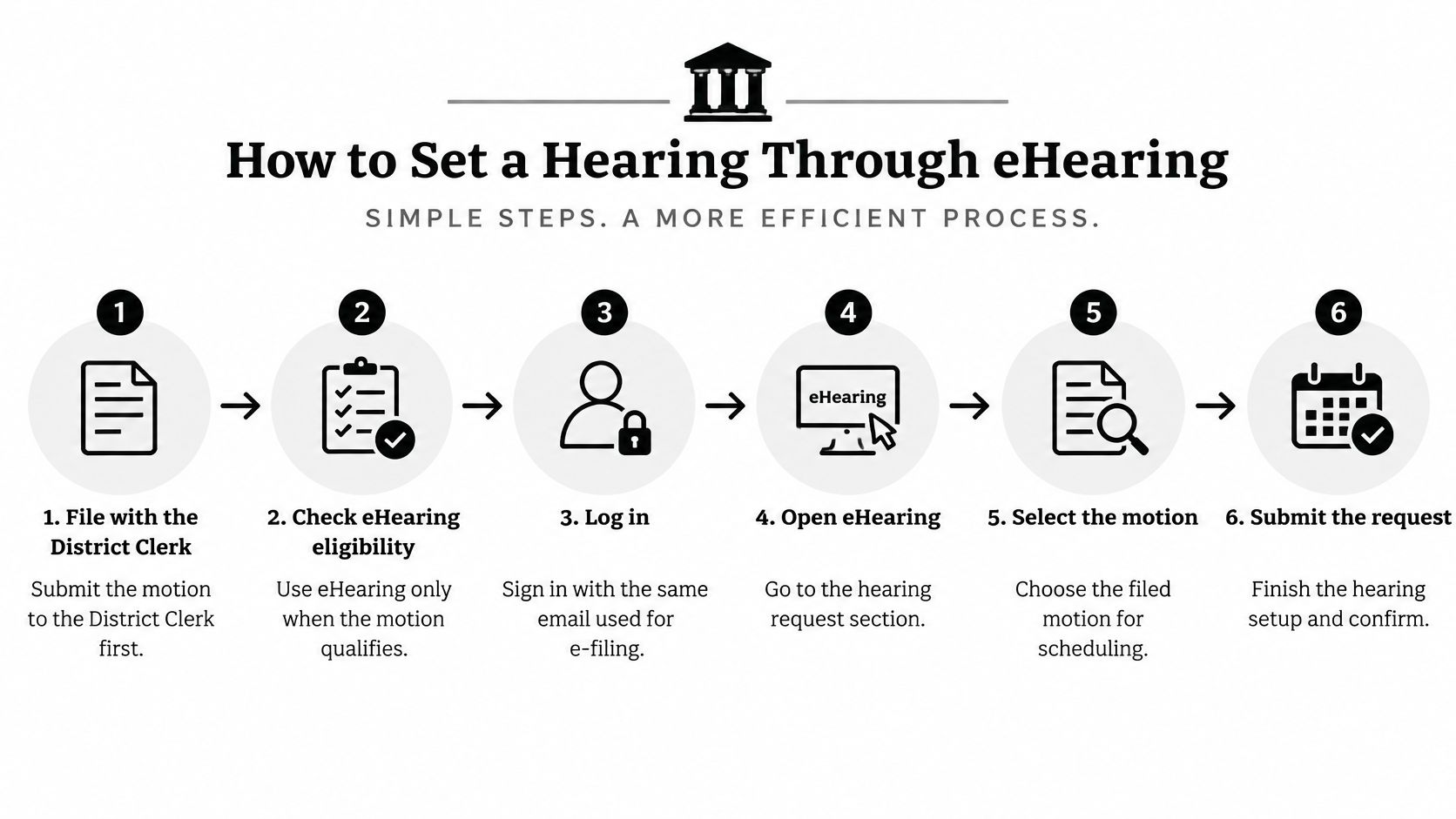
The Nine Steps in Order
The Harris County District Clerk eHearing guide lays out a workflow that begins by filing the motion through the District Clerk and then using eHearing when the motion qualifies, logging in with the same email used for e-filing, opening Online Services > My Filings, locating the filed motion, selecting the gavel icon, entering hearing information, choosing an available date, submitting the request, and waiting for clerk review. Work through it like this.
- File the motion first. Submit it through the District Clerk before you touch the calendar, because eHearing schedules a motion that already exists in the system.
- Log in with your e-filing email. Use the same email you used for e-filing so your filings show up in your account.
- Open Online Services then My Filings. Your filed documents are stored there.
- Locate the filed motion. Pick the exact motion you want heard, not an earlier draft or a different pleading in the same case.
- Select the gavel icon. That icon opens the hearing request for that motion.
- Enter the hearing information. Match what you type to the relief you requested in the motion.
- Choose an available date. Treat your selection as a request at this stage, not a confirmed setting.
- Submit and wait for clerk review. Don't notify witnesses or book time off as if the date were final yet.
- Serve the file-stamped notice. Once the clerk returns it by email, serve it on every other party and save your proof.
The Clerk Approval Checkpoint
Here's the checkpoint that protects you. The clerk, not the automated calendar alone, records the final hearing time and returns a file-stamped notice by email. Until that notice arrives, you have a pending request, not a setting you can safely build a work schedule around. If you're coordinating a drive from Kingwood or arranging for someone to watch your children in Humble, wait for that email.
If you want background on how court coordinators fit into this process, our guide on getting a hearing date through the Harris County family court coordinator explains that role in plain terms. For readers at the very start of a case, The Divorce Process in Humble: What to Expect offers a step-by-step look at filing for divorce in Humble and Harris County.
A Quick Quality Control Check
Before you rely on any setting, run four checks.
- File stamp present: Confirm the motion itself is file-stamped.
- Relief matches docket type: Confirm the relief you requested matches the kind of setting you selected.
- Notice shows the approved setting: Confirm the notice reflects the clerk-approved date and time, not just your requested date.
- Proof of service saved: Keep proof that you served the notice on the other parties with the notice itself.
A tentative online date is a planning hint. A clerk-approved, file-stamped notice is a court date.
One more caution belongs here because it causes real resets. Requests for temporary or additional temporary orders must be accompanied by an affidavit. Arriving with a well-written motion but no sworn statement attached can leave the court with nothing proper to act on for that relief. Check the attachment before you submit, not in the courthouse hallway.
Forms, Affidavits and Exhibit Deadlines
Start with the counting problem that catches good, organized parents off guard. Say your hearing is on a Monday. Your exhibits don't go to the other side on Monday morning, and they don't go on Sunday night either. Count backward to the business day before the hearing, and you're looking at Friday afternoon. That single calculation changes your whole week, including when you need copies made and when you can still fix a labeling mistake.
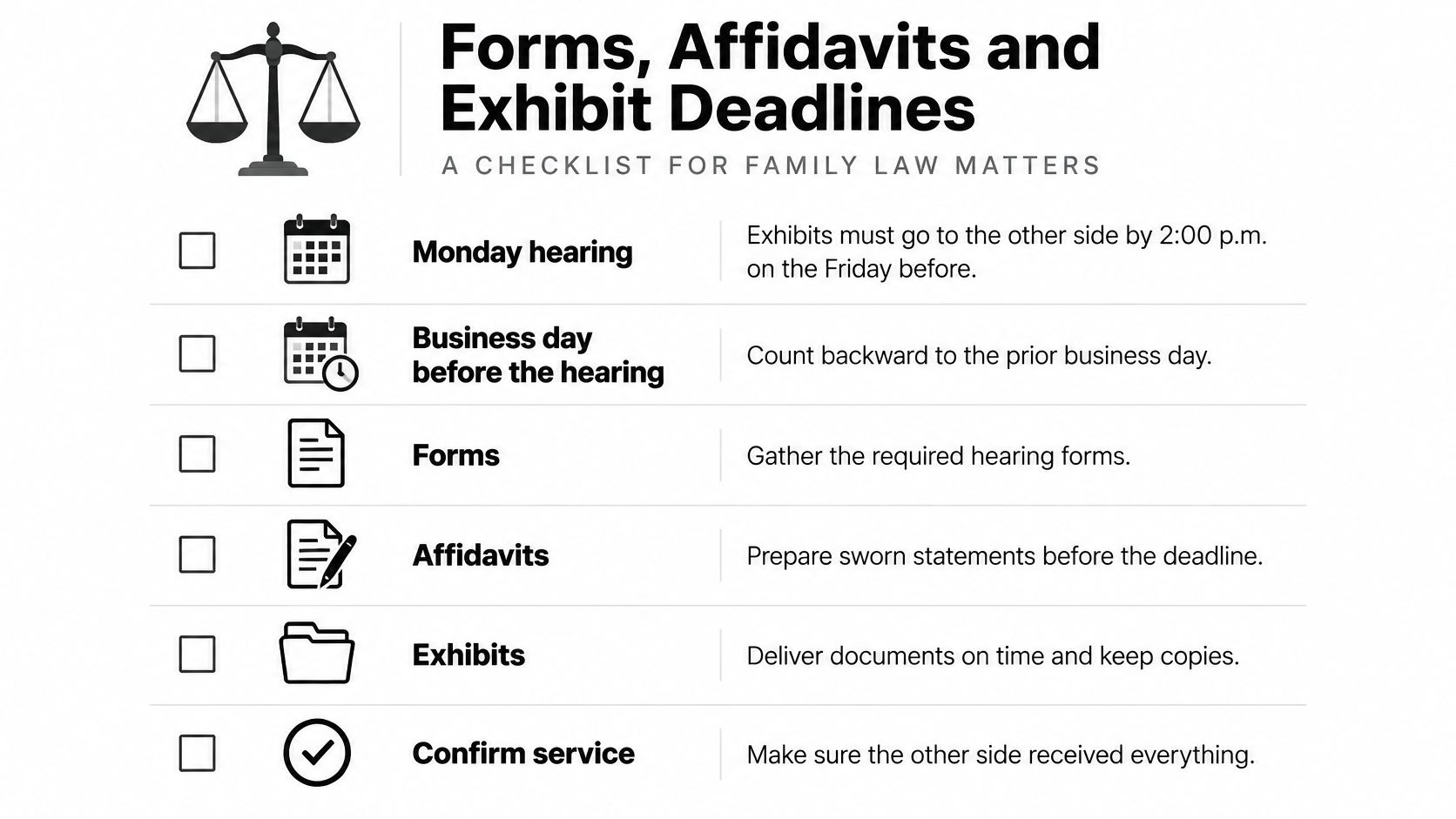
The court's published FAQ states enforcement hearings are usually scheduled Thursdays at 9:00 a.m., CPS matters are heard Tuesdays at 8:00 a.m., and entries are set Fridays at 9:00 a.m., and a Harris County procedural guide states exhibits must be exchanged with the other parties by 2:00 p.m. on the business day before the hearing. For a Monday hearing, that means your evidence is generally due to the opposing party by 2:00 p.m. on the preceding Friday. I would put that Friday time on your calendar in larger print than the hearing itself, because missing it can undermine a hearing you otherwise prepared for carefully.
A Worked Example From Kingwood
Say a Kingwood father is asking for temporary child support while a divorce is pending. He has a Monday temporary orders setting. Working backward, he needs his request supported by a sworn affidavit that explains, in his own words and based on his own knowledge, why he needs the temporary relief he's requesting. Pay records, childcare receipts, health insurance costs, and a simple monthly budget might become exhibits, but only if they're organized, labeled, and exchanged on time.
His week now has a shape. By Wednesday, the affidavit should be drafted, reviewed for accuracy, and ready to sign. By Thursday, exhibits should be in a clean order, each labeled so the judge, the other parent, and he are all looking at the same page when someone says Exhibit 3. By early Friday, copies for each party should be complete, because a printer problem at 1:30 p.m. leaves almost no room to recover before the exchange deadline.
He also needs to log how and when he sent the exhibits and keep that record with the hearing notice and proof of service. If the other side later says they never received a document, a calm, dated record beats a stressed memory. That's not about being adversarial. It's about making your file easy to verify.
Your Paperwork Checklist
Keep one folder, paper or digital, for the setting. When anxiety spikes the night before a hearing, you want to open one place and see everything checked off rather than searching texts, email threads, and a kitchen counter.
| Item | Rule | Check |
|---|---|---|
| Affidavit | Required with a request for temporary or additional temporary relief | Attach it to the request |
| Exhibits | Exchange by 2:00 p.m. on the business day before the hearing | A Monday hearing means Friday at 2:00 p.m. |
| Proof of service | Serve the file-stamped notice on every other party | Save the proof with the notice |
| Discovery and mediation | Use the dates in the court's order and scheduling | Do not assume a standard interval |
| Forms and judge preferences | Current District Clerk and 257th materials, standing orders, and court staff | Do not use an older copy |
| Two-day check | Two business days before the hearing | Confirm the setting, exchange, affidavit, room, and time |
Use the table as a tick list, not as reading material. Print it or copy it into your case notebook, then mark each row only when the task is done. Labeled and copied means the other parties' sets exist, not that the documents exist somewhere on your phone. Exchange logged means you wrote down the date, time, and method of delivery, not that you remember hitting send.
If electronic filing is part of your preparation, review the local basics in our overview of Harris County eFileTexas requirements for a family case so a rejected filing doesn't eat the day you set aside for exhibits. A filing bounce on Thursday can consume the buffer you needed on Friday. Build the buffer in advance.
What an Affidavit Should Do
An affidavit is a sworn written statement. It should stick to facts you personally know, in a clear order, and support the specific temporary relief you're asking the court to grant. Vague conclusions don't help a judge who has limited time. Specific dates, amounts from documents you can point to, and a short explanation of what changed or what's needed right now give the court something usable.
Don't pad it. A focused affidavit that tracks your exhibits is stronger than a long narrative that wanders into the entire history of the marriage. If an exhibit proves a point, refer to it plainly so the judge can connect your words to the paper. If you don't have personal knowledge of something, don't guess in a sworn statement.
Building an Exhibit Set the Court Can Follow
Judges and opposing parties can only use what they can find quickly. Put exhibits in the order you expect to mention them, label each one the same way in every copy, and remove duplicates that add bulk without adding proof. A short, well-labeled set signals preparation and respect for the court's time. A document dump forces everyone to hunt, and the point you cared about most can get lost.
- Label consistently: Use the same exhibit number or letter on your copy, the court's copy, and every party's copy.
- Order by use: Arrange exhibits in the sequence your affidavit or testimony will raise them.
- Cut duplicates: Keep the clearest copy of each record and leave out repeats.
- Check legibility: Make sure screenshots, receipts, and statements are readable when printed, not just on your phone screen.
- Log the exchange: Write down when and how you delivered the set to the other parties.
There's a trade-off here. Sending exhibits early gives the other side more time to prepare, which some people resist instinctively. Meeting the deadline cleanly, though, protects your ability to use your proof and keeps the hearing focused on your children's needs instead of a fight about late paper. In family court, credibility gained through orderly preparation is worth more than surprise.
Discovery and Mediation Dates Live in Your Order
Don't assume discovery or mediation follows a standard interval that applies to every case in the same way. Those dates depend on the court's order and scheduling in your case. Read the order you received, pull the dates from it, and put them on the same backward timeline as your hearing. If an order gives you a mediation deadline or a discovery cutoff, treat that date as the anchor and count your preparation days back from it.
If you can't find a date you expected to see, that's a question to resolve before filing, not at the hearing. Check current District Clerk and 257th Court materials, review any standing orders that apply, and confirm judge-specific preferences with court staff when needed. Older copies of forms passed around between friends in Humble or Atascocita can be out of date. Confirm the form is current before you spend an evening completing it.
The Two Business Day Compliance Check
Two business days before the hearing, pause and verify five things. Confirm the clerk-approved setting, confirm the exhibit exchange is done or scheduled to be done on time, confirm the affidavit is attached where required, and confirm the room and time from your notice. This check is about compliance. It does not predict how a judge will rule, and no one should present a tidy checklist as a probability of success. What it does is remove preventable problems so the court can focus on the core issues in your family's case.
Work backward from the hearing, and let each deadline claim its own day. Cramming the affidavit, exhibits, and service into the final afternoon is where small, fixable mistakes turn into resets.
For Northeast Houston families juggling shift work, school pickups, and a drive downtown, that backward plan is the difference between a stressful hearing and a manageable one. You can't control the other party or the outcome. You can control whether your paper is complete, exchanged, and easy to follow.
Docket Call and Courtroom Conduct
Think of hearing morning as a walk that starts in a parking garage, not at the courtroom door. You leave Humble, Atascocita, or Kingwood early enough to handle downtown traffic, you park, you clear security, you find the right courtroom, and only then does docket call begin. Every one of those steps takes longer when you're nervous. Build slack into the morning so a slow elevator doesn't become a legal problem.

The early arrival advice exists for a concrete reason. Family Trial Division rules allow a court to pass a motion at the responding party's request when the moving party or attorney doesn't appear within the early window after docket call. In plain English, if you filed the motion and you're not there promptly, your hearing can be passed even though you prepared for weeks. I would rather see a client sitting in the courtroom well before the call than sprinting through security hoping the judge starts late.
Getting There Without the Scramble
The county's family district courts sit at the Harris County Civil Courthouse, 201 Caroline Street, Houston, Texas 77002, with regular weekday operating hours that run through the business day. Plan around a weekday trip and give yourself time for parking and security screening. If you're coming from Northeast Houston during morning rush, your drive time on a calm Sunday is not a useful estimate.
- Leave with a buffer: Aim to be parked and inside with time to spare, not pulling in at your report time.
- Bring your file: Carry the notice, affidavit, exhibits, and identification in one folder you can open quickly.
- Know your room: Confirm the courtroom from your notice before you leave home so you're not searching directories under pressure.
If you've never attended one of these settings, our walk-through of what happens at a family court hearing in Harris County can lower the uncertainty before the morning arrives. Knowing the rhythm of check-in, waiting to be called, and speaking in turn helps you stay composed.
Conduct That Helps Your Presentation
Dress neatly, silence your phone before you enter, and speak only when you're addressed unless the court invites more. If you have an attorney, let your attorney lead and answer the questions you're asked clearly and briefly. Don't interrupt the judge, the other party, or a witness, even when you disagree strongly with what's being said. Your turn to respond will come, and a calm response carries more weight than a frustrated one.
If you're representing yourself, a short, organized presentation usually serves you better than a long speech. State what you're asking for, point to the affidavit or exhibit that supports it, and stop when you've made the point. Judges handling a full family docket appreciate a litigant who can find a document quickly and answer a direct question directly. That steadiness doesn't guarantee an outcome, but it keeps the court focused on your children's or your property's actual issues instead of courtroom friction.
If your case is passed or reset, don't leave on a verbal understanding alone. Confirm the new setting in writing before you head back to the parking garage, and note any new deadlines the court gives you that day. A reset is disappointing, especially after arranging childcare and time off, but leaving with the correct new date and instructions turns a frustrating morning into a usable next step.
Book a Free Consultation With Our Humble Office
Put your next steps in order and the docket stops feeling like a maze. First, confirm your docket day and time from the notice itself. Second, check whether your motion qualifies for eHearing and wait for clerk approval before you treat a date as final. Third, list your affidavit, exhibits, and proof of service, and mark the Friday exhibit deadline in bold if your hearing falls on a Monday.
Most family cases don't end at one setting. A divorce can move through temporary orders, discovery, mediation, and later hearings on custody, child support, or property division. Each setting builds on the paper and the orders that came before it, which is why getting the first timeline right matters beyond a single morning downtown. Families in Humble, Atascocita, Kingwood, and Northeast Houston do better when they treat the docket as a sequence they can plan, rather than a series of surprises.
Where to Read Next
If you'd like a broader picture before your hearing, start with our Harris County Family Courts guide for an overview of how family cases move through the county's courts. If your problem is different, and an existing divorce decree or custody order isn't being followed, the Enforcement of Court Orders page covers that path. Reading the right overview first keeps you from preparing for a temporary orders hearing when your real issue is enforcing an order the court already signed.
Small offices, including local firms, often look at tools such as answering services for law firms from Voicedial.ai to make sure calls about settings and deadlines aren't missed when staff are in court. For you as a client, the point is simpler. You deserve a call back and a clear answer when a date changes or a deadline is close.
A Clear First Step
You don't have to sort out trial weeks, ancillary dockets, and exhibit counting on your own. At the Law Office of Bryan Fagan, our Humble team helps local families with divorce, custody, child support, and property division, and we also serve neighbors who need criminal defense or estate planning guidance. A free consultation at our downtown Humble office gives you a chance to bring your notice, ask what your specific setting requires, and leave with a backward timeline built around your actual date.
Bring what you have, even if it's just the notice and a list of questions. We'll help you confirm the setting, identify the paper you still need, and talk about the next step without promising an outcome no attorney can guarantee. A clear plan and local knowledge can make your next trip downtown feel manageable.
If a 257th District Court setting is on your calendar and you're unsure whether your affidavit, exhibits, and service are in order, the Law Office of Bryan Fagan can review your notice and build a deadline plan around your hearing date. Visit Law Office of Bryan Fagan to schedule a free consultation with our Humble office and get clear, local guidance for your family's next step.