You filed a motion on Tuesday, saved the confirmation email, and started arranging time off work. By the weekend, you're still wondering when the judge will hear it. For a parent in Humble trying to resolve a custody or divorce problem, that uncertainty can feel like another problem piled onto an already difficult week.
The important distinction is simple: filing a document is not the same as getting a hearing. Harris County 247th District Court family docket procedures involve separate decisions about filing, scheduling, notice, and appearance. Knowing who handles each step helps you avoid unnecessary trips from Humble, Atascocita, Kingwood, or Northeast Houston.
Which Family Docket Your Case Lands On
That Tuesday filing could involve an uncontested divorce, a temporary parenting arrangement, or a request to enforce an existing order. Those matters don't automatically belong on the same calendar. Before asking when the judge can hear your request, identify what you're asking the judge to do.
Docket means the court's calendar or list of matters awaiting action. A docket call is different from the hearing itself: the court calls scheduled cases and determines how they'll proceed.
Match the request to the calendar
247th District Court family docket tracks at a glance
| Docket track | Typical matters | Published timing | Live hearing? |
|---|---|---|---|
| Daily docket call | Active family matters on the day's calendar | Daily at 9:30 a.m. | Follow the appearance instructions for the scheduled matter |
| Uncontested matters | Uncontested final decrees and prove-ups | From 8:30 a.m. once required forms are filed | Yes, unless an authorized submission method is used |
| Temporary orders and ancillary | Temporary orders, counsel withdrawals, substitutions | Generally Tuesday, Wednesday and Thursday | Yes |
| Contempt and enforcement | Contempt motions and enforcement requests | Confirm setting time with court coordinator | Yes |
| Submission docket | Motions decided on paper | Fridays, with published guidance listing 10 a.m. or 1:30 p.m.; confirm with court | No |
Published schedules don't always agree. In particular, the Friday submission times differ between policy documents, and ancillary scheduling descriptions aren't identical either. Treat the table as an orientation tool, not permission to appear without confirming your actual setting.
Ask these questions before scheduling
- What is the matter? Identify the motion or order, rather than describing everything that has happened in the case.
- Is it contested? An agreement on some issues doesn't make the remaining disputed issues uncontested.
- Is an appearance required? Confirm whether the judge expects live testimony, a remote appearance, or written materials only.
A prove-up is a presentation supporting an agreed or otherwise uncontested final order. Even when everyone agrees, the court still needs the required paperwork and an authorized method of presenting it.
Your filing date records when you submitted papers. Your hearing date tells you when the court has scheduled action. Keep those entries separate.
Ancillary Relief Versus Final Resolution
Think of the ancillary docket as urgent care: it addresses something that needs attention while the larger case continues. Final resolution is the broader treatment plan that settles the remaining issues.
Court staff help direct families through different stages of that process.

The Supreme Court of Texas-approved Local Rules of the Family Trial Division classify temporary injunctions, temporary orders in original proceedings, writs of habeas corpus, most enforcement and contempt motions, temporary receiverships, and motions to transfer as ancillary matters. These proceedings address immediate, interim, or procedural needs rather than necessarily resolving the entire family case.
What temporary relief can accomplish
Say a spouse is preparing to sell a shared vehicle while a divorce is pending. The other spouse may seek temporary relief to preserve the vehicle, while the eventual division of that property remains unresolved. The temporary request and the final property decision serve different purposes.
Choosing the wrong docket can delay consideration. Calling something urgent also doesn't automatically establish an emergency or entitle someone to immediate relief.
- Interim signals: A time-sensitive risk, a need for stability before trial, or a request to preserve property.
- Final signals: A request to resolve the overall property division, parenting arrangement, or support dispute.
For the broader filing sequence, The Divorce Process in Humble: What to Expect provides a step-by-step look at divorce in Humble and Harris County.
This video offers another format for learning about the process.
Practical distinction: Ask what protection you need while the case is pending, separately from what you want the final judgment to decide.
How to File and Serve Your Papers Step by Step
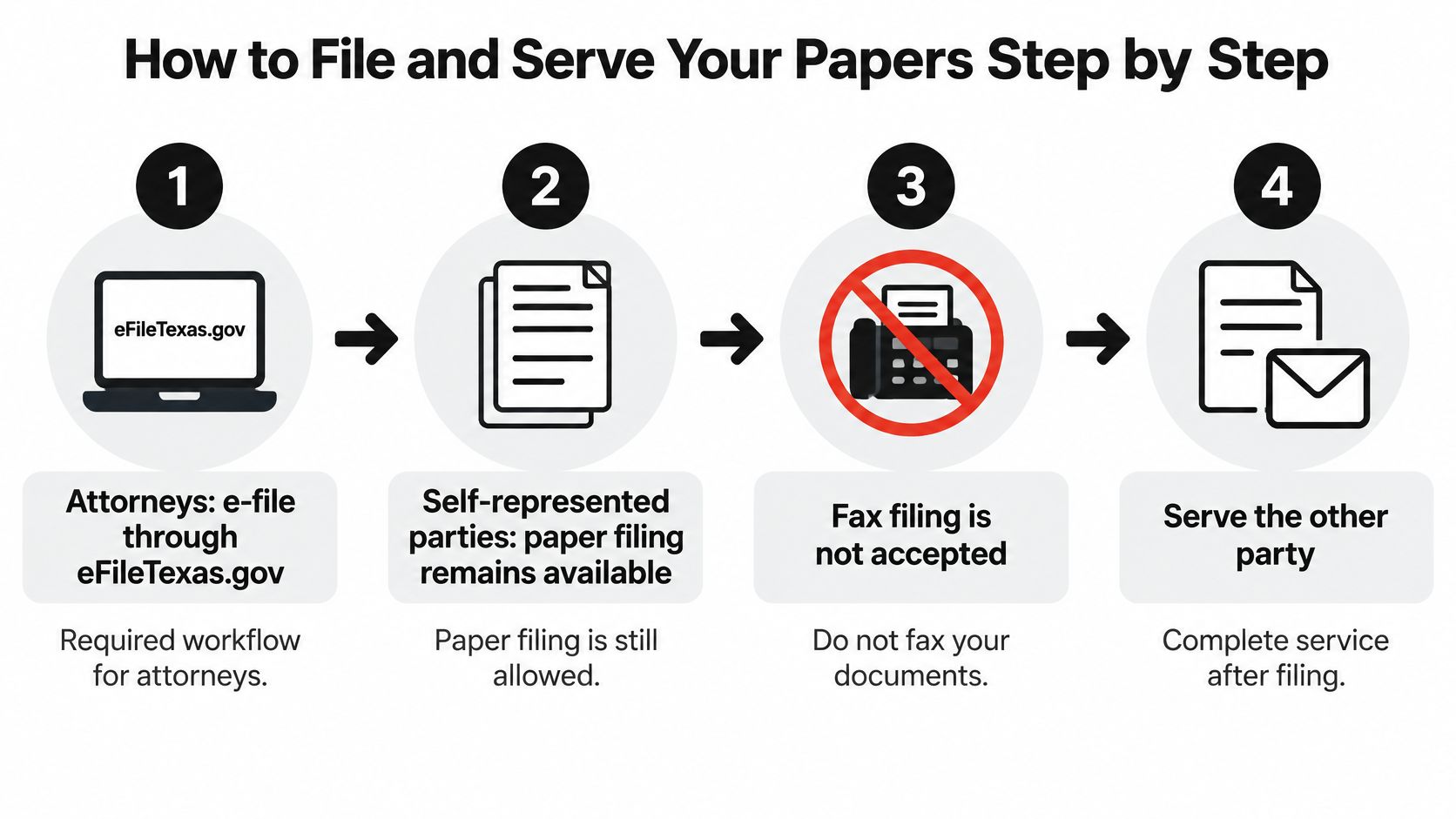
The Harris County District Clerk's filing guidance states that attorneys must e-file, paper filing remains available to self-represented parties, and fax filing isn't accepted. Electronic filing generally goes through eFileTexas.gov using an electronic filing service provider.
The filing methods are summarized below.
Build a complete filing package
- Confirm the case information. For an existing case, check the cause number, party names, and assignment to the 247th District Court so your documents reach the correct record. A new case won't have an assigned cause number until the clerk creates it.
- File the appropriate initial pleading. Depending on your role and the case's posture, this may be a petition, answer, notice of appearance, or substitution-of-counsel motion. Attorneys must formally establish their participation rather than assuming correspondence puts them on the record.
- Prepare the motion and supporting documents together. Include the proposed order, any required affidavit, and supporting exhibits, following the filing system's document categories. Preparing them as a coordinated package doesn't necessarily mean combining everything into a single PDF.
- Complete the correct service process. Initial service and service of later filings aren't interchangeable. Use the applicable method and ensure the appropriate return, certificate, or other proof reaches the record.
- Verify acceptance. Open the acceptance notice and inspect the clerk's record because a transmission receipt alone doesn't resolve a rejection or missing attachment.
- Request the setting separately. Keep the accepted documents available when scheduling so you can identify precisely what needs a hearing.
Our guide to Harris County eFileTexas requirements for a family case can help you organize the electronic-filing portion.
Don't confuse document delivery with court filing
If a private recipient separately requests a fax, you can compare ways to fax your paperwork through SendItFax. That's a document-delivery resource, not an accepted way to file papers with the Harris County District Clerk or a substitute for legally sufficient service.
Keep an electronic folder containing the filed version, acceptance confirmation, service documentation, and proposed order. Use filenames that identify the document and case without exposing sensitive information unnecessarily.
Grandparents navigating these questions can also consult Grandparents' Rights in Humble, which addresses custody and visitation rights for grandparents in Harris County. Whatever the underlying family issue, confirm both that the filing was accepted and that the correct people received legally sufficient notice.
Hearing Settings, Notice and Time Limits
An accepted motion still needs an appropriate setting. Under the joint court policies, e-filed motions generally use the District Clerk's electronic hearing system, except for CPS matters and final trials; submission settings generally require at least 10 days' notice, and hearing limits are 1.5 hours when no parent-child issues are contested or 3 hours when parent-child issues are contested.
Self-represented parties filing outside the electronic process should contact the court clerk to obtain a setting. Don't assume that emailing a preferred date creates an approved hearing.
Choose the method and protect the notice deadline
Hearing setting rules and time limits
| Matter type | Setting method | Notice or time rule | Key requirement |
|---|---|---|---|
| E-filed motion | District Clerk electronic hearing system | Obtain a date separately from filing | Filing alone is not a setting |
| Submission setting | Decided without oral hearing | At least 10 days' notice unless a statute or rule requires more | Complete pleadings and proposed orders by the applicable deadline |
| Uncontested matter, no parent-child issues | Set on uncontested docket using current instructions | Up to 1.5 hours of hearing time | File all listed final-order forms |
| Contested matter, parent-child issues | Use e-hearing procedures and coordinator guidance | Up to 3 hours of hearing time | Mediation before temporary orders and final trial unless waived |
| CPS matters and final trials | Set outside the e-hearing process | Confirm with court | Follow current scheduling instructions |
| Continuance or late arrival | Notify the court and opposing party | Give notice as early as possible | Send written notice before docket call and follow any motion requirements |
The hearing limits describe the applicable categories, not a promise that an uncontested prove-up needs the entire allotted period. Likewise, a custody dispute doesn't bypass the electronic scheduling process merely because coordinator guidance is needed.
For help identifying the correct scheduling contact, use our guide to working with a Harris County family court coordinator to get a hearing date.
Calendar backward, then confirm service
Start with the approved setting date and determine the applicable notice deadline. Check whether a statute, rule, or case-specific order requires additional time, then serve notice early enough to comply.
Keep the approved setting confirmation and proof of notice together. A calendar invitation sent to your own phone doesn't establish notice to the other party.
Asking for a postponement doesn't mean the court granted it. Unless the court changes the setting, prepare to comply with the existing one.
If you'll be late or absent, notify both the court and the opposing party promptly. Explain the scheduling problem clearly, but don't treat that communication as an approved continuance.
Also watch dismissal-for-want-of-prosecution notices. The court handles those matters by submission rather than an oral DWOP hearing, so waiting to explain yourself in person can be a serious mistake.
Evidence, Affidavits and Pre-Trial Checklist
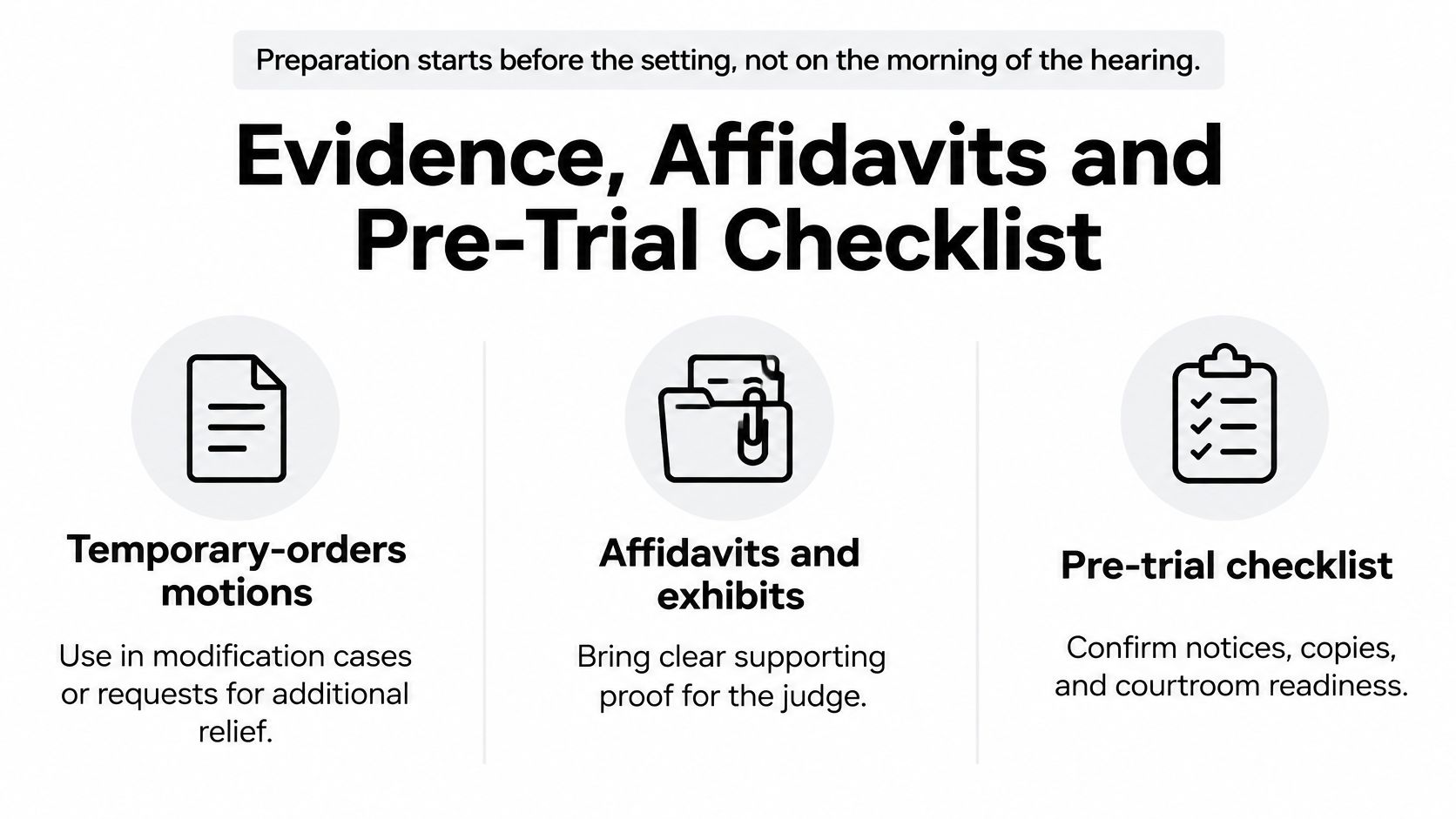
Preparation starts before the setting, not on the morning of the hearing. Your goal is to give the judge usable evidence and a proposed order that matches the relief you're requesting.
Use a checklist to separate missing paperwork from evidence you still need to obtain.
Before filing or requesting a hearing
Temporary-orders motions in modification cases, and requests for additional temporary orders, need an affidavit and court approval before a hearing. Identify that requirement while drafting rather than discovering it after arranging witnesses and childcare.
An affidavit should give specific facts within the signer's knowledge. Describe what happened and why the requested relief is needed; broad accusations are less useful than an organized factual account.
For an uncontested final decree or order, the 247th Court's published policies and procedures require the documents identified in its required-orders-and-forms checklist to be filed before the matter will be heard as uncontested. Audit the actual clerk's file, not just the folder on your laptop.
Before the hearing
For contested family matters, plan for mediation before temporary-order hearings and final trials unless the court waives it. Contact a mediator early, preserve the session documentation, and confirm the current requirements and waiver process with the coordinator before relying on an exception.
Child-support enforcement parties should bring a Texas State Disbursement Unit payment history. Compare it with the order being enforced and identify the payment periods at issue.
- Exhibits: Mark and organize records, preserve complete originals, and prepare copies in the format the court permits.
- Witnesses: Identify who has firsthand knowledge and arrange attendance or the appropriate legal process.
- Proposed order: Draft language the judge could sign that accurately states the requested ruling.
- Affidavit: Confirm it's properly completed and signed before submission.
- Payment history: Obtain a readable version and flag discrepancies you need to explain.
On the day
Bring your hearing notice, filed motion, proposed order, and organized exhibits. Keep a short outline of the facts you must establish so stress doesn't cause you to omit the central issue.
Say you're asking to change a parenting arrangement because work schedules changed. Bring the relevant schedule and explain the practical effect on exchanges, rather than handing over unrelated messages from the entire relationship.
Preparation doesn't guarantee admission of every document. Evidence rules still apply, and the court may require testimony or another foundation before considering an exhibit.
Tracking Your Case Online and Getting Ready for Court Day
Parties are responsible for monitoring the Harris County District Clerk's docket for rulings under the Family Trial Division's joint policies. Checking the record is part of managing your case, not merely a courtesy after the hearing.
Save important docket entries and signed orders where you can retrieve them.

Agreed orders and paper decisions
Agreed orders generally don't need a submission setting unless the agreement is contested or a required signature is missing. An authorized prove-up method may include Zoom, an in-person appearance, or an affidavit or unsworn declaration accompanied by the required forms and signed final order.
Don't choose a method solely because it's convenient. Confirm that it's authorized for your matter and that the proposed final order contains the necessary signatures.
For a submission matter, there's no oral appearance where you can supply a missing explanation. Review the pleadings, evidence, service documentation, and proposed order before the submission deadline.
Our Harris County District Clerk family-case lookup guide can help you access the record. Read the actual signed document when available rather than relying entirely on a brief docket description.
Make the appearance manageable
- Arrival: Allow time for travel from Northeast Houston, parking, security, and finding the courtroom before docket call.
- Documents: Carry an organized hearing folder and have your lawyer's contact information accessible.
- Courtroom conduct: Dress neatly, silence your phone, address the judge as Your Honor, and speak when recognized.
- Remote attendance: Test your camera, microphone, connection, display name, and background beforehand.
- Family arrangements: Arrange childcare unless the court specifically needs the child present.
If a judicial interview of a child is needed, the requesting attorney should arrange a specific time through the coordinator. Don't bring a child expecting an unscheduled conversation with the judge.
Monitoring habit: Check the docket the afternoon before a setting and again after a submission deadline, then continue checking until you have the signed order.
After a ruling, review what the signed order requires. If its wording differs from your understanding, seek clarification promptly rather than acting on assumptions.
Timelines, Judge Preferences and Local Forms
A workable timeline follows the required sequence, not an assumed turnaround. Clerk acceptance, service, scheduling, judicial consideration, and signing can occur at different stages.
For a Humble family, practical planning means arranging work and childcare around a confirmed event rather than guessing when the court might act. No two dockets necessarily move at the same pace.
Keep a case calendar with separate tasks
- File and serve. Save the accepted documents and the appropriate service record.
- Obtain the setting. Record the approved date, docket type, appearance method, and any preparation deadlines.
- Calculate notice. Work backward using the applicable rule and leave room to address service problems.
- Prepare for the correct event. Distinguish docket call, a prove-up, a contested hearing, and a paper submission.
- Retrieve the signed order. Read it and calendar any obligations it creates.
Ask the coordinator for the judge's current scheduling instructions. Useful questions include whether written materials are sufficient, whether testimony is expected, and whether the hearing will be in person or remote.
Use current forms rather than old examples
An old decree from a friend's divorce isn't a reliable filing checklist. Start with the court's current required-orders-and-forms list, then identify the proposed order, affidavit or unsworn declaration, and any supporting documents appropriate to your case.
The Harris County Family Trial Division's scheduling policies emphasize following the assigned court's scheduling instructions and confirming whether a matter requires an appearance or consideration by submission. Ask procedural questions with your cause number and motion title ready.
Use the Harris County District Clerk's public records to inspect the case record and eFileTexas.gov for the electronic filing workflow. These tools serve different purposes, and neither replaces confirmation of the court's current instructions.
Keep a dated note of scheduling communications, including who responded and what was confirmed. That record helps you avoid relying on a remembered conversation when plans change.
Confirm Your Next Setting With a Free Consultation
Local counsel can be especially useful when a custody or property issue is contested, temporary protection is needed, or a submission deadline is approaching. A missed notice that creates a risk of default deserves prompt attention, not a plan to explain everything at an uncertain future hearing.
The procedural pressure points are concrete: a motion assigned to the wrong docket, a hearing request that never became a confirmed setting, or an affidavit or mediation requirement left unfinished. An attorney can review the record, identify what remains incomplete, and explain the available next steps.
Bring what you already have
- Court papers: Include the petition, motions, notices, existing orders, and any signed decree.
- Scheduling records: Bring acceptance emails, setting confirmations, service records, and court correspondence.
- Immediate concerns: Identify the next deadline and the practical issue affecting your children, finances, or property.
Families across Humble, Atascocita, Kingwood, and Northeast Houston can meet with our team at the downtown Humble office. Free consultations are available concerning family law, divorce, child custody, child support, and property division.
Ask about the Harris County Family Courts guide for a broader overview of how cases move through the courts. If an existing decree or custody order isn't being followed, ask about the enforcement page and bring the order itself.
Our office also assists neighbors seeking criminal defense or estate-planning support, which involve different procedures from this family docket. Whatever brings you in, you should leave with a clearer understanding of the problem and the next decision you need to make.
The Law Office of Bryan Fagan offers free consultations to help you understand your family-law filings, hearing notices, and next procedural steps. Before your next court date, visit Law Office of Bryan Fagan to schedule a consultation with our Humble office and discuss what needs attention in your case.