A parent in Humble may need the words from a custody hearing before the next court date, perhaps because the judge made a decision from the bench and the written order doesn't explain why. The first worry is often the cost. Before paying a deposit, decide whether you need the official transcript of what people said in court or a certified copy of a document the judge signed.
Those records do different jobs. A transcript can help you review testimony, preserve oral findings, or prepare an appeal. A clerk copy can give you the signed order itself. For families in Atascocita, Kingwood, and Northeast Houston, choosing the right record first can avoid paying for pages that won't answer the question.
Harris County Transcript Cost and the Clerk Copy Choice
| Record | Who provides it | How it is priced | Deposit | Best use |
|---|---|---|---|---|
| Ordinary original transcript | Official court reporter | Per page under Texas law or the reporter agreement | Usually required before typing starts | Hearings you may cite or appeal |
| Copy for another party | Same reporter | Lower per-page copy rate | Sometimes included in the estimate | Extra counsel or a co-party |
| Expedited, daily, or hourly | Official court reporter | Premium above the ordinary page rate | Larger deposit, sometimes payment in full | Settings days or weeks away |
| Rough draft or audio, if offered | Reporter; not a certified record | Separate fee | Ask whether payment is due before release | Early review only |
| Certified clerk copy of orders and pleadings | Harris County District Clerk | Clerk per-page fee plus certification | Pay when ordering | Signed orders and the case file |
| Appeal or statement of facts | Official reporter for the trial court | Full requested testimony, index, and often exhibits | Deposit tied to the appeal deadline | Perfecting an appeal |
There's no single flat price for every Harris County transcript. The amount may follow Texas law, the reporter's agreement, or a court order, and the reporter needs to confirm the applicable rate. Ask for a written estimate before paying. It should identify the estimated page count, rate, deposit, whether an index and exhibits are included, and the expected delivery date.
A transcript records spoken proceedings. You may need one to challenge testimony, review a plea or sentencing, capture findings the judge stated but didn't include in the written order, or prepare an appeal. If only a particular witness's testimony matters, ask whether you can order that portion rather than the entire hearing.
A clerk copy serves another purpose. If you need a signed divorce decree, custody order, protective order, judgment, or probate order, ask the Harris County District Clerk for a certified copy. The clerk can provide court-file documents; the clerk doesn't create a transcript of what was said in the courtroom.
Match the record to the task
Start with the question you need the record to answer. If you need to know what the judge signed, the order may be enough. If you need to know what a witness said or what findings the judge announced orally, ask the court reporter about a transcript.
For example, a parent who wants to show a school what a custody order requires may need the signed order, not every spoken word from the hearing. A parent preparing to challenge what happened in court may need the transcript, because the signed order may not capture the testimony or the judge's oral explanation.
If an appeal is planned, don't assume an ordinary transcript request is the right one. Tell the reporter that the request is for an appeal and ask how to identify the testimony, index, and exhibits needed for the appellate record. The appeal process has its own deadlines, so get legal advice promptly if you're unsure what to order.
Get the estimate in writing
Ask what the deposit covers and whether the final bill can change if the transcript runs longer than estimated. Clarify the cost of another party's copy, any expedited service, and any separate charge for exhibits or an index. If the reporter offers a rough draft or audio, confirm what you're receiving: those options aren't certified transcripts.
Fee caps for medical records aren't necessarily the rule for a court reporter transcript, but this overview of limits on record copy fees can help explain why different record providers may charge under different rules. For your court record, ask the reporter or clerk to identify the pricing basis and charges in writing.
Before sending a deposit, ask yourself: Will I cite what was said? Is the order already signed? Is an appeal deadline running? Would a partial transcript answer the question? Those answers can help you avoid ordering both records when only one is needed.
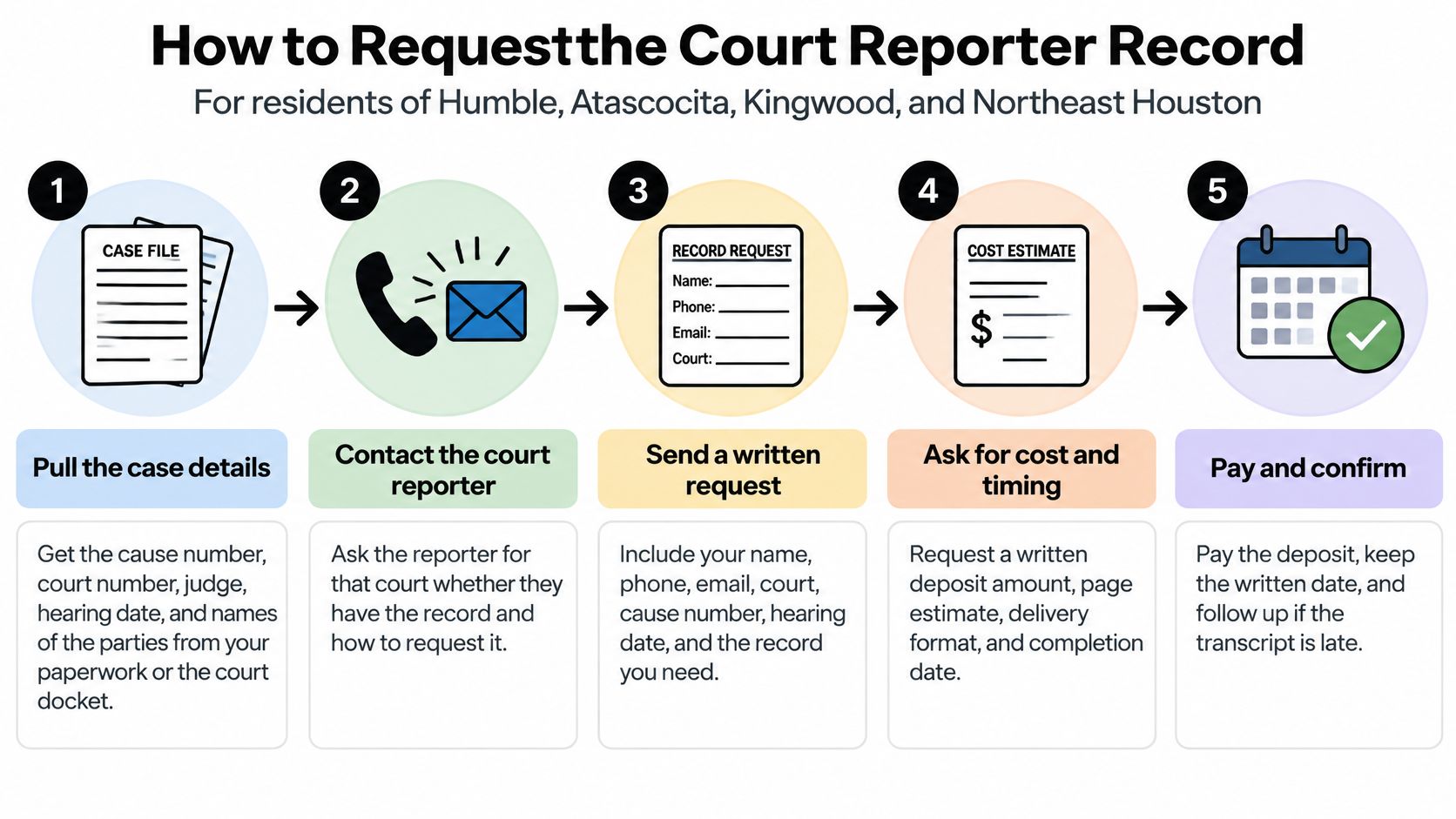
How to Request the Court Reporter Record
A Humble, Atascocita, Kingwood, or Northeast Houston resident can start the request without hiring a lawyer. The key is to identify the correct court and hearing, then make a specific written request so the reporter can estimate the work.
Gather the case details. Find the cause number, court number, judge, hearing date, and party names on your paperwork. Missing or mismatched details can delay the search.
Choose what you need. Decide whether you need spoken testimony or a signed document. Use the record comparison above to avoid ordering a transcript when a clerk copy will do.
Identify the reporter. After you have the cause number, identify the Harris County court on your paperwork. Ask the District Clerk which official reporter covered that judge and hearing date. The clerk can point you to the reporter, but doesn't type the transcript.
Write down the request. Name the hearing, specify whether you want the full hearing or selected portions, state ordinary or expedited delivery, and give an email or mailing address for delivery. A general request for “the record” may leave the reporter unsure what to estimate.
Request the estimate. Ask for the expected page count, per-page rate, deposit, and target completion date. Check whether the estimate includes the index, exhibits, delivery format, and postage.
Pay and save the receipt. Use the payment method the reporter accepts. Keep the deposit receipt with the cause number and save the reporter's email and written estimate together.
Calendar the delivery date. Confirm the expected date in writing and compare it with your next setting, whether that's in Humble or downtown Houston. If the date won't work, ask about a narrower transcript or expedited service before the reporter begins.
Check the record when it arrives. Make sure the cover shows the right cause number, hearing date, and judge. Then focus your review on the testimony or proceedings relevant to the next hearing.
Family, criminal, and probate cases use the same basic request logic, even though the hearings feel different. A custody dispute may turn on a parent's testimony; a criminal case may require a plea or sentencing record; a probate matter may involve testimony about an estate. A private lawyer can help match the request to the remedy, but you can begin by asking for an estimate yourself.
Use the District Clerk's civil or criminal copy desk for certified orders and pleadings, not to order a transcript. If you look up the case online, this Harris County District Clerk case-lookup guide may help you locate case information.
A private lawyer can also help you decide which portions are likely to matter at the next hearing. For now, save the reporter's email, estimate, and deposit receipt in one place so you can confirm the request details later.
Timelines and Expedited Transcript Options
| Speed | Typical window | What to tell the reporter | Cost effect |
|---|---|---|---|
| Ordinary | Often several weeks after deposit and estimate | No rush; ask for a written target date | Base per-page rate |
| Expedited | Days to a couple of weeks, as agreed in writing | Name the hearing or filing date | Premium above ordinary |
| Daily or hourly | Same day or next day if the reporter can staff it | Request before the hearing when possible | Highest premium |
| Appeal record | Set by Texas appellate deadlines, not the ordinary queue | State that it is for an appeal and give the notice date | Large deposit and page count |
The reporter's written completion date is what you should plan around. Ordinary typing often takes weeks after the deposit and page estimate, and no statewide clock replaces the date the reporter commits to in writing. Ask when the work can start and what delivery date the reporter can meet.
Expedited service means the reporter agrees to a shorter window and charges a premium. Daily or hourly service is a more demanding request: same-day or next-day delivery is possible only if the reporter can staff it, so ask before the hearing when you can. An appeal record follows appellate deadlines rather than the ordinary queue, and the larger amount of testimony, index, and exhibits can require a substantial deposit.
Make the deadline concrete
Say a Kingwood parent has an enforcement hearing coming up in ten days and needs the transcript to prepare. The parent shouldn't assume an ordinary request will arrive in time. The practical choices may be to pay for a rush request, if the reporter can meet the date, or to narrow the request to the testimony that will be cited.
A rush request still has to fit around the reporter's other court work. Don't rely on the word “rush” by itself. Give the reporter the actual filing or hearing date, ask whether that date is workable, and get the promised completion date and added cost in the estimate.
If an appeal may be involved, contact a lawyer promptly rather than treating the transcript as an ordinary copy request. Texas appellate deadlines can affect what record you need and when you need it. This guide to appealing a family court decision may help you understand why it's important to identify the appeal purpose in the request.
Sample Request Language for Local Families
A clear email gives the reporter enough information to locate the hearing and price the work. This is a plain-language sample, not an official Harris County form.
Subject: Transcript estimate, [cause number], hearing on [date]
My name is [full name]. My phone number is [phone] and my email is [email].
The case is in [court number and court name], cause number [cause number]. The hearing was on [hearing date] before Judge [name].
Please provide a transcript of [the full hearing / the testimony of named witness or witnesses / the specific portion needed]. I'm requesting [ordinary / expedited] delivery. Please send the file to [email address or mailing address].
Before I pay, please send a written estimate showing the expected page count, per-page rate, deposit, target completion date, and whether the index and exhibits are included.
For an Atascocita custody hearing, a filled request might say:
Subject: Transcript estimate, cause number [number], custody hearing on [date]
My name is [name]. I can be reached at [phone] or [email]. The case is in [court number and name], and the hearing took place on [date] before Judge [name].
I'm requesting the testimony of both parents and the judge's oral findings, rather than the full hearing. Ordinary delivery is acceptable. Please send the transcript to [email or mailing address] and provide a written estimate of the pages, per-page rate, deposit, completion date, and whether the index and exhibits are included.
For a criminal plea or probation matter, name the specific portion instead of asking for everything:
Please estimate a transcript of the sentencing portion of the hearing in cause number [number], held on [date] before Judge [name]. I'm requesting [ordinary / expedited] delivery to [email or mailing address]. Please include the estimated pages, rate, deposit, completion date, and whether an index or exhibits are included.
For a certified clerk copy, send a separate, simple request to the District Clerk: “Please provide a certified copy of the signed [name of order] in cause number [number]. Please tell me the fee and accepted payment method.”
Five details that can stall a request: the cause number is missing; the hearing date is wrong; the requested portions aren't identified; no delivery speed is selected; or there's no email or mailing address for the file.
Keep a copy of your sent request, the reporter's reply, and the deposit receipt together. If you're preparing for a family court appearance, this explanation of what happens at a family court hearing in Harris County may help you identify which part of the hearing you need to review.

Decide on the Record with a Free Review
The best request is the one that answers the question you have, not automatically the longest transcript available. A signed order may resolve a paperwork need; a dispute about testimony, oral findings, a plea, or sentencing may call for a reporter's transcript. Whether you're dealing with divorce or custody, a criminal charge, or a probate dispute in Harris County, choosing the record before paying can keep your money focused on the material that matters.
Bring the cause number, the last order, and the next hearing date to a free consultation. During that confidential review, you can get honest feedback about legal options and potential outcomes, guidance on Texas family, estate, or criminal law, and clear direction on what to do next. Asking for a reporter's estimate doesn't commit you to paying the deposit.
We serve families and individuals in Humble and nearby communities, including Atascocita, Kingwood, and Northeast Houston. If the transcript is only one piece of a larger matter, our family law, criminal defense, and estate planning services may be relevant. For a free consultation, call our Humble office at (281) 817-1827 or stop by the downtown Humble location.
The Law Office of Bryan Fagan offers free consultations to help Humble-area families understand whether they need a certified clerk copy or a court reporter transcript, and what practical step to take next. Bring your cause number, last order, and hearing date, and visit Law Office of Bryan Fagan to connect with our team.