You're looking at a court notice at the kitchen table in Humble, trying to understand what RIC means for someone you love. You may be wondering whether it means treatment, another hearing, or a chance to avoid a felony conviction. Before rearranging work, childcare, and transportation, you need to know which court is handling the case and what the notice requires.
The Harris County Responsive Interventions for Change docket offers a treatment-focused path for certain felony cases. But the name on a notice doesn't tell you whether a particular resolution has been approved. Start with the paperwork, confirm the assignment, and get clear answers about eligibility before making assumptions.
What the RIC Docket Is and Who It Covers
RIC is a centralized court docket, meaning a coordinated calendar for handling qualifying cases from different criminal district courts. It isn't a criminal charge, a finding of guilt, or a promise that the case will disappear.
Harris County implemented RIC in October 2016 for low-level felony drug and prostitution cases, according to the county presentation submitted to the Texas Legislature. Its stated purposes include reducing reliance on incarceration, reducing reoffending, and addressing racial and ethnic disparities through intervention, supervision, and treatment.

Understand the difference between referral and acceptance
Official descriptions include state-jail and third-degree felony offenses within RIC's scope. Those descriptions help identify cases worth discussing with counsel, but they aren't a complete eligibility checklist.
Public materials don't clearly establish how criminal history, prior diversion, the alleged conduct, immigration concerns, or prosecutor approval affect every application. They also don't provide a complete explanation of which defendants may receive pretrial intervention rather than deferred adjudication. Being referred for screening and being accepted into a specific program are different decisions.
Practical rule: Treat a RIC reference as a reason to ask specific questions, not as confirmation that an agreement has been reached.
Say a Humble man faces a state-jail felony drug-possession charge. His attorney can investigate whether RIC is appropriate while also reviewing the evidence, protecting his rights, and evaluating other defenses. Asking about treatment shouldn't replace evaluating the underlying charge.
Families sometimes confuse felony proceedings with the county's misdemeanor courts. Our guide to the Harris County Criminal Courts at Law misdemeanor process addresses that separate court track.
For an initial check, compare the offense name and felony classification on the charging document with RIC's described offense categories. If they appear consistent, ask counsel to verify current eligibility and actual docket status rather than relying on an older program description.
Check Whether Your Case Is on the RIC Docket
Start with the Harris County District Clerk's online case search, using the defendant's name or cause number. Next, check the posted settings for the Criminal District Court where the case is filed. If records are incomplete, take photo identification and the cause number to the clerk's counter at the Harris County Criminal Justice Center in downtown Houston to request notices.
A court number alone may not settle the question. Harris County's visiting-judge records describe the formerly named Reintegration Impact docket as consolidating nearly 5,000 low-level felony cases annually, with two full-time visiting criminal-division judges presiding over RIC and the Felony Mental Health Court.
Where to confirm RIC docket status
| Method | Where | What it shows | When to use it |
|---|---|---|---|
| Online case search | Harris County District Clerk website | Cause number, court, charge and next setting | After every new notice and before each setting |
| Posted court settings | Criminal District Court where the case is filed | Judge, court number and scheduled setting dates | Before attending any hearing |
| In-person clerk request | Harris County Criminal Justice Center, downtown Houston | Copies of notices, filings and case file documents | When online records are incomplete or you need certified copies |
| Attorney or court staff call | Defense attorney office or court coordinator | Whether the case was transferred or assigned to RIC, and the deadlines that apply | As soon as a case is filed and before the first RIC setting |
Read the online entry against the latest notice, not from memory. Then check the posted setting for the hearing location and date. Use an in-person request when you need the underlying documents, and ask counsel or the coordinator to resolve any conflicting information.
Assignment doesn't guarantee diversion or dismissal. Ask whether the record reflects a referral, a completed transfer, or acceptance into a particular option.
Families in Humble, Atascocita, Kingwood, and Northeast Houston should check mailed notices alongside online entries and promptly address an outdated mailing address. If there's also a separate custody or divorce case, Harris County Family Courts: A Humble Resident's Guide explains how those family proceedings work.
Copy down this checklist before ending your search:
- Case identity: Cause number and assigned court.
- Next appearance: Date, time, and confirmed location.
- Pending work: Assessment and application deadlines.
- Legal contact: Attorney's name and contact information.
How to Prepare for Your First RIC Setting
Prepare in this order: confirm counsel, organize the documents, identify deadlines, and address required assessments. Don't start by guessing which program you'll receive or signing up for services without checking whether they satisfy the court's requirements.
Harris County's Community Supervision and Corrections budget materials describe initial hearings involving access to counsel, bond review, assessment, and recommendations for diversion or deferred adjudication. They describe low-level felony drug and prostitution cases, including state-jail and third-degree offenses, but don't publish a complete current eligibility decision tree.
Build a usable court folder
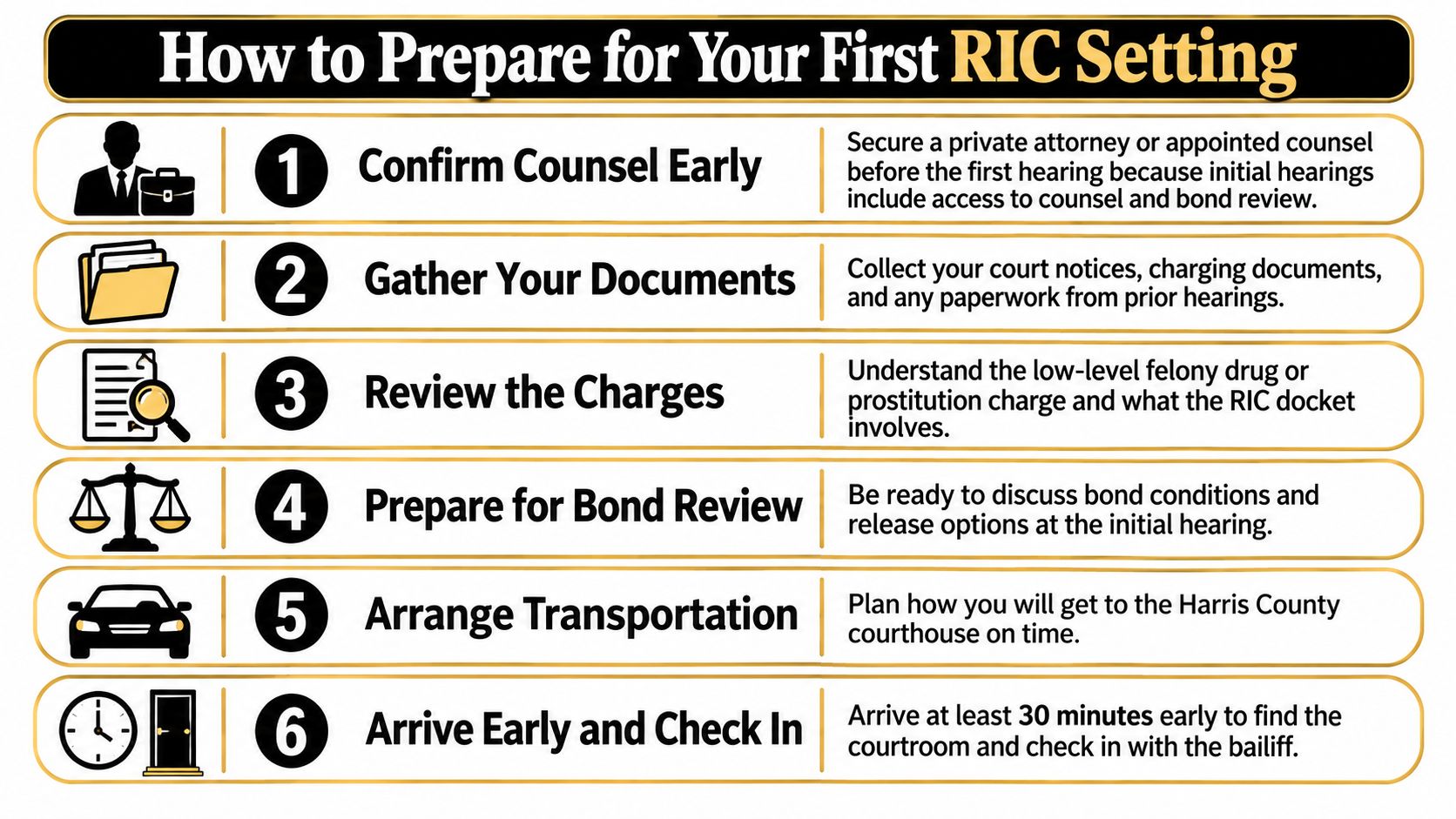
Confirm counsel early. Contact your private attorney or confirm the status of appointed counsel before the setting, because bond conditions and screening may need attention immediately. Don't assume a family member's conversation with court staff substitutes for legal advice.
Collect the actual documents. Put notices, bond papers, charging documents, and prior reset forms in one folder, with digital copies as a backup. A common mistake is keeping only a photograph of the newest notice while overlooking an earlier condition that still applies.
Build a case timeline. Record the arrest date, bond conditions, settings, and outstanding deadlines in chronological order. Check that notices aren't still going to an old address, and use the latest confirmed information rather than an earlier calendar entry.
Gather practical background records. Bring proof of work, housing, school, caregiving responsibilities, and past treatment or counseling for counsel to review. Don't submit sensitive medical records broadly without discussing what's relevant and how they should be handled.
Write your eligibility questions. Ask how criminal history, prior diversion, the alleged conduct, immigration status, and prosecutor approval affect this case. Also ask whether the proposed route is pretrial intervention or deferred adjudication, and what legal consequences come with that choice.
Schedule a required assessment promptly. Confirm the approved provider, deadline, payment arrangements, and proof of attendance, then retain the receipt or completion letter. Don't assume an assessment can wait until after the hearing or that independently chosen treatment automatically satisfies an order.
Plan your courthouse arrival. Arrange transportation, allow time for security, and bring photo identification and the cause number, dressed appropriately for court. Confirm where to check in rather than following someone whose case happens to have the same court number.
The visual checklist reinforces the basic preparation tasks.
Separate recovery planning from court approval
For help understanding treatment intake, Addiction Resource Center LLC's steps for getting into drug rehab can help you prepare questions for a provider. It's a general recovery resource, not confirmation that a facility meets your court's conditions.
Review your written release requirements alongside our explanation of Harris County pretrial services supervision conditions. If a separate CPS investigation is also involved, tell criminal counsel; our CPS Defense Attorney in Humble resource addresses defense against CPS investigations for local families.
A prepared first setting means having:
- A folder: Complete notices and relevant records.
- A timeline: Current conditions and deadlines.
- Written questions: Your most important eligibility concerns.
- Confirmed counsel: Someone who knows the setting and can explain the proposed next step.
Possible Outcomes and What Each One Means
A RIC setting can lead to different resolutions, and the label alone does not explain what a person must do or what will happen to the charge. Read the proposed terms closely. Ask counsel to connect each requirement to the result the court may order.
RIC case outcomes and county-wide averages
| Outcome | What it means | Typical requirements |
|---|---|---|
| Pretrial intervention | The case is handled before a conviction. | Assessment and court-set or agreed conditions |
| Deferred adjudication | Adjudication of guilt is postponed while conditions are completed. | Supervision, treatment, and reporting |
| Community supervision | Court-ordered obligations are served in the community rather than through confinement. | Treatment, testing, and supervision terms |
| Conviction and incarceration | A conviction is entered with a confinement sentence. | The sentence controls; diversion requirements no longer describe the outcome |
| County-wide average, all eligible cases | Cases diverted from conviction and incarceration. | Requirements set by the particular agreement and court order |
The historical county presentation reports approximately 79 percent before RIC versus 15 percent after implementation for conviction and incarceration, and 21 percent versus approximately 85 percent for diversion (county presentation). Treat these as county-wide history for eligible cases, not a prediction for your case. The figures do not establish current acceptance rates or show whether a particular person qualifies.
Pretrial intervention addresses the case before conviction through defined obligations. Ask what happens to the pending charge after successful completion, and what consequence the agreement specifies if it ends unsuccessfully. Eligibility and the prosecutor's agreement matter; appearing on a RIC calendar does not itself mean intervention is approved.
Deferred adjudication postpones an adjudication of guilt while the defendant completes conditions. It differs from pretrial intervention and does not automatically erase the case record. Ask whether the proposal requires a plea, what is deferred, and what record remains after successful completion.
Read the proposed resolution, not just its label
Community supervision means serving court-ordered obligations in the community. Deferred adjudication can also involve supervision, so these labels may overlap rather than describe separate paths. The written proposal and court order are more useful than a shorthand label: have counsel identify whether there is a conviction or plea, what reporting, treatment, and testing are required, and what completion changes.
A Harris County Auditor review describes RIC as focusing on low-level drug-possession, theft, and prostitution cases and seeking to keep felonies off participants' records when program requirements are met. That is a program objective, not a promise of dismissal or automatic record clearing.
Before accepting a proposal, ask counsel to explain what will appear on your record after successful completion and whether any separate record-relief process would be necessary.
For example, a Kingwood parent completing outpatient treatment should keep attendance letters and submit them as directed. Those records can help show compliance; an intention to start treatment later does not complete an assessment requirement.
Practical obligations may include attending settings, completing evaluations, documenting treatment, and following testing and supervision terms. The final resolution depends on eligibility findings, the prosecutor's agreement, the court's order, and compliance. Ask counsel what timeline to expect for screening, acceptance, supervision, and final disposition in your particular case.
Missed Appointments, Relapses and Other Setbacks
If you miss a setting after a relapse or a positive test, the next step is to check the written conditions and tell your counsel promptly. Treatment-focused dockets still require full compliance, and a single relapse does not automatically lead to conviction. The response depends on the order, what happened, and how quickly the issue is addressed.
Harris County's peer-recovery contract record identifies $214,721 for a contract approved for the period beginning March 2026 following a vendor-name amendment involving Houston Recovery Center. County materials describe assessment, treatment, supervision, and peer recovery support. The contract record does not specify which services an individual participant can access or whether they have a cost.
Ask about access before a problem becomes a violation
Confirm with counsel and the assigned program contact which services apply to your placement, including available recovery support, appointment hours and location, transportation or housing assistance, medication-assisted treatment, mental-health care, language access, and any costs. Public information does not answer these questions for every placement, so get details that apply to your own case. If you travel from Atascocita or Northeast Houston, raise appointment location and work-hour conflicts before a deadline is missed.
- Missed appointment: Contact counsel the same day, keep the reason and any supporting documents, and ask how to address the missed requirement.
- Positive test: Ask which testing condition applies and gather relevant treatment and medication records. Attend the next court setting.
- Relapse: Seek appropriate treatment support and promptly tell counsel, so the response can address both recovery needs and court obligations.
- Inability to pay: Document the financial barrier and ask counsel whether relief or an accommodation can be requested before you miss a requirement.
A setback needs a response, not silence. A provider's understanding does not change the court's written conditions.
Consequences depend on the applicable order and the participant's response. If a supervision violation is alleged, a Humble probation violation guide explains the related concern.
Embarrassment or fear can make it tempting to avoid asking for help after a relapse. Contact counsel early so they can assess the issue and consider an appropriate response before another obligation is missed.
Confirm Your Next Step with Local Counsel
A RIC assignment is a fork in the road, not a verdict. Your next decision should rest on the actual charge, current paperwork, eligibility requirements, and consequences of any proposed agreement.
Families understandably weigh cost, preparation, and how much individual involvement they need. A no-cost process may offer less individual control in some legal settings, while other situations call for a strategy adapted closely to the facts. For a criminal charge, ask about appointed counsel if you can't afford representation; don't assume hiring private counsel guarantees faster acceptance, a different judge, or a favorable result.
Bring the questions that affect your family
The most useful conversation starts with the documents rather than a prediction. Bring your latest notice, bond conditions, cause number, and any assessment paperwork so counsel can distinguish what's already ordered from what's only being discussed.
- Status: Has the case been assigned or transferred to RIC?
- Eligibility: What must be decided before a particular option can be offered?
- Consequences: What would the proposed agreement require and mean for the record?
- Immediate action: What must happen before the next setting?
During our free consultation, we provide a confidential review of your case details, honest feedback about legal options and potential outcomes, guidance on the Texas family, estate, or criminal law relevant to your situation, and clear direction on what to do next. If criminal charges overlap with custody concerns or other family responsibilities, identify those issues at the beginning.
Call (281) 817-1827, request a consultation online through our website, or visit our office at 414 E Main St, Humble, TX 77338, in downtown Humble. We serve Humble, Atascocita, Kingwood, and Northeast Houston; you can also find the criminal defense practice page through the website's main navigation.
The sooner you confirm your docket status and ask the right questions, the better positioned you are to protect the choices available in your case.
Law Office of Bryan Fagan offers a free, confidential consultation to help you understand your RIC paperwork, potential legal options, and next practical steps. Bring your court notice and bond documents, and visit Law Office of Bryan Fagan or call (281) 817-1827 to schedule with our Humble office.