 Skip to content
If you're in Humble, Atascocita, Kingwood, or Northeast Houston and staring at a stack of account statements, business records, retirement summaries, and property documents, divorce can feel less like one legal case and more like your entire financial life being pulled apart. That feeling is common for business owners, professionals, executives, and long-time families who've built wealth over many years.
A high-asset divorce isn't only stressful because of the money involved. It's stressful because every asset may raise a different question. Is it community property or separate property? What is it worth? Has income been underreported? Did a crypto wallet grow during the marriage? Can an ESOP be divided without creating avoidable tax trouble?
Those are the moments when people start searching for a High Asset Divorce Lawyer Humble TX because they need more than general divorce advice. They need careful legal and financial guidance that fits Harris County practice and the realities of modern asset ownership. At the local level, that means understanding the families, businesses, and property patterns that shape life in Humble and the greater Lake Houston area.
Navigating a High Asset Divorce in the Humble Community
A Humble-area divorce often starts with a very ordinary scene. One spouse runs a family business near downtown Humble. The other has helped hold the household together while retirement accounts, investment accounts, and real estate gradually grew over the years. Then the marriage reaches a breaking point, and suddenly every practical question lands at once.
Who keeps the business interest?
What happens to the house?
How do you sort out accounts that were opened before marriage but added to later?

For families in Kingwood, Atascocita, and Northeast Houston, these cases often carry a second pressure. Your money isn't abstract. It's tied to your daily life here. It may be wrapped up in a medical practice, a construction company, rental property, stock compensation, or a retirement plan you've counted on for years.
The emotional side of financial complexity
People often think a high-asset divorce is only about numbers. It isn't. It's also about control, privacy, and fear of making one expensive mistake.
You may worry about:
- Your life's work: A business you've built over time may be central to your identity and your future income.
- Your children's stability: The family home, school routines, and long-term savings may all feel at risk.
- Financial blind spots: Many spouses know assets exist but don't know exactly how they're titled, valued, or managed.
A fair result starts with clear information. Panic usually comes from not knowing what's in the estate, what it's worth, and how Texas law treats it.
In a community like Humble, where many families have deep roots and strong local ties, people don't want a legal process that adds confusion. They want straight answers in plain language. That's especially true when the marital estate includes both traditional assets and newer ones that generic divorce articles barely mention.
Why local context matters
Harris County procedure matters. So does local experience with the kinds of property held by residents in Humble and nearby communities. A divorce involving a local business, compensation package, or mixed portfolio of real estate and digital assets won't move like a simple uncontested case.
That doesn't mean you're trapped. It means the case needs structure, patience, and a plan.
What Makes a Divorce High Asset in Texas
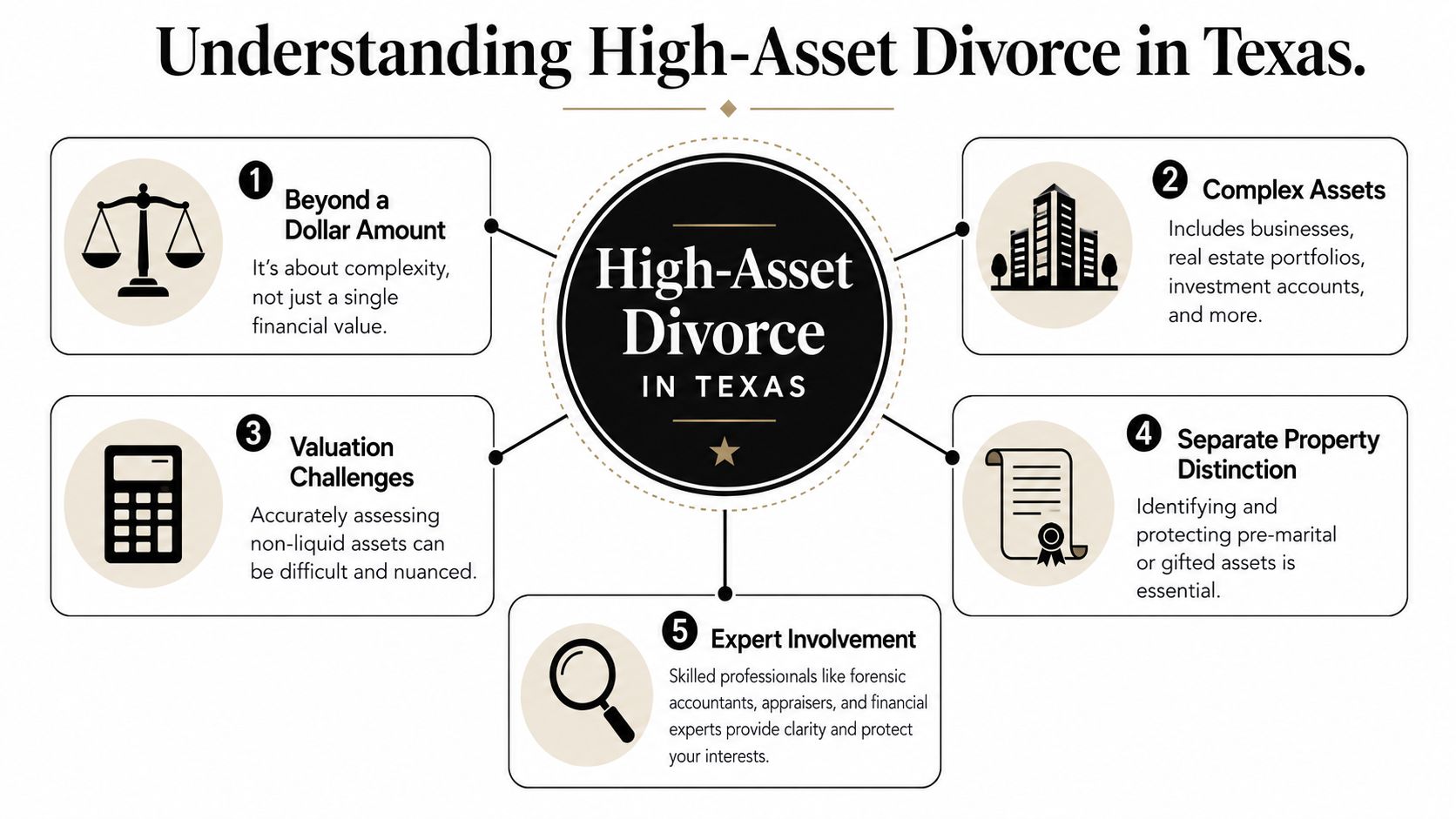
In Texas, there isn't a fixed legal number that automatically turns a divorce into a high-asset case. Legal professionals commonly use a $1 million marital estate as a practical benchmark, but the more important issue is complexity, not just total value, according to Matt Horak's discussion of high net worth divorce in Texas.
That surprises many people in Humble. They assume "high asset" only applies to ultra-wealthy families. In practice, a case can become high asset because the property is hard to classify, hard to trace, or hard to value.
Community property and separate property
Texas follows a community property system. One of the clearest ways to understand it is to think about shopping bags.
The shared grocery cart is the marriage. Items put into that cart during the marriage are generally treated as part of the marital estate. A personal bag you brought with you before entering the store is different. That personal bag is more like separate property.
The key legal rule is this: Texas is a community property state where all property acquired during marriage is presumed to be community property, but a spouse claiming an asset is separate property bears the burden of proving its separate character by clear and convincing evidence, as explained in McClure Law Group's overview of high-asset divorce.
That presumption affects nearly every major property decision.
Assets people often misunderstand
Here are the categories that create confusion most often:
- Business interests: A company may have been started before marriage, expanded during marriage, or funded with mixed sources.
- Retirement accounts: Contributions made at different times may have different character.
- Investment accounts: Separate funds can become hard to trace if they're mixed with community funds.
- Real estate: A property's title, mortgage payments, improvements, and rental income can all matter.
- Inheritance: In Texas high-asset divorces, inheritances are generally separate property and not divided unless a spouse has a present possessory right to trust assets, as outlined by Towson Law's discussion of high-asset divorce.
Why complexity matters more than labels
A divorce can involve substantial property without being unusually difficult. On the other hand, a smaller estate can become highly contested if tracing is messy or ownership records are incomplete.
That's why many Humble families dealing with business ownership or layered financial accounts need focused help with division issues. A Property Division Lawyer in Humble handles division of community property and complex assets for Humble divorces.
Practical rule: If an asset changed form, mixed with other funds, or increased in value during the marriage, don't assume its classification is obvious.
The Challenge of Valuing Complex Assets
In a Humble high-asset divorce, value is often the point where a manageable case becomes a technical one. Listing an asset is only the first step. The harder question is what that asset was worth on a specific date, under real market conditions, with documents that can hold up in negotiation or court.
A house may have a recent appraisal. A brokerage account may have a monthly statement. Complex assets are different. A closely held business, stock options, deferred compensation plan, restricted shares, or a cryptocurrency wallet can require a much closer review because the number on a screen is not always the number a court can rely on.
Business interests and real estate require context
A business in the Humble or Atascocita area can look simple from the outside and still be difficult to value correctly. Revenue may be rising, but debt may be high. The owner may receive a modest salary while the business pays personal expenses. Equipment, goodwill, accounts receivable, and owner reputation can all affect the final number.
That is why business valuation usually works more like assembling a full picture than reading a price tag. Tax returns, balance sheets, payroll records, contracts, and year-to-year trends all matter. If your case includes a company interest, this local guide on divorce involving a small business in Humble, Texas gives a useful look at how ownership and valuation issues can shape the rest of the divorce.
Real estate can create similar problems. One property may be the family home. Another may be a rental in Northeast Houston. Another may have come from one spouse's family but was improved with marital funds. The legal title matters, but so do mortgage payments, renovations, rental income, depreciation, and reimbursement claims.
For readers who want a plain-language explanation of price versus supportable value, this overview of fair market value for estate sales is a helpful starting point. Divorce valuation is more specific, but the comparison helps explain why a court looks for evidence instead of assumptions.
Digital assets add a modern layer of difficulty
Cryptocurrency shows up in divorce cases more often now than it did even a few years ago, and it creates problems that generic high-asset divorce articles often skip. A spouse may hold Bitcoin, Ethereum, stablecoins, tokens stored on an exchange, or assets kept in a private wallet with no bank-style monthly statement.
The first problem is identification. The second is access. The third is timing.
A crypto account can change value quickly, sometimes within hours. One wallet may contain coins bought before marriage, additional purchases made during marriage, and transfers between exchanges that are poorly documented. If a spouse used a hardware wallet, moved assets off-platform, or traded one coin for another, tracing the history can become painstaking. Lawyers often need transaction records, exchange histories, screenshots, tax filings, and wallet addresses to build a reliable timeline.
NFTs and other digital holdings raise similar questions. Ownership may be clear to the person who bought them, but proving value on the right date can be much harder. The market for those assets may be thin, irregular, or highly volatile, which means a casual estimate usually is not enough.
Retirement plans can be just as technical
Retirement assets often look stable because people recognize the account names. The details are where mistakes happen.
A 401(k) may include premarital contributions, marital contributions, employer matches, loans, and investment gains that accrued over different periods. A pension may require actuarial work instead of a simple account balance. Executive compensation plans can include stock grants, deferred bonuses, or benefits that vest over time. In high-asset cases, those plans must be valued and divided with care, and some of them require a Qualified Domestic Relations Order, or QDRO, so the division is carried out correctly.
A QDRO works like a set of precise delivery instructions. It tells the plan administrator what portion goes to which spouse and how the transfer should happen under the rules of that plan. If the wording is off, the division can be delayed or rejected, even after the divorce decree is signed.
High-value estates often include a mix of old and new assets. Family businesses, rental properties, crypto, pensions, stock awards, and trust-related interests do not fit into one simple formula.
The question is rarely "What do we own?" by this stage. The harder question is "How do we prove what it was worth, and on what date?"
Using Forensic Discovery to Ensure Fairness
When the numbers don't line up, the answer isn't guesswork. It's disciplined investigation.

In Harris County, high-asset divorces often require deeper financial review because standard divorce procedures may not be enough for estates with layered accounts, business interests, and unusual holdings. Hernandez Law notes that high-asset divorces in Harris County frequently involve forensic discovery processes to trace hidden assets and appraise complex holdings.
What forensic discovery actually looks like
The phrase sounds intimidating, but the work is usually methodical. Lawyers and financial professionals review records, compare statements, track transfers, and test whether the story matches the documents.
That may include:
- Bank and brokerage review: Looking for transfers, unexplained withdrawals, or missing accounts.
- Business record analysis: Checking compensation, retained earnings, owner benefits, and unusual expenses.
- Property tracing: Following where funds came from and where they went.
- Digital record gathering: Identifying online financial platforms, exchange records, and account histories.
The purpose isn't to create conflict for its own sake. It's to make sure the marital estate is accurately identified before division happens.
Why hidden assets aren't the only issue
Many people hear "forensic" and think only of deliberate concealment. Sometimes that is the issue. Other times, the problem is poor recordkeeping, mixed accounts, or a spouse who handled the finances without explaining them.
If you're worried that your spouse may be moving money, underreporting income, or keeping accounts off the table, this local resource on what happens if a spouse hides money in a Texas divorce can help you understand the concern in practical terms.
A short overview can help you see how these investigations fit into a divorce case:
Financial transparency protects both sides. It keeps one spouse from being shortchanged and keeps the other from being accused without evidence.
Key Legal Strategies for Your Case
A high-asset divorce strategy in Humble often starts with a practical problem. One spouse can see the checking account, but not the stock grants. The retirement statement shows a balance, but not the plan rules. A phone app shows cryptocurrency transfers, yet the wallet history raises more questions than it answers.
That is why legal strategy has to do more than ask for a fair split. It has to protect access, preserve timing, and match each asset to the right legal tool.
Temporary orders and early financial stability
Temporary orders often set the tone for the entire case. They can decide who pays the mortgage, who uses certain accounts, whether unusual spending stops, and how each spouse covers monthly living expenses while the divorce is pending.
In a high-asset case, early orders also help prevent financial confusion from turning into permanent loss. If one spouse controls the business records, manages investment platforms, or has sole access to digital accounts, delay can make it harder to sort out what existed on the date of separation and what changed afterward.
That matters with cryptocurrency in particular. Digital assets can move quickly between exchanges, private wallets, and third-party platforms. A clear court order can help preserve records and reduce the chance that key transaction history disappears before both sides understand what they are looking at.
Retirement division and QDRO planning
Retirement accounts are often treated like a single bucket of money. In real cases, they are more like a set of locked boxes, each with its own key, tax rules, and transfer restrictions.
A Qualified Domestic Relations Order, or QDRO, is commonly used to divide certain employer-sponsored retirement benefits. The hard part is not just getting a judge's signature. The order has to match the exact language of the plan, fit the divorce decree, and account for details such as loans, survivor benefits, vesting schedules, and dates used for gains or losses.
That gets more complicated with ESOPs, deferred compensation, pensions, and executive benefit plans. These assets may not divide cleanly, and mistakes can create tax problems or leave one spouse with less than the decree intended. Careful drafting matters because retirement division is often implemented months after mediation or trial, when fixing an error is harder and more expensive.
Choosing between settlement and trial
Settlement and trial solve different problems. Mediation works well when both sides have enough reliable information to negotiate from the same set of facts. Trial becomes more likely when the disagreement is about value, credibility, or whether a spouse's explanation of an asset can be trusted.
That choice can also turn on the kind of property involved. A family home in Humble is one issue. Real estate held through an LLC in another state or country is another. If part of the marital estate includes foreign property, World Property Investor's international lawyer guide gives helpful background on cross-border ownership issues that can affect divorce planning.
Here is a practical comparison:
| Factor | Settlement (Mediation/Collaboration) | Trial (Litigation) |
|---|---|---|
| Control | Spouses usually keep more control over outcomes | Judge decides disputed issues |
| Privacy | Often allows more private resolution | Court process can be more public |
| Speed | Can move faster if both sides exchange information | Often takes longer when disputes are deep |
| Complex valuation disputes | Can work if experts narrow the disagreement | Useful when experts strongly disagree |
| Cost management | May reduce prolonged courtroom activity | Can increase expense if many issues are contested |
| Emotional strain | Often less adversarial | Usually more demanding for families |
Strategy should match the asset
A useful legal plan is asset-specific. Business interests may call for one approach. Crypto holdings, restricted stock, and retirement plans may call for another. The goal is to line up the legal process with the financial reality, instead of treating every account as if it works the same way.
That is one reason it helps to review how to choose a divorce lawyer in Humble, Texas for a complex property case. In a case involving QDROs, executive compensation, or digital assets, the right questions are often as important as the first filing.
A Checklist for Choosing Your Humble High Asset Divorce Lawyer
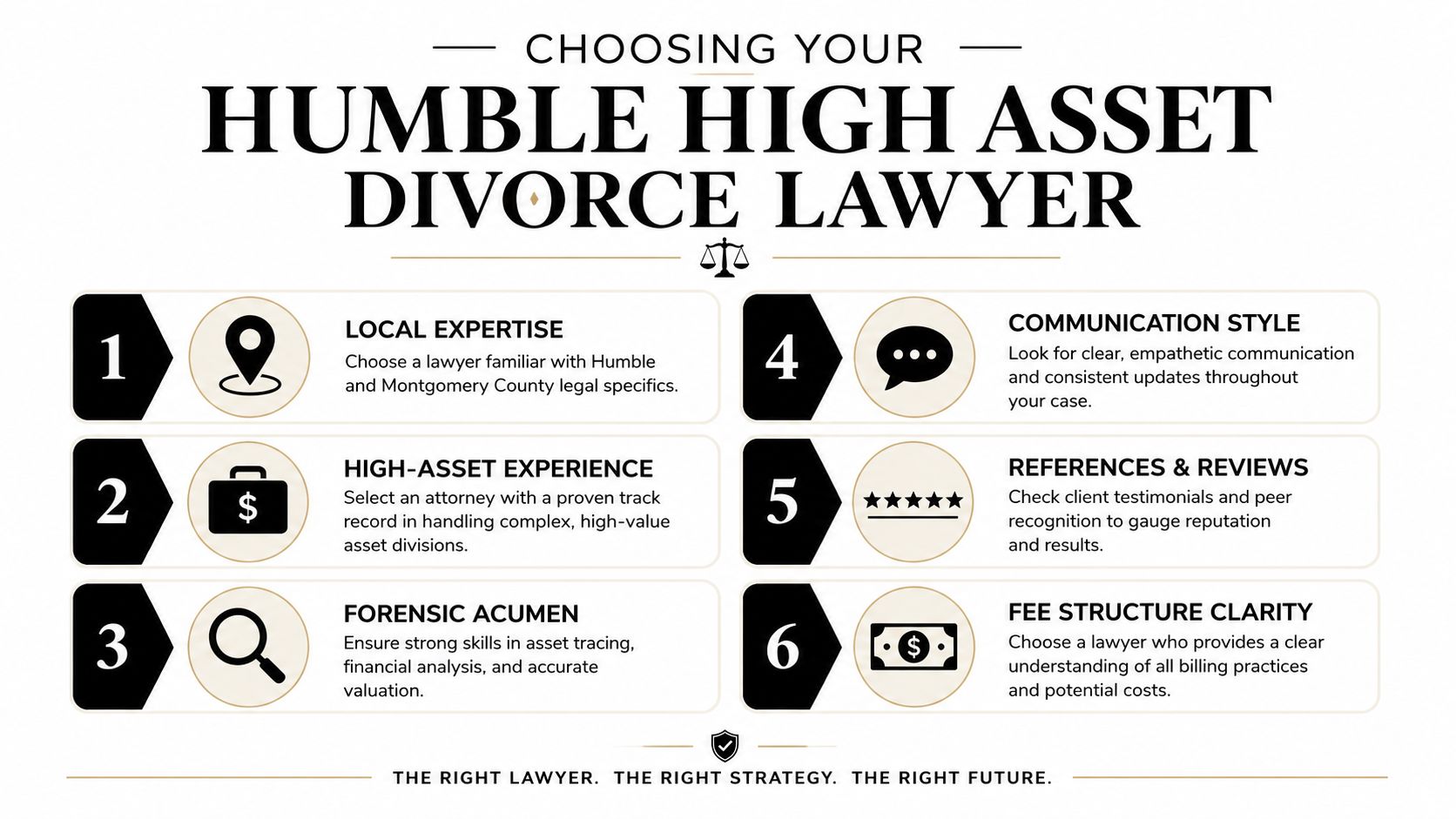
Choosing counsel in a high-asset case isn't only about finding someone who handles divorce. You need someone who can deal with records, experts, valuation disputes, and the practical realities of Harris County family law.
Documents to gather before the first meeting
Bring enough information so the attorney can spot issues early. Start with what you already have and build from there.
Tax returns and pay records
Gather personal returns, business returns if relevant, and recent compensation documents.Bank, brokerage, and retirement statements
Include accounts in your name, your spouse's name, and joint accounts if you can access them.Business and property records
Think operating agreements, deeds, mortgage statements, lease agreements, and appraisals.Digital asset information
Save exchange statements, wallet records, transaction histories, and screenshots showing holdings and dates.
Questions worth asking in a consultation
The goal isn't to hear a perfect sales pitch. It's to test whether the lawyer understands complexity.
- How do you handle business valuation disputes?
- What financial experts do you typically work with in high-asset cases?
- How do you approach tracing separate property claims?
- What is your process when retirement plans or deferred compensation are involved?
- How do you communicate during periods when financial discovery is taking time?
For a broader framework, this local guide on how to choose a divorce lawyer in Humble, Texas is a useful companion read.
Red flags people should take seriously
A few warning signs should make you pause.
- Guaranteed outcomes: No careful attorney should promise a specific property result at the first meeting.
- No discussion of experts: Complex assets often require appraisers, forensic accountants, or plan specialists.
- Rushed analysis: If the lawyer doesn't ask where assets came from, how they changed, or who controls the records, that's a concern.
- Weak communication: In a high-asset case, silence creates anxiety and mistakes.
Watch for this: A lawyer who treats a business, crypto account, and retirement plan as if they're all valued the same way may not be digging deeply enough.
Protect Your Future with a Trusted Local Partner
A high-asset divorce can touch every part of your life in Humble. Your income, business interests, retirement plans, digital assets, property rights, and long-term security may all be on the line at the same time. That's why these cases need calm analysis, organized discovery, and legal strategy built for complex assets.
For families in Humble, Atascocita, Kingwood, and Northeast Houston, the most important step is often the first one. Get clear on what you own, how Texas law may classify it, and what records you need before decisions are made too quickly. When modern assets like cryptocurrency or ESOPs are part of the estate, careful legal guidance matters even more.
You don't need to have every answer before talking with a lawyer. You just need a place to start, and a local team that can explain the process without making it harder than it already is. A thoughtful consultation can give you a clearer view of the road ahead and help you avoid mistakes that are difficult to undo later.
If you're dealing with a complex divorce and need straightforward guidance, schedule a free consultation with Law Office of Bryan Fagan. Our Humble office works with local families and individuals throughout Humble, Atascocita, Kingwood, and Northeast Houston to address divorce, property division, estate planning, criminal defense, and other legal concerns with practical, community-focused support.


